Buildship
No-code visual backend builder. Connect APIs, LLMs, and databases to build AI agent backends.
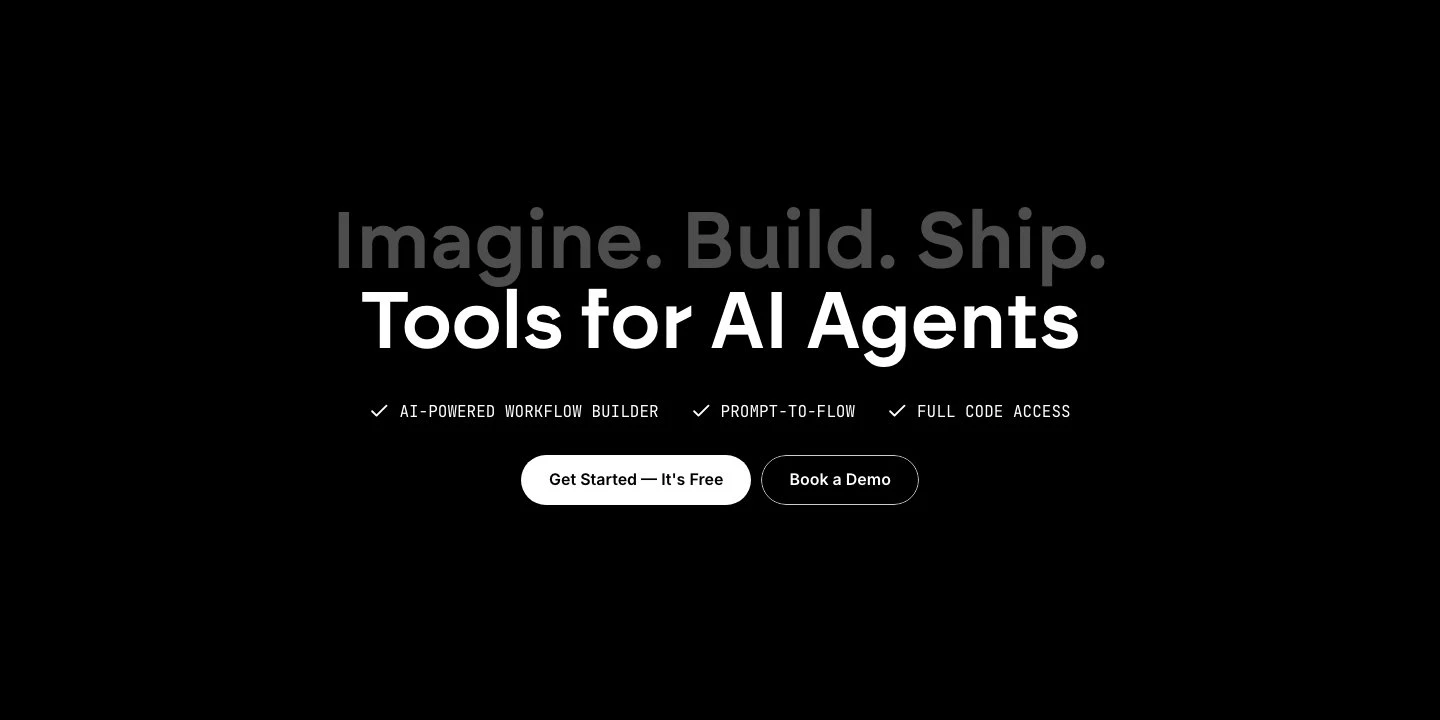
BuildShip is a visual, no-code backend builder designed to help developers and non-developers alike create AI-powered workflows, backend APIs, and automated processes without writing raw code from scratch. It sits at the intersection of no-code tooling and AI workflow orchestration, offering a drag-and-drop interface for connecting APIs, large language models, and databases into functional backend systems.
At its core, BuildShip uses a node-based visual flow builder where users assemble workflows by connecting pre-built or custom nodes. Each node represents a discrete operation — calling an API, querying a database, running an LLM prompt, or executing custom JavaScript. The platform includes 50+ ready-to-use nodes covering common integrations, and users can generate new nodes from scratch using the built-in AI builder simply by describing what they need in plain language.
The "Prompt-to-Flow" capability is a standout feature: users describe their intended workflow in natural language and the AI generates the corresponding flow logic and nodes automatically. This dramatically reduces the time from idea to working prototype, making it practical for business teams in HR, Finance, or Marketing to automate processes without deep engineering involvement.
BuildShip targets a gap between low-code automation tools like Zapier or Make and full-code backend frameworks. Unlike Zapier, which focuses primarily on trigger-action automations between SaaS apps, BuildShip is purpose-built for AI agent backends — workflows that involve LLM reasoning, multi-step logic, and custom API endpoints. Compared to tools like Flowise or Langflow (which are also visual AI workflow builders), BuildShip emphasizes backend API creation and deployment as a first-class outcome, not just internal pipeline orchestration.
Deployment flexibility is a notable differentiator. Users can host on BuildShip Cloud with instant, pay-per-use infrastructure, or export the source code and self-host on their own infrastructure. This makes it viable for teams with compliance requirements or cost-sensitive scaling needs.
The platform also maintains an escape hatch for developers: full code access is available at any point. Custom scripts can be added, existing nodes can be fine-tuned, and the underlying logic can be inspected and debugged. This hybrid approach — no-code speed with full-code flexibility — makes it accessible to teams of mixed technical backgrounds.
BuildShip reports over 100,000 AI builders using the platform, suggesting meaningful adoption across the indie developer and small business segments. Its positioning as an "AI-powered workflow builder" reflects the broader market shift toward tools that use AI both as a feature (LLM integrations) and as a development aid (AI-assisted flow generation).
Key Features
- Visual node-based flow builder with 50+ ready-to-use nodes for APIs, databases, and LLMs
- Prompt-to-Flow: describe a workflow in natural language and AI generates the flow logic automatically
- Full code access alongside no-code editing — add custom scripts or fine-tune node behavior at any point
- Deploy to BuildShip Cloud (instant, pay-per-use) or self-host with source code export
- AI-assisted node generation: generate individual nodes from scratch or modify existing ones via prompts
- Upload API specs to auto-generate integration nodes
- End-to-end testing within the visual editor before deployment
- Unlimited AI generation included on all plans
Pros & Cons
Pros
- Combines no-code accessibility with full code escape hatches, serving both technical and non-technical users
- AI-powered flow generation significantly reduces time to build working backends
- Flexible deployment options including self-hosting with source code access
- Large library of pre-built nodes reduces integration work for common services
- Suitable for teams across departments, not just engineering
Cons
- Visual flow builders can become complex and hard to maintain as workflow logic grows
- Pay-per-use cloud hosting costs may be unpredictable at scale without careful monitoring
- Less mature ecosystem compared to established automation platforms like Zapier or Make
- Self-hosting requires infrastructure management that may negate the no-code convenience for smaller teams
Pricing
BuildShip offers a free tier to get started. Paid plans and enterprise options are available, with cloud hosting operating on a pay-per-use model. Visit the official website for current pricing details.
Who Is This For?
BuildShip is best suited for developers, indie hackers, and cross-functional business teams who need to build and deploy AI-powered backend APIs or automation workflows without maintaining complex infrastructure. It excels for use cases involving LLM integration, multi-step AI agent backends, and rapid prototyping where teams want visual development speed but may need to drop into code for custom logic.
Tags:

Similar to Buildship