Deepgram
Enterprise speech-to-text and text-to-speech APIs. Fast, accurate transcription for voice agent pipelines.
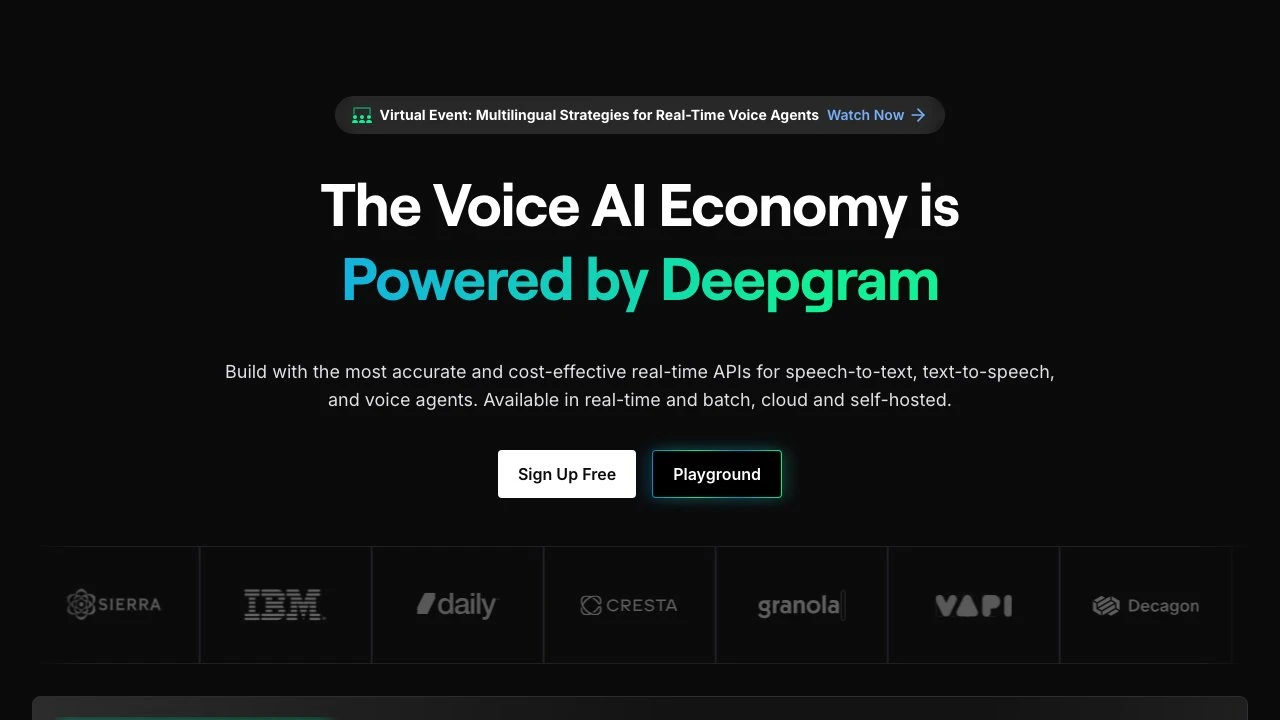
Deepgram is an enterprise-grade voice AI platform offering speech-to-text, text-to-speech, and voice agent APIs built for production-scale applications. Founded to address the accuracy and latency limitations of legacy transcription providers, Deepgram has positioned itself as the infrastructure layer for the emerging Voice AI economy, with customers including Twilio, Cloudflare, IBM, and Vapi.
At its core, Deepgram provides two primary transcription models: Nova for high-accuracy batch and real-time transcription, and Flux for voice agent pipelines where low latency is critical. The platform also includes Speak, its text-to-speech offering, rounding out the full audio pipeline that voice agent developers need in one place.
The API is available in both real-time streaming and batch processing modes, giving developers flexibility depending on their use case — live call transcription, async meeting notes, or embedded voice assistants. Deepgram also supports self-hosted deployment for enterprises with strict data residency or compliance requirements, a differentiator from cloud-only competitors like AssemblyAI or Rev AI.
Deepgram's Audio Intelligence layer adds features beyond raw transcription, including sentiment analysis, topic detection, summarization, and intent recognition — capabilities that transform raw audio into structured, actionable data.
In the competitive landscape, Deepgram sits alongside AssemblyAI, Rev AI, and OpenAI's Whisper. Compared to Whisper, Deepgram offers significantly lower latency for real-time use cases and enterprise SLAs. Against AssemblyAI, Deepgram is often preferred for voice agent workloads due to its Flux model's speed optimization. Rev AI and traditional transcription services tend to lag on API developer experience and real-time support.
The platform is particularly well-suited for developers building voice agents, call center analytics tools, meeting transcription products, and accessibility features. Its SDKs support Python, Node.js, Go, .NET, and Rust, and the playground at playground.deepgram.com allows developers to test models directly without writing any code.
Deepgram's adoption by companies like Vapi (voice agent infrastructure), Cresta (sales coaching), and Granola (meeting notes) signals its strength as a foundational layer for AI-native voice applications rather than a standalone end-user product. For teams building on top of voice AI, Deepgram functions more as infrastructure than a tool — it is the speech layer that other products are built on.
Key Features
- Real-time and batch speech-to-text transcription via REST and WebSocket APIs
- Nova model optimized for transcription accuracy across diverse audio conditions
- Flux model optimized for low-latency voice agent pipelines
- Text-to-speech (Speak) for generating natural-sounding audio responses
- Audio Intelligence features including summarization, sentiment analysis, topic detection, and intent recognition
- Self-hosted deployment option for enterprise data privacy and compliance requirements
- Multi-language support for real-time and pre-recorded audio
- Interactive playground for testing models without code
Pros & Cons
Pros
- Industry-leading latency for real-time transcription, critical for voice agent use cases
- Full-stack voice API (STT, TTS, and agent tooling) reduces need for multiple vendors
- Self-hosted option available for compliance-sensitive deployments
- Trusted by major enterprise customers including IBM, Twilio, and Cloudflare
- Developer-friendly with SDKs across multiple languages and an interactive playground
Cons
- Primarily an API platform — not designed for non-technical end users
- Pricing at scale can be significant for high-volume workloads
- Audio Intelligence features may require additional configuration and cost
- Self-hosted deployment requires infrastructure expertise and likely enterprise contracts
Pricing
Deepgram offers a free tier via its sign-up at console.deepgram.com. Visit the official website for current pricing details on paid plans and enterprise options.
Who Is This For?
Deepgram is best suited for developers and engineering teams building voice-enabled applications — particularly voice agents, call analytics platforms, meeting transcription tools, and accessibility features. It excels in production environments where real-time transcription accuracy and low latency are non-negotiable requirements.
Similar to Deepgram