Dust
Build AI assistants trained on your company data. Connect to internal tools and knowledge bases.
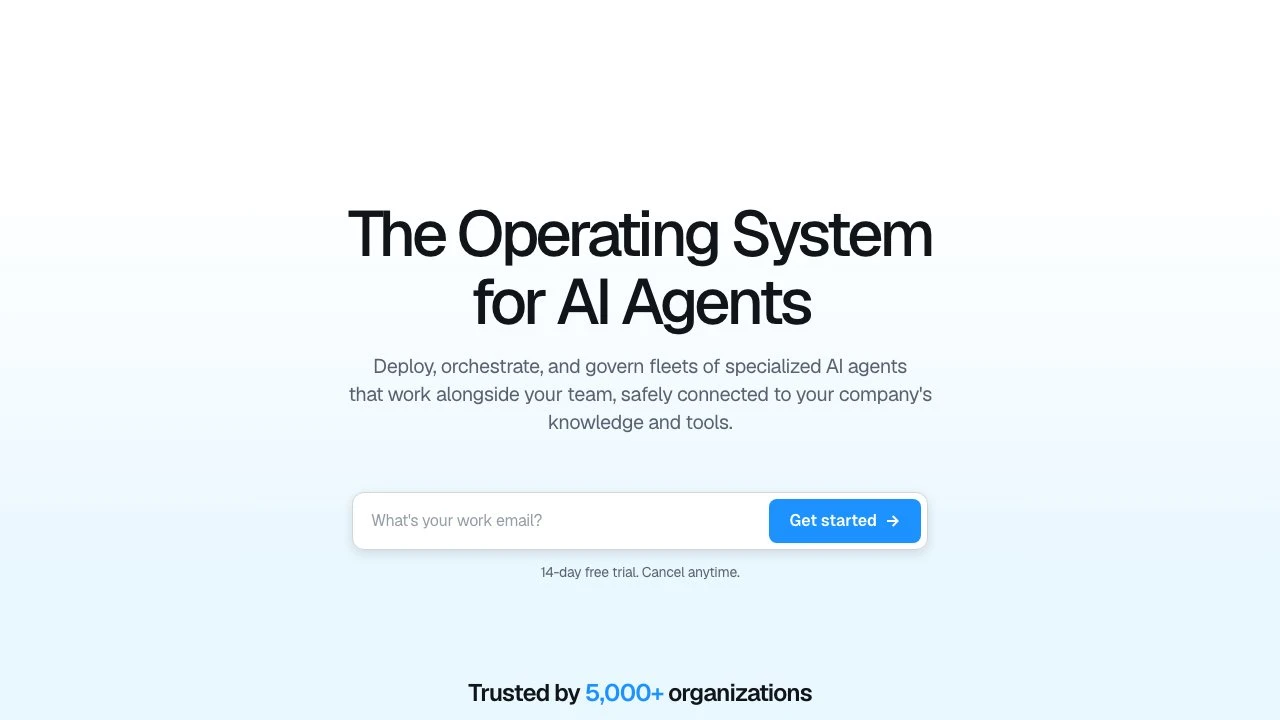
Dust is an enterprise AI platform designed to deploy, orchestrate, and govern fleets of specialized AI agents across an organization. Rather than offering a single general-purpose chatbot, Dust functions as an operating system for AI agents — providing the infrastructure to build, connect, and manage multiple purpose-built agents that work alongside human teams.
At its core, Dust allows teams to create AI agents without writing code. These agents are connected to company data sources including Slack, Google Drive, Notion, Confluence, and GitHub, giving them context-aware access to internal knowledge. This architecture means agents can answer questions, execute multi-step tasks, and collaborate with one another based on actual company data rather than generic training data.
Dust targets a broad range of business functions. Pre-built agent templates and workflows exist for Sales, Customer Support, Marketing, Engineering, Legal, HR, IT, Data & Analytics, and Productivity use cases. Each department can configure specialized agents tuned to their own knowledge bases and workflows, reducing the need for cross-team requests just to access internal information.
The platform goes beyond standard RAG (retrieval-augmented generation) chat interfaces by enabling agents to use multiple tools in combination: semantic search, data analysis, web navigation, and integrations with existing business software. This positions it closer to autonomous agent orchestration than simple AI chat.
Dust is model-agnostic, meaning teams are not locked into a single underlying LLM. This is a meaningful differentiator compared to tools like Glean or Guru, which focus primarily on enterprise search, or Microsoft Copilot, which is tightly coupled to the Microsoft 365 ecosystem. Dust's open connector approach and model flexibility make it more adaptable for organizations with heterogeneous toolstacks.
On the security side, Dust holds SOC 2 Type II certification, is GDPR compliant, and supports HIPAA compliance configurations. Data is not used to train models. Role-based access controls, SSO/SCIM support, and audit logs are available for enterprise deployments, making it suitable for regulated industries including financial services, insurance, and healthcare-adjacent companies.
Dust reports over 5,000 organizations using the platform, with documented case studies from companies including Clay, Vanta, Qonto, Doctolib, and Back Market. These cases span fraud detection systems, GTM team productivity, and customer support automation — indicating real-world production deployments rather than pilot-only adoption.
For teams evaluating Dust, the closest alternatives include Glean (enterprise search-first), Guru (knowledge management with AI), and custom deployments using LangChain or similar frameworks. Dust occupies the middle ground: more structured than rolling your own agent infrastructure, but more flexible and extensible than vertical-specific AI tools.
Key Features
- No-code agent builder for creating specialized AI agents in minutes
- Native connectors to Slack, Google Drive, Notion, Confluence, GitHub, and more
- Multi-agent orchestration allowing agents to collaborate on complex tasks
- Model-agnostic infrastructure supporting multiple underlying LLMs
- Spaces and role-based access controls for managing data permissions across teams
- Agents capable of semantic search, data analysis, and web navigation in a single workflow
- Chrome Extension for accessing agents directly in the browser
- Enterprise compliance: SOC 2 Type II, GDPR, HIPAA-ready, with audit logs and data residency options
Pros & Cons
Pros
- Covers a wide range of department use cases out of the box, from Sales to Legal to Engineering
- Model-agnostic design avoids LLM vendor lock-in
- Strong security and compliance posture suitable for regulated industries
- No-code agent creation lowers the barrier for non-technical teams
- Active customer base with documented ROI case studies across multiple industries
Cons
- Enterprise-grade features may be more than small teams need
- Pricing is not publicly listed, requiring a sales conversation for full details
- Dependent on quality of connected data sources — poorly maintained knowledge bases will limit agent usefulness
- Platform depth may involve a learning curve for organizations new to multi-agent workflows
Pricing
Dust offers a 14-day free trial with no credit card required. Specific plan pricing is not published on the website; interested teams should contact Dust sales for pricing details.
Who Is This For?
Dust is best suited for mid-size to large organizations that want to deploy AI agents across multiple departments without building custom infrastructure from scratch. It is particularly well-matched for teams in sales, customer support, legal, and engineering who need agents grounded in internal company knowledge rather than generic AI responses. Organizations in regulated industries — financial services, insurance, or healthcare-adjacent — will find the compliance certifications and access controls especially relevant.
Tags:
Similar to Dust