E2B
Sandboxed cloud environments for AI agents to execute code safely. Run untrusted code securely.
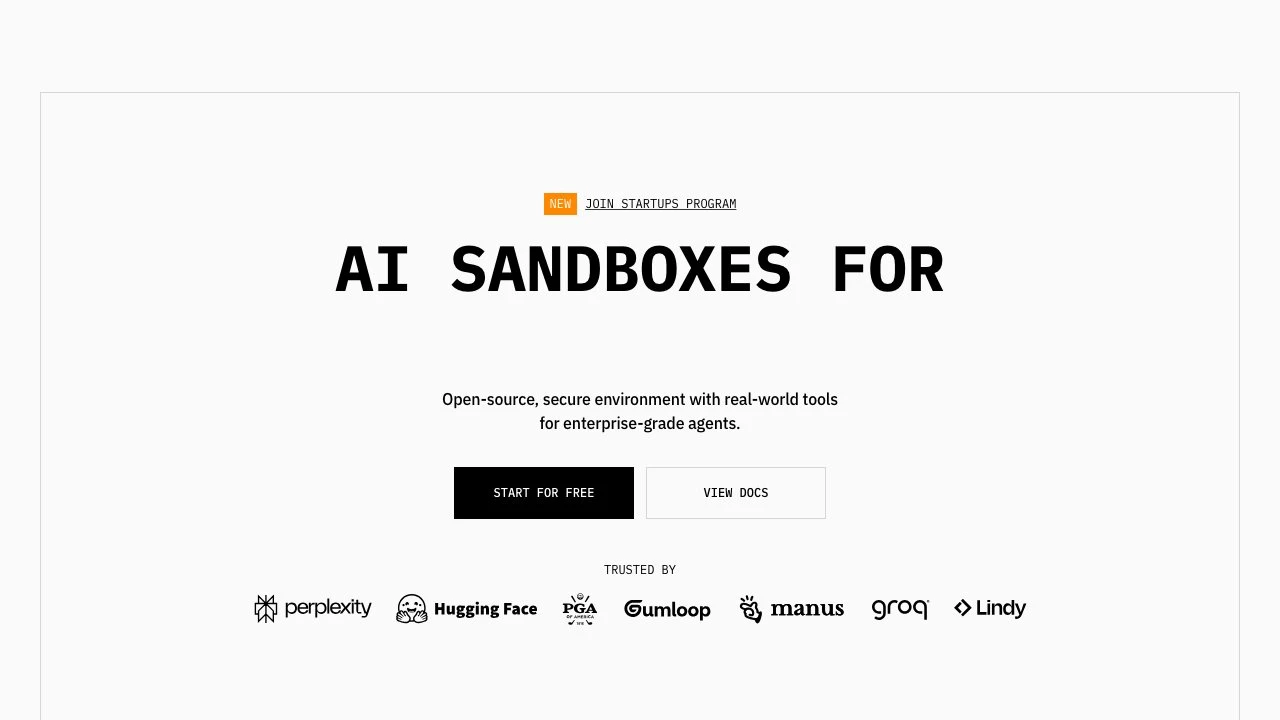
E2B (short for "Edge to Backend") is an open-source platform that provides secure, sandboxed cloud environments for AI agents to execute code. Where most AI frameworks stop at generating code, E2B closes the loop by giving agents a real, isolated runtime to actually run it — safely and at scale.
The core product is the E2B Sandbox: a lightweight, fast-booting virtual environment that agents can spin up on demand to execute arbitrary code without any risk to the host system or other tenants. Each sandbox is fully isolated, equipped with a real Linux environment, and exposes standard tools — file system access, network calls, package installation — that agents need to do meaningful work.
E2B is purpose-built for the agentic era. Rather than serving human developers who run code interactively, it serves AI models that need to run code autonomously as part of a larger workflow: deep research agents scraping and analyzing data, computer-use agents automating browser tasks, background automation agents processing files, and reinforcement learning pipelines that require repeated code execution in a controlled environment. The platform also supports secure Model Context Protocol (MCP) servers, letting agents interact with external tools inside the sandbox boundary.
The platform is trusted by a notable roster of AI companies. Perplexity used E2B to ship advanced data analysis features for Pro users in one week. Hugging Face uses it to replicate DeepSeek-R1 experiments. Manus uses it to provide agents with full virtual computers. Groq's compound AI systems run on E2B infrastructure, and Lindy powers its AI workflow automations through E2B's code execution layer.
For developers, E2B offers an API and SDKs (Python and JavaScript/TypeScript) that make it straightforward to integrate sandbox execution into any agent stack, regardless of the underlying LLM. This LLM-agnostic design means it works with OpenAI, Anthropic, open-source models, or any framework that can make an HTTP call.
Compared to alternatives, E2B occupies a distinct position. Running code in a local subprocess or Docker container is simpler but creates security exposure when the code comes from an LLM. Hosted notebook environments like Code Interpreter in ChatGPT are closed ecosystems. Modal and Fly.io offer cloud execution but are general-purpose compute platforms, not agent-specific sandboxes with the same focus on fast startup, short-lived execution, and the specific primitives agents need. E2B's open-source core also means teams can audit, extend, and self-host if required.
The platform has raised a $21M Series A, signaling institutional backing for its approach to secure agent infrastructure.
Key Features
- Isolated Linux sandbox environments that boot in milliseconds for safe execution of untrusted AI-generated code
- Real-world tooling inside each sandbox: file system access, network requests, package installation, and process execution
- LLM-agnostic API and SDKs for Python and JavaScript/TypeScript, compatible with any model or agent framework
- Support for Secure MCP (Model Context Protocol) servers, letting agents call external tools within the sandbox boundary
- Purpose-built primitives for deep research agents, computer-use agents, background automations, and reinforcement learning pipelines
- Open-source core with enterprise deployment options for teams requiring audit trails, custom environments, or self-hosting
- Proven at scale by production deployments at Perplexity, Hugging Face, Manus, Groq, and Lindy
Pros & Cons
Pros
- Purpose-built for AI agent use cases, not a repurposed general-compute platform
- Open-source core gives teams full visibility and the option to self-host
- LLM-agnostic design works with any model or orchestration framework
- Strong production validation from high-profile customers across diverse use cases
- Fast sandbox startup reduces latency in agent loops that require frequent code execution
Cons
- Adds an external dependency and network hop to every code execution step
- Pricing details are not publicly listed on the website, making cost estimation difficult before signing up
- Teams with strict data residency requirements may find cloud sandboxes challenging without self-hosting
- Relatively specialized — not useful for agents that do not need code execution capabilities
Pricing
Visit the official website for current pricing details. E2B offers a free tier to get started, with paid plans available for higher usage. An enterprise plan and a startups program are also listed on the site.
Who Is This For?
E2B is best suited for AI engineering teams building agents that need to execute code as part of their workflow — whether that is data analysis, file processing, browser automation, or research pipelines. It is particularly well-matched for teams at the stage of moving from prototype to production, where running LLM-generated code in a local process is no longer acceptable from a security standpoint. Companies building on top of LLMs that want to offer end users a Code Interpreter-style capability without building sandbox infrastructure in-house will find E2B a practical fit.
Tags: