Google AI
Gemini models with massive context windows. Multimodal capabilities for diverse agent use cases.
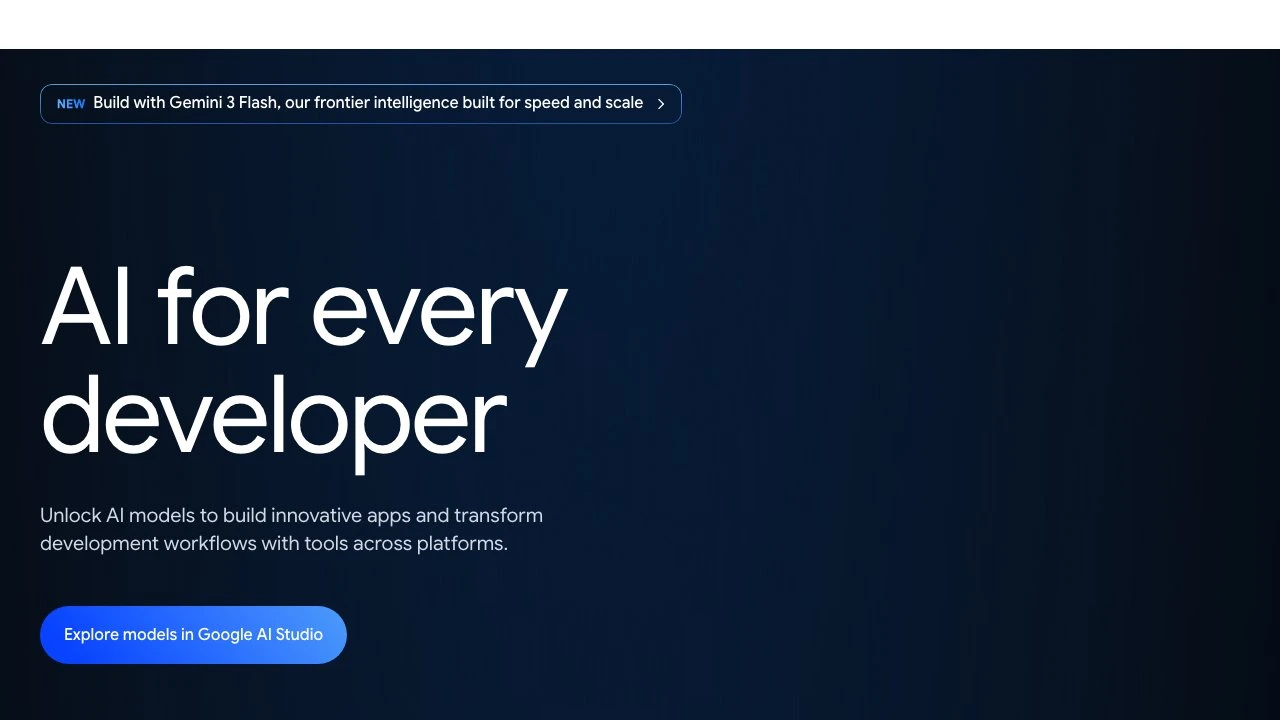
Google AI for Developers is Google's unified platform for accessing and building with its family of AI models, primarily centered on the Gemini API. The platform provides developers with direct access to Gemini, Imagen, and Veo models from Google DeepMind, alongside open-weight Gemma models that can be fine-tuned and self-hosted.
At its core, the platform offers two primary paths: cloud-hosted model access via API key, and on-device inference through Google AI Edge. The cloud path gives developers access to Gemini's full capabilities, including its notably large context windows and multimodal support (text, images, video, code, audio). The on-device path, particularly Gemini Nano on Android, targets latency-sensitive or privacy-sensitive applications where data should not leave the device.
The developer entry point is Google AI Studio, a browser-based environment where developers can prototype prompts, evaluate model outputs, and generate API integration code before committing to production infrastructure. This lowers the barrier to experimentation considerably — developers can go from prompt idea to working API call without setting up any local tooling.
Compared to alternatives like OpenAI's platform or Anthropic's Claude API, Google AI's primary differentiators are context window size (Gemini 1.5 Pro supports up to 1 million tokens, with 2 million in some configurations), native multimodal capabilities across text, image, video, and audio, and tight integration with Google's broader developer ecosystem including Firebase, Google Cloud, Android Studio, and Colab. For teams already invested in Google Cloud, the path to production is more direct than competitors.
The Gemma open models offer a genuinely distinct option within the same platform: developers who need full model control, custom fine-tuning, or air-gapped deployments can work with Gemma (2B, 7B, and larger variants) without API dependency. These are built from the same research foundation as Gemini but are released as open weights, supported across frameworks like Keras, JAX, and PyTorch.
The platform also includes responsible AI tooling through the Responsible GenAI Toolkit and Secure AI Framework, which provides guidance and utilities for building safer AI applications — a consideration that's increasingly relevant for enterprise teams navigating compliance requirements.
For agent use cases specifically, the combination of large context windows, multimodal input support, function calling, and code execution capabilities makes Gemini models well-suited for orchestrating multi-step workflows. The API supports structured outputs, grounding, and tool use patterns that map cleanly to agentic architectures.
Overall, Google AI for Developers is a mature, broad-scope platform suited to developers ranging from solo builders prototyping in AI Studio to enterprise teams building production pipelines on Google Cloud.
Key Features
- Access to Gemini, Imagen, and Veo models via a unified API key
- Google AI Studio for prompt development, model evaluation, and code generation without local setup
- Gemini models with up to 1–2 million token context windows for long-document and multi-turn use cases
- Native multimodal support: text, images, video, audio, and code in a single API
- Gemma open-weight models for self-hosted, fine-tuned, or offline deployments
- Google AI Edge for on-device inference on Android, web (Chrome), and embedded applications
- Integrations with Firebase, Google Cloud, Android Studio, Colab, VS Code, and JetBrains
- Responsible AI utilities including the Responsible GenAI Toolkit and Secure AI Framework
Pros & Cons
Pros
- Industry-leading context window sizes make Gemini models well-suited for long documents, codebases, and extended agent sessions
- Multimodal capabilities (text, image, video, audio) in a single API reduces the need to stitch together separate services
- Open-weight Gemma models provide a self-hosted option for teams needing full model control or fine-tuning
- Deep integration with Google's developer ecosystem (Firebase, Cloud, Android) simplifies production deployment for existing Google users
- Google AI Studio provides a no-setup browser environment for rapid prototyping and prompt iteration
Cons
- Platform breadth (Gemini, Imagen, Veo, Gemma, Edge) can make it harder to find the right starting point compared to more focused competitors
- Some advanced features and higher rate limits require Google Cloud rather than the simpler AI Studio API key path
- Gemma open models require more infrastructure investment to self-host compared to managed API alternatives
- Enterprise-grade support and SLAs are tied to Google Cloud pricing, which adds complexity for smaller teams
Pricing
Google AI offers a free tier for the Gemini API via Google AI Studio. Paid pricing is usage-based and varies by model and modality. Visit the official website at ai.google.dev/pricing for current rates.
Who Is This For?
Google AI for Developers is best suited for software developers and engineering teams building applications that require large context windows, multimodal inputs, or on-device inference. It is particularly well-matched for teams already using Google Cloud, Firebase, or Android who want a tight integration path to production, and for developers who need both managed API access and the option to self-host or fine-tune open models via Gemma.

Similar to Google AI