Groq
Ultra-fast LLM inference on custom hardware. Sub-100ms response times for agent applications.
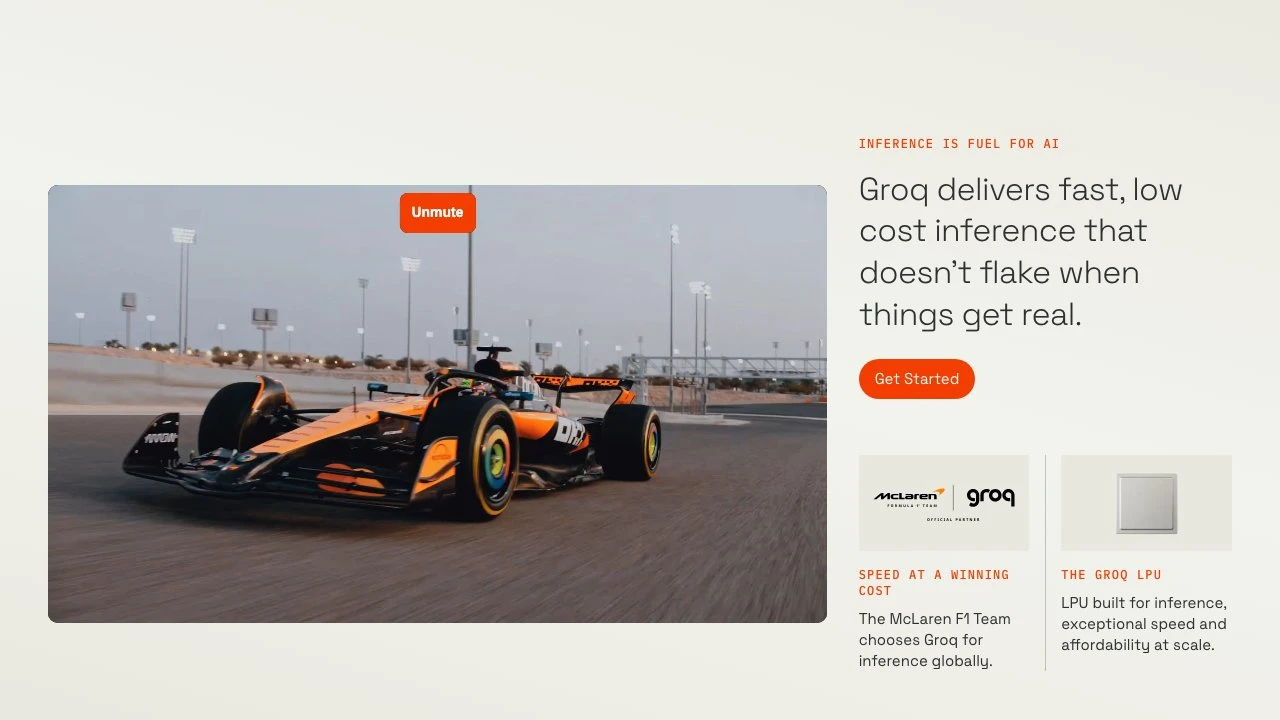
Groq is an AI inference platform built around custom silicon — the Language Processing Unit (LPU) — designed specifically to run large language models at high speed and low cost. Where most inference providers rely on GPUs originally built for graphics or general-purpose compute, Groq's LPU architecture is purpose-built for the sequential, memory-bound workloads that define transformer model inference. The result is consistently fast response times that hold up under real production load.
The platform is accessible through GroqCloud, a developer-facing API that supports popular open-source models including Llama, Mixtral, and Gemma variants. Developers interact with it via a REST API that is largely compatible with OpenAI's API format, making it straightforward to swap Groq in as the inference backend for applications already built against standard LLM APIs.
Groq positions itself as infrastructure for production AI — not a chat interface or application layer, but the engine underneath. Its primary audience is developers and engineering teams building latency-sensitive applications: real-time voice assistants, coding tools, customer-facing agents, and any workflow where waiting on inference creates a bottleneck. With over 3 million developers and teams on the platform — including Dropbox, Vercel, Canva, and Riot Games — it has established itself as a credible production option rather than a hobbyist API.
Compared to alternatives like OpenAI, Anthropic, or Together AI, Groq's differentiation is almost entirely on inference speed and hardware architecture. It does not develop foundation models — it runs other organizations' open-source models faster. For teams that need a specific proprietary model (GPT-4o, Claude, Gemini), Groq is not a replacement. But for teams that can work with open-weight models and need throughput or latency that GPU-based providers struggle to guarantee, Groq is a strong fit.
The platform offers a free tier with an API key available immediately from the developer console, making it accessible for prototyping before committing to paid usage. Enterprise access is also available for teams with larger scale or reliability requirements, including the McLaren Formula 1 team which uses Groq for global inference.
For agent-based applications specifically, Groq's low-latency characteristics matter more than in single-turn use cases. Multi-step agent loops call the model repeatedly, so per-call latency compounds quickly. A provider that adds 2–3 seconds per call becomes a significant drag on end-to-end agent performance. Groq's architecture is well-suited to this pattern, which is why it has found adoption in agentic frameworks and real-time AI pipelines.
Key Features
- Purpose-built LPU (Language Processing Unit) hardware architecture optimized for LLM inference
- GroqCloud API with OpenAI-compatible REST interface for easy integration
- Support for popular open-source models including Llama, Mixtral, and Gemma families
- Free API key with no credit card required for getting started
- Enterprise access tier for production deployments at scale
- Developer console with documentation, community, and changelog
- Used by teams at Dropbox, Vercel, Canva, Robinhood, and Riot Games
Pros & Cons
Pros
- Exceptionally fast inference speeds due to purpose-built LPU hardware
- OpenAI-compatible API makes migration and integration straightforward
- Free tier available with immediate API key access
- Strong track record with production teams across multiple industries
- Well-suited for latency-sensitive use cases like agents and real-time apps
Cons
- Does not offer proprietary frontier models — limited to supported open-source models
- Not a replacement for providers like OpenAI or Anthropic if specific closed models are required
- Hardware architecture is purpose-built, so flexibility for non-inference workloads is limited
- Dependent on open-source model availability for capability improvements
Pricing
Groq offers a free tier with API key access available through the developer console. Paid pricing details and enterprise access are available on the official pricing page.
Who Is This For?
Groq is best suited for developers and engineering teams building latency-sensitive AI applications — particularly real-time agents, voice interfaces, and any multi-step pipeline where inference speed compounds across calls. It is a strong fit for teams already working with open-source models who want to reduce per-call latency without managing their own inference infrastructure.
Similar to Groq