Julep
Build stateful AI agents with built-in memory, tool use, and multi-step workflows. Managed infrastructure.
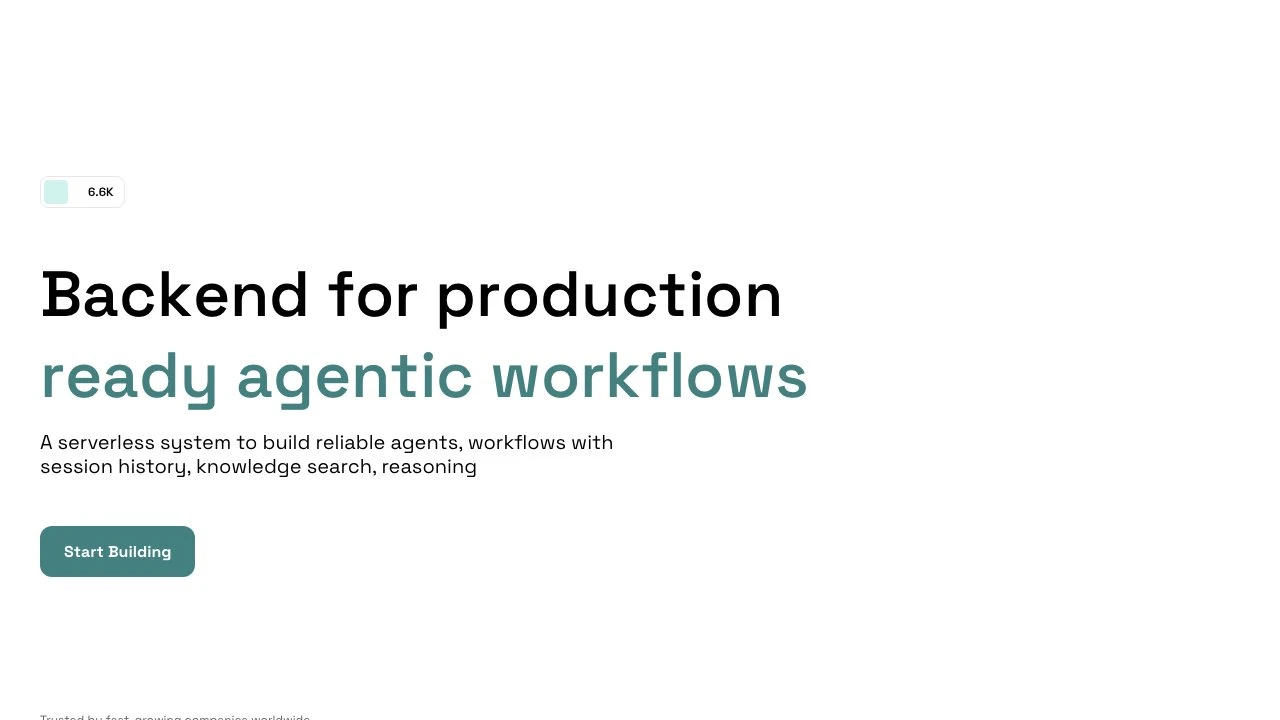
Julep is a serverless backend platform for building production-grade AI agents and multi-step workflows. Rather than requiring developers to stitch together their own infrastructure for state management, memory, and task orchestration, Julep provides a managed system that handles these concerns out of the box.
At its core, Julep lets developers define agents and workflows using YAML or JSON — a declarative approach that keeps logic readable and version-controllable, much like infrastructure-as-code. Workflows can span multiple steps, branch conditionally, and coordinate between tools and LLMs without the developer needing to manage execution state manually. Sessions maintain conversation history between agents and users across interactions, making it practical to build assistants that remember context over time.
The platform connects to 50+ LLMs, meaning teams are not locked into a single model provider. Knowledge search, reasoning capabilities, and tool integrations are available as first-class features rather than bolted-on additions. Julep was selected for Meta's Llama Startup Program, signaling alignment with open-weight model ecosystems as well.
Where Julep differs from alternatives like LangChain, LlamaIndex, or CrewAI is in its infrastructure stance. Those frameworks run inside the developer's own application process and require the developer to manage deployment, persistence, and reliability. Julep is a managed service — the orchestration engine runs on their infrastructure, and developers interact with it via API. This is closer in spirit to platforms like Inngest or Temporal for workflow orchestration, but purpose-built for agentic AI workloads.
Compared to cloud-provider AI services (AWS Bedrock Agents, Google Vertex AI Agents), Julep is model-agnostic and less coupled to a specific cloud ecosystem, which gives teams more flexibility. The YAML/JSON workflow definition also tends to be more portable and auditable than proprietary visual builders.
The platform is positioned for teams that want to move from prototype to production without building orchestration infrastructure themselves. It handles session history, knowledge retrieval, and multi-step task execution as managed primitives. This makes it particularly well-suited for applications like customer support agents, research automation pipelines, document processing workflows, and any scenario where agents need to maintain state across multiple interactions or execute long-running tasks reliably.
Julep's API-first design means it can plug into existing backend architectures without dictating how the rest of the application is built. Developers define agent behavior through configuration rather than imperative code, which reduces boilerplate and makes workflows easier to inspect and modify. For teams that need observable, deterministic AI logic without the operational overhead of managing their own orchestration layer, Julep occupies a compelling position in the growing ecosystem of agentic AI infrastructure.
Key Features
- Serverless managed infrastructure for AI agent execution — no orchestration servers to operate
- Multi-step workflow definition via YAML or JSON with support for branching, loops, and conditional logic
- Stateful sessions that maintain conversation and interaction history between agents and users
- Built-in knowledge search and retrieval for grounding agent responses in documents or data
- Connects to 50+ LLMs, enabling model-agnostic agent development
- Session history and memory management handled as platform primitives, not custom code
- API-first design that integrates with existing backend systems without requiring framework lock-in
Pros & Cons
Pros
- Managed infrastructure removes the operational burden of running orchestration engines, state stores, and task queues
- Declarative YAML/JSON workflow definitions are version-controllable and easier to audit than imperative orchestration code
- Model-agnostic with 50+ LLM integrations, avoiding lock-in to a single provider
- Session and memory management are built-in, reducing the custom code required for stateful agents
- Serverless model means teams pay for usage rather than provisioning capacity upfront
Cons
- As a managed service, teams have less control over the underlying infrastructure and execution environment compared to self-hosted alternatives
- YAML/JSON workflow definitions may feel limiting for complex conditional logic that would be more natural in a full programming language
- Vendor dependency — migrating away from Julep would require rebuilding the orchestration layer
- Newer platform with a smaller community and ecosystem compared to established frameworks like LangChain
Pricing
Visit the official website for current pricing details.
Who Is This For?
Julep is best suited for engineering teams building production AI agents that require stateful sessions, multi-step task execution, and knowledge retrieval without the overhead of managing their own orchestration infrastructure. It excels at use cases like customer support automation, research pipelines, document processing workflows, and any application where agents need to maintain context across multiple interactions or coordinate complex sequences of tool calls reliably at scale.
Tags:

Similar to Julep
