Langfuse
Open-source observability and analytics for LLM applications. Trace, evaluate, and debug agents.
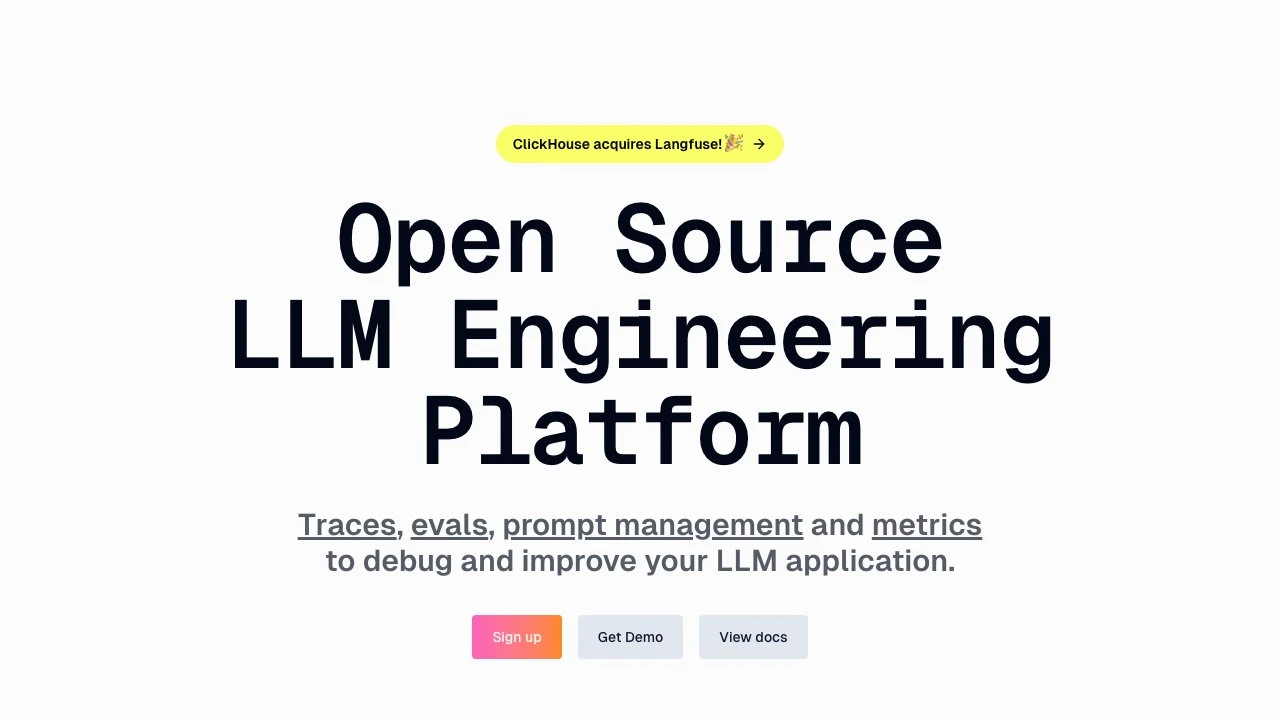
Langfuse is an open-source LLM engineering platform designed to give developers full visibility into how their AI applications behave in production. Built around four core pillars — observability, prompt management, evaluation, and metrics — it provides the tooling needed to debug, iterate on, and improve LLM-powered systems at any scale.
At its core, Langfuse captures detailed traces of LLM interactions, allowing engineers to inspect individual requests, intermediate steps in multi-step pipelines, and the full execution flow of complex agents. This tracing capability is especially valuable for agentic systems where understanding why a model made a particular decision — or where a chain failed — requires more than just logging inputs and outputs.
Prompt management is handled natively within the platform, letting teams version, deploy, and test prompts without code deployments. This decouples prompt iteration from release cycles, which is meaningful for teams that need to move quickly on prompt quality without involving engineering every time.
The evaluation layer supports both automated scoring and human review workflows. Teams can define evaluation rubrics, run LLM-as-judge scoring, and collect human feedback — all tied back to the traces that generated the outputs. This closes the loop between what the model produces and what the team considers acceptable quality.
Metrics and dashboards surface usage patterns, latency distributions, cost breakdowns, and quality trends over time, giving product and engineering teams a shared view of application health.
Langfuse is self-hostable, which distinguishes it from many commercial alternatives like LangSmith, Arize, or Weights & Biases. For teams with data residency requirements or those operating in regulated industries, this is a meaningful architectural difference. The open-source codebase (24K GitHub stars at time of writing) also means teams can audit, extend, or fork the platform as needed.
The platform integrates with most major LLM SDKs and frameworks, including LangChain, LlamaIndex, OpenAI SDKs, and others. A playground feature lets users test prompts directly in the UI without switching tools.
Langfuse was acquired by ClickHouse in 2026, which signals a trajectory toward deeper analytics capabilities built on ClickHouse's columnar storage engine — a natural fit for the high-volume, time-series nature of LLM trace data.
For teams already using managed cloud tooling, Langfuse Cloud provides a hosted option that removes infrastructure overhead while retaining the same feature set. The combination of open-source roots, cloud offering, and enterprise tier makes Langfuse accessible at most organizational scales.
Key Features
- Distributed tracing for LLM calls, chains, and agents with nested span support
- Prompt management with versioning, deployment controls, and A/B testing capabilities
- Evaluation framework supporting automated LLM-as-judge scoring and human annotation workflows
- Metrics and dashboards covering latency, cost, token usage, and quality scores over time
- Self-hosting support for teams with data residency or compliance requirements
- Broad SDK and framework integrations including LangChain, LlamaIndex, and OpenAI-compatible SDKs
- Prompt playground for iterating on prompts directly within the platform
- API and data platform access for exporting traces and building custom analytics pipelines
Pros & Cons
Pros
- Open-source codebase with 24K GitHub stars provides transparency, auditability, and community support
- Self-hosting option gives teams full control over data residency and infrastructure
- Covers the full LLM development lifecycle — tracing, evaluation, prompt management, and metrics — in one platform
- Active development cadence with a public roadmap and changelog
- Flexible deployment: self-hosted, cloud, or enterprise, depending on organizational needs
Cons
- Self-hosting requires infrastructure management, which adds operational overhead for smaller teams
- The breadth of features means there is a learning curve to configure and get the most out of the platform
- Subscriber analytics and some advanced capabilities may vary depending on deployment mode
- As a relatively young platform, enterprise-grade integrations and support SLAs may be less mature compared to incumbents like Datadog or Arize
Pricing
Langfuse offers a free tier via Langfuse Cloud for individuals and small teams. Paid plans and an enterprise tier are available for larger organizations with advanced needs. For self-hosted deployments, the open-source version is free to use. Visit the official website for current pricing details.
Who Is This For?
Langfuse is best suited for engineering teams building production LLM applications who need structured observability and evaluation tooling without being locked into a proprietary platform. It is particularly well-matched to teams with data residency requirements or strong open-source preferences, as well as organizations running complex agentic workflows where trace-level debugging is essential.

Similar to Langfuse