LlamaIndex
Connect custom data sources to large language models. Best for RAG and knowledge-intensive agent applications.
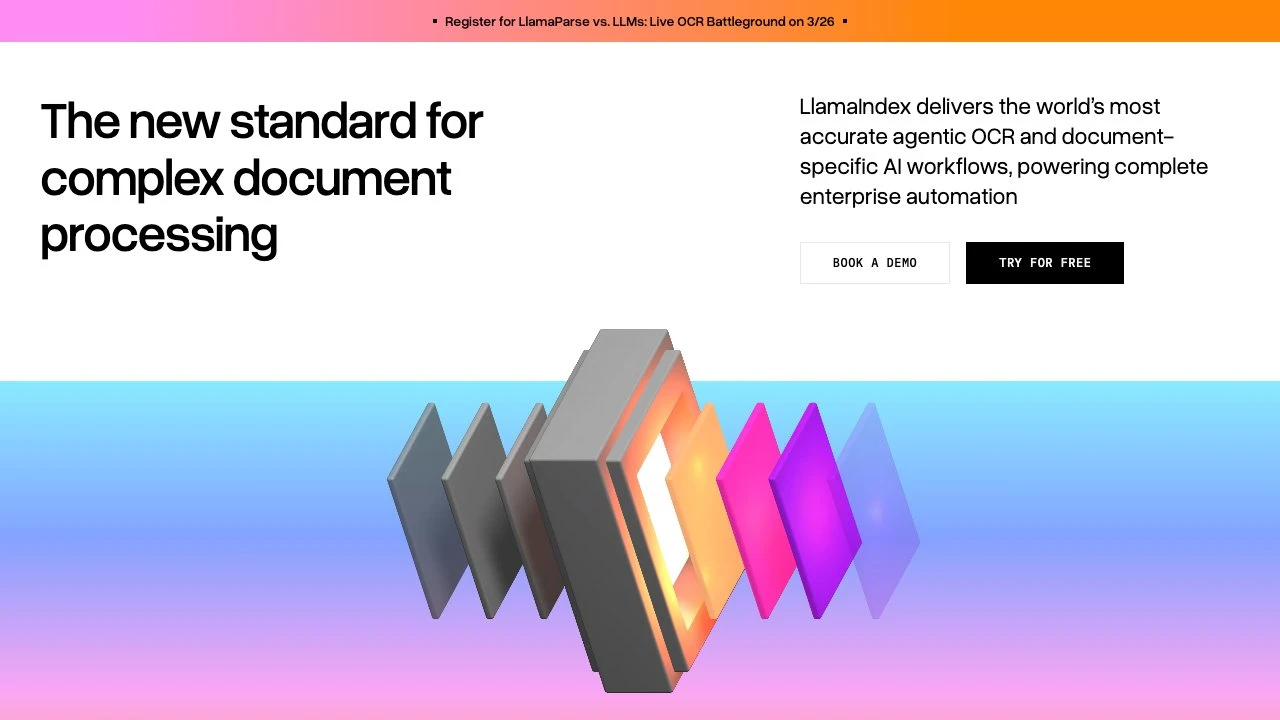
LlamaIndex is an open-source data framework designed to connect custom data sources to large language models (LLMs). Originally focused on retrieval-augmented generation (RAG), the project has expanded into a broader platform that includes document processing, agentic workflows, and cloud-hosted indexing infrastructure.
At its core, LlamaIndex provides the building blocks developers need to move beyond generic LLM interactions and into applications that reason over private, domain-specific data. This makes it particularly valuable for use cases like enterprise document search, financial analysis, customer support automation, and knowledge-intensive agent pipelines.
The framework is organized around several interconnected products. The open-source LlamaIndex library provides the foundational abstractions — data connectors, indices, query engines, and agent components — that developers compose to build RAG and agentic applications in Python (with a TypeScript variant also available). On top of this, LlamaParse handles document ingestion with a focus on complex, layout-heavy formats like PDFs, tables, and scanned files where standard text extraction typically falls short. LlamaExtract extends this further into structured data extraction from unstructured documents. LlamaCloud provides a managed cloud service for indexing and retrieval, removing the need to host and maintain the infrastructure yourself.
The Workflows component adds orchestration primitives for controlling the flow of multi-step GenAI applications, filling a role similar to what LangGraph or Temporal do for stateful agent pipelines.
Compared to alternatives, LlamaIndex sits closest to LangChain in scope but has historically placed a stronger emphasis on data ingestion quality and retrieval accuracy rather than general-purpose chain composition. Developers who have tried both often describe LlamaIndex as more opinionated about the data layer, which can be an advantage when document fidelity is critical and a constraint when building more general orchestration logic. For pure RAG use cases, LlamaIndex's native abstractions tend to require less custom plumbing than building equivalent pipelines in LangChain.
The framework has attracted production adoption across insurance, finance, manufacturing, and healthcare sectors, with documented enterprise deployments including a Boeing subsidiary reporting roughly 2,000 engineering hours saved through a unified chat framework built on LlamaIndex.
LlamaIndex is open source (Apache 2.0 licensed), maintained by the LlamaIndex company, and supported by an active community on GitHub and Discord. The cloud products are commercial, while the core framework remains freely available. For teams that want to build quickly without managing infrastructure, LlamaCloud offers a hosted path. For teams that need full control or have data residency requirements, the self-hosted open-source route is viable.
Key Features
- Data connectors for ingesting from databases, APIs, PDFs, spreadsheets, and other custom sources into LLM-ready formats
- Native RAG primitives including vector indices, keyword indices, and hybrid retrieval strategies
- LlamaParse: specialized document processing with high accuracy on complex layouts, tables, and scanned content
- LlamaExtract: structured data extraction from unstructured documents via schema-driven pipelines
- Agentic workflows with control flow primitives for building multi-step, stateful GenAI applications
- LlamaCloud: managed cloud service for hosted indexing and retrieval without self-managed infrastructure
- Python and TypeScript support, with a large ecosystem of integrations for LLM providers, vector databases, and storage backends
- Active open-source community with Apache 2.0 licensing and enterprise support options
Pros & Cons
Pros
- Strong out-of-the-box support for complex document ingestion, particularly PDFs and tables where other frameworks struggle
- Clear separation between data layer, retrieval layer, and agent layer makes large RAG applications easier to reason about
- LlamaCloud offers a managed path for teams that want production-grade indexing without operational overhead
- Large and active open-source community with frequent updates and a wide integration ecosystem
- Flexible enough for both simple RAG prototypes and production multi-agent systems
Cons
- Learning curve is steeper than lightweight alternatives like simple vector DB SDKs for teams that only need basic retrieval
- The product surface has grown significantly; navigating LlamaParse, LlamaExtract, LlamaCloud, and the core framework can be confusing for newcomers
- TypeScript support lags behind the Python library in features and documentation
- Cloud pricing is not publicly listed, requiring a demo call for enterprise tiers
Pricing
The core LlamaIndex framework is open source and free to use. LlamaCloud (managed indexing and document processing) offers a free tier to get started, with paid plans available for higher usage. Visit the official website for current pricing details on cloud products.
Who Is This For?
LlamaIndex is best suited for developers and engineering teams building production RAG systems, knowledge-intensive AI agents, or document automation pipelines where data quality and retrieval accuracy are critical. It is particularly well-matched for enterprises in finance, insurance, healthcare, and manufacturing that need to process large volumes of complex documents and expose that knowledge to LLM-powered applications.
Tags:

Common Use Cases for LlamaIndex
View allSimilar to LlamaIndex