Anyscale
Scale AI workloads with Ray. Distributed training, fine-tuning, and inference for agent applications.
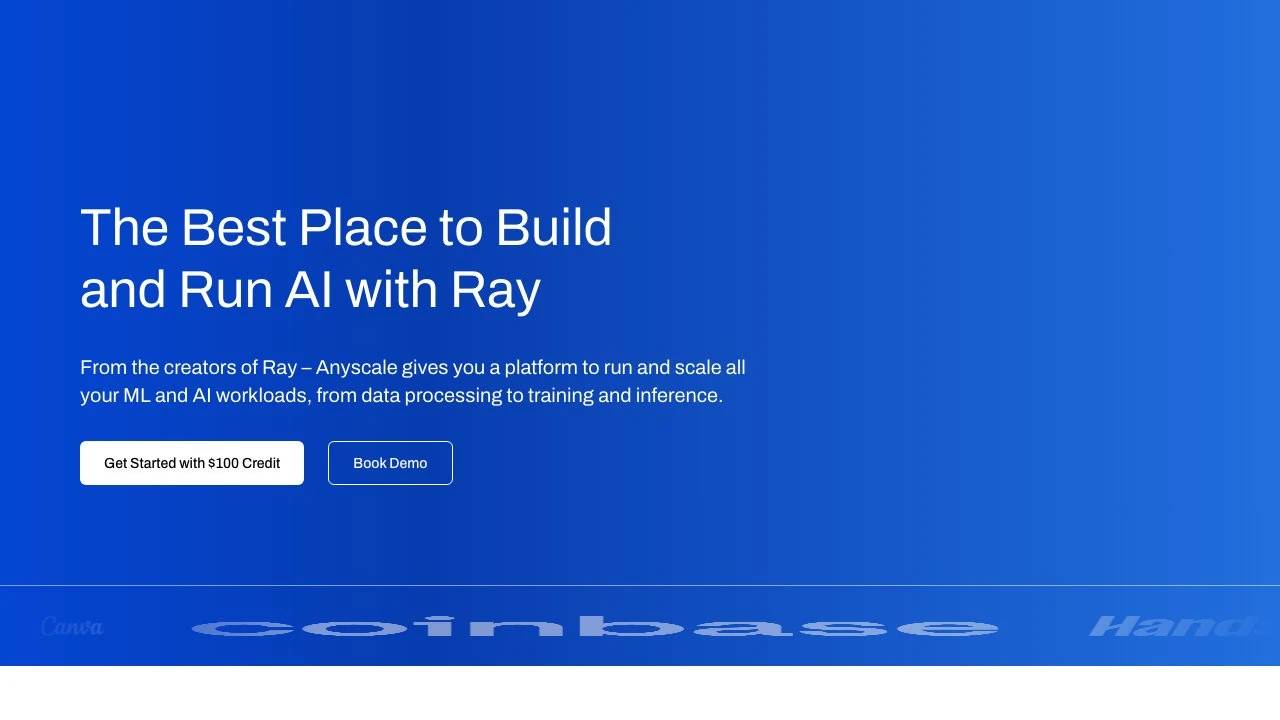
Anyscale is a managed cloud platform built by the creators of Ray, the open-source distributed computing framework. It provides the infrastructure and tooling needed to run machine learning and AI workloads at scale — from data processing pipelines to model training, fine-tuning, and inference — without requiring teams to manually manage the underlying cluster operations.
At its core, Anyscale wraps Ray with a production-grade platform layer. Ray itself is a Python-native framework that lets developers distribute workloads across CPUs, GPUs, and other accelerators, scaling from a single laptop to tens of thousands of nodes. Anyscale adds a managed control plane on top: automated cluster provisioning, fault tolerance, autoscaling, dependency management, and observability tooling that would otherwise require significant DevOps investment to build and maintain.
The platform targets three main stages of the AI development cycle. For development, it provides cloud-based IDE environments (accessible via VSCode, Jupyter, and Cursor) with idle termination to control costs, along with profiling tools designed for distributed workloads. For production deployment, it handles fault-tolerant cluster management across heterogeneous VM or Kubernetes environments, with zero-downtime upgrades, rollback support, and managed Prometheus and Grafana dashboards. For cost efficiency, it includes proprietary runtime optimizations across training and inference pipelines, plus governance and cost controls for multi-user or multi-job environments.
Anyscale supports all major data modalities — images, video, text, audio, and tabular data — making it applicable across a broad range of AI use cases including LLM fine-tuning, batch inference, and agentic application backends.
Compared to alternatives like Databricks (which also runs distributed Python workloads but is more tightly coupled to Apache Spark and a data lakehouse architecture) or SageMaker (AWS's managed ML platform), Anyscale's differentiation is its native Ray integration. Teams already using Ray get the most value here, since Anyscale eliminates the operational overhead of self-managing Ray clusters on raw cloud infrastructure. For teams not yet committed to Ray, the platform requires adopting Ray as the compute substrate, which is a meaningful architectural choice.
The platform deploys into the user's cloud of choice, which keeps data within existing cloud accounts and makes it compatible with enterprise security and compliance requirements. Customers using the platform include Canva, Coinbase, Notion, and Runway, suggesting it is in active production use for demanding AI workloads at scale.
Anyscale also offers a learning path through its courses portal, providing an introduction to Ray for teams building familiarity with distributed Python before scaling to production.
Key Features
- Managed Ray clusters with autoscaling across CPU and GPU VMs or Kubernetes
- Built-in IDE environments (VSCode, Jupyter, Cursor) with idle termination for cost control
- Distributed workload observability with profiling tools designed for Ray applications
- Fault-tolerant deployments with proactive unhealthy node draining and automatic replacement
- Zero-downtime upgrades with built-in rollback support
- Managed Prometheus and Grafana dashboards with persistent log storage
- Automatic dependency propagation (container and uv) across all Ray cluster nodes
- Proprietary Anyscale Runtime optimizations for training and inference pipelines
Pros & Cons
Pros
- Built by the Ray creators, ensuring deep integration and first-class support for the framework
- Eliminates significant DevOps overhead for teams running distributed AI workloads
- Supports heterogeneous compute (CPUs, GPUs, accelerators) in a single cluster
- Deploys into the customer's own cloud account, satisfying enterprise data residency requirements
- Covers the full AI pipeline from data processing to training to inference
Cons
- Requires adopting Ray as the compute substrate, which limits flexibility for teams using other frameworks
- Enterprise-grade platform likely carries significant cost for large-scale usage
- Managed layer adds abstraction on top of Ray that may constrain advanced cluster customization
- Vendor lock-in risk if workloads become tightly coupled to Anyscale-specific features
Pricing
Anyscale offers new users $100 in free credits to get started. A demo can be booked for enterprise inquiries. Visit the official website for current pricing details.
Who Is This For?
Anyscale is best suited for ML engineering teams and AI infrastructure teams that are running or planning to run distributed workloads using Ray at scale. It is particularly well-matched for organizations that need to train, fine-tune, or serve large models in production without dedicated platform engineering resources to manage Ray clusters manually. Enterprises with strict data residency requirements benefit from its bring-your-own-cloud deployment model.
Tags:
Similar to Anyscale