Agentic Business Intelligence Explained for Leaders
Learn what agentic business intelligence is, how AI agents transform BI architectures, use cases, ROI scoring and governance for adoption.
Written by HeadOfAgents
Your executive dashboard says revenue is below plan. You ask why, then ask which regions are responsible, whether the issue comes from volume or pricing, and what the team should do next. The dashboard can answer only the questions someone designed in advance. Your analyst exports data, checks a spreadsheet, joins it with operational records, and returns an answer after the decision window has started to close.
That pattern explains why agentic business intelligence matters. Traditional BI has been built around static reports, predefined metrics, and manual analyst work. Agentic systems can retrieve data, clean it, interpret it, explain the reasoning, and recommend or execute a next step within a controlled workflow.
The shift is gaining enterprise attention. A 2026 industry survey reported that 72% of enterprises are using or testing AI agents, while 84% of enterprise leaders expect to increase investment in the next 12 months. The same survey found that 47% of enterprises use AI agents for data management, a foundational BI activity because preparation, integration, and monitoring happen upstream of dashboards and decision support. The 2026 agentic AI statistics overview also describes independent reporting that companies have automated 31% of workflows with agentic AI on average and expect to expand adoption by 33% in 2026.
The important question for leaders isn't whether an agent can produce a fluent answer. It's who owns the agent, what evidence supports its conclusion, which actions it may take, and how the business will measure the result. This guide moves from the basic model to architecture, practical value, ROI scoring, governance, and a controlled adoption plan.
Introduction to Agentic Business Intelligence
A traditional BI workflow usually stops at information. A team opens a report, notices an unusual movement in a KPI, and asks an analyst to investigate. The analyst checks the semantic model, queries the warehouse, validates definitions, looks for related operational signals, and writes a short explanation. If the executive asks a follow-up question, the cycle starts again.
An agentic BI workflow is designed to continue beyond the first answer. The system can monitor a defined business objective, identify an exception, gather relevant evidence, perform several analytical steps, and present a recommendation with an escalation path. It might find that a margin decline is concentrated in a product group, compare the movement with pricing and fulfillment data, and route the finding to a finance owner for approval before any action occurs.
The practical shift: traditional BI helps people inspect information, while agentic BI helps organizations move from a business objective to evidence, interpretation, and a controlled decision.
This doesn't mean dashboards disappear. A trusted dashboard, governed metric, and reliable warehouse remain essential. The agent depends on them for context, permissions, definitions, and data quality. Agentic capability sits above that foundation, coordinating work that previously required several manual handoffs.
The market's software direction reinforces the strategic importance. Gartner projected that 40% of enterprise applications will include task-specific AI agents by the end of 2026, compared with less than 5% in 2025, and estimated agentic AI spending would reach $201.9 billion in 2026. Those are projections, not guarantees, but they indicate that agents are moving toward mainstream enterprise software rather than remaining limited to experimental analytics interfaces. Gartner's agentic AI statistics and enterprise forecast provides the relevant forecasting context.
For leaders, the result is a new operating question. BI teams still own data models and analytical quality, but agent programs also need owners for prompts, tools, permissions, evaluation, incident response, and business outcomes. Understanding what agentic AI means for business can help executives frame that shift before they select a platform or authorize autonomous actions.
What Agentic Business Intelligence Really Means
Think of traditional BI as a research assistant. You ask for a number, the assistant retrieves it, and you decide what it means. A copilot improves the interaction by translating natural language into queries or summarizing a report, but it generally waits for the next instruction.
Agentic BI behaves more like an autonomous analyst working under a mandate. You give it a goal, such as monitoring gross margin or investigating service-level deterioration. It plans the work, selects approved data sources, calls analytical tools, checks intermediate results, and either delivers a conclusion or asks a person to resolve an ambiguity.
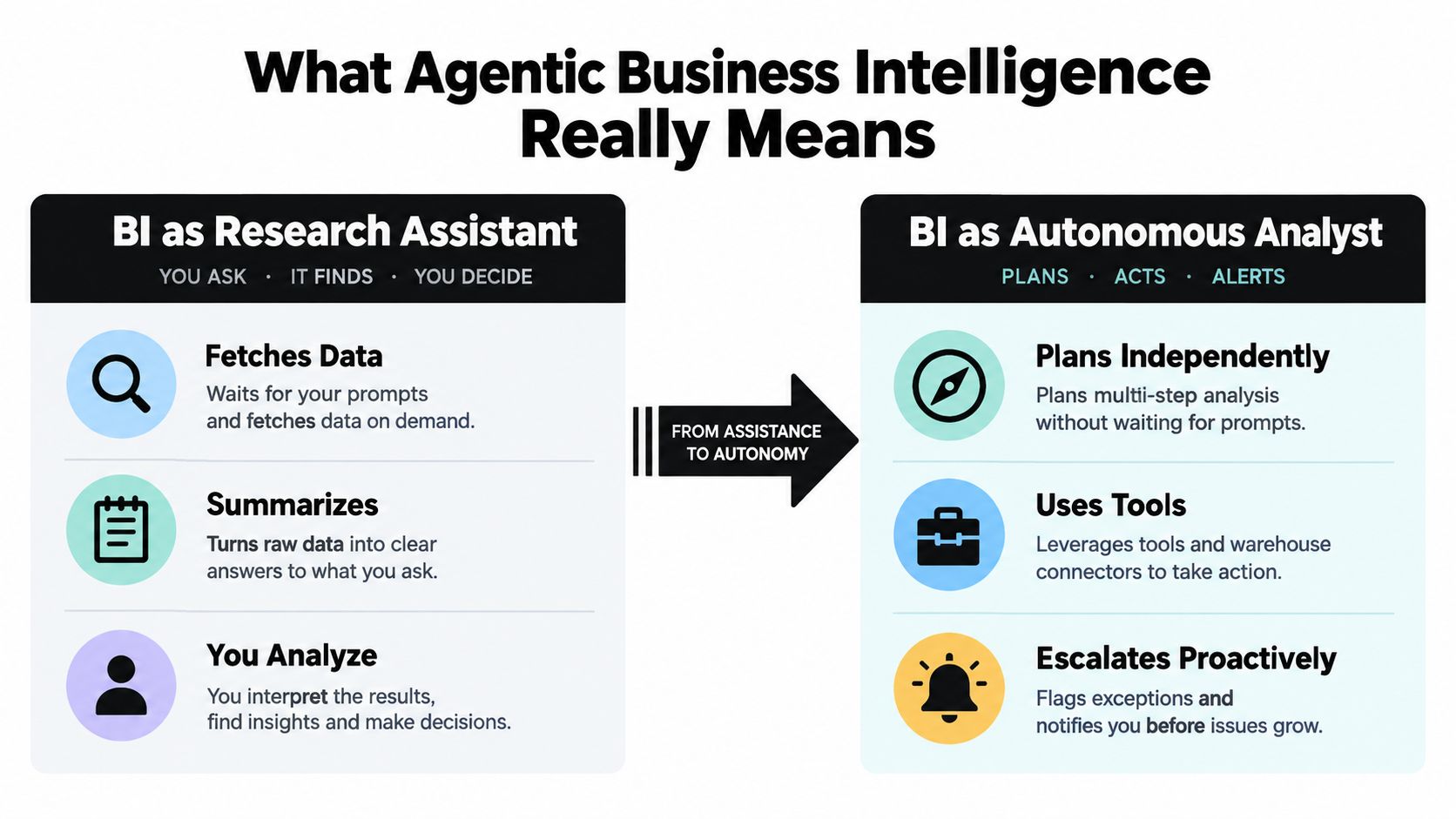
The progression from questions to goals
The distinction becomes clearer when you separate the work into steps:
- Traditional BI responds to a predefined request. A user filters a report or submits an analyst ticket.
- Generative BI adds interpretation. The system describes a chart, creates a query, or drafts a summary.
- Agentic BI coordinates a process. The system decomposes a goal into tasks, uses tools, evaluates the outputs, and decides whether it can proceed.
- Controlled autonomy connects insight to action. The agent may recommend an action, request approval, or execute within explicit limits.
A simple question might be, “What were sales last month?” An agentic task is closer to, “Monitor sales performance, identify material deviations from the operating plan, investigate likely causes, and notify the regional owner when evidence meets the escalation rule.”
That distinction matters because agentic systems are judged by the quality of the entire analytical path, not only by the wording of the final response. The system must preserve the source data, calculations, tool calls, assumptions, and uncertainty that support its conclusion.
What agentic BI is not
Agentic BI isn't merely a chat window over a warehouse. It isn't a scheduled automation that always follows the same fixed sequence. It also isn't permission for a language model to improvise decisions without business rules.
An agent needs a goal, an operating context, tools, permissions, memory, evaluation criteria, and a human escalation model. Without those elements, organizations often get a polished interface around the same manual process, with new failure modes and less obvious accountability.
The most useful test is practical: can the system pursue a business objective across multiple steps and show why it stopped, continued, or escalated? If it can only answer isolated questions, you're evaluating an AI-assisted BI feature, not a complete agentic operating model.
Core Architecture Behind Agentic BI Systems
A reliable agentic BI system has several layers, and each layer answers a different trust question. The data layer asks whether the agent has the right context. The reasoning layer asks whether it can plan the work. The tools layer asks whether it can retrieve and affect systems safely. The trace layer asks whether a person can reconstruct what happened.
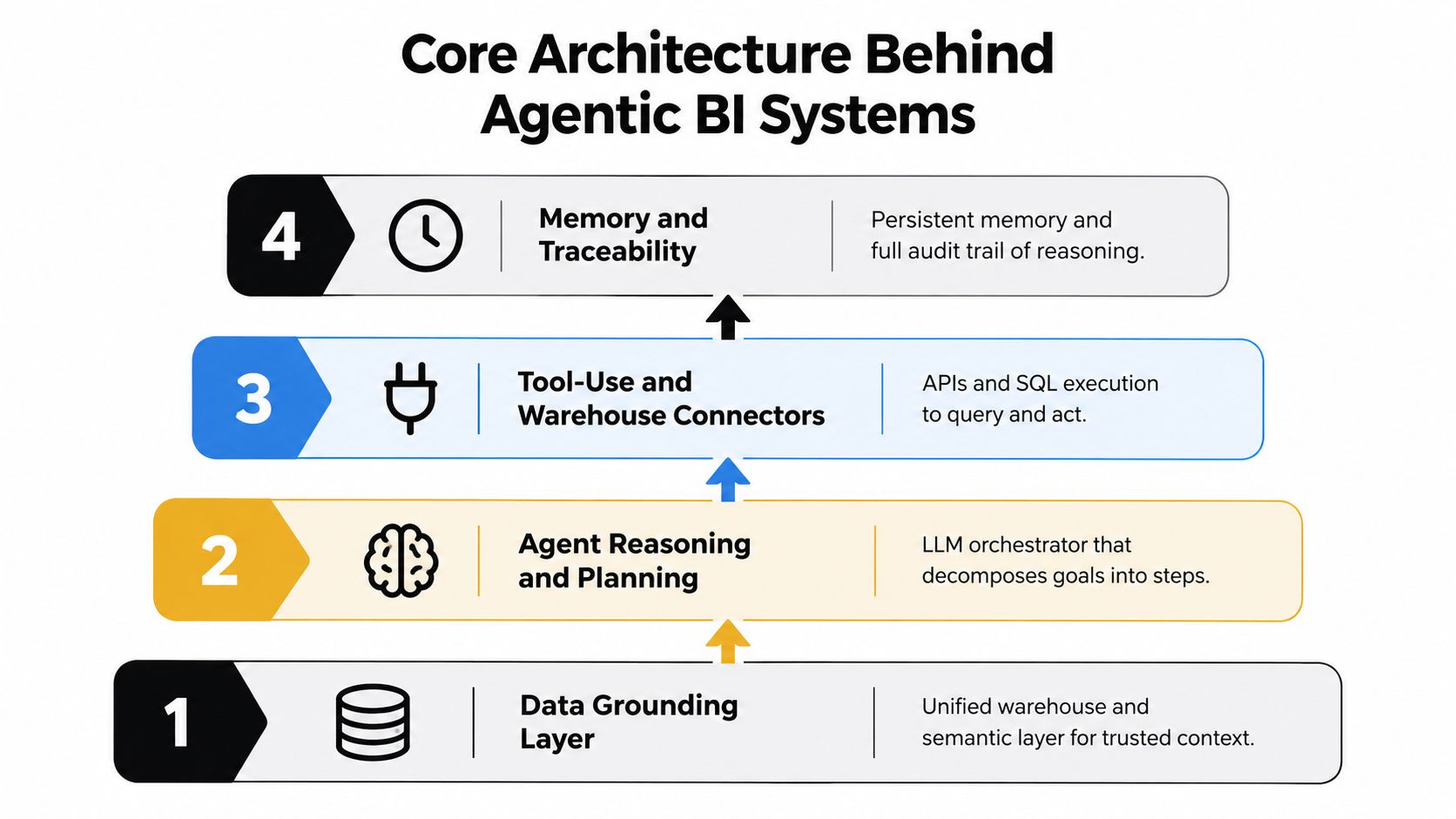
Data grounding comes first
The agent needs access to governed warehouse tables, semantic definitions, spreadsheets, documents, and metadata. Grounding isn't just retrieval. It includes selecting the correct version of a metric, respecting row-level access, identifying stale inputs, and distinguishing an authoritative source from a diagnostic one.
A business question may require a sequence such as:
- locating the approved revenue definition,
- retrieving the relevant period and segment,
- comparing actuals with the operating plan,
- joining the result to pricing or fulfillment records,
- checking whether the evidence is sufficient for a conclusion.
The AA-AnalystAgent benchmark reflects this end-to-end expectation. It covers 80 questions across 14 business and scientific domains, with each question tied to source spreadsheets and documents. The benchmark description from Artificial Analysis emphasizes multi-step retrieval, quantitative reasoning, evidence use, runtime trace capture, abstention, escalation, and cross-run stability.
Planning and tool use turn intent into work
The reasoning layer converts a goal into an ordered plan. It should know when to use SQL, a document retriever, a calculation service, or a workflow connector. Tool access must be explicit, typed, permissioned, and observable. A tool that can read a table shouldn't automatically gain permission to update a record or send a customer-facing message.
The agent should also validate intermediate outputs. If a join produces an unexpected result, the system needs a way to detect the problem, retry with a different method, or escalate instead of confidently continuing.
Memory and traceability preserve accountability
Memory can retain approved definitions, prior decisions, unresolved exceptions, and user preferences. It must be governed carefully, because persistent context can also preserve outdated assumptions or sensitive information. A practical guide to persistent memory for AI agents is useful when deciding what the system should remember and how that memory should be reviewed.
Trace capture should be a first-class output, not an engineering log hidden from business users. A decision-grade result should expose:
- the source files and records used,
- the query or calculation path,
- intermediate findings,
- confidence and abstention behavior,
- approvals and tool calls,
- the final recommendation and responsible owner.
Without this evidence, a successful demo can become an unreviewable production dependency.
Where Agentic BI Delivers Real Value Today
The strongest early use cases have a clear objective, repeatable data access, and an identifiable owner. They also produce a visible handoff, such as a validated data-quality ticket, an exception alert, or an approval request. The weakest use cases ask an agent to provide broad strategic insight without reliable definitions or a clear decision process.

Start with work upstream of the dashboard
Data management is often a practical starting point. An agent can monitor schema changes, identify missing fields, flag lineage breaks, compare incoming data with expected patterns, and prepare a remediation request. This work can reduce analyst load because it removes repetitive inspection before analysis begins.
KPI monitoring is another strong pattern. Rather than asking a manager to check several reports, an agent watches agreed thresholds and contextual signals. When a metric moves outside the expected range, it gathers supporting evidence, distinguishes a likely data issue from a business event, and sends an explanation to the appropriate owner.
Root-cause analysis can also benefit when the investigation path is known. A finance agent might examine revenue by segment, pricing changes, order volume, and delivery status, then show which findings are supported and which remain uncertain. The human still owns the business judgment, but the agent performs the evidence-gathering sequence.
Keep self-service inside guardrails
Conversational insight generation is useful when the agent works from governed metrics and cites the underlying records. It becomes risky when users treat an unverified answer as an official result, especially where definitions differ between departments.
Workflow orchestration creates another distinction. An agent that identifies an exception and drafts a task may create value with limited risk. An agent that changes pricing, reallocates budget, or contacts a customer needs stronger permissions, approvals, rollback procedures, and monitoring.
The following video offers additional visual context on how AI systems can support analytical collaboration. It should be treated as conceptual material, not as evidence for a business case.
A useful filter: if the agent's output still requires a person to repeat the same investigation manually, you've automated the interface, not the analytical work.
Multi-agent scenarios deserve caution. Several specialized agents may coordinate across finance, operations, and customer systems, but orchestration adds integration, testing, and accountability complexity. Begin with one bounded workflow whose inputs, outputs, and decision owner are easy to audit.
Scoring ROI and Feasibility Before You Build
A compelling demo doesn't establish a business case. Before building or buying an agentic BI capability, score each proposed use case across value, feasibility, and control burden. The aim isn't to find the most impressive autonomous workflow. It's to find the workflow where reliable execution improves a meaningful decision without creating a larger exception-management job.
Use the accuracy, cost, and time frontier
Correctness is necessary, but it isn't sufficient. ClickHouse's data-agent-mnist benchmark evaluates pass rate alongside tokens and cost and wall-clock time. It reported 76.6% correctness on 201 warehouse questions for Claude Fable 5.1. The benchmark methodology shows why leaders should evaluate the accuracy-cost-time frontier rather than optimize one score in isolation.
For your own evaluation, measure:
- Decision quality: Does the output support the intended business decision?
- Evidence fidelity: Can reviewers trace the conclusion to approved data?
- Latency: Does the answer arrive within the decision window?
- Run cost: Does repeated inference cost less than the human work it replaces?
- Exception burden: How often must analysts repair, clarify, or rerun the workflow?
- Maintenance effort: Who updates definitions, permissions, prompts, and connectors?
A use case with high analytical accuracy can still lose money if it runs slowly, consumes expensive inference, or requires constant human correction.
Build a comparable backlog
| Use Case | ROI Potential | Feasibility | Key Blocker |
|---|---|---|---|
| Data-quality monitoring | High | High | Unclear ownership for remediation |
| KPI exception investigation | High | Medium | Inconsistent metric definitions |
| Root-cause analysis | Medium to high | Medium | Cross-system data access |
| Broad self-serve analytics | Variable | Medium | Risk of unsupported conclusions |
| Autonomous operational execution | Potentially high | Low to medium | Approval, rollback, and accountability controls |
Score each row using your own qualitative scale, then validate the highest-ranked candidate with historical examples. Don't promise savings before you know how much analyst time the workflow consumes and how much review it still requires.
Performance measurement should cover the complete operating loop, including accuracy, cost, latency, escalation, and stability. The agent performance metrics framework can help teams turn those dimensions into an evaluation plan.
The build-versus-buy-versus-hire decision follows from the score. Buy when the workflow is common and your differentiation lies in governance or data. Build when proprietary processes or decision rules are central. Hire dedicated leadership when several functions need a single accountable owner and the program requires sustained architecture, governance, and change management.
Governance and Accountability for Autonomous Analytics
Autonomy is not the default objective. Controlled decision support is often the better starting point because it lets the organization test evidence quality, escalation behavior, and business ownership before granting execution rights.
Capgemini reported that only 23% of organizations had initiated AI agent pilot projects, while 14% had reached partial or full-scale implementation. Capgemini's report on AI agents also cites Gartner projections that 15% of day-to-day work decisions could be made autonomously through agentic AI by 2028 and that 33% of enterprise software applications could include agentic AI by then. These figures describe a widening gap between adoption ambitions and operating readiness.
Assign decision rights before permissions
Every agent should have a written operating boundary:
- Recommend only: The agent investigates and proposes an action. A named person approves it.
- Execute within limits: The agent can perform low-risk actions within defined thresholds, such as opening an internal task.
- Escalate by rule: The agent must stop when evidence conflicts, confidence falls, data is stale, or the action exceeds a threshold.
- Never execute: Certain actions remain outside the agent's authority, regardless of confidence.
The owner isn't automatically the person who built the agent. The business owner should be accountable for the decision outcome, while technical owners maintain the system, access, evaluation, and incident process.
Make control visible in the workflow
Auditability should show the source data, reasoning steps, tool calls, approvals, and final action. Role-based access must apply to the agent's queries, not only to the user's interface. High-risk actions need human gates and a rollback path.
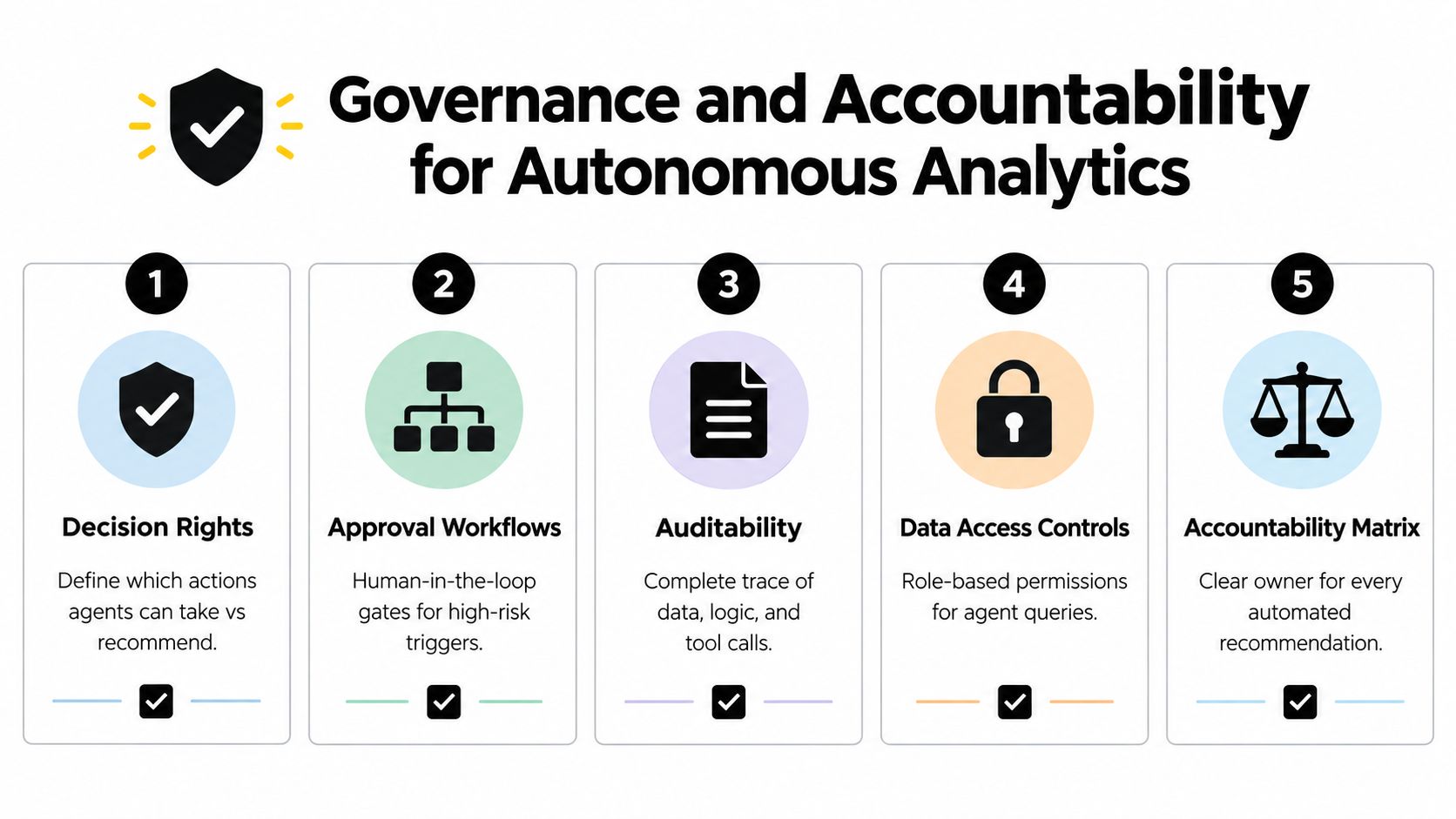
Executives should also review AI agent security risks, particularly where agents can access multiple systems or retain context across tasks. A focused AI agent governance framework can help translate those concerns into ownership, approval, audit, and access controls.
Governance rule: an agent may be technically capable of taking an action long before the organization is ready to make that action part of its operating model.
Your 90 Day Roadmap to Adopt Agentic BI
A short adoption cycle should produce a decision, not a permanent pilot. Assign one executive sponsor, one business owner for the selected workflow, one technical owner for data and integrations, and one governance owner for approvals and auditability.
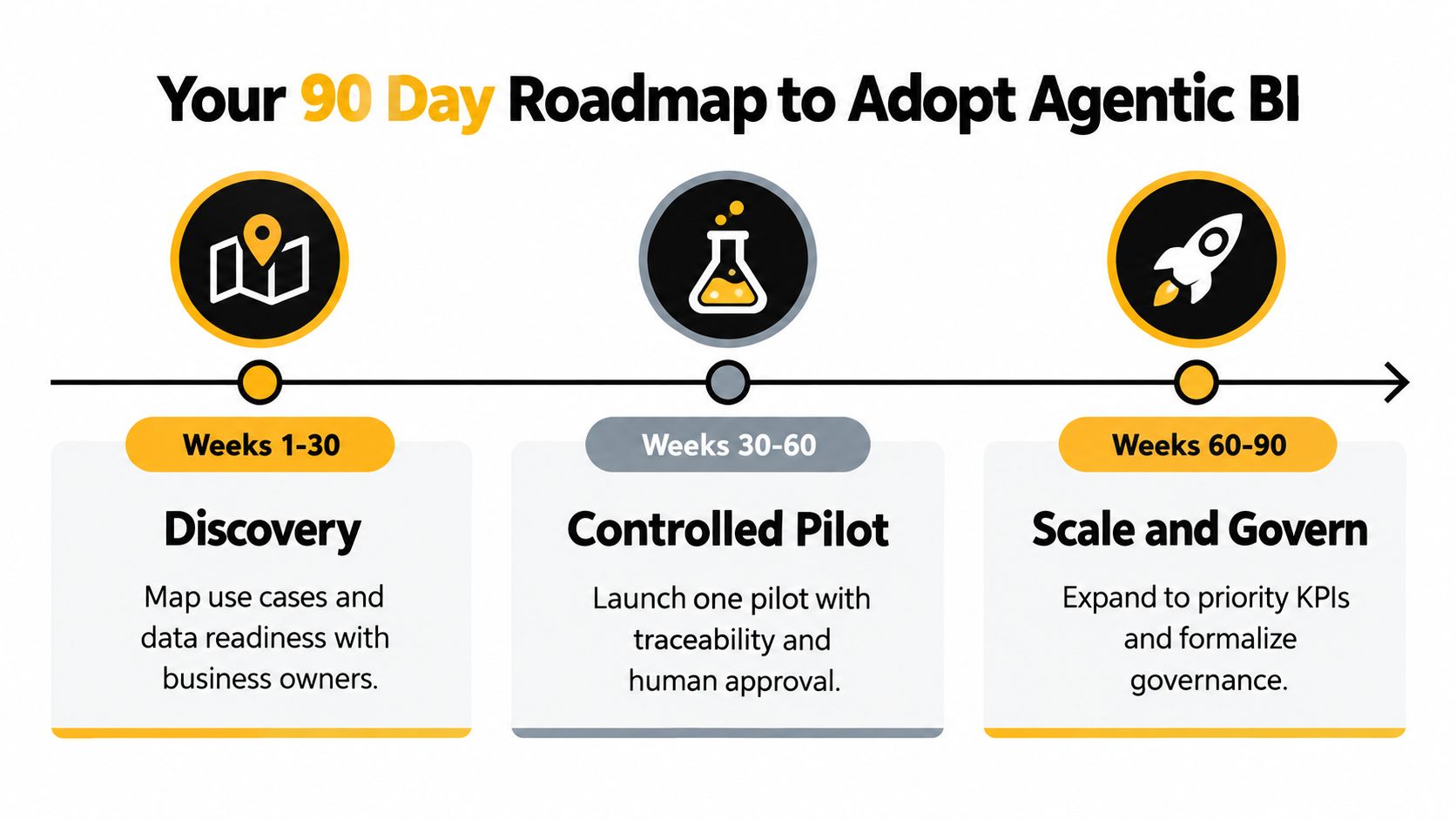
Weeks 1 to 30 focus on discovery
Map recurring BI requests, exception workflows, data dependencies, and current analyst effort. Rank candidates by business value, data readiness, decision frequency, and control complexity. Write the agent's decision rights before selecting technology.
Weeks 30 to 60 run one controlled pilot
Choose one workflow with governed inputs and a clear human approval gate. Capture source files, intermediate calculations, tool calls, latency, cost, correctness, escalations, and maintenance work. Test both normal and failure conditions, including missing data and conflicting definitions.
Weeks 60 to 90 decide whether to scale
Compare the pilot with the baseline process. Expand only if the agent improves the decision loop without shifting excessive work into exception handling. Formalize ownership, access reviews, incident response, and evaluation cadence before adding more workflows.
Use an internal owner when the program is strategically central and spans multiple functions. Use fractional leadership when the organization needs experienced direction while validating the operating model. Bring in a vetted implementation partner when integration work exceeds internal capacity, but keep decision rights and business accountability inside the company.
Head of Agents offers Agent Readiness Audits that map use cases, assess governance gaps, score ROI and feasibility, and produce build-versus-buy-versus-hire recommendations with a 90-day roadmap. Visit Head of Agents to evaluate your agentic BI priorities and identify the accountable leadership your program needs.