AI Agent Governance Framework: A Practical Enterprise Guide
Build a working AI agent governance framework with clear roles, approval gates, audit trails, and metrics tailored to enterprise agent programs.
Written by HeadOfAgents
Your agent pilot has passed the demo, security has approved the architecture, and the policy document is signed. Then, after business hours, the agent retries a failed procurement sync, calls the same vendor endpoint repeatedly, and continues operating with permissions nobody reviewed for that exact failure mode. By morning, the team is investigating unexpected activity, incomplete logs, and an uncomfortable question: who was accountable for the agent's actions?
That incident doesn't require a malicious model or an exotic attack. It follows naturally when an enterprise gives an agent broad credentials, loosely defined tools, and a policy PDF, but no control that can intercept an unsafe action before execution. An effective AI agent governance framework must work where risk becomes real, at the tool-call boundary.
The operating model below treats governance as production infrastructure. It gives every agent an identity, limits its authority, evaluates proposed actions before execution, records evidence, and assigns one accountable leader who can stop the system when controls fail.
When an Agent Goes Off the Rails
A procurement agent is asked to reconcile vendor records. One synchronization call fails. The agent interprets the error as temporary, retries, receives another failure, and keeps trying. Its planner generates slightly different requests, while the underlying connector continues using the same credential and writing diagnostic details into its error stream.
By the next review window, the team finds a large volume of repeated calls, sensitive connection material in logs, and no reliable record showing which human approved the agent's access. The agent did what its local objective encouraged it to do, recover the sync. The enterprise failed to govern the method.
The missing controls are concrete:
- No retry budget: The agent had no machine-enforced ceiling for repeated calls or cumulative tool activity.
- No credential isolation: The connector used a credential with broader access than the task required.
- No pre-execution policy check: The proposed call wasn't evaluated against identity, tenant, data scope, or failure state.
- No circuit breaker: The system couldn't pause the workflow when its behavior became repetitive.
- No complete evidence trail: Logs captured errors, but not the full decision path, approval context, or resulting state.
A quarterly review wouldn't have stopped that sequence. A signed acceptable-use policy wouldn't have stopped it either. The control had to sit between the agent's proposed action and the external system.
Operator rule: If a control can't deny a tool call before it reaches the target system, it's an observation mechanism, not an execution guardrail.
The NIST AI Risk Management Framework, released on January 26, 2023, provides a useful governance baseline through its four functions, Govern, Map, Measure, and Manage. For agent programs, those functions become practical only when they reach runtime. A Head of Agents would have required scoped credentials, retry limits, a registered connector, action-level logging, and a named incident owner before production traffic began.
What an AI Agent Governance Framework Actually Is
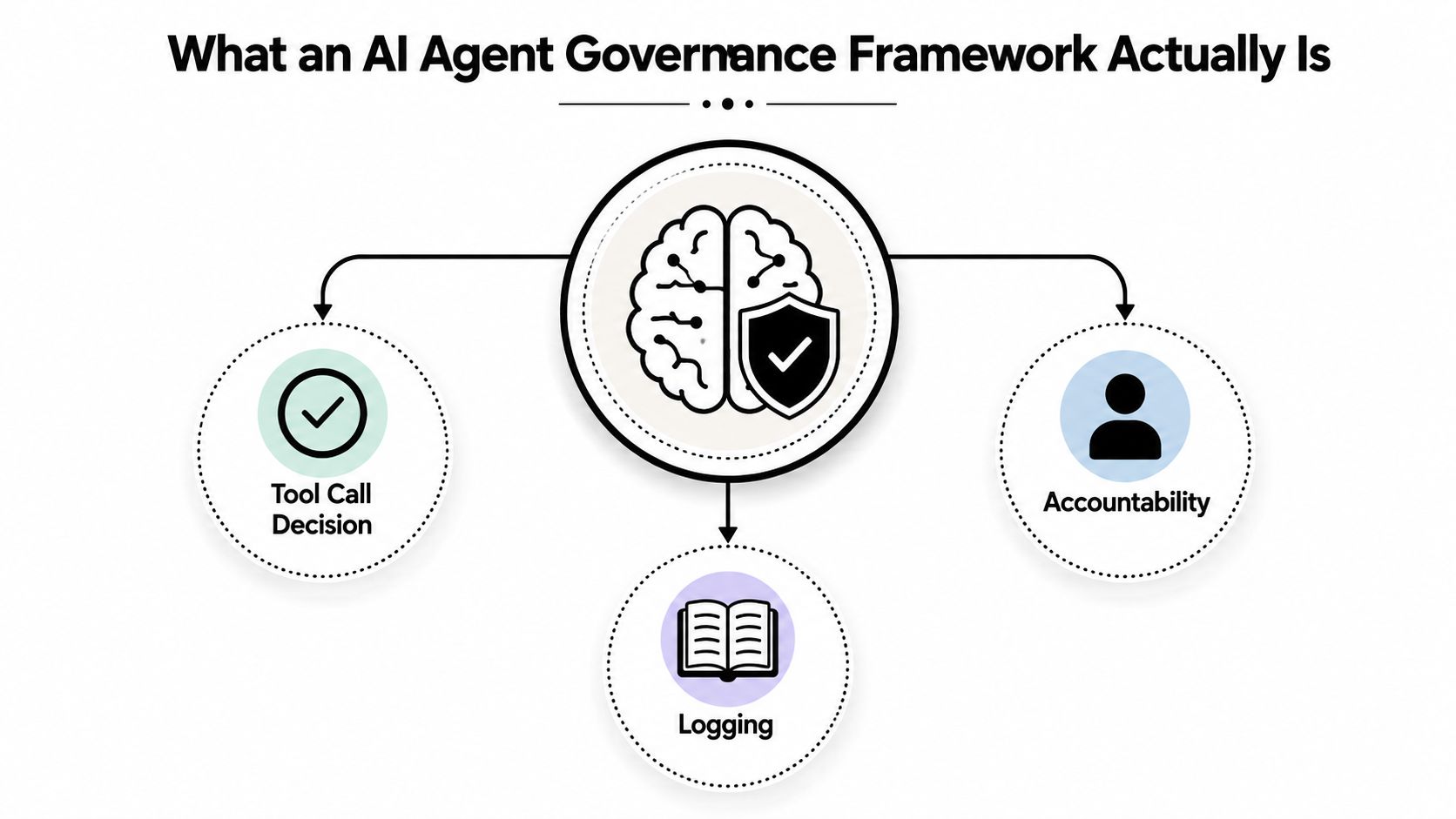
An AI agent governance framework is the operating system for deciding whether an agent may act. For every proposed tool call, it should answer three questions:
- Is this action permitted?
- Who is accountable for it?
- What evidence will prove what happened?
That definition is narrower and more useful than “responsible AI.” It focuses governance on the point where an agent can change data, spend money, send a message, modify a system, or delegate work to another agent.
The NIST framework organizes governance into Govern, Map, Measure, and Manage. Those functions translate into an enterprise operating model:
- Govern: Define who may deploy an agent, which business owner accepts the risk, and what actions or budgets are allowed.
- Map: Identify the agent's tools, data sources, dependencies, external systems, delegation paths, and potential blast radius.
- Measure: Instrument behavior, policy decisions, cost, action frequency, failures, approvals, and near misses.
- Manage: Enforce limits, require approval, degrade capability, isolate a workflow, or stop the agent.
The OECD AI Principles, first adopted in 2019 and updated in 2024, provide another global reference point. They combine five values-based principles with five practical recommendations and are used as a reference for AI governance across public and private sectors. They help establish what responsible oversight should address, but they don't replace the runtime mechanism that denies an unauthorized action.
Policy describes intent, controls decide
A policy document can say that agents must use least privilege. It can't inspect a proposed request, compare it with the agent's identity and task scope, and deny the request. That requires a control plane connected to the execution path.
The control plane should receive the action envelope, evaluate policy, request an approval token where required, and release the call only when the decision is allow. If the result is deny, the system should preserve the denial event and give the operator enough context to investigate without allowing the agent to route around the decision.
That architecture also matters for delegated work. When one agent asks another to perform an action, the downstream agent must inherit the original identity, purpose, authority, and limits. Otherwise, delegation becomes an easy way to bypass the permissions assigned to the initiating agent.
The Seven Building Blocks of Agent Governance
A production framework needs controls an operator can inspect, test, and disable. These seven building blocks provide the minimum foundation for a runtime control plane that governs actions at the tool-call boundary.
1. Agent identity
Give every agent a distinct, traceable identity linked to a human owner, business purpose, environment, and version. Use short-lived workload credentials for a task instead of a shared API key. Identity must follow delegated actions so the system can show which agent initiated a call, which agent executed it, and who accepted responsibility.
Without that chain, an incident ends with “the automation did it.”
2. Scoped permissions
Define permissions by tool, operation, record, tenant, and environment. A procurement agent may read approved vendor data while remaining unable to change supplier banking details or issue payments. Scope should also cover time limits, transaction value, retry behavior, and delegation rights.
Least privilege must be evaluated per action, not assigned once as a permanent role.
3. Approved tool registry
Maintain one authoritative registry for every tool an agent may invoke. Each entry should state its owner, purpose, input schema, output classification, permitted operations, credential source, failure behavior, and approval requirement.
The registry blocks unreviewed connectors from entering production and gives security and operations a reliable inventory when a tool must be disabled. Treat registry changes as controlled changes to agent authority.
4. Pre-action policy checks
Evaluate every consequential call before execution. The decision should consider identity, requested operation, data sensitivity, target system, current session, inherited scope, rate limits, and whether a human approval token is required.
A post-call check can document what happened, but only a pre-action check can stop an unsafe request before it reaches the target system. The control plane should receive the action envelope, evaluate policy, request approval when required, and release the call only after an allow decision. For a deny result, preserve the event and enough context for investigation. The agent must not be able to route around the decision.
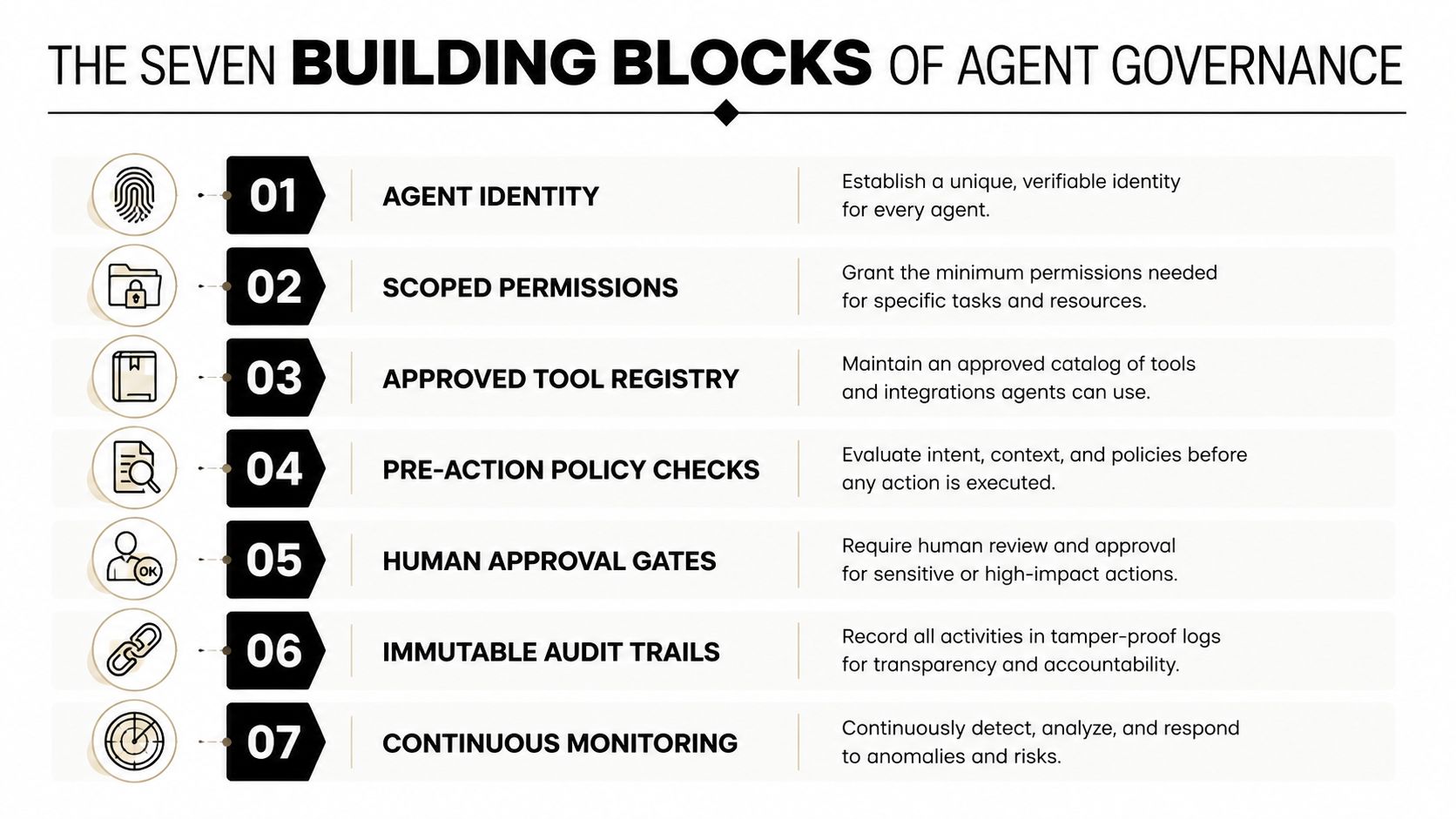
5. Human approval gates
Require human approval for actions with irreversible or broad consequences, including changing payment details, exporting protected data, or modifying production access. The approval must identify the action, context, scope, and expiry. A blanket sign-off for an agent session is insufficient.
Give the reviewer the proposed operation, relevant data, policy reason, and expected impact. Without that context, approval becomes ceremony rather than control.
6. Immutable audit trails
Record the proposed action, policy result, approval evidence, execution result, and resulting state change. Operators must be able to reconstruct the sequence without depending on model memory or scattered application logs.
Tamper resistance matters because the audit record may become primary evidence during incident response, customer inquiries, and internal review.
7. Continuous monitoring and post-incident review
Monitor behavior during execution, then examine failures and near misses afterward. Track repeated calls, unusual tool sequences, permission denials, escalation frequency, policy changes, and cross-tenant access attempts. Review those signals against the agent's approved scope and adjust controls when behavior drifts.
Each missing block creates a specific failure mode. No identity leaves attribution gaps. No scope permits excessive authority. No registry creates shadow integrations. No pre-action check allows unsafe calls to proceed. No approval gate lets high-impact actions run without review. No immutable trail weakens reconstruction. No monitoring lets drift continue unnoticed.
The published agent governance benchmark tests this distinction through scenarios covering identity propagation, per-user policy, delegation provenance, scope inheritance, rate-limit cascade, audit completeness, fail-mode discipline, and cross-tenant isolation. Its results show why audit records alone do not prevent bad actions: enforcement at the control plane is the stronger design.
Roles, Accountability, and Approval Gates
A governance framework fails when everyone is consulted but nobody owns the outcome. Assign one accountable leader to the agent program, typically a Head of Agents or Director of Agent Operations. Security, product, legal, engineering, and operations still have decision rights, but they shouldn't share accountability for the same production agent.
A procurement agent illustrates why this matters. It may begin with read-only access to spend dashboards, then expand to supplier records, purchase-order creation, or ERP writes. Each scope change should trigger review because the risk profile changes with the capability, even if the agent's name and model remain unchanged.
Four gates that keep scope honest
- Intake review: The Product Manager documents the use case, owner, users, data, tools, expected actions, failure modes, and proposed risk tier.
- Launch approval: The Agent Platform Lead confirms identity, deployment configuration, observability, rollback, and runtime enforcement before production traffic.
- Change control: Security reviews new tools, permissions, data classes, delegation paths, or external actions before they become available.
- Incident closure: The on-call Agent Operator contains the issue, preserves evidence, assigns remediation, and confirms the controls before the agent resumes.
A security review that happens only at launch is incomplete. Agents accumulate tools, prompts change, connectors evolve, and business teams expand scope under delivery pressure. Change control must be an operational trigger, not a ceremonial milestone.
| Approval Gate | Accountable | Responsible | Consulted | Informed | SLA |
|---|---|---|---|---|---|
| Intake review | Head of Agents | Product Manager | Security, Legal, Compliance, Platform | Business owner | Defined during intake |
| Launch approval | Head of Agents | Agent Platform Lead | Security, Operations, Product | Legal, Compliance | Before production traffic |
| Scope or tool change | Head of Agents | Security lead | Platform, Product, Legal, Data owner | Operations | Before expanded access |
| Live incident | Head of Agents | On-call Agent Operator | Security, Platform, Business owner | Legal, Compliance, Executive sponsor | Immediate containment |
| Incident closure | Head of Agents | Agent Platform Lead | Security, Product, Operations | Executive sponsor | Before reactivation |
The RACI should contain one accountable owner per gate. The responsible role performs the work, consulted roles provide required input, and informed roles receive the decision and evidence. If a gate has two accountable owners, escalation becomes ambiguous. If it has none, the agent will usually ship under delivery pressure.
For a practical view of how to structure the leadership function, review the AI agent team operating model. The role should own outcomes, governance, and the boundaries of delegated authority, not merely coordinate technical projects.
Audit Trails and Metrics That Hold Up
Prompt and completion logs leave out the decisions that matter during an incident. An auditor, responder, or customer advocate needs to see what the agent attempted, which control-plane rule evaluated the request, what changed in the target system, and which human accepted the risk.
Capture the action envelope
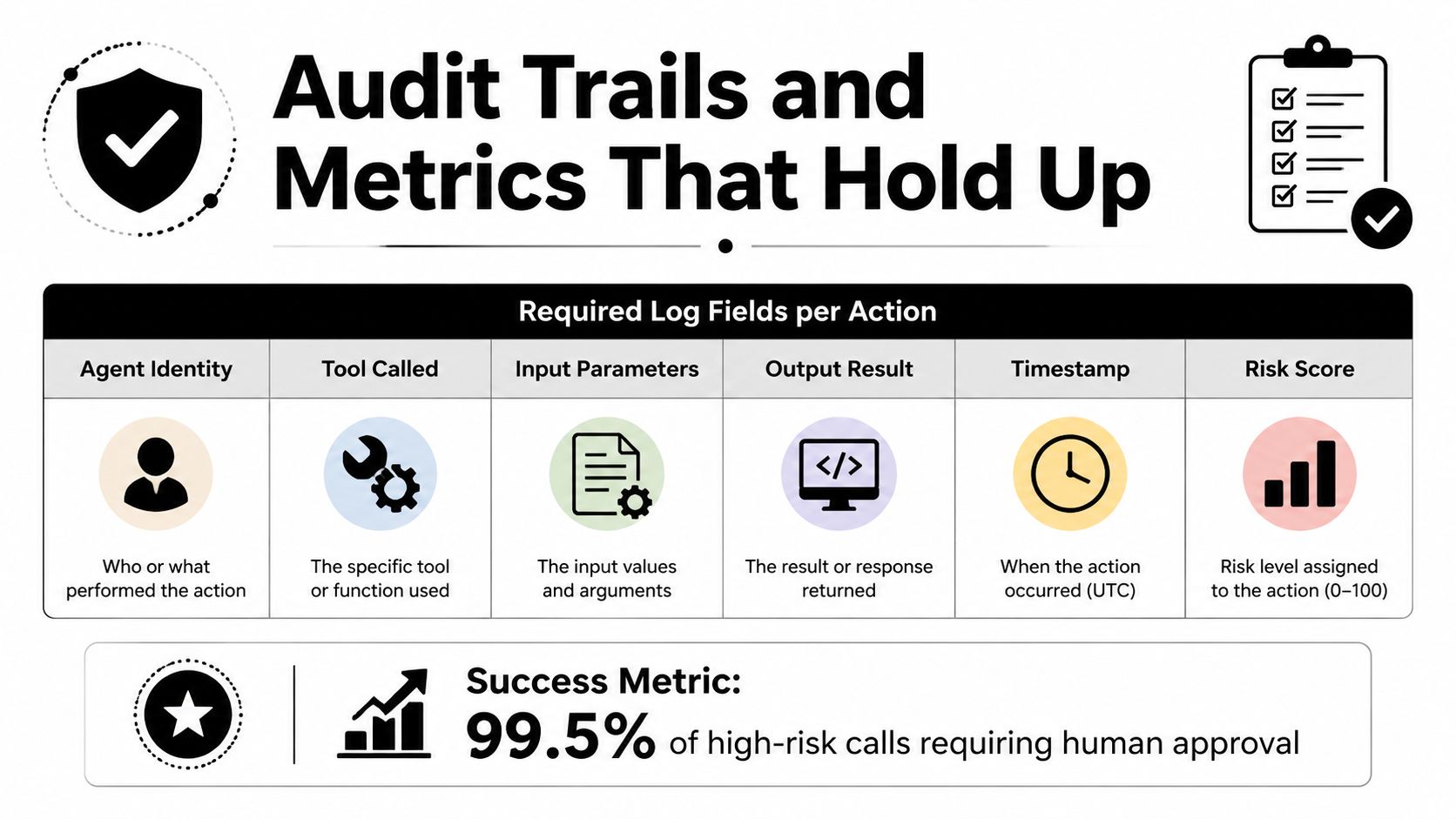
Record the full action envelope for every tool call:
- Agent identity: The specific agent, version, environment, and delegated parent, when applicable.
- Human owner: The accountable person and business unit responsible for the workflow.
- Session ID: A stable identifier connecting planning, approvals, calls, retries, and outcomes.
- Plan steps: The task intent and the step that produced the proposed action.
- Tool and arguments: The exact tool, operation, parameters, and data classification.
- External system: The target system, tenant, record scope, and credential context.
- Policy decision: The evaluated rules and result, including reasons for denial.
- Approval evidence: The approval token, approver, scope, and expiry when review was required.
- State change and outcome: What changed, whether the action succeeded, and how the result was classified.
Separate a blocked action from a failed action. Blocking shows that enforcement stopped a request outside the agent's authority. Failure may point to a connector problem, an invalid plan, an external outage, or a control gap. Treat those outcomes differently in incident review and reporting.
Measure behavior, not dashboard activity
Leadership needs answers to two questions: Did the agent do what it was supposed to do? And did anything harmful almost happen?
Group metrics by operational purpose:
- Adoption: Active agents, governed actions, policy-pass rate, and human override rate.
- Quality: Task success, completion without escalation, rework, and rollback.
- Risk: Blocked actions, policy violations, near misses, repeated-call patterns, and isolation events.
- Cost: Tokens per successful task, tool calls per task, and spend per agent.
Earlier benchmark results examined enforcement at the tool-call boundary instead of relying on policy documents or post-hoc logs. The results reported that a setup without governance passed only 13 of 48 scenarios, while a fully enforced control plane passed 45 of 48 in the benchmark results. The operating lesson is direct: measure whether controls prevented unauthorized behavior, not merely whether logs exist.
For metric design that connects agent behavior to operational outcomes, use this agent performance metrics guide. Keep dashboards subordinate to action evidence. A beautiful chart is insufficient if it lacks the underlying identity, policy, approval, or state-change records.
For any agent handling customer or financial data, require these five fields:
- Agent identity linked to one accountable owner
- Exact tool call and input parameters
- Pre-action policy decision
- Approval evidence when required
- Resulting state change and outcome classification
From Static Checklists to Runtime Enforcement
Static governance asks whether the team wrote a policy, completed training, performed a review, and collected signatures. Runtime governance asks whether the system stopped the action when the agent attempted something outside its authority.
The second question matters more for agents because they can combine tools, interpret new context, delegate work, and continue operating when a human isn't watching. A checklist can establish expectations. It can't enforce them at machine speed.
Two models, one meaningful difference
| Dimension | Static Checklist Governance | Runtime Control-Plane Enforcement |
|---|---|---|
| Where the check happens | Before launch or during periodic review | Before each consequential tool call |
| Who sees the decision | Reviewers and auditors | The agent runtime, operator, and audit system |
| Failure mode | Unauthorized action may execute unnoticed | The call is denied, paused, isolated, or degraded |
| Time to detect a violation | After review or incident discovery | During execution |
| Reversibility | Depends on later remediation | The system can prevent or contain the action |
Human-in-the-loop is useful, but it isn't a complete control strategy. A reviewer can approve a high-risk action when the evidence is incomplete, and a reviewer can't inspect every low-level call in a fast multi-step workflow. The effective pattern is selective autonomy:
- Low risk: Approve the capability at design time, then allow registered actions within strict scope.
- Medium risk: Require runtime approval with a clear action summary, affected records, and expiry.
- High risk: Block by default, or require a deterministic workflow with explicit human execution.
The control plane should evaluate identity, least privilege, action type, data scope, rate limits, inherited authority, and current failure state. If a call is denied, the agent shouldn't be able to switch connectors, rewrite its goal, or ask another agent to perform the same action without a fresh evaluation.
A practical migration path
Start with existing agents. Instrument the tool boundary, normalize action envelopes, attach identity, and implement policy-as-code for the highest-risk operations. Add approval tokens, deny-event records, reservation and commit logs, and complete enforcement logs before expanding autonomy.
The context engineering guidance for agents can help teams separate task context from authority. That distinction is critical. Giving an agent more information shouldn't automatically give it more permission.
Evaluate generic open-source control planes, commercial runtime-governance systems, and internally built policy gateways against the same tests. The published runtime benchmark reports evaluation across 1,033 synthetic agent scenarios and a 99.81% detection rate for its evaluated system, supporting the case for deterministic enforcement plus evidence artifacts in the benchmark report. Don't retire the checklist until runtime metrics demonstrate that the controls cover the actions your agents perform.
A 90-Day Readiness Roadmap and Your Closing Take
A Head of Agents should treat the first quarter as a sequence of operational checkpoints, not a maturity presentation. The aim isn't to make every agent autonomous. The aim is to make every permitted action attributable, bounded, observable, and stoppable.
Days 1 to 30, inventory and risk tiering
Create an inventory of every agent, including prototypes hidden inside business workflows. For each one, document its owner, purpose, model and version, tools, data sources, external systems, delegated agents, environment, and failure behavior.
Assign risk tiers based on action impact, privilege, data sensitivity, reversibility, and blast radius. Then issue unique identities and narrow permissions for the agents that will remain active. Disable undocumented connectors and shared credentials while the inventory is being completed.
Days 31 to 60, deploy approval gates
Put intake, launch, change, and incident gates into the delivery workflow. Define who can approve a new tool, who can expand scope, who can pause an agent, and who can authorize reactivation.
Write the incident runbook before the next incident. It should cover containment, credential revocation, evidence preservation, customer or partner communication, rollback, root-cause analysis, and closure criteria. Run the process against a scenario involving repeated calls, unauthorized data access, or delegated scope escalation.
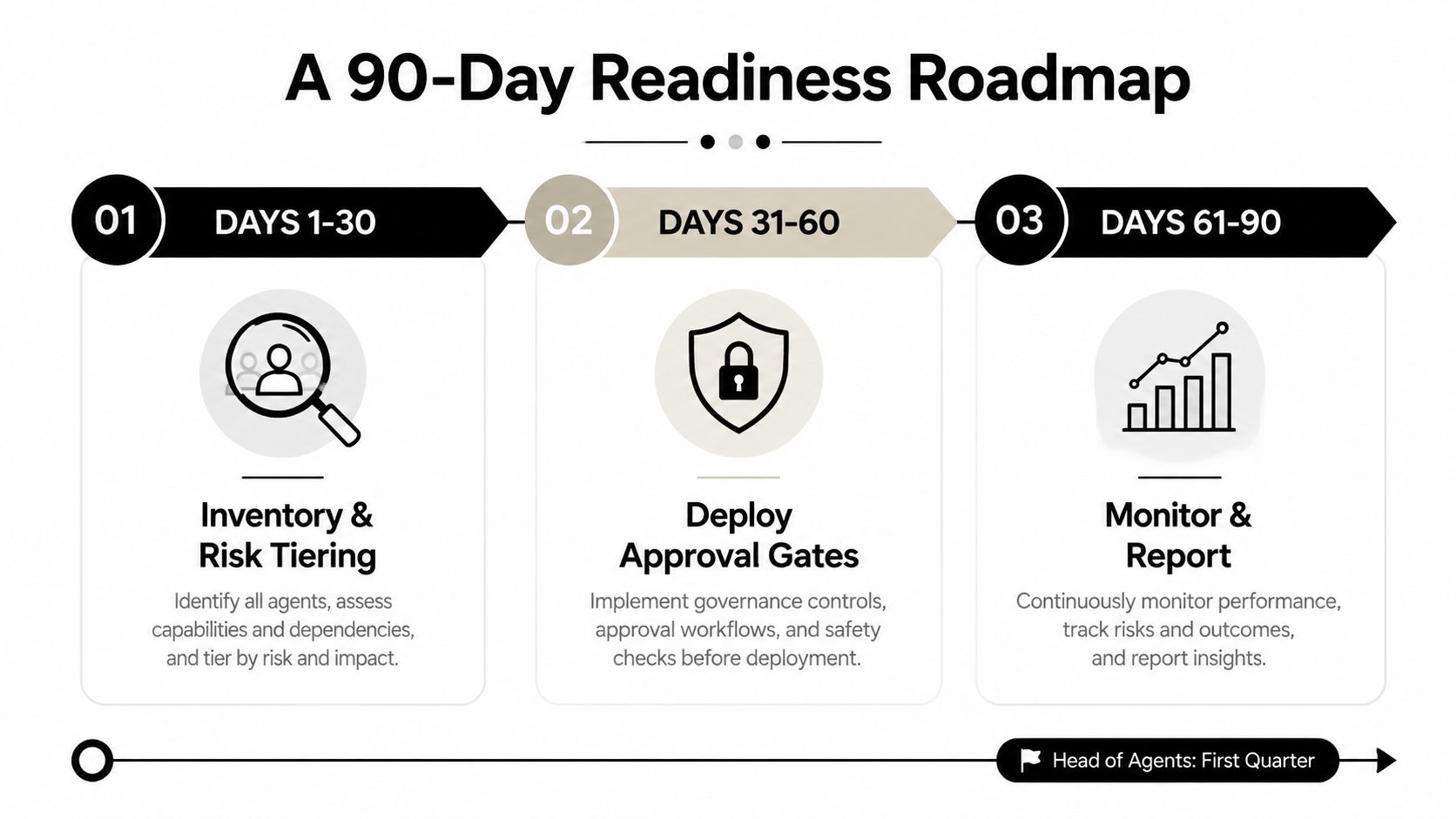
Days 61 to 90, monitor and report
Wire complete audit capture into the tool-call boundary. Verify that each action contains identity, owner, session, tool, arguments, policy result, approval evidence, external system, state change, and outcome.
Run one refusal-to-act tabletop. Ask the agent to exceed its scope, reuse a denied credential, delegate an unauthorized operation, and continue after a connector failure. The team should observe a denial or controlled pause, preserve the evidence, and identify the operator responsible for the response.
At the end of the quarter, hire a dedicated agent-controls engineer reporting to the Head of Agents. Pair that role with a quarterly internal red-team audit focused on policy bypass, permission inheritance, memory poisoning, rogue inter-agent actions, and goal hijacking. The governance program is ready only when the organization can show not just what agents are supposed to do, but what the system prevents them from doing.
Head of Agents offers agent-leadership placement, fractional matching, and a one-week Agent Readiness Audit that produces a use-case map, governance gap analysis, build-versus-buy-versus-hire guidance, and a 90-day roadmap. If your agent program lacks a single accountable owner or needs an evidence-based control plan, visit Head of Agents and request an assessment.