AI Agent Platform Comparison for Enterprise Buyers
A practical AI agent platform comparison scoring leading options on scalability, observability, governance, and cost — plus build vs buy guidance for 2026.
Written by HeadOfAgents
Most advice on AI agent platform comparison starts with a feature matrix. That's the wrong starting point for an enterprise. A platform can demonstrate memory, tool use, workflow builders, and model choice while still leaving your security team unable to answer a basic question: who is accountable when an agent takes an incorrect action across a production system?
The adoption curve makes that gap difficult to ignore. One 2026 summary of surveyed enterprises reported that 79% use AI agents, but only 21% have a mature governance model and under 15% have reached production at scale. Those figures point to a market where experimentation is widespread, while operating discipline remains uneven. The enterprise governance summary supports a different buying lens, one based on control, orchestration efficiency, and lifecycle cost rather than demo breadth.
| Evaluation lens | What to test | Why it changes the decision |
|---|---|---|
| Governance surface | Identity, permissions, auditability, approval controls | Determines whether actions can be defended and investigated |
| Orchestration efficiency | Task reliability, latency, token amplification, failure recovery | Converts technical behavior into operating cost |
| Ecosystem fit | Data access, integration depth, portability, ownership | Shows whether the platform works across your actual estate |
| 12 to 24 month TCO | Inference, engineering, support, migration, governance work | Exposes costs hidden behind subscription or usage pricing |
Why Feature-List Comparisons Fail Enterprise Buyers
A feature list assumes that capabilities are interchangeable. Enterprise deployments prove otherwise. Two platforms may both claim autonomous execution, but one might place approvals, identity, and audit logs inside a central control plane, while the other distributes those responsibilities across application teams and infrastructure. The difference only becomes visible when an agent needs write access, encounters an exception, or operates across multiple business systems.
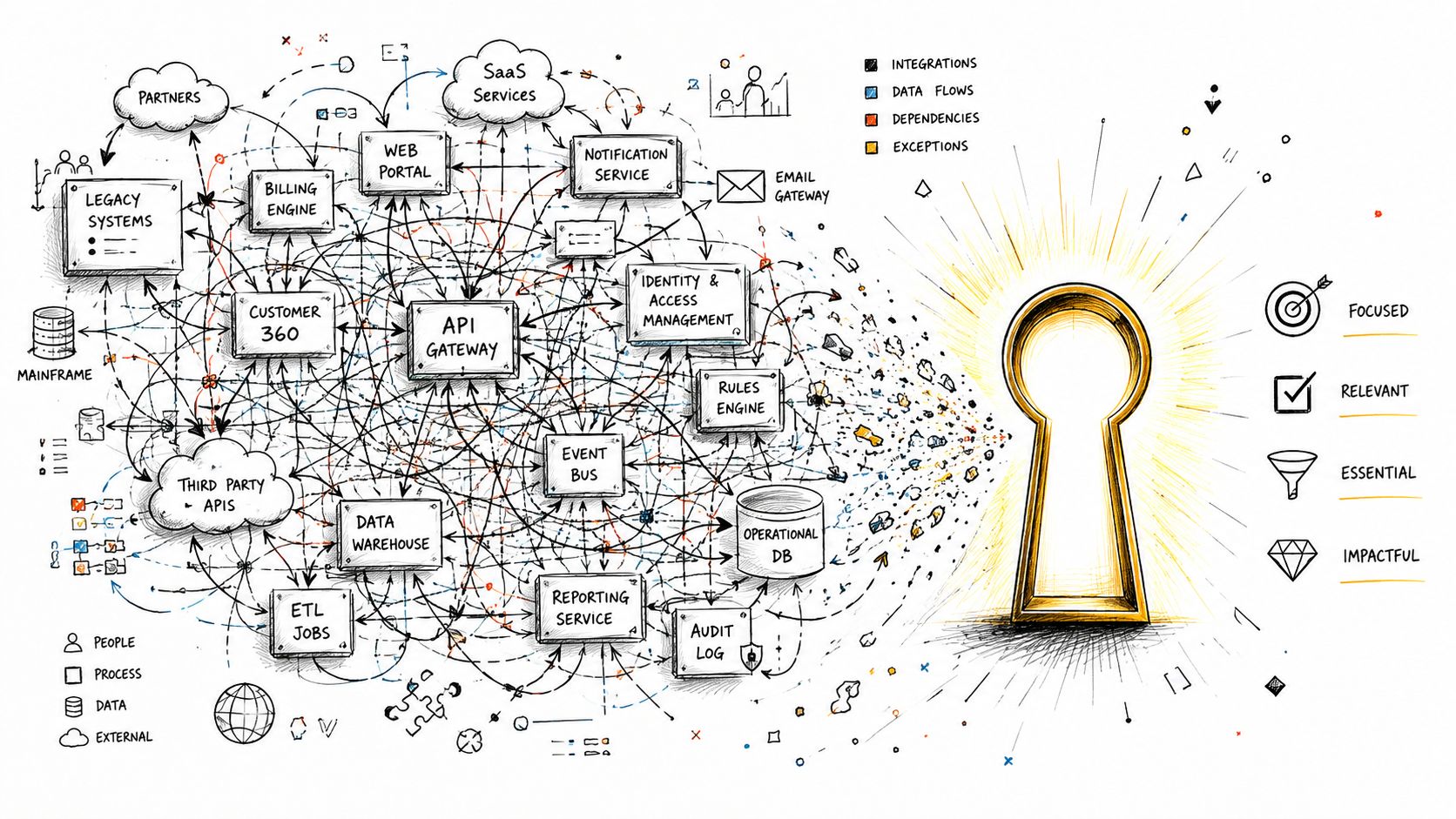
The first question is where governance lives. If every team implements its own identity mapping, approval logic, action logs, and retention policy, the organization hasn't bought governance. It has bought a collection of building tasks. The governance summary cited above shows why this matters: adoption can move ahead of maturity, leaving executives with more agents than control mechanisms.
Three questions that predict production fit
Ask the vendor to show the complete action path, not just the agent interface.
- Where does identity originate? Establish whether an agent acts as a bounded service identity, a user-delegated identity, or a broad workspace identity. Then test how permissions change when the agent moves from reading information to writing records.
- How does the platform handle heterogeneous agents? Your estate may include suite-native assistants, CRM-connected workers, hyperscaler runtimes, automation tools, and custom frameworks. A platform that governs only its own agents may increase fragmentation rather than reduce it.
- Who owns ongoing risk? Assign responsibility for evaluation, incident response, model changes, prompt changes, connector changes, and retirement. If the answer is “the business team” without a defined operating model, the platform is shifting risk rather than managing it.
Core reframe: Don't ask which platform has the longest feature list. Ask which platform fits your control environment, governs a mixed agent estate, and gives a named team ownership of failure.
A polished demo rarely answers those questions because demos optimize for successful paths. Enterprise architecture has to test denial paths, partial completion, duplicate actions, stale data, human escalation, and evidence collection. The right comparison therefore starts with your control model and workload boundaries, then evaluates platform capability against them.
The Four Enterprise Criteria That Actually Matter
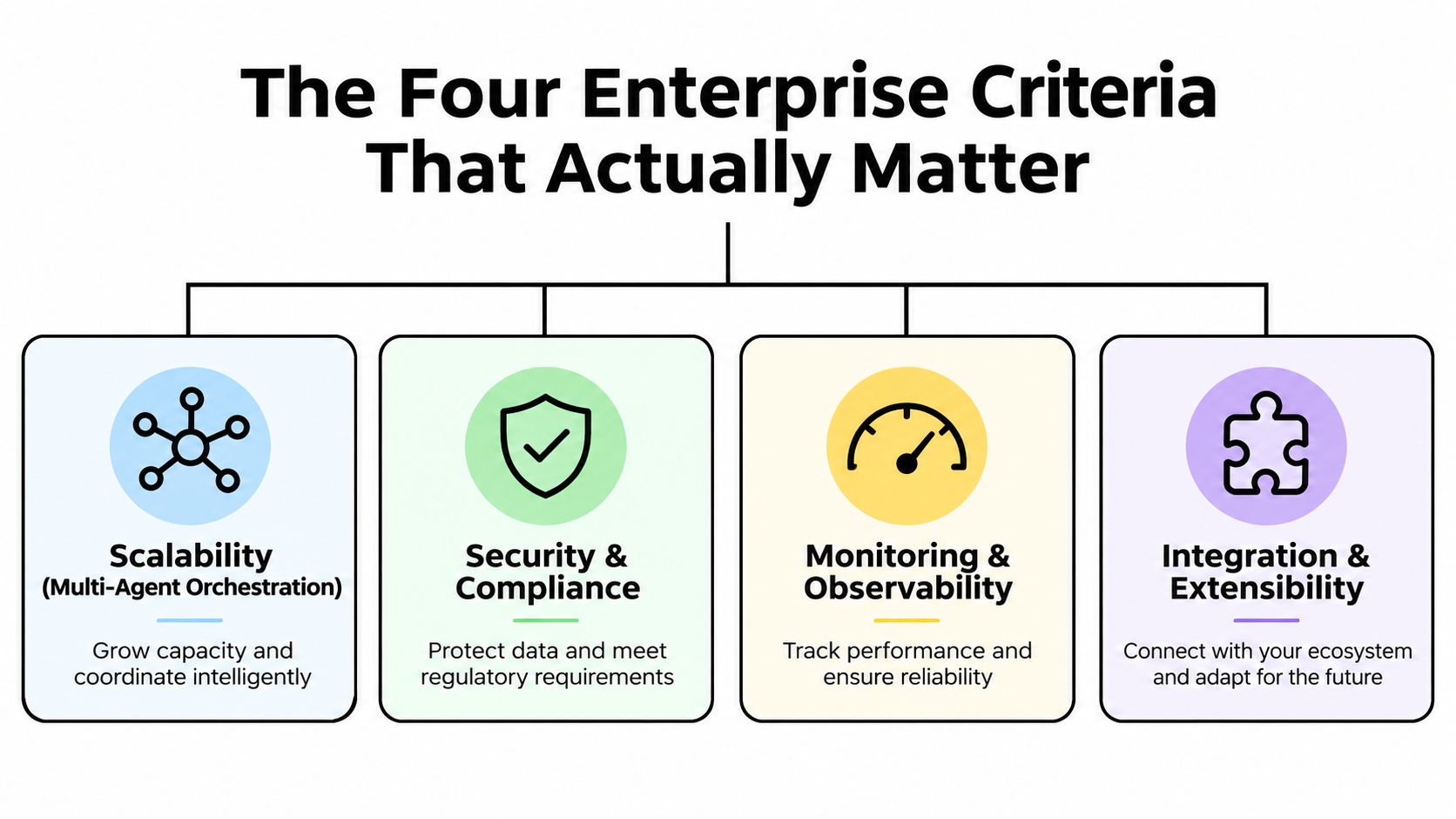
A practical scorecard should separate scalability, observability, governance, and cost. These criteria overlap in production, but keeping them distinct prevents a strong integration demo from masking weak monitoring or an attractive usage price from hiding token amplification.
Scalability starts with orchestration
Scalability isn't only the ability to run more requests. Test whether the platform can coordinate multiple agents, teams, environments, and regions without forcing every workflow into one shared identity or execution queue. Demand evidence from a production-like workload, including retries, scheduled jobs, long-running tasks, and a failure that requires human intervention.
Warning signs include vague answers about concurrency, no isolation model, and architecture diagrams that omit state storage, background workers, or recovery behavior. A platform that scales a successful demo but can't explain failed execution paths isn't ready for a critical workflow.
Observability must explain failure
Logs that show “agent completed” aren't enough. Buyers need traces of tool calls, intermediate decisions, approval events, data sources, latency, token consumption, and final outcomes. Ask how evaluators distinguish a correct answer from a correct business action, and how operators reproduce an incident without exposing sensitive data.
Teams building a measurement system can use the agent performance metrics guide to structure the operational questions. The important point is ownership. Monitoring should help a named operator diagnose and improve behavior, not merely produce dashboards for an architecture review.
The embedded material below can provide additional context for teams defining their evaluation vocabulary.
Governance and cost complete the scorecard
Governance covers identity, authorization, auditability, data boundaries, approval thresholds, retention, and cross-platform control. Ask for evidence of denied actions and policy changes, not only successful transactions. A buyer should also know whether governance is native, configured through adjacent infrastructure, or left to internal engineering.
Cost includes inference, token amplification, platform usage, seats, engineering, support, evaluation, and migration. Require vendors to model a real workflow with its actual tool calls and exception paths. A low unit price can become expensive if the orchestration layer repeatedly expands context or requires substantial custom control work.
Side-by-Side Benchmark Results for Leading Platforms
Independent benchmark data shows why an enterprise buyer shouldn't declare a universal winner. One 2026 comparison measured Claude Managed Agents at 100% task completion, 1,172 seconds of wall time, and $2.50 cost, while Vertex AI Agent Engine also reached 100% completion, with 1,447 seconds and $1.45. OpenAI Responses plus CI completed 27 of 30 tasks, or 90%, in 522 seconds at $1.54. The same benchmark measured token usage ranging from 93,000 to 159,000. The managed-agent benchmark results show a three-way tradeoff between reliability, speed, and spend.
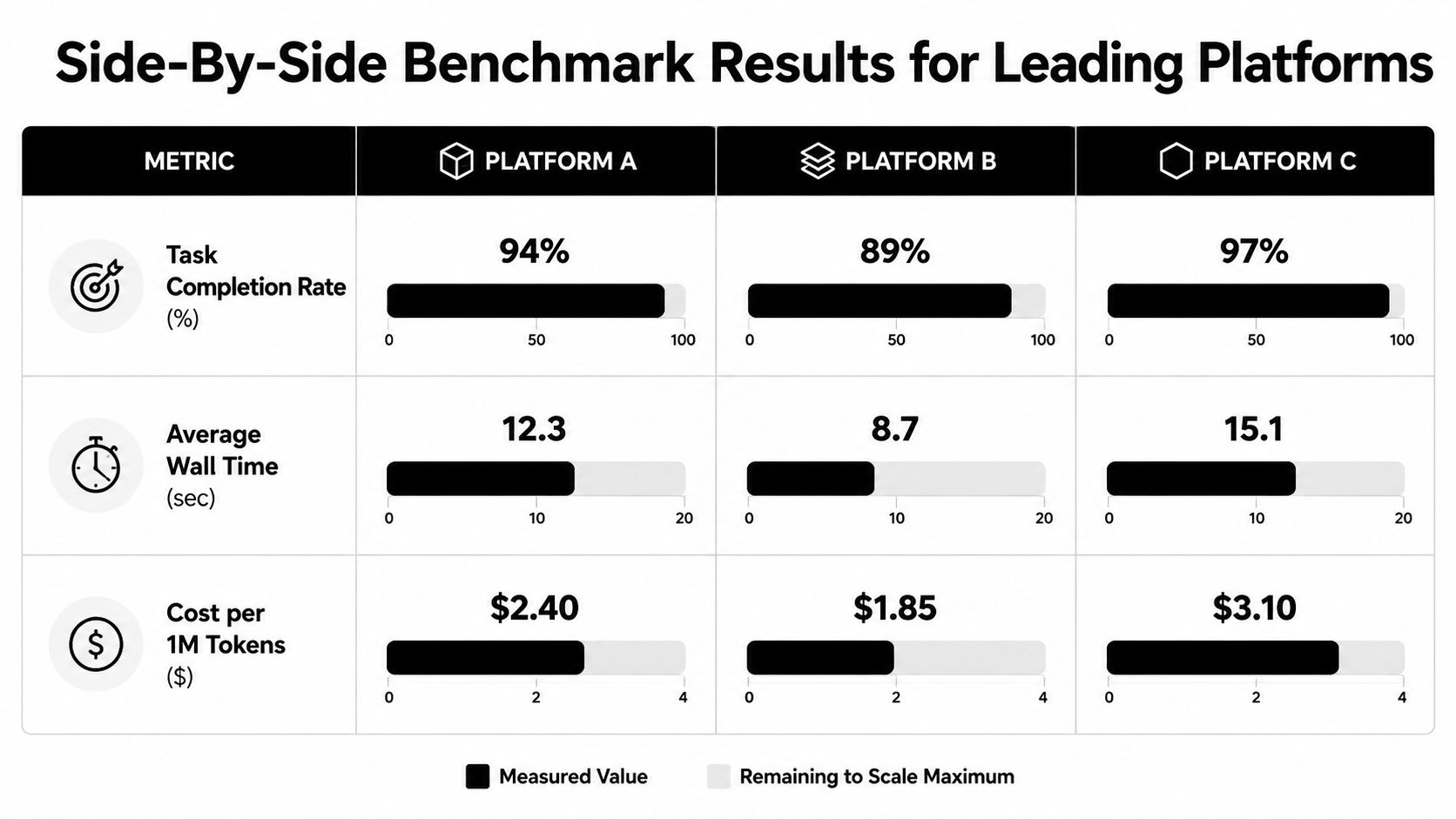
| Platform stack | Task completion | Wall time | Cost |
|---|---|---|---|
| Claude Managed Agents | 100% | 1,172s | $2.50 |
| Vertex AI Agent Engine | 100% | 1,447s | $1.45 |
| OpenAI Responses + CI | 27/30, 90% | 522s | $1.54 |
Reliability and latency serve different workloads
A customer-facing workflow may value speed and graceful escalation because a slow interaction damages the user experience. A back-office reconciliation process may accept longer wall time if completion reliability is the priority and a human reviews exceptions later. The benchmark doesn't decide between those contexts. It gives the architecture team a way to make the tradeoff explicit.
The two 100% results also shouldn't be treated as equivalent. One completed the suite faster, while the other used less reported cost. The faster 90% result may suit a workflow where a failed task is recoverable, but it may be unacceptable where every transaction must complete correctly without manual repair.
There's no single best agent stack. The right choice depends on which failure costs more, delay, inference spend, or incomplete execution.
Token usage creates another budgeting risk. A benchmark range from 93,000 to 159,000 tokens can materially change the economics of a workflow, even when the visible platform fee looks similar. Your bake-off should therefore record tokens, tool calls, retries, wall time, successful outcomes, and human interventions together.
Framework Overhead and the True Cost of Orchestration
The framework layer can determine whether a build path remains affordable. A 2026 benchmark roundup reported that LangGraph had the lowest latency and roughly $0.08 per task, CrewAI was the fastest path to production with 18% token overhead, and AutoGen was strongest on open-ended reasoning but carried 5 to 6 times higher cost and 400% to 500% token overhead versus a bare model. The framework benchmark roundup makes orchestration efficiency a financial concern, not merely a developer preference.
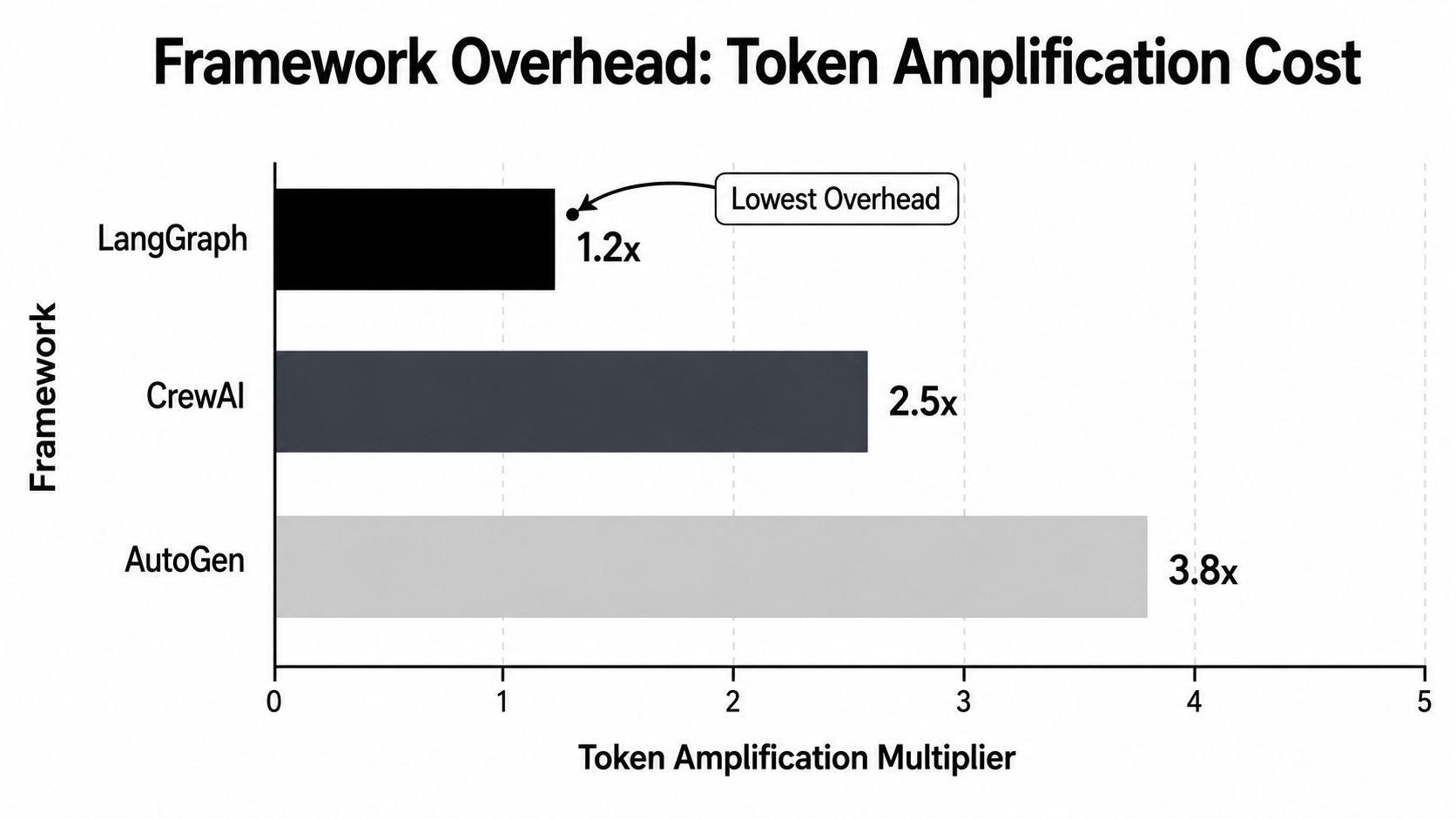
Token amplification changes the unit economics
A bare model call is an easy baseline because it exposes the minimum inference work. An agent framework adds planning, routing, memory retrieval, tool descriptions, intermediate messages, retries, and sometimes multi-agent debate. Those layers may improve task quality, but they also expand the amount of context processed per business task.
The practical calculation is simple: measure the tokens consumed by one complete business outcome, not one model response. Include failed tool calls and recovery attempts. Then compare the result with the bare-model baseline and run the same measurement across the shortlisted frameworks.
| Framework | Reported operational signal | Cost implication |
|---|---|---|
| LangGraph | Lowest latency, roughly $0.08 per task | Attractive where execution efficiency dominates |
| CrewAI | Fastest path to production, +18% token overhead | Faster implementation can justify moderate amplification |
| AutoGen | Strong open-ended reasoning, 5 to 6 times higher cost | Reasoning capability may require a higher spend envelope |
Production volume magnifies small inefficiencies
At production volume, each extra planning step is repeated across every task. The exact business impact depends on task frequency, model pricing, context size, and failure rates, so a vendor's generalized cost claim can't replace your own trace data.
Use the multi-agent orchestration platform analysis to frame the architecture discussion around coordination patterns rather than brand preference. The key question is whether your workflow needs sequential specialists, parallel workers, hierarchical delegation, or a simpler single-agent loop. Over-orchestrating a predictable process can waste tokens, while under-orchestrating an ambiguous process can increase failures and human repair.
Adoption Reality Across the Platform Ecosystem
Enterprise adoption is growing, but it isn't converging on one platform model. A 2026 practitioner dataset reported that 41% of organizations with more than 1,000 employees had at least one AI agent in production, up from 19% in Q1 2025. The same dataset reported 12% adoption for Salesforce Agentforce and 3% for Microsoft Copilot among their respective enterprise bases, a reminder that platform reach differs sharply even among established ecosystem options. The practitioner adoption dataset gives buyers useful context, but it doesn't identify a universal fit.
| Platform or market metric | Figure | Context |
|---|---|---|
| Organizations with more than 1,000 employees with an agent in production | 41% | Reported for 2026, compared with 19% in Q1 2025 |
| Salesforce Agentforce adoption | 12% | Reported among its respective enterprise base |
| Microsoft Copilot adoption | 3% | Reported among its respective enterprise base |
Five ecosystem clusters create different dependencies
Productivity-suite agents usually benefit from proximity to collaboration data and familiar administration. Their tradeoff is dependency on the suite's identity, permissions, data model, and commercial roadmap.
CRM-native agents can work effectively where customer records, service cases, or pipeline objects already define the workflow. Cross-system processes may require more integration work because the agent's strongest context resides inside the CRM boundary.
Hyperscaler runtimes offer infrastructure depth and deployment flexibility for engineering organizations. They may still require internal teams to assemble governance, evaluation, user experience, and business ownership.
Automation and RPA tools fit structured processes with known triggers and system actions. Buyers should test whether the platform reasons through exceptions or adds natural-language interaction to predefined automation.
Developer frameworks maximize control and portability, but the enterprise must own more of the harness, security model, observability, deployment lifecycle, and maintenance.
The market trajectory raises the stakes. The global AI agents market was estimated at USD 7.63 billion in 2025 and is projected to reach USD 182.97 billion by 2033, implying a 49.6% CAGR from 2026 to 2033. The market estimate suggests infrastructure buildout will accelerate, but buyers should interpret that as a reason to demand repeatable operating workflows, not as proof that every category will mature equally.
Governance becomes the connective layer across these clusters. A practical AI agent governance framework can help teams define policy ownership before they add another runtime to the estate.
Build vs Buy vs Buy-in-a-Suite
The build-versus-buy decision is really a 12 to 24 month ownership decision. Building on an open framework can preserve flexibility and sovereignty, but your team must maintain orchestration, identity boundaries, evaluations, deployment, observability, and recovery. Buying a managed platform can shorten the path to a controlled pilot, while transferring some infrastructure responsibility to the vendor and creating dependency on its pricing, roadmap, and data model.
Buying in a suite often wins when the workflow already lives inside that suite. The organization can reuse existing identities, records, permissions, and administration. That convenience becomes a constraint when the process crosses several ecosystems or when the business wants to move agents between runtimes.
Match the path to the operating profile
| Path | Strength | Cost and dependency risk | Appropriate context |
|---|---|---|---|
| Build on an open framework | Control, portability, custom orchestration | Internal maintenance and governance burden | Engineering-led organizations with existing platform capability |
| Buy a managed platform | Faster deployment and packaged operations | Usage exposure, vendor dependency, less control over internals | Teams needing a production path without building the full harness |
| Buy in a suite | Deep access to existing data and identity | Ecosystem lock-in and weaker cross-platform portability | Organizations whose workflows stay within one established suite |
Regulated enterprises should prioritize auditability, scoped identity, approval controls, data residency, and evidence collection before optimizing developer convenience. A managed platform is useful only if it exposes enough control for the organization's risk model. If it doesn't, building may be more expensive initially but more defensible over the lifecycle.
Mid-market teams starting with a small number of use cases should avoid premature platform sprawl. A suite-native path may be sensible for a contained workflow, while a managed cross-system platform may fit a process that already spans customer records, collaboration tools, and internal databases.
Engineering-led companies with strong ML investment can justify an open framework when custom behavior is a strategic differentiator. They should still price the internal work required to operate the system, including evaluation, security reviews, incident response, and future migration.
The decision isn't which option has the most features. It's which option minimizes total cost of ownership and organizational dependency over the period in which your agents must keep working.
Recent market commentary points to diverging economics across agent marketplaces and platform models, including different approaches associated with GPT Store, Claude Skills, Replit, and Cloudflare's inference-based billing. The 2026 vendor landscape analysis reinforces the need to model your own workload rather than compare headline pricing.
Your 90-Day Platform Selection Roadmap
A platform selection should produce evidence, not enthusiasm. Start by mapping the current agent estate, including prototypes, production workers, embedded assistants, custom services, and unmanaged experiments. Score each against scalability, observability, governance, and cost, then identify which team owns each gap.
Weeks one through six
During the first two weeks, define the control requirements and choose a real workload. Don't use a toy prompt. Select a process with representative data, meaningful tool calls, clear success criteria, recoverable failure modes, and a human escalation path.
From weeks three through six, run a bake-off with two or three shortlisted paths. Keep the task definition constant and record:
- Outcome quality: Whether the business action was correct, not merely whether the response sounded plausible.
- Execution behavior: Wall time, retries, tool failures, human interventions, and recovery quality.
- Resource use: Token consumption, model calls, storage, and platform usage.
- Control evidence: Identity mapping, approval events, action logs, policy enforcement, and incident reconstruction.
Weeks seven through thirteen
From weeks seven through ten, move the leading option into a production-adjacent environment. Test governance, monitoring, cost alerts, rollback, access reviews, and ownership handoffs. A platform that performs well in a controlled bake-off but can't support operational review should not advance by default.
During weeks eleven through thirteen, model the build, managed, and suite paths over 12 to 24 months. Include engineering capacity, support, audits, migration work, evaluation maintenance, inference, token amplification, and the cost of switching if the platform fails to meet cross-system requirements.
Platform choice alone won't solve execution risk. Someone must own outcomes, governance, and the roadmap. Organizations that need an external diagnostic can use Head of Agents' readiness audits and verified leadership network to structure the ownership decision, alongside internal architecture and security review.
Selection checklist: named owner, real workload, repeatable evaluation, traceable actions, explicit failure handling, lifecycle TCO, and a written exit or migration plan.
The market is expanding rapidly, but growth doesn't reduce the burden of operational discipline. Choose the platform that can turn a successful pilot into a controlled workflow, then assign a leader who remains accountable after the vendor demo ends.
Head of Agents helps enterprises assess agent readiness, structure build-versus-buy decisions, and identify verified leaders accountable for governance and production outcomes. Visit Head of Agents to request a readiness audit or explore leadership support for your agent platform program.