AI Executive Search for Agent Leadership
Master ai executive search for agent leadership. Learn how to evaluate candidates, define governance, and choose the right hiring model for AI initiatives.
Written by HeadOfAgents
The popular advice is to hire the person with the deepest AI credentials. That advice is incomplete, and for agent leadership it can be dangerous. A brilliant researcher may understand models while lacking the authority, operating discipline, and governance judgment required to let an autonomous system act inside a real business.
AI executive search should find accountable operators, not impressive titles. The right leader can connect strategy to production, establish permission boundaries, manage risk, and stop an agent that creates more exposure than value. Boards should define that mandate before they ask the market for candidates.
Redefining AI Leadership Beyond Technical Credentials
Technical expertise matters, but it isn't the hiring decision. A Head of Agents or Chief AI Officer must turn an ambiguous mandate into a portfolio with owners, budgets, controls, and measurable outcomes. That requires enterprise context, influence across functions, and enough infrastructure knowledge to understand why a promising prototype may fail in production.
The warning is especially clear in research on AI leadership roles. In a 2025 survey of 318 data, analytics, and AI executives, nearly half said their organizations had reclassified existing roles to add AI responsibilities. The same research identified change management and cloud engineering as especially important for responsible, scalable integration, according to the 2025 Data, Analytics and AI Officers Compensation Survey.
A candidate who has trained models but never owned deployment, adoption, or operating-model change is an incomplete executive hire.

The operator's mandate
Boards should test whether a candidate has personally handled the following:
- Production accountability: Systems that moved beyond demonstrations into live workflows, with clear owners and service expectations.
- Cross-functional governance: Decisions involving engineering, product, security, legal, data, finance, and business operations.
- Portfolio judgment: The ability to reject low-value use cases, sequence investments, and explain trade-offs to executives.
- Organizational adoption: Evidence that employees changed how they work because the leader created the right processes, incentives, and training.
- Operational controls: Permissioning, human approval, monitoring, audit trails, incident response, and retirement criteria.
The test isn't whether a candidate can describe an agent architecture. The test is whether they can explain who was allowed to change it, who could stop it, how exceptions were handled, and what happened after launch.
For organizations deciding whether they need permanent leadership, a fractional Head of AI can be a practical alternative when the mandate is real but the portfolio isn't yet large enough for a full-time executive. That decision should follow a readiness assessment, not a desire to add a prestigious title.
Board question: What business outcome, risk boundary, and decision right will this executive own on the first day?
Title inflation creates false confidence. “AI lead” might describe an executive with budget authority, or an individual contributor coordinating experiments. Search committees must verify scope through artifacts, references, and detailed operating questions. If they don't, they may hire a technically credible adviser when the company needs an accountable owner.
The Market Reality of AI Executive Hiring
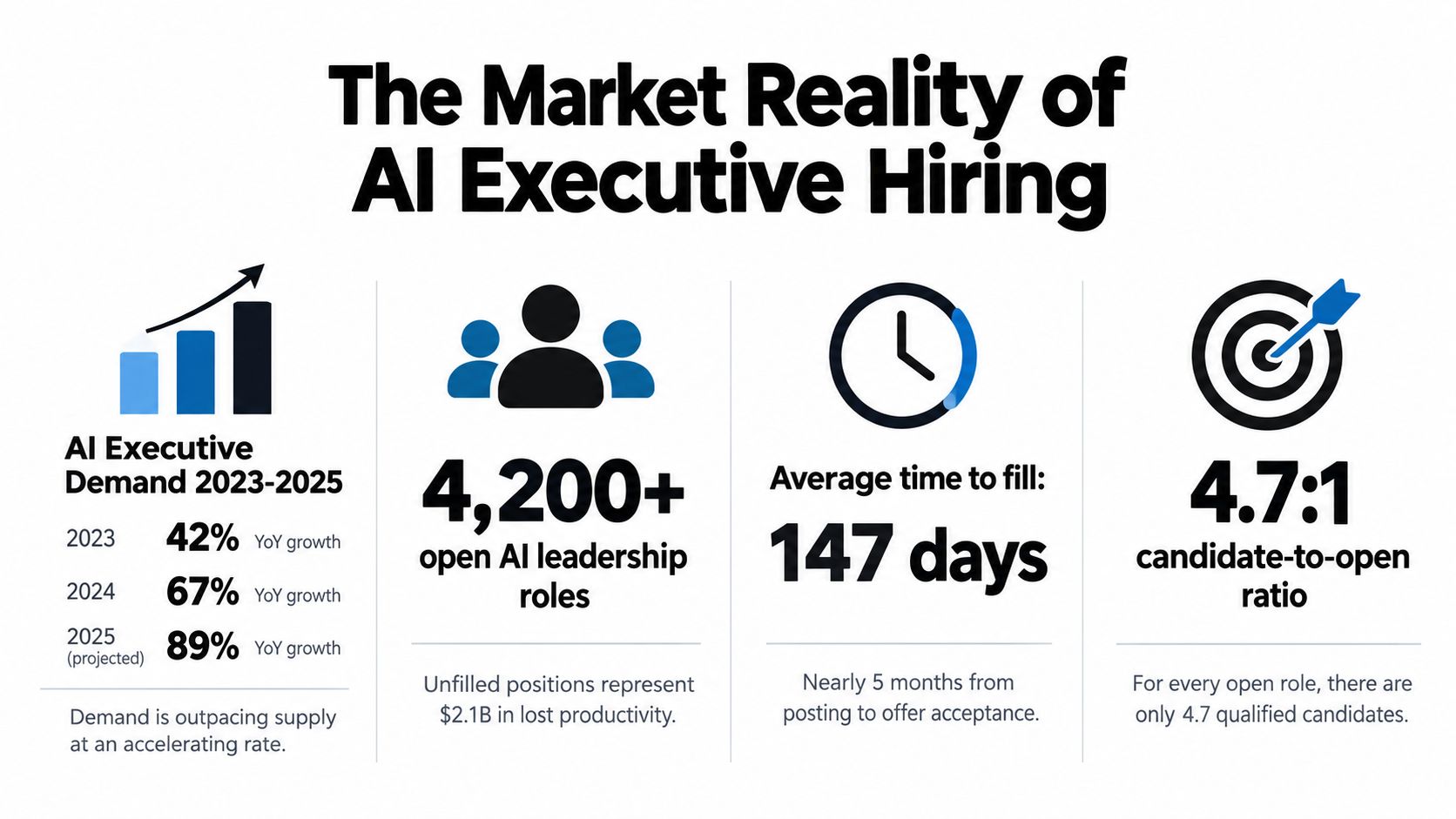
The market has moved quickly, but role design hasn't kept pace. An IBM Institute for Business Value study conducted with Oxford Economics and the Dubai Future Foundation surveyed more than 2,300 organizations across 22 geographies and 21 industries in the first quarter of 2025. Twenty-six percent reported having a CAIO, compared with 11% in 2023, while 66% of surveyed CAIOs expected most organizations to have one within two years, as reported in the source covering the rise of the Chief AI Officer.
That adoption shift represents a 15-percentage-point increase and more than a twofold rise in reported adoption. It also explains why candidates with internal enterprise knowledge are valuable. Fifty-seven percent of surveyed CAIOs had been appointed from within their organizations, so external searches compete with succession plans and internal promotion pathways.
Demand is ahead of accountability
Indeed data reported a 478% year-over-year increase in chief AI job postings during 2024, while senior AI postings rose 265% year over year in 2025, the largest annual increase for that category since 2020, according to the reported hiring-market update. These figures describe a demand shock, not a mature profession with standardized scopes.
The shortage is structural. A global executive survey reported that 94% of leaders face AI-critical skill shortages, with one in three reporting gaps of at least 40%. Another 2025 executive survey found that 85% of senior leaders ranked AI as their top strategic priority, while only 33.1% of companies had established CAIO roles, according to the World Economic Forum's analysis of jobs and labour-market trends.
Before discussing compensation, boards should settle four questions:
- Who owns the AI portfolio?
- Which executive receives escalation authority?
- What counts as production success?
- Which risks require human approval?
For practical context on structuring the broader talent function, HR leaders can review how HR leaders build AI teams. The useful lesson is not to copy a template. It's to connect role design to the company's actual operating model.
An AI executive search mandate should therefore specify reporting lines, budget control, deployment responsibility, governance authority, and success measures before sourcing begins. Otherwise, the market will supply candidates who optimize for title alignment rather than business accountability.
Building an Outcome-Based Evaluation Scorecard
A conventional executive scorecard rewards pedigree, seniority, and strategic language. That isn't enough for agent leadership. The scorecard must distinguish someone who advises on AI from someone who owns live systems, controls risk, and delivers measurable business value.
Use four dimensions. Give each dimension evidence thresholds, then ask every finalist the same core questions.
Four dimensions that matter
Strategy and portfolio economics should test whether the candidate can prioritize use cases by value, feasibility, risk, and operating cost. Ask for a portfolio they personally shaped. The candidate should explain what they funded, what they rejected, and how they connected deployment decisions to business outcomes.
Production engineering and reliability requires more than familiarity with architecture diagrams. Ask which systems reached production, how the team handled failures, how dependencies were monitored, and who approved changes. Request references from engineering leaders who worked with the candidate under delivery pressure.
Governance across data, privacy, security, and human escalation should be concrete. Probe agent permissions, access to sensitive systems, approval thresholds, audit evidence, incident ownership, and the process for suspending an unsafe workflow.
Organizational adoption separates an operating executive from a technical specialist. Ask how the candidate changed processes, trained teams, handled resistance, and measured actual use after launch. Change management isn't a supporting skill. It determines whether the business receives value from the technology.
| Dimension | Traditional Criteria, Red Flag | Outcome-Based Criteria, Green Flag |
|---|---|---|
| Strategy and economics | Talks about an ambitious AI vision without portfolio decisions | Shows prioritization, budget ownership, business cases, and stopped investments |
| Production and reliability | Describes prototypes or research outputs | Demonstrates shipped systems, monitoring, incident response, and post-launch reviews |
| Governance | Treats compliance as a later review | Defines permissions, approval thresholds, audit trails, and escalation rights |
| Adoption and change | Relies on tool availability or executive sponsorship | Shows process redesign, stakeholder alignment, training, and sustained usage |
Require proof, not polished answers
A serious process asks candidates to bring artifacts, subject to confidentiality limits. Useful evidence includes an anonymized launch review, an operating dashboard, a governance decision record, a portfolio prioritization memo, or a reference who can verify budget and team scope.
For a Head of Agents, the operating dashboard should include measures such as task completion, exception rates, approval latency, cost per transaction, adoption, and incident frequency. The metrics matter because they expose trade-offs. High completion with unacceptable exceptions isn't success, and broad adoption of an uneconomic workflow isn't a win.
A candidate who can't describe the measurement system they used probably didn't own the outcome. More guidance on choosing practical measures is available in agent performance metrics.
Interview standard: Never accept “I led the AI initiative” without asking what the candidate could approve, what they could stop, and which results were visible after launch.
The final score should combine evidence, references, and practical assessment. Don't let a famous employer or research background override a weak record of transformation, infrastructure ownership, or governance execution.
Matching the Hiring Model to Organizational Readiness
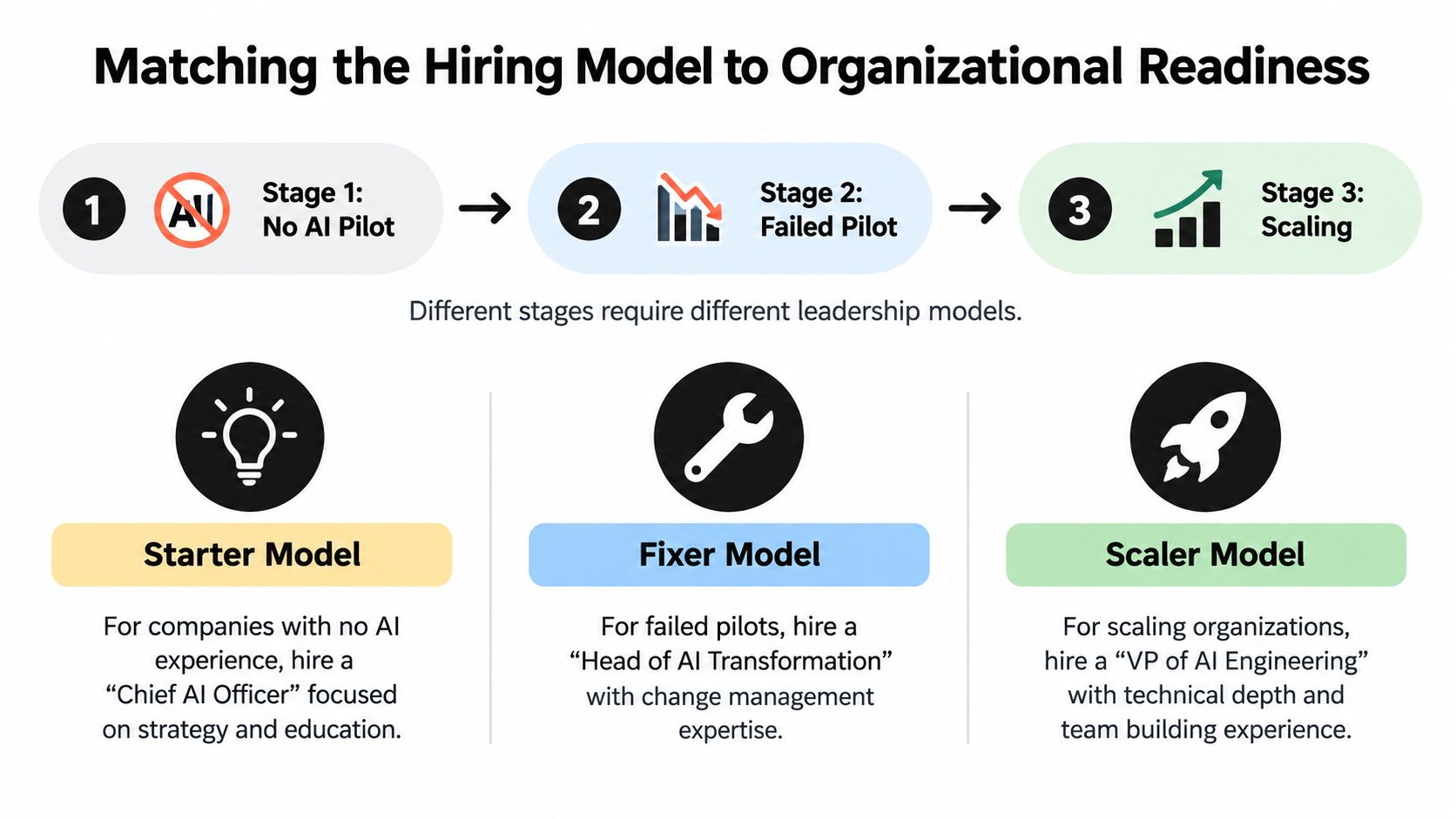
Not every stalled pilot requires a full-time executive. A company with no usable data foundation may need education and strategic direction. A company with a failed pilot may need a transformation operator. A scaling business may need a technical leader who can build teams and reliability into the delivery system.
Start with a pre-search diagnostic. Score the value and feasibility of priority use cases, governance maturity, identity and access controls, integration complexity, data readiness, and change-management capacity. The result should identify the bottleneck, not merely confirm that AI is important.
Choose the engagement that fits the gap
Permanent executive ownership makes sense when AI spans multiple functions, carries material operational or regulatory exposure, and needs a durable reporting line. The executive should own the portfolio, governance model, leadership team, and business outcomes.
Fractional leadership fits a bounded portfolio, early-stage operating model, or company that needs senior judgment while it validates scope. A fractional leader can establish priorities, decision rights, and a roadmap without forcing the board into a premature permanent appointment.
Specialist implementation support is appropriate when the mandate is already clear and the only constraint is technical delivery. Hiring a senior executive to solve a narrowly defined integration problem creates expensive ambiguity and may leave the actual accountability gap untouched.
The readiness gap often hides in workforce capability. EY found that 69% of senior AI executives were concerned about insufficient internal expertise to evolve governance controls, while Deloitte found workforce readiness at 25%, compared with 48% for technology infrastructure, as reported in the EY governance-gap findings.
Those figures point to a practical decision. If infrastructure exists but the organization can't govern or adopt agents, don't automatically buy more engineering capacity. Define the leadership responsibility first.
Teams should also keep the process disciplined. A clear brief, structured feedback, and a visible candidate ledger help streamline your hiring pipeline without confusing administrative speed with search quality.
How Specialized Search Partners Mitigate Hiring Risk
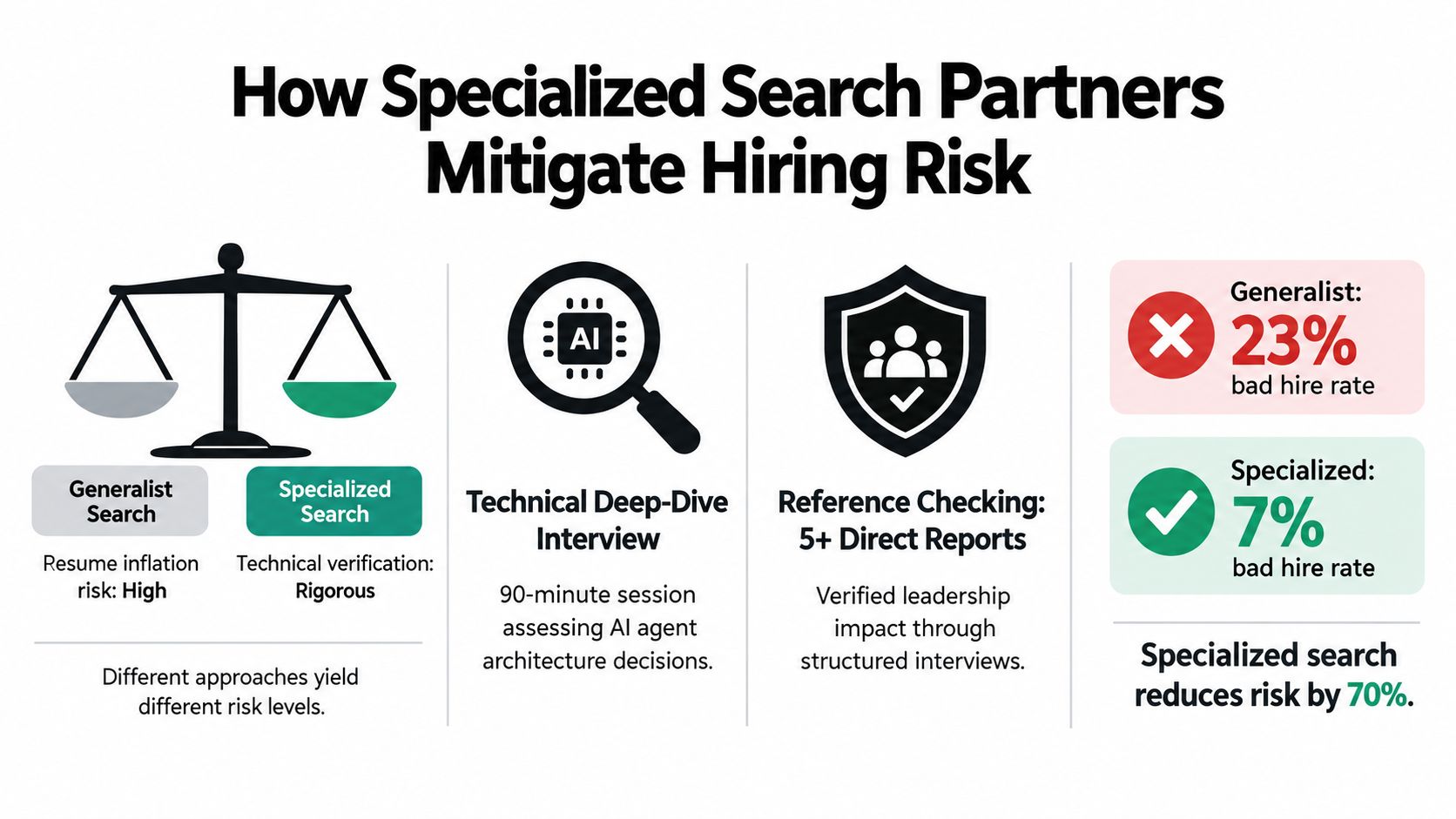
Generalist search can identify senior people with credible titles. It often struggles to verify whether those leaders shipped agent systems, governed production risk, or influenced business adoption. That verification gap matters because AI resumes can sound impressive while leaving scope, authority, and outcomes unclear.
A specialized process should begin with a public standard for inclusion. Candidates need evidence of shipped-to-production work, structured references, and a practical assessment that tests architecture, operating decisions, and governance judgment. The search partner should also remain neutral, with candidates and consultancies excluded from paid ranking or visibility arrangements.
What the process must verify
A credible partner should be able to answer:
- Production evidence: Which systems did the candidate ship, and what did they personally own?
- Leadership impact: Which direct reports, peers, and business stakeholders can verify the result?
- Technical judgment: Can the candidate explain design trade-offs, failure modes, access controls, and escalation?
- Commercial neutrality: Does the firm earn revenue from the hiring company rather than from candidate placement visibility?
- Candidate confidentiality: Can the company remain anonymous until a vetted shortlist is ready?
- Placement protection: Does the agreement include a documented replacement guarantee?
Head of Agents is one specialized option. Its stated model combines a verified network, practical assessment, references, permanent placement, fractional matching, readiness audits, and a 90-day replacement guarantee tied to first-year salary. Boards should still inspect the methodology, evidence standard, and contract language before selecting any partner.
The point isn't to outsource judgment. It's to make judgment more defensible. A search firm should bring forward evidence that lets the board compare operators on production ownership, governance capability, and organizational influence rather than on polished biographies.
A search partner that can't explain how it verifies agent leadership claims is adding another layer of title inflation to the process.
Timelines and Costs for Agent Leadership Searches
Boards need a realistic process plan, but they shouldn't accept generic benchmarks as guarantees. The right timeline depends on role clarity, candidate availability, internal alignment, and whether the company is seeking a permanent executive or a fractional operator.
A disciplined search usually follows four phases:
- Needs assessment and role scoping: Define the readiness gap, mandate, reporting line, decision rights, evidence thresholds, and engagement model.
- Candidate sourcing and verification: Map the relevant operator pool, conduct technical deep dives, confirm production claims, and complete structured references.
- Interview and decision: Use the scorecard consistently, test practical scenarios, align stakeholders, and check the candidate's authority requirements.
- Offer and onboarding: Calibrate the package to scope, document governance responsibilities, and create a first-quarter operating plan.
The cost framework should separate search fees, executive compensation, onboarding, and any implementation support. Finance should ask what is included in the fee, when invoices are due, how replacement protection works, and whether a fractional arrangement can be converted into a permanent role.
Avoid using unverified market figures to force a board decision. Compensation should reflect budget authority, team scale, deployment criticality, enterprise exposure, geography, and the scarcity of the required operating profile. A candidate who owns a high-risk, cross-functional portfolio shouldn't be benchmarked against a general machine-learning management role just because both include “AI” in the title.
The most expensive failure is not a longer search. It's hiring an executive without authority, then discovering that the company still lacks governance, adoption, or delivery ownership. Spend early effort on the mandate and evidence standard. That reduces wasted interviews and gives finance a defensible basis for approving the engagement.
Establishing Governance and Decision Rights Post-Hire
The offer letter doesn't create accountability. The operating model does. A Head of Agents must know which decisions they own, which decisions require approval, and when they have the authority to stop a deployment that is unsafe, uneconomic, or impossible to audit.
The need is urgent because adoption is moving faster than oversight. Deloitte's global survey of 3,235 technology and business leaders found that only 21% of organizations had a mature governance model for agentic AI, while 74% expected at least moderate agent use by 2027, according to Deloitte's analysis of scaling AI agents.
Put decision rights in writing
On day one, the executive should receive a written charter covering:
- Agent permissions: Which systems and data each agent may access, and who approves changes.
- Human approval thresholds: Which actions require review before execution, especially external communication, financial activity, sensitive-data access, or irreversible changes.
- Monitoring obligations: Which operational, safety, and business metrics are reviewed, by whom, and at what cadence.
- Incident escalation: How engineering, security, legal, product, and business teams respond to failures or unexpected behavior.
- Release and retirement authority: Who can launch, pause, roll back, or retire an agent when results deteriorate.
- Business accountability: Which executive owns realized value, adoption, cost, and risk outcomes.
This charter should connect directly to the hiring scorecard. If the candidate was hired to improve task completion and reduce exception handling, the board should receive reporting that shows both. If the candidate was hired to establish governance, the board should see the control inventory, unresolved gaps, and decisions awaiting executive action.
Organizations should start with lower-risk use cases, establish controls, and scale deliberately, as Deloitte's findings recommend. Practical guidance such as Applied's AI governance best practices can help teams structure the policy work, but the appointed executive must own implementation inside the business.
Measure the leader, not just the agents
A board should review whether the executive has created a portfolio that produces value without weakening control. That means tracking realized outcomes, adoption, incident patterns, approval friction, auditability, and the retirement of low-value agents.
The strongest appointment is therefore not the person with the most visionary presentation. It's the operator who can set boundaries, align stakeholders, make difficult trade-offs, and remain accountable when an autonomous system behaves unexpectedly.
Head of Agents helps companies assess readiness, choose between permanent and fractional leadership, and identify verified operators for AI agent ownership. If your organization is hiring a Head of Agents, Head of AI, or CAIO, start by defining the mandate and governance gap, then visit Head of Agents to structure the search around accountable outcomes.