AI Readiness Assessment: A Practical Playbook
Run an AI readiness assessment that uncovers real gaps. Step-by-step guide with stakeholder interviews, ROI scoring, governance checks, and a 90-day roadmap.
Written by HeadOfAgents
You've got a pilot that demos well, a board that wants agents in production this quarter, and a team that can't agree on who owns the risk if an agent acts on bad data. Copilots are live. Usage looks strong. But no one can answer who approves tool access, who stops a runaway workflow, or how you'd prove what happened afterward. That's not a tooling gap. That's an operating gap, and it's exactly what a useful AI readiness assessment should expose before you grant autonomy.
Why Most AI Readiness Assessments Miss the Real Risks
A common failure looks harmless in a demo. An agent triages support tickets, drafts a refund, and updates the customer record. In production it issues the refund twice, writes the wrong note, and nobody can reconstruct which data it used. The model didn't fail in an interesting way. The workflow had no permission boundary, no human override, and no audit trail worth trusting.
Most maturity scores wouldn't catch that. They inventory models, rate data quality, and check cloud capacity, then average the result into a reassuring number. That approach works for copilots that suggest text. It doesn't work for agents that take actions, access systems, and coordinate with other software.
Adoption Is Not Operating Capability
Stanford HAI's 2025 AI Index findings show organizations using AI in at least one function rose from 55% in 2023 to 78% in 2024, while generative AI use rose from 33% to 71%. Yet most reported cost savings were below 10%, and the most frequent revenue gain was below 5% in several functions. Broad use signals interest. It doesn't prove repeatable value, controlled execution, or clear ownership.
An organization can be ready to experiment and still be unready to let an agent act without supervision.
Test governance under failure instead of documenting it. Run scenarios where an agent tries an unauthorized purchase, exposes sensitive data, or takes an incorrect customer action. Score recovery time, accountability, and evidence quality. If your estate spans major enterprise platforms, a focused readiness check for SAP and Microsoft from Kagool offers a useful lens on that platform-specific layer before you widen the diagnostic.
This playbook is for CTOs, CAIOs, product and engineering leaders, HR partners, and mid-market operators who need artifacts, not opinions. You'll finish with a one-week diagnostic plan, a scored use-case map, a gap analysis, a build versus buy versus hire call, and a 90-day roadmap tied to named owners.
Scoping the Assessment and Stakeholder Map
Scope the diagnostic in 48 hours or it'll drift into an open-ended strategy debate. A tight brief forces trade-offs early, when they're cheap. It also protects the work from the most common derailer, which is adding a new function or use case every day.
Start with four decisions, written on one page.
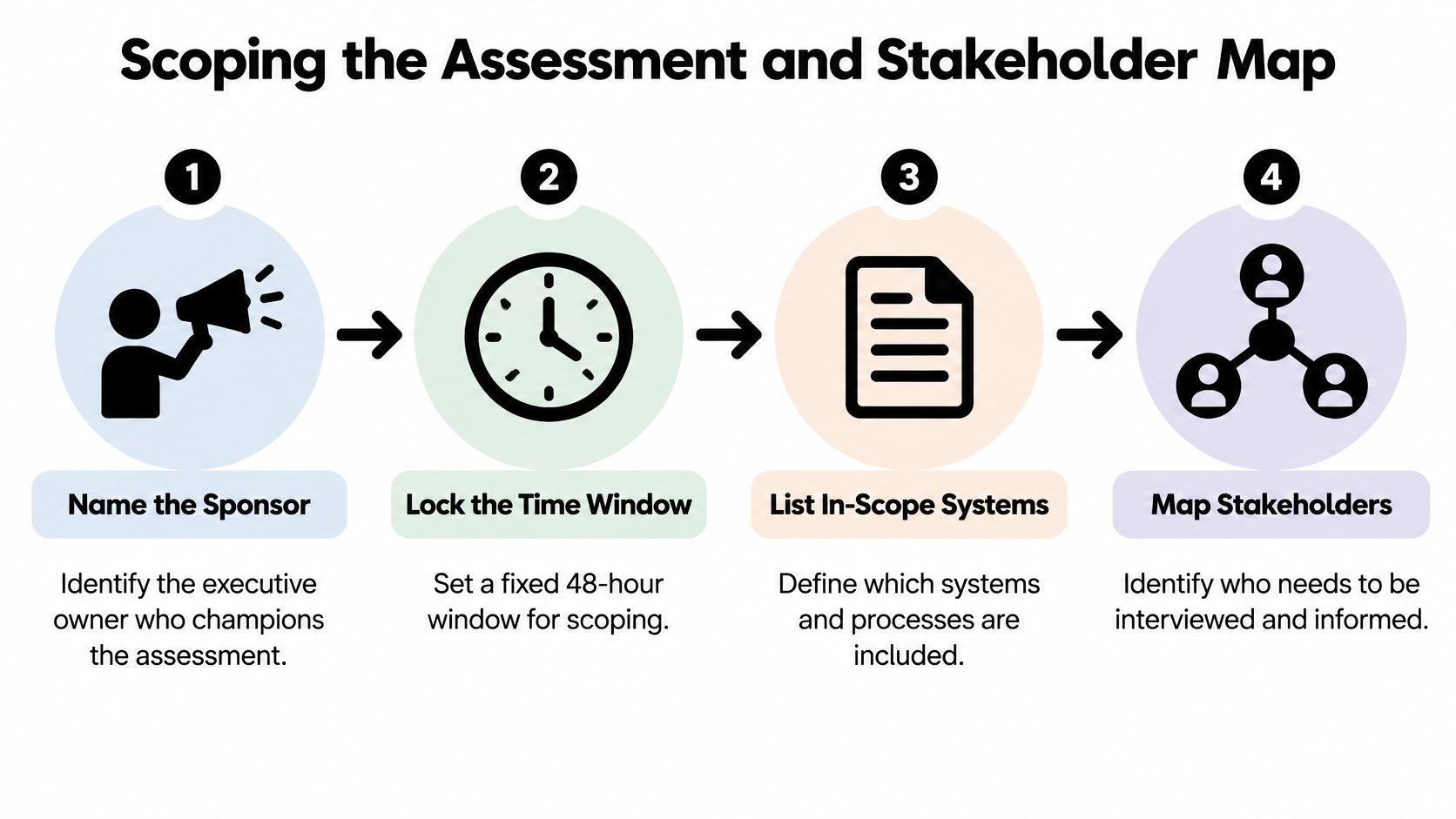
- Name the sponsor: Pick the executive who can fund fixes, assign owners, and say no to a risky launch.
- Lock the time window: Set start and decision dates, and state what happens if interviews slip.
- List in-scope functions: Name the processes, systems, data domains, and agent actions you're evaluating.
- Define deliverables: Commit to a use-case map, gap analysis, build versus buy versus hire recommendation, and 90-day roadmap.
Who Gets Interviewed and What You Ask
Don't interview everyone the same way. You're testing different claims with each person.
- Business owner: What outcome changes, what's the current baseline, and who owns the metric after launch?
- Data lead: Which sources are authoritative, who can access them, and where does lineage break?
- Engineering lead: Which APIs exist, how are permissions scoped, and can you run the agent in shadow mode?
- Security lead: What abuse cases matter, how is identity enforced, and what's logged?
- Legal and risk: Which obligations apply, what needs human review, and what triggers escalation?
- HR partner: Which roles change, who needs new skills, and who manages the redesigned workflow?
Book the sponsor first, then business owners, then technical and risk leads. Send artifact requests before each session, including process maps, access policies, incident procedures, and any pilot results.
Close scoping with explicit exclusions. If a team, region, or high-risk action isn't in scope, write that down. A diagnostic that tries to evaluate everything produces a score no leader can act on.
Use-Case Mapping and ROI Feasibility Scoring
Score every candidate use case on two axes. ROI covers value capture, frequency, and strategic fit. Feasibility covers data readiness, integration effort, governance burden, and change readiness. Score each from 1 to 5, assign a risk tier, and force a recommended path.
That discipline matters because experimentation and scale are different states. McKinsey's 2025 State of AI survey found 88% of respondents regularly use AI in at least one function, yet only 23% said their organizations were scaling an agentic AI system and 39% were experimenting with agents. Treating a popular copilot use case as proof of agent readiness skips the gates that determine whether autonomous execution is safe.
A Worked Contrast
Consider two procurement ideas. An agent that triages inbound vendor invoices runs often, uses structured data, and fails in visible, reversible ways. A person can review exceptions before payment. It scores high on feasibility even if value per transaction is modest.
An agent that negotiates supplier contracts looks more valuable on a slide. In practice it needs judgment about trade-offs, access to sensitive terms, and authority to commit the company. Errors are expensive and hard to reverse. It scores lower on feasibility and lands in a higher risk tier, regardless of model quality.
Use-Case Scoring Template
| Use Case | ROI Score (1-5) | Feasibility Score (1-5) | Risk Tier | Recommended Path |
|---|---|---|---|---|
| Invoice triage and exception routing | 4 | 4 | Medium | Buy or build, pilot first |
| Supplier contract negotiation | 4 | 2 | High | Deprioritize pending controls |
| Internal knowledge retrieval for staff | 3 | 5 | Low | Buy |
| Customer refund execution | 5 | 3 | High | Hire owner, then limited pilot |
Require evidence before a use case earns priority status. You need a validated business owner and ROI hypothesis, production-grade data access, scoped tool permissions, an evaluation harness, human escalation, and monitoring. For the financial side of that hypothesis, structured cost estimation models for agent programs help you separate build cost, run cost, and leadership cost instead of lumping them into one optimistic figure.
Priority rule: No owner, no baseline, no pilot. A use case without all three stays an idea, however strong the demo looks.
Fund only the top use cases that clear both axes. Park the rest with a named reason, such as missing data access or unresolved risk ownership, so teams don't relitigate the same list next quarter.
Governance and Technical Gap Analysis
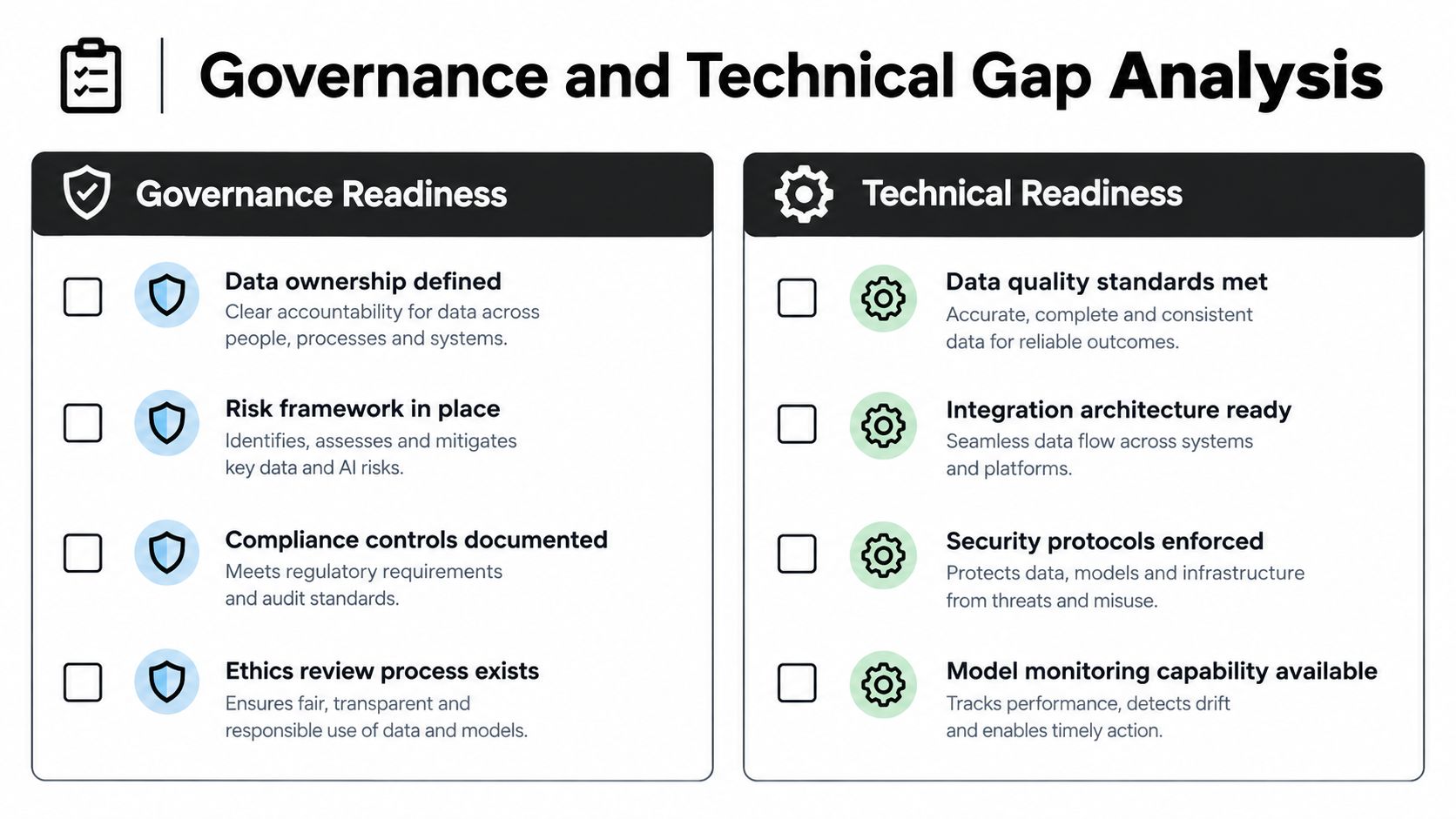
Organize the gap analysis around Govern, Map, Measure, Manage. NIST's AI Risk Management Framework core functions sequence the work so you inventory owners and obligations first, map each use case to its context and harms, measure performance and risk, then manage residual risk against tolerance. The output should be an evidence pack, not a maturity score, with one row per use case linking KPI, technical metric, control, owner, test result, and remediation deadline.
Governance gaps are measurable, not abstract. McKinsey's global AI research in PDF form reported only 28% of respondents from AI-using organizations said the CEO was responsible for AI governance and 17% said the board held that responsibility, while just 27% said employees reviewed all generative AI content before use. It also found 51% had experienced at least one negative consequence from AI, with inaccuracy among the most common causes.
Prompts That Turn Discussion Into a Test
- Accountable owner: Who can approve, pause, or retire this agent, by name?
- Escalation path: What event triggers human takeover, and who gets paged?
- Audit evidence: Can you replay inputs, tool calls, outputs, and approvals for a single transaction?
- Human review: Which actions require approval before execution, and which only need sampling?
- Data access: Which fields can the agent read or write, and who granted that scope?
- Evaluation: What offline tests, shadow runs, and production checks run before and after release?
- Rollback: How do you disable the agent and reverse its actions without engineering heroics?
- Abuse testing: How have you tested prompt injection, data leakage, and unauthorized tool use?
For teams formalizing these controls, Yellow.ai enterprise governance best practices from Yellow.ai provide a helpful reference for structuring enterprise oversight. Pair that with a clear view of what audit readiness requires in practice so your evidence pack matches what reviewers will ask for.
Rate each gap critical, major, or minor. No rollback, no owner, and no evaluation harness are critical for any agent that writes to systems of record. Don't average them away with strong scores elsewhere.
Build, Buy, or Hire the Capability You Need
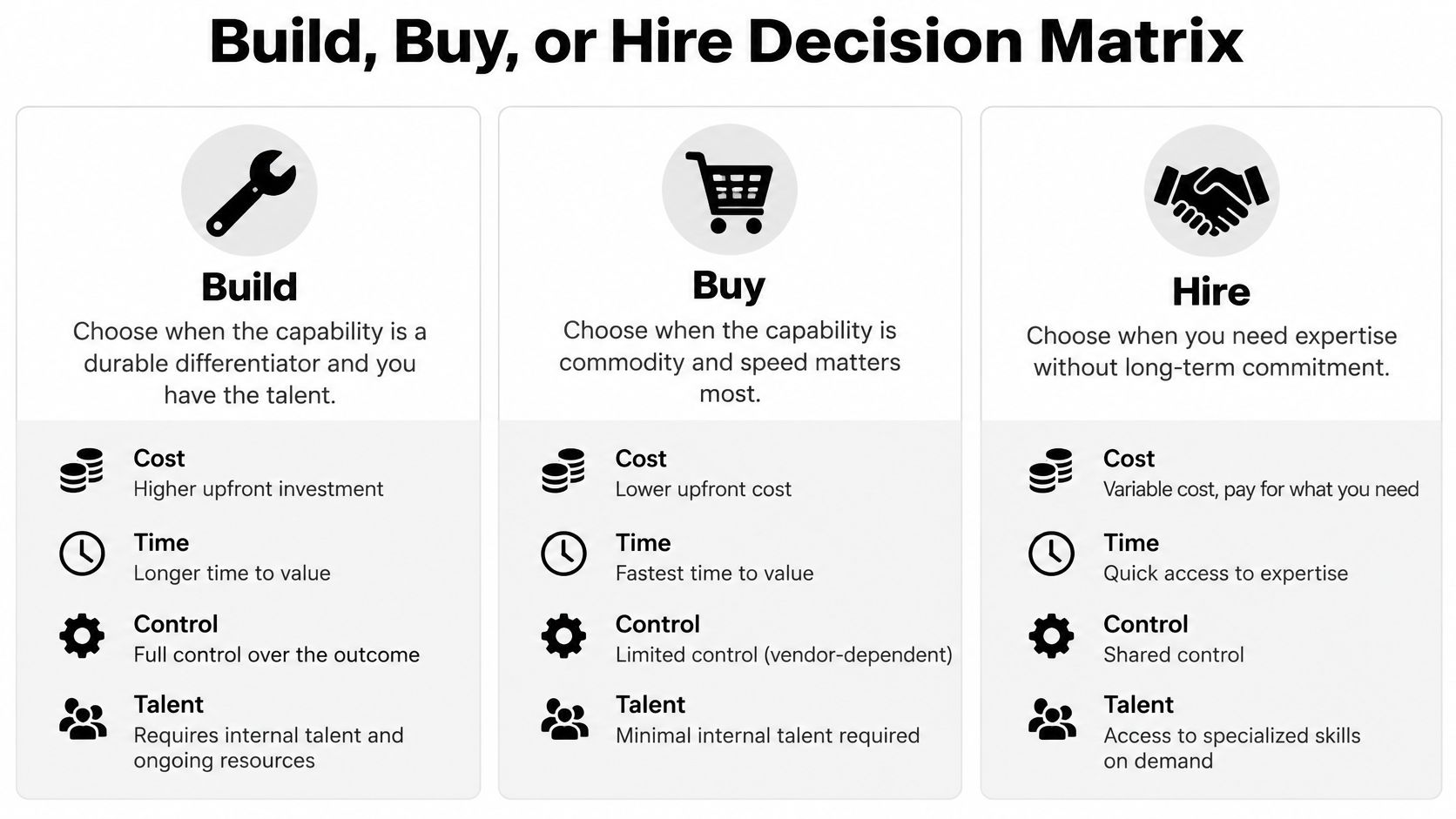
Make the build, buy, or hire call only after scoring and gap analysis. The right answer depends on your binding constraint, which is often organizational rather than technical. Infosys research on responsible enterprise AI in the agentic era surveyed more than 1,500 executives across six countries and found 86% expected agentic AI to create additional risks and compliance issues, yet only 2% met the highest responsible AI control standard. It also identified insufficient worker skills as the leading barrier to integrating AI into workflows, while education was the most common talent response.
That pattern is the trap. Training raises awareness, but it doesn't create an accountable owner, a redesigned workflow, or decision rights for production incidents.
When Each Path Wins
Build when the capability is a durable differentiator, your data and workflows are distinctive, and you have engineering capacity to operate it. Accept slower delivery and full ownership of evaluation, security, and maintenance.
Buy when the capability is commodity, speed matters, and your edge comes from process design rather than the underlying agent. You'll still own integration, permissions, monitoring, and vendor oversight.
Hire when ownership is the bottleneck. If strong engineers and data exist but no executive owns outcomes, risk, and roadmap end to end, you're in a hire-first situation. Buying more tooling won't fix absent accountability.
A structured comparison of build versus buy decisions for AI agents helps separate platform cost from operating cost. Where the missing piece is senior technology leadership rather than a product, some firms hire a fractional CIO through nexus IT group to cover executive oversight while they recruit. Head of Agents offers a related option for agent programs specifically, matching companies with verified fractional or full-time leaders who have shipped agents to production.
Write the recommendation on one page. State the chosen path, the evidence from scoring, the top risks, what you'll defer, and the decision date for revisiting it. If you can't name the accountable owner on that page, you don't have a recommendation yet.
Sample One-Week Diagnostic Runbook
Run the diagnostic in five working days, with synthesis starting before the last interview ends. Waiting until Friday to write guarantees vague findings. Draft the use-case map and gap table as evidence arrives.
The timeline below shows the intended sequence, from scoping through draft recommendations.
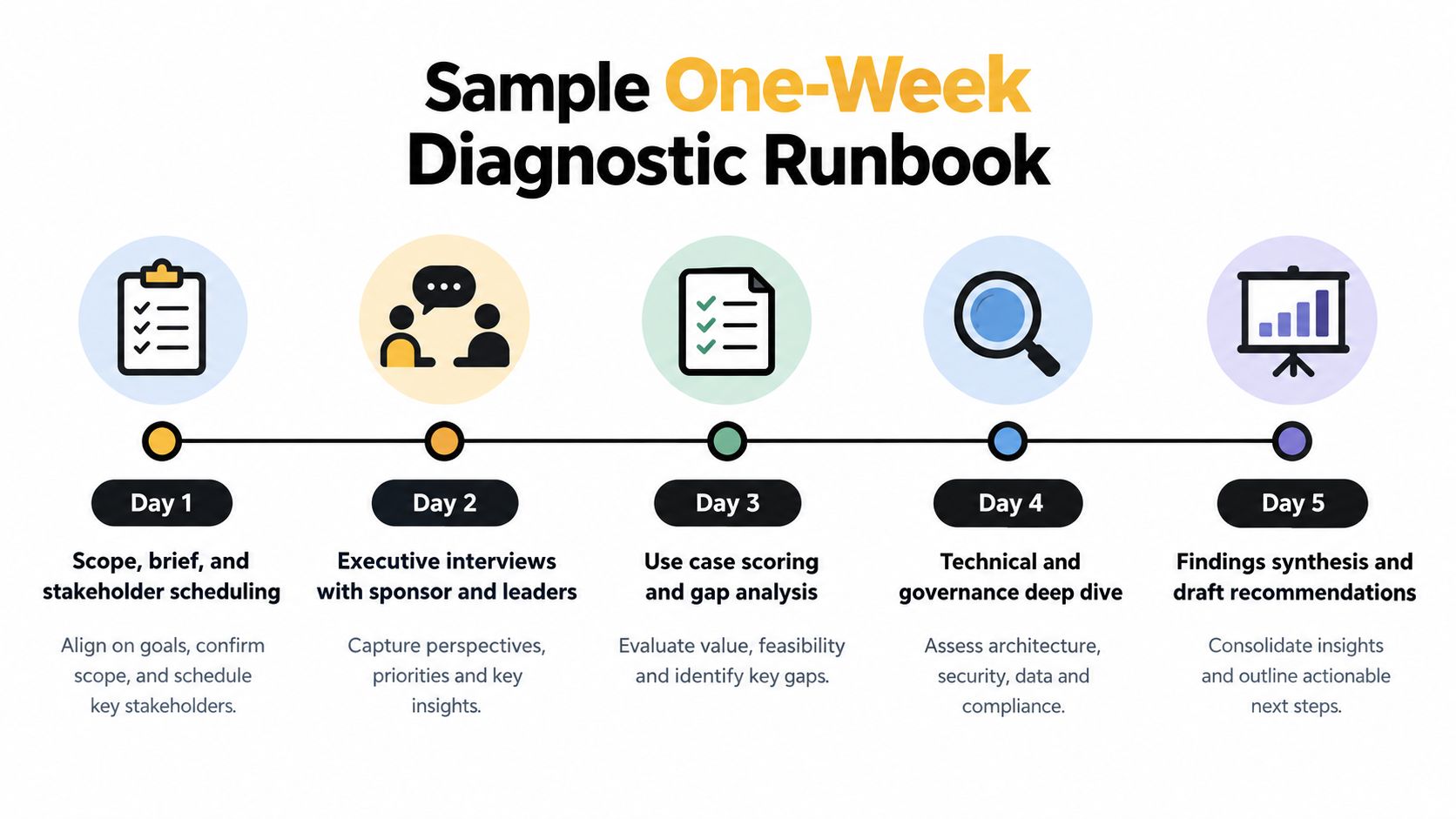
Day by Day
- Day 1, scope and scheduling: Confirm sponsor, brief, in-scope functions, artifact list, and interview calendar. Publish exclusions in writing.
- Day 2, executive interviews: Meet sponsor, business owners, and risk leads. Test outcome ownership, risk tolerance, and decision rights.
- Day 3, technical deep dives: Work with engineering, data, and security on access, APIs, evaluation, observability, and rollback. Review current-state artifacts against claims.
- Day 4, scoring and gap testing: Score use cases, run failure scenarios, and rate gaps critical, major, or minor. Challenge any priority use case missing an owner or baseline.
- Day 5, synthesis and draft roadmap: Present findings, the build versus buy versus hire call, and a working 90-day plan. Agree owners and dates before people leave.
Request artifacts in advance, including architecture diagrams, data access policies, pilot metrics, incident runbooks, and vendor contracts where relevant. Interviews should verify documents, not substitute for them.
This short walkthrough shows how a focused diagnostic sequence works in practice.
Handle derailers directly. If executives can't meet, use short sessions with pre-reads and written answers, then confirm decisions live. If a stakeholder resists scrutiny, return to the sponsor and the agreed scope. If scope expands midweek, log the new request for a later cycle instead of diluting the current one.
Turning Findings into a 90-Day Roadmap
Translate gaps into three 30-day phases, each with an owner, a milestone, and a definition of done. Sequence governance and observability before scale. An agent you can't monitor or stop shouldn't gain broader permissions because a pilot looked promising.
The mismatch you're planning around is common. Deloitte's State of AI in the Enterprise research describes organizations feeling strategically prepared while less prepared in infrastructure, data, risk, and talent, with only one in five companies having a mature governance model for autonomous agents. It also found 14% of large organizations had implemented agents at partial or full scale and another 23% were piloting them.
Three Phases
- Days 1 to 30, close critical gaps: Appoint the accountable owner, approve permission boundaries, define escalation and incident response, and set go or no-go gates.
- Days 31 to 60, prove in shadow mode: Stand up evaluation, logging, and human review for the top two use cases. Compare agent decisions with human outcomes without executing actions.
- Days 61 to 90, limited production: Release one use case to a bounded population with override, rollback, and daily review. Hold a formal build versus buy versus hire review using pilot evidence.
For a mid-market company, done at day 90 might mean one invoice agent in limited production, a tested rollback, and a named owner reporting accuracy, override rate, and cost per transaction weekly. That's more valuable than five pilots with no operating discipline.
Questions Leaders Ask Next
How often should you rerun the assessment? Rerun it when a use case changes risk tier, gains new tool access, or moves from shadow mode to execution. A calendar reminder alone won't catch those shifts.
Fractional leader or permanent hire? Choose fractional coverage when you need accountable direction now and the role scope is still forming. Choose a permanent hire when agent operations are a durable, funded function.
What if the board wants a number you can't support? Give the range, state the missing evidence, and name the test that will produce a defensible figure. Don't convert uncertainty into false precision.
If your assessment shows strong pilots but no accountable owner to carry them into production, Head of Agents can run a one-week Agent Readiness Audit and match you with verified fractional or full-time agent leaders who have shipped to production. Start there to turn your scored use cases, gap analysis, and 90-day roadmap into a staffed program with clear ownership.