Build vs Buy AI Agents: Enterprise Decision Framework 2026
Enterprise guide to build vs buy AI agents — compare cost, control, and speed with a practical decision framework for your organization.
Written by HeadOfAgents
76% of enterprise AI use cases were purchased in 2025, up from 47% built internally in 2024. Buying is the practical default, but it isn't a universal answer, and 95% of generative-AI pilots still produce no measurable P&L impact when ownership and governance are missing.
That should change how you approach build vs buy AI. The market has moved toward packaged solutions because enterprise budgets matured and production needs became harder to satisfy with experiments. Menlo Ventures estimates that enterprise generative-AI spending rose from $11.5 billion in 2024 to $37 billion in 2025, a 3.2-fold year-over-year increase, while purchased use cases became more common.
But a purchased agent doesn't own its permissions, business process, escalation policy, or outcome. Your company does. The decisive question is therefore not only whether you should build or buy an agent. It's whether someone inside the organization is accountable for making the choice work in production.
| Decision dimension | Build | Buy | Buy and extend |
|---|---|---|---|
| Best fit | Differentiated workflows and proprietary data | Standardized capabilities and urgent deployment | Commodity core with organization-specific orchestration |
| Main advantage | Control and customization | Speed and external operational capability | Balance between speed and control |
| Main risk | Long-term maintenance without a clear owner | Lock-in and weak internal governance | Extension creep and unclear responsibility |
| Required internal strength | Engineering, security, evaluation, and operations | Product ownership, procurement, integration, and governance | All of these, divided clearly across teams |
| Default recommendation | Use selectively | Start here for commodity use cases | Prefer this when the workflow is unique but the platform isn't |
The Build-Buy Reality Shift and the Missing Variable
The market signal is clear. Menlo Ventures reported that 47% of enterprise AI solutions were built internally and 53% were purchased from vendors in 2024. Its 2025 research found that 76% of enterprise AI use cases were purchased, implying that approximately 24% were built internally.
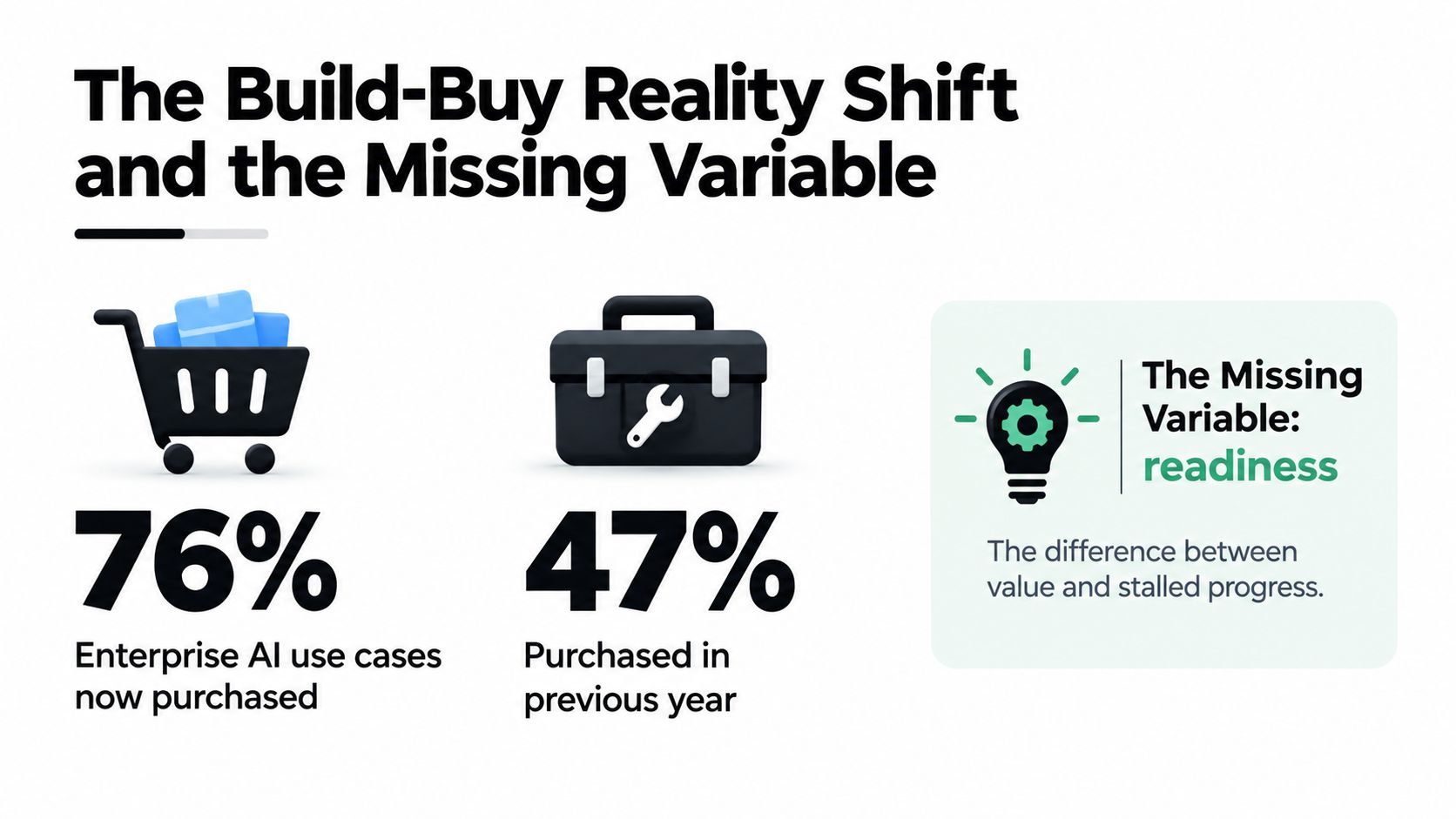
That shift doesn't prove that vendors create more value in every situation. It shows that enterprises are increasingly willing to purchase core capabilities, then focus internal effort on integration, workflow orchestration, security, data boundaries, and governance. As budgets expanded, companies stopped treating every agent as a research project and started asking which layers they genuinely need to own.
The uncomfortable counterpoint is that deployment activity doesn't equal business impact. MIT NANDA research reported that 95% of generative-AI pilots produced no measurable P&L impact, while external partnerships using customized, learning-capable tools reached deployment more often than internally built tools. A bought agent can therefore fail in a different way from a built agent. It may launch quickly, accumulate users, and still produce no accountable business result.
Ownership is the missing variable
Most decision guides compare license price, engineering effort, customization, and launch speed. Those criteria matter, but they omit the operating model. Who approves the agent's access to customer records? Who owns evaluation sets when the workflow changes? Who decides when the agent must hand work to a human? Who handles an incident, vendor outage, quality regression, or unexpected behavior?
If nobody can answer those questions, both paths are premature. A build without ownership becomes an abandoned internal product. A buy without ownership becomes an uncontrolled dependency that users adapt around.
Practical rule: Don't approve an agent budget until one named leader owns the workflow outcome, risk acceptance, evaluation process, and production roadmap.
Buying can reduce technical workload, but it doesn't transfer accountability. The vendor may provide infrastructure, model access, support, and controls. Your organization still owns the decision to expose data, change a process, accept residual risk, and measure value.
Treat portability as an operating requirement
Vendor lock-in isn't limited to contract terms. It can enter through prompts, workflow definitions, evaluation data, permissions, user habits, and proprietary configuration. Before you buy, document what you can export, how you can reproduce evaluations, and how much of the orchestration layer can move elsewhere.
A practical resource for this work is SpecStory, Inc.'s SpecStory portability guide, which can help teams frame portability before a platform becomes embedded in daily operations. The point isn't to avoid every vendor relationship. It's to ensure that your organization retains enough control to change models, vendors, or orchestration components when the economics or risk profile changes.
Five Criteria That Actually Determine Build vs Buy Success
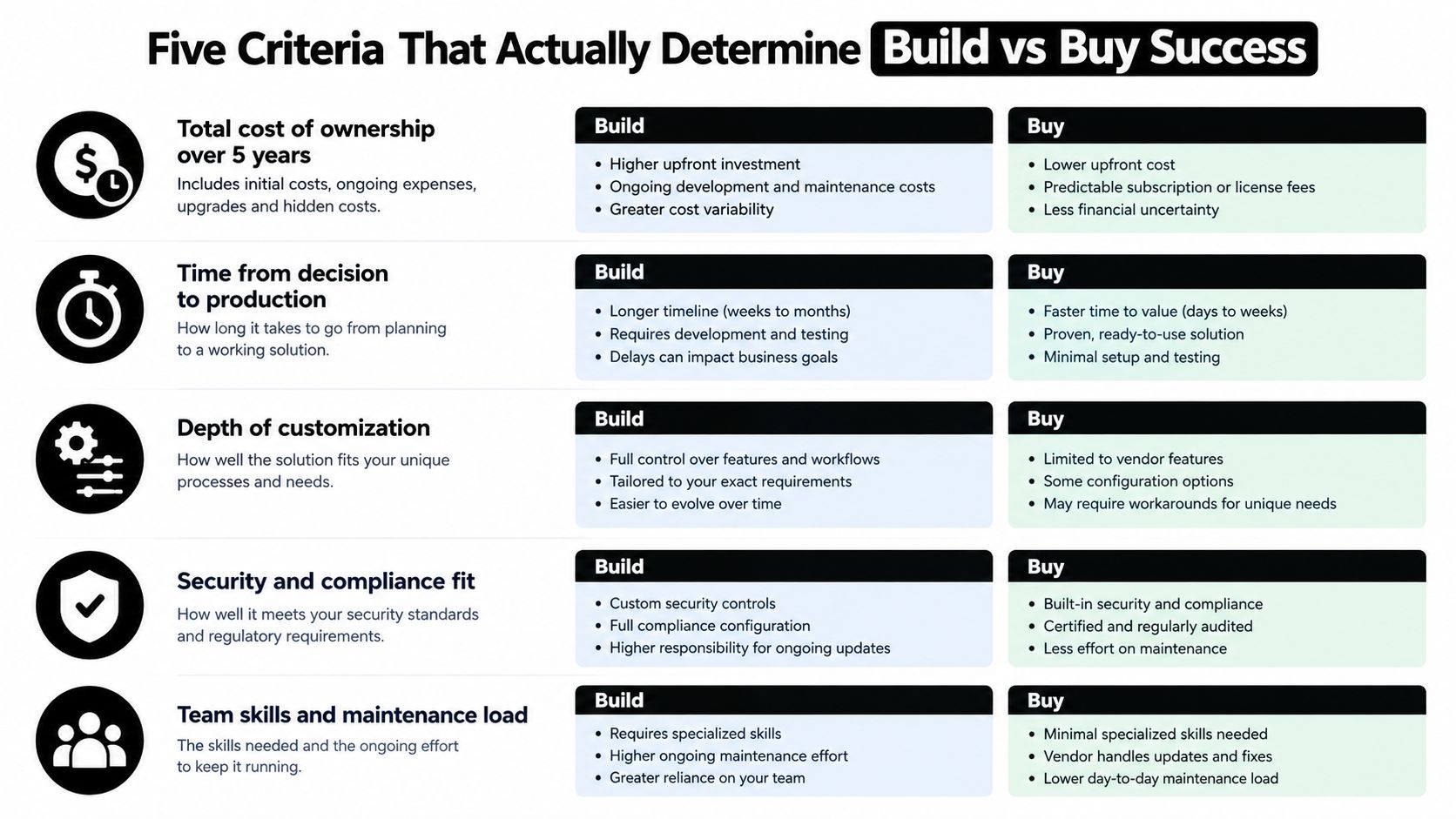
A feature checklist produces a procurement winner, not necessarily a production winner. Evaluate both paths against the full ownership burden, then make the decision based on the constraint that can stop deployment.
Total cost of ownership
Build looks attractive when the first estimate focuses on engineering time and infrastructure. The full burden includes evaluation tooling, monitoring, security reviews, incident response, retraining, documentation, and the opportunity cost of keeping engineers on a system that isn't the company's differentiator. Build wins when proprietary data or workflow control creates durable value that justifies those obligations.
Buy makes cost more visible, but not automatically lower. Implementation, integration, usage growth, governance work, renewal exposure, and migration risk still belong in the model. The verdict favors buy when the capability is standardized and the vendor's operating investment replaces work your team would otherwise have to create.
For a practical modeling structure, use this AI cost estimation models guide to separate one-time delivery costs from recurring operational costs.
Time from decision to production
Build can move quickly from idea to demonstration, especially when the workflow is narrow and the team already understands the data and integrations. It slows when security, reliability, permissions, auditability, and human escalation become production requirements.
Buy usually wins when the workflow is common and the vendor has credible integration patterns. Don't confuse a fast configuration with a production rollout. Your team still needs a controlled evaluation, stakeholder acceptance, access reviews, monitoring, and a support path.
Depth of customization and differentiation
Build wins when the agent is part of the product, depends on proprietary feedback loops, or encodes a workflow competitors shouldn't be able to copy. It also wins when no purchased product can represent the required decisions without forcing harmful process compromises.
Buy wins when users need a familiar capability rather than a unique one. If the process is broadly standardized, custom code creates ownership obligations without creating strategic advantage. The hybrid path is strongest when the platform handles the generic capability and your team builds the integration, policy, and orchestration layer that makes it useful.
Security and compliance fit
Build offers control over architecture, data handling, access rules, and audit design, but your organization must implement and maintain that control. A team that lacks security and governance capacity shouldn't choose build merely because a vendor's controls feel restrictive.
Buy can provide established controls and operational evidence, but the customer must verify isolation, retention, access administration, logging, incident procedures, and contract language. The verdict depends less on whether the product is purchased and more on whether the control model matches the workflow's risk.
Team skills and maintenance load
A build requires sustained ownership across engineering, product, security, data, and operations. A buy requires internal expertise in integration, vendor management, configuration, adoption, and governance. Neither path is maintenance-free.
Choose build only when the organization can staff the whole lifecycle. Choose buy when the vendor's capability offsets a genuine internal gap, not when leadership is trying to avoid appointing an accountable owner.
The Deployment Probability Gap and What It Means for You
The most useful comparison isn't the estimated cost of a build against a subscription quote. It's the probability that either option will reach controlled production and generate validated business value.
An MIT-cited comparison found that external partnerships using learning-capable, customized tools reached deployment 67% of the time, compared with 33% for internally built tools (deployment comparison and evaluation guidance). Treat that as directional, not universal. Use-case complexity, internal engineering maturity, governance requirements, and partner quality can change the result.
The implication is straightforward. A build that appears cheaper on paper becomes expensive if it stalls before production. A vendor that deploys successfully but fails task-quality or adoption tests isn't a success either. Model expected value as production probability multiplied by validated business impact, then subtract lifecycle and switching costs.
Turn the statistic into gates
Don't ask a vendor to promise production readiness. Test it against a representative workflow, held-out evaluation data, real permission boundaries, and failure recovery. Run the same discipline against an internal build.
| Metric | Build path benchmark | Vendor path benchmark | Decision threshold |
|---|---|---|---|
| Pilots reaching production | Measure across internal initiatives | Verify with production references and your proof | Choose the path with evidence, not an optimistic forecast |
| Prototype-to-rollout time | Track from approved prototype to controlled release | Measure configuration, integration, and approval time | Stop if the timeline misses the business window |
| Task success rate | Test on representative workloads | Test the vendor on the same held-out set | Proceed only when quality meets the workflow requirement |
| Human escalation rate | Record uncertainty and exception handling | Verify routing, queueing, and audit behavior | Require a defined escalation path before launch |
| Peak-concurrency reliability | Stress the complete internal stack | Stress the vendor integration and service limits | Reject any option that fails under expected demand |
Ask what the vendor really brings
A credible partner contributes more than model access. Look for integration readiness, workflow customization, observability, security controls, production references, and a clear incident path. If the vendor can't demonstrate those capabilities in your environment, its deployment claim has little decision value.
Internal teams should face the same standard. Strong engineering talent doesn't replace production evidence. Require a working slice, measurable acceptance criteria, rollback behavior, and an owner who will operate the system after the pilot team moves on.
The cheapest path is the one that reaches a controlled production outcome without creating an unowned system.
Three Enterprise Scenarios That Reveal the Right Path
The right answer changes with the workflow, the risk, and the organization's ability to operate what it chooses. These scenarios show why a simple preference for build or buy produces weak decisions.
A regulated financial services firm
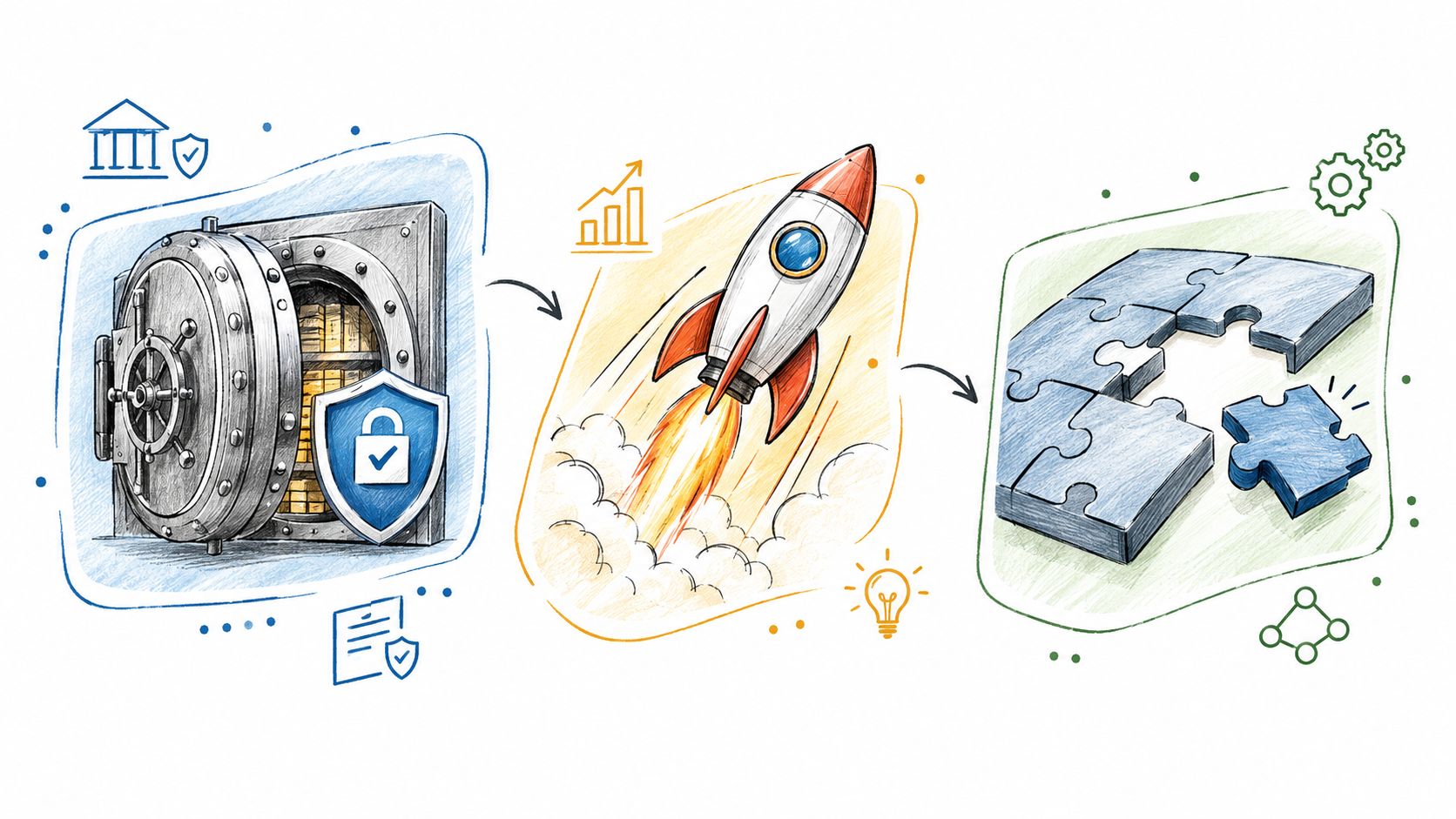
The company has a proprietary fraud-detection workflow, strict data-residency requirements, and a small set of decisions where false positives create operational consequences. A generic purchased agent might offer a fast interface, but it can't dictate the organization's policy logic or satisfy every data boundary.
The sensible route is buy the core agent capability and build the specialized layer. The purchased component can provide standard agent functions, while internal engineering owns the fraud-specific tools, permissions, evaluation set, escalation logic, and residency controls.
The trigger condition is differentiation combined with control requirements. A full build may create unnecessary infrastructure work, while a pure buy may surrender too much control. The lesson is to own the part that creates the advantage and govern the rest tightly.
A mid-market SaaS company
The company wants customer-support agents for several standard support workflows. Its engineering team is focused on the product roadmap, and the support organization needs a dependable capability without creating a new internal platform.
Here, buying a proven platform is the rational direction. The workflow is standardized, the value comes from consistent execution rather than proprietary agent mechanics, and a vendor can reduce the time spent creating basic evaluation, monitoring, and administration capabilities.
The company still needs an internal product owner. That person defines acceptable answers, approves knowledge sources, monitors escalation, manages access, and decides whether the agent is improving the support process. Buying removes unnecessary construction. It doesn't remove management.
A large manufacturer with no agent leader
The manufacturer wants agents across legacy enterprise systems, but nobody owns the program. Engineering sees integration work, operations sees process risk, security sees access exposure, and procurement sees a vendor decision. Each group can identify a problem, but no one can make the complete call.
Neither build nor buy is ready. Appoint an accountable leader first, then run a readiness audit against one workflow. That leader should establish the use-case portfolio, define permissions, select evaluation measures, assign escalation ownership, and decide whether each layer should be built, purchased, or extended.
The lesson is blunt. Legacy complexity doesn't make buying the answer, and technical capability doesn't make building the answer. Missing ownership blocks both.
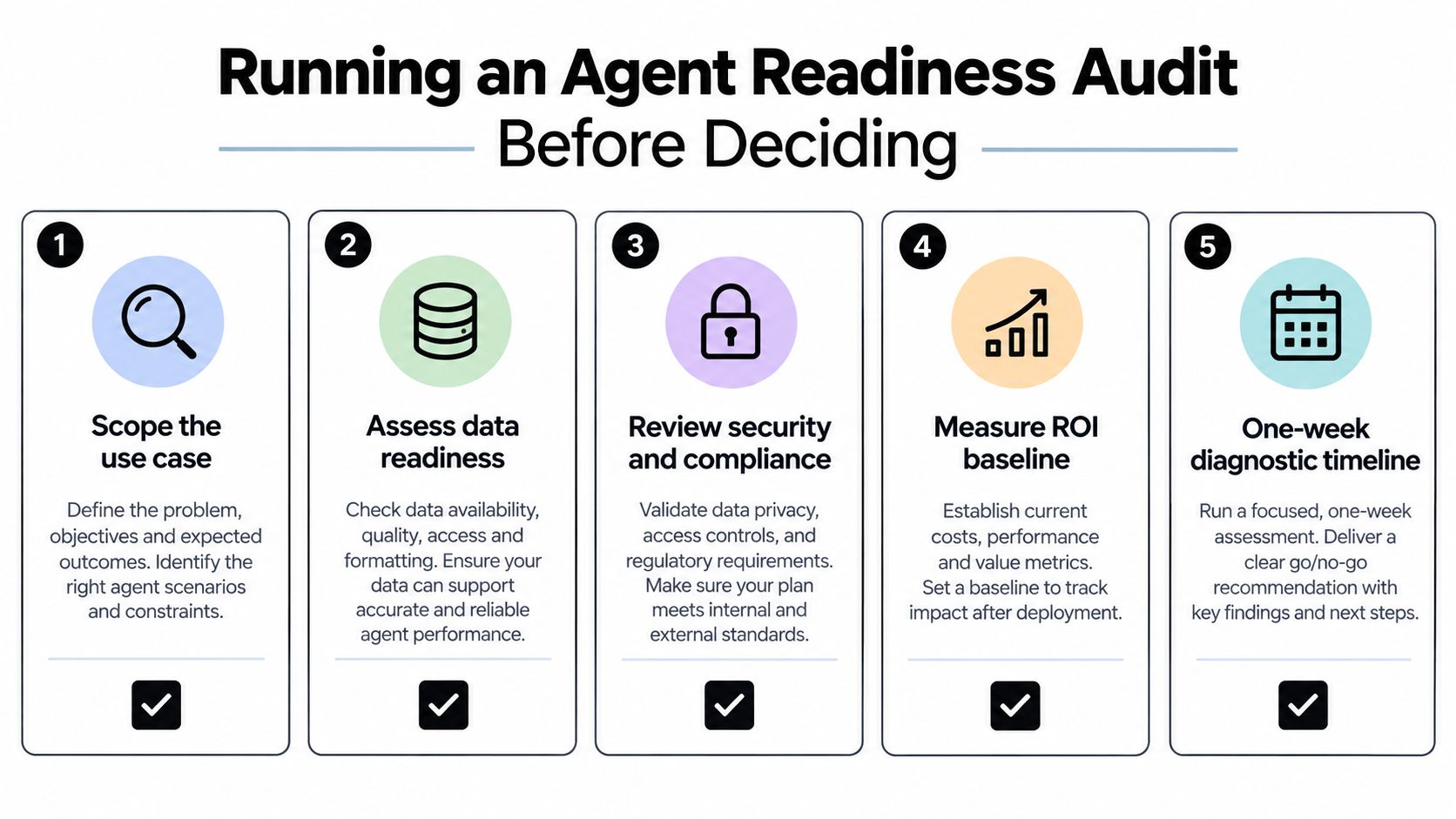
Running an Agent Readiness Audit Before Deciding
A readiness audit should produce a decision, not another presentation. The fastest useful audit maps the work, exposes governance gaps, tests delivery capacity, models the full cost, and ends with a named owner and a near-term plan.
Step one maps the use case
List candidate workflows and write the business outcome in operational terms. Don't start with “we need an agent.” Start with the work that must change, the people affected, the systems touched, the cost of failure, and the evidence that would demonstrate improvement.
Score each use case qualitatively for ROI potential and technical feasibility. Prioritize a workflow with a clear decision boundary, accessible data, manageable escalation, and an owner who can approve changes.
Step two examines governance
Review data access, retention, permissions, audit trails, hallucination exposure, human escalation, incident response, and vendor concentration. Ask who can authorize an action, who reviews exceptions, and who can shut the system down.
The governance gap is material. A 2025 Gartner survey found that 75% of IT application leaders were piloting, deploying, or had deployed an AI agent, while only 13% strongly agreed that their organizations had the right governance frameworks. The same survey reported that 74% viewed agents as a new attack vector, and only 19% had high or complete trust in vendors' ability to prevent hallucinations (Gartner survey findings).
Step three tests delivery maturity
Separate the ability to prototype from the ability to operate. Review engineering capacity, integration ownership, security review processes, evaluation practices, observability, support coverage, and the team's experience handling model or workflow changes.
A weak internal build capability doesn't automatically justify buying. It may indicate that the organization needs an external implementation partner, a stronger internal owner, or a narrower first use case.
Step four models five-year ownership
Build a cost model that includes development, integration, infrastructure, evaluation, monitoring, security, staffing, training, workflow change, vendor renewals, migration, and switching costs. Put internal labor into the model even when it isn't charged to the project.
Compare build, buy, and buy-plus-extension using the same assumptions. If one option leaves major costs unnamed, the comparison isn't ready.
Step five produces the recommendation
End with one of three recommendations: build, buy, or hire before deciding. Add the accountable owner, the first production workflow, the evaluation method, the governance gates, and the next ninety-day sequence.
A practical audit checklist should answer:
- Outcome: What business result must change?
- Workflow: Which steps can the agent perform, recommend, or never control?
- Data: What information can it access, and under which permissions?
- Risk: What happens when the output is wrong or unavailable?
- Ownership: Who approves, monitors, escalates, and retires the system?
- Economics: What costs continue after deployment?
- Portability: What can the organization export or replace?
- Evidence: What test result authorizes the next gate?
A one-week diagnostic can create enough clarity to stop a weak initiative or narrow a viable one. For a deeper explanation of the governance and evidence requirements, see this audit readiness guide.
Use the following briefing as a companion to the audit process.
Why Hiring an Agent Leader Should Come First
The third option in build vs buy AI is hire before deciding. That isn't a delay tactic. It's a recognition that an agent program needs one person who can connect strategy, workflow design, engineering, security, procurement, and measurable business outcomes.
The governance evidence makes the staffing problem visible. Organizations are deploying agents while a much smaller share strongly agrees that the right governance framework exists (Gartner survey findings). A vendor can supply technology, but it won't accept your internal risk, decide which permissions are appropriate, or own whether the workflow improves.
Give one leader the full mandate
The accountable owner should control evaluation standards, permissions management, human escalation, incident response, vendor concentration risk, portfolio prioritization, and value measurement. The title may be Head of Agents, Head of AI, or another equivalent role. The mandate matters more than the label.
A full-time leader makes sense when the program is strategic and broad. A fractional Head of AI model can fit an organization that needs experienced ownership while it validates demand, establishes governance, and determines the long-term operating model.
Head of Agents provides audits, market data, and access to verified leaders for agent ownership roles. Treat that as one route to accountable leadership, alongside internal promotion or another qualified external partner.
Don't sign a major agent contract or fund a broad internal build until the owner can answer five questions: what outcome matters, what can the agent access, how quality will be tested, who handles failure, and what makes the investment worth continuing.
Head of Agents can run a one-week Agent Readiness Audit, map use cases by ROI and feasibility, identify governance gaps, and produce a build-vs-buy-vs-hire recommendation with a 90-day roadmap. Visit Head of Agents to secure accountable leadership before your next agent investment becomes another stalled pilot.