Cost Estimation Models for AI Agent Programs
Learn cost estimation models for AI agent programs. Compare TCO, activity-based, and ROI approaches to plan build, buy, or hire decisions with real examples.
Written by HeadOfAgents
Early-stage cost estimates for AI agent programs can be inaccurate by up to 400%, so no single formula deserves commitment-level authority at the start. Modern practice favors calibrated, multi-method models that combine parametric estimates, historical analogies, activity data, and continuous validation.
That finding changes the leadership question. The goal isn't to discover a magical number for an agent program. The goal is to build a cost model that helps executives choose among build, buy, and hire, understand uncertainty, and update the decision as scope, labor, governance, and operating conditions change.
Why Early Estimates for AI Agent Programs Often Miss
A project can look small on a planning slide and become expensive once people define what production readiness really means. An early estimate might cover workflow design, model usage, and implementation. It may not yet include evaluation, access controls, audit evidence, escalation paths, monitoring, retraining, incident response, or the leadership capacity needed to coordinate all of it.
The historical warning is stark. Early lifecycle software estimates have been reported as inaccurate by up to 400%, while documented prediction errors in the literature range from 32% to 1,107%. The classic validation work behind these lessons compared SLIM, COCOMO, Function Points, and ESTIMACS against completed projects. The strongest model explained 88% of the behavior of actual man-month effort in that dataset, yet substantial project-level error remained, as documented in the ACM empirical validation record.
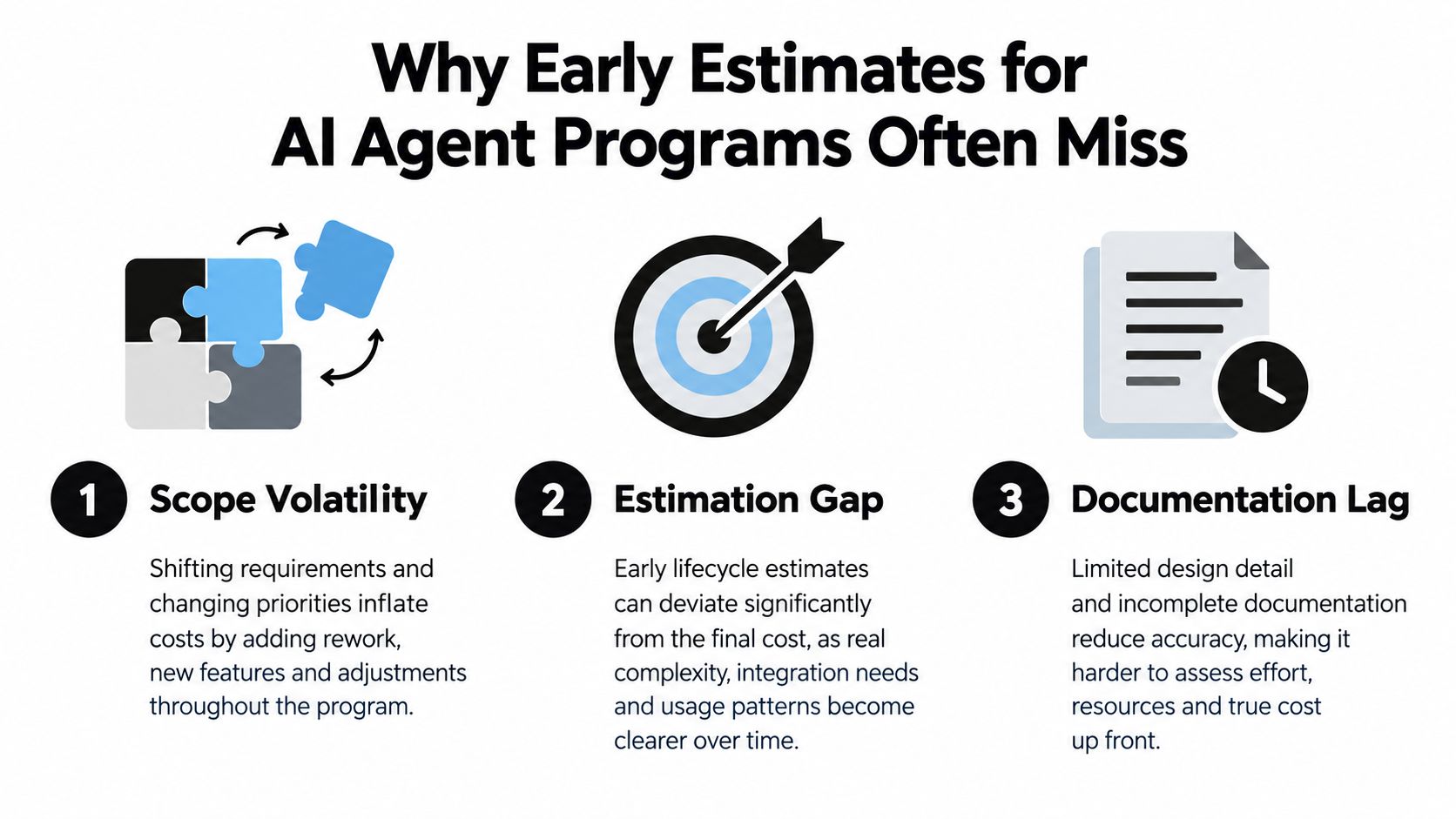
Scope changes faster than the spreadsheet
Consider an enterprise team that starts with an internal support agent. The first brief says the system will answer questions from approved documents. During discovery, stakeholders add ticket creation, identity-aware responses, human escalation, multilingual support, access logging, and quality review. The original estimate wasn't necessarily careless. It described a different system.
Agent programs amplify this problem because the boundary between product, workflow, governance, and operations is fluid. A change in autonomy can alter evaluation requirements. A new data source can introduce security work. A request for reliable action, rather than text generation, can create integration and rollback obligations.
Practical rule: Treat the first estimate as a decision range with explicit assumptions, not as a promise disguised as precision.
Statistical fit isn't delivery certainty
A model can fit historical behavior and still miss the next program because the next program has different scope volatility, staffing constraints, data quality, or governance expectations. The Kemerer validation study found that model choice alone wasn't enough. Calibration and local parameter tuning materially affected error, and uncalibrated models were more appropriate for rough-order planning than commitment-grade budgeting.
Leadership teams should therefore ask three questions before approving a figure:
- What is included: Does the estimate cover only implementation, or also operation, governance, and ownership?
- Which assumptions are unstable: Which requirements, usage patterns, integrations, and staffing decisions could change the result?
- How will the estimate be corrected: What completed work, usage data, and scope changes will trigger a new calculation?
A multi-method estimate doesn't eliminate uncertainty. It makes uncertainty visible enough for leaders to decide whether to fund discovery, purchase a capability, hire an owner, or stop a weak use case before more money is committed.
Core Cost Drivers in AI Agent Programs
Simple headcount multiplied by project duration misses the cost structure of an agent program. A useful model separates fixed costs, variable costs, and hidden operating costs, then assigns each to a decision owner.
Platform and implementation choices
Fixed costs can include architecture, integration design, environment setup, security review, and initial evaluation. Variable costs rise with activity, such as model calls, retrieval, workflow execution, data processing, human review, and support volume. A platform decision affects both categories, but the effect depends on how much the organization must customize and operate itself.
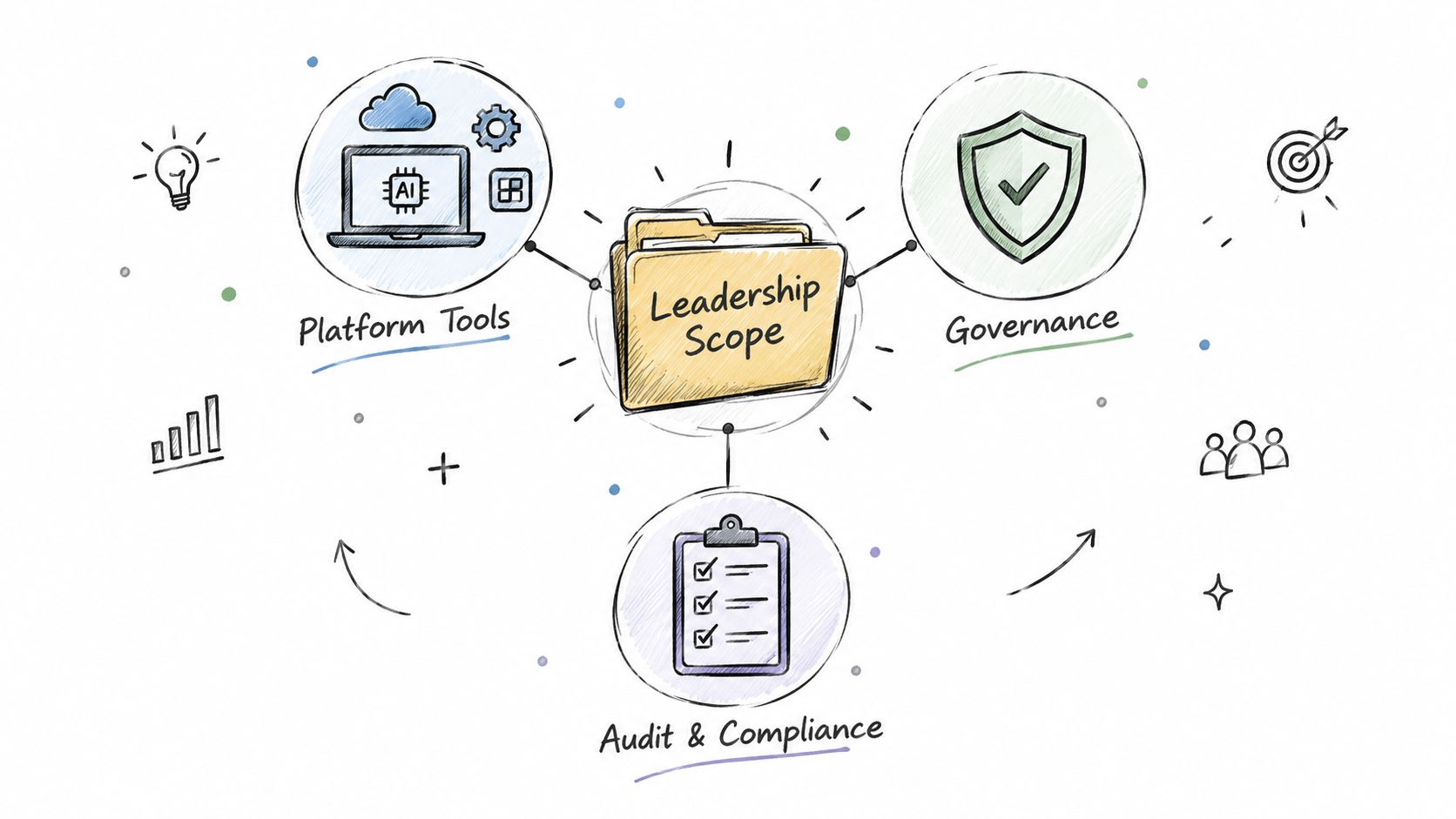
The platform isn't the whole program. A leadership team should map every required capability around it:
- Workflow ownership: Who defines the use case, approves changes, and owns business outcomes?
- Integration work: Which systems must the agent read from or write to, and how will failures be contained?
- Evaluation: How will the team test factuality, policy adherence, tool selection, escalation, and regression?
- Operations: Who monitors behavior, investigates incidents, manages releases, and retires stale workflows?
A practical overview of the architectural choices behind Beam for agentic applications can help teams frame platform requirements before they turn those requirements into a budget.
Governance and audit are delivery costs
Governance isn't a separate administrative layer that appears after launch. It changes the design, staffing, documentation, testing, and approval workload from the beginning. Regulated workflows may need traceable decisions, access controls, retention rules, human checkpoints, incident records, and evidence that the system behaved within policy.
That work is often omitted because the initial request describes a user experience rather than an operating model. The estimate should attach cost to each control, identify its owner, and record whether the control is required before pilot, before production, or during ongoing operation.
Leadership scope and maintenance
The senior owner coordinates product priorities, engineering delivery, risk decisions, procurement, adoption, and measurement. A narrow implementation estimate can look reasonable while the organization remains unable to decide which use cases deserve production investment.
Maintenance also has a different shape from ordinary feature work. Source documents change, permissions change, workflows change, models change, and evaluation sets become outdated. Teams should connect operating costs to the performance measures they use, including the measures described in this agent performance metrics guide.
The right estimate reflects program readiness and ownership, not just raw engineering capacity.
Common Cost Estimation Approaches for Agent Leadership
No approach answers every leadership question. The practical choice is to use each model where its assumptions fit, then reconcile the outputs rather than forcing one method to carry the entire decision.
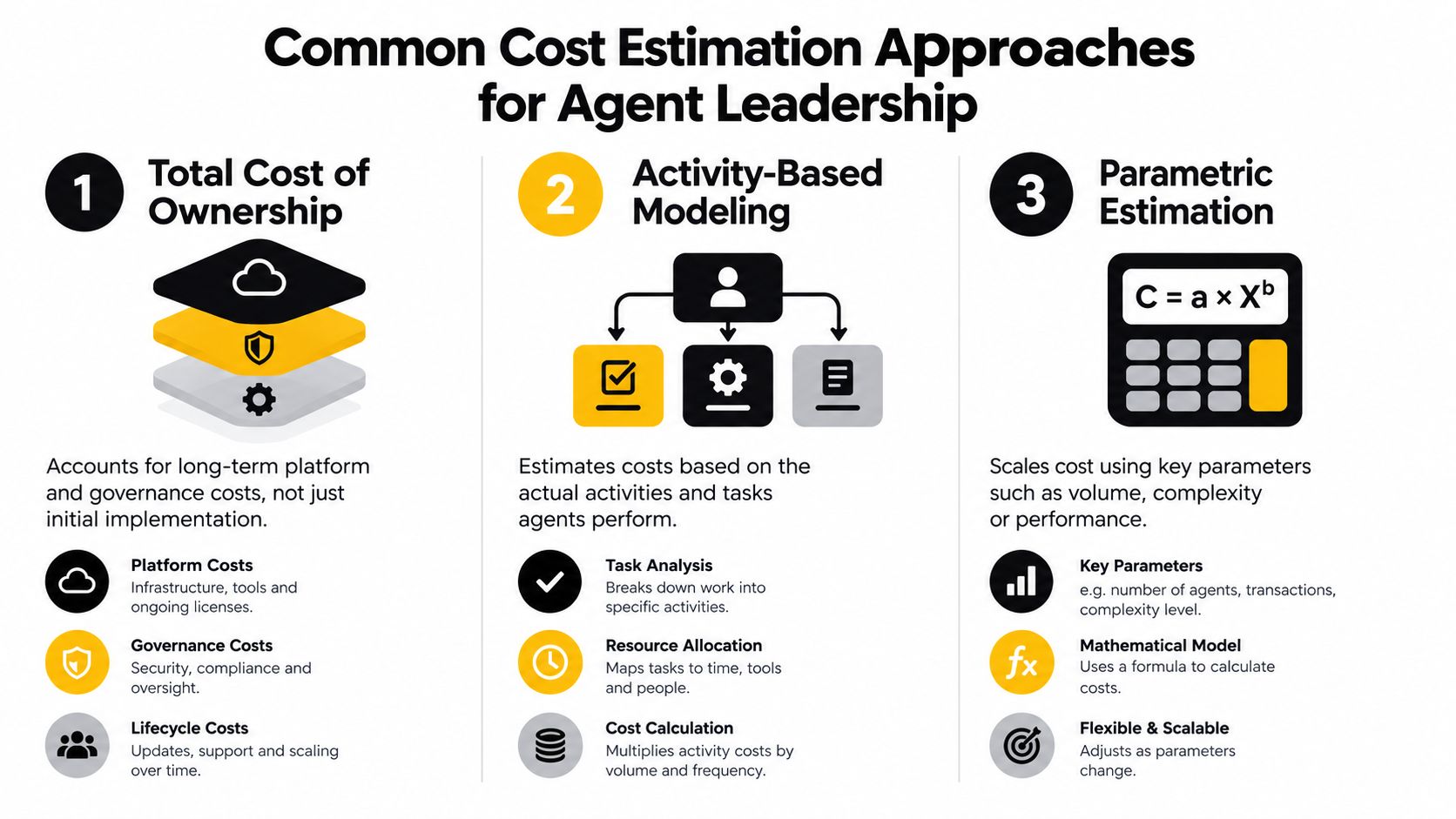
Total cost of ownership
TCO asks what the program will consume across its useful operating life. It includes implementation, platform access, integrations, governance, leadership, monitoring, support, change management, and retirement. TCO works best when an executive is comparing a durable internal capability with a purchased service or a short pilot.
Its strength is completeness. Its weakness is sensitivity to assumptions about duration, adoption, usage, and future operating requirements. Use a range, document the drivers, and separate costs that are unavoidable from costs that depend on scale.
Activity-based modeling
Activity-based modeling assigns cost to work units rather than treating the program as one block. For an agent, those units might include a workflow, a transaction, an escalation, a review, an integration, or an evaluation cycle.
This approach is useful when leadership wants to know which use cases consume resources and why. It also exposes cross-subsidies. A low-volume workflow may require expensive controls, while a high-volume workflow may create substantial variable usage and support demand.
Build the model from an operational map:
- Define the activity: State what the agent does and where a human takes over.
- Assign resources: Map engineering, operations, governance, support, and leadership effort.
- Attach variable drivers: Record usage, review frequency, data movement, and incident handling.
- Recalculate by scenario: Test low, expected, and high workload assumptions without pretending that one forecast is certain.
Parametric estimation
Parametric models scale an estimate from selected drivers, such as workflow complexity, integration count, autonomy, data sensitivity, required assurance, or expected operating volume. They provide speed and consistency, especially when historical project records are limited.
The risk is false confidence. If the parameters don't represent the organization's actual delivery environment, the formula produces a neat answer with weak decision value. Historical analogy and expert review should challenge the result before anyone treats it as a budget.
ROI and scenario analysis
ROI analysis connects cost to an outcome, but it shouldn't reduce the decision to a single ratio. Compare the financial and operational consequences of building internally, purchasing capability, or hiring an accountable leader. Include adoption uncertainty, time to readiness, switching costs, governance exposure, and the value of preserving strategic control.
For leadership hiring, model full-time, fractional, and implementation-partner scenarios separately. The relevant question is not only what each option costs, but which bottleneck it removes and which responsibilities remain with the company. Teams evaluating role scope can also find the right agent plan before converting an engagement choice into a spreadsheet assumption.
Use the accompanying video as a prompt for reviewing how your assumptions connect to the operating model, not as a substitute for local data.
How to Choose and Calibrate Your Cost Model
Start with the decision, not the formula. A build-versus-buy decision needs lifecycle cost and control assumptions. A hiring decision needs role scope, operating maturity, and engagement scenarios. A pilot decision needs a bounded activity model and a clear rule for expanding, revising, or stopping the work.
Match the method to the evidence
Use a parametric model when the program has a stable set of measurable drivers. Use historical analogy when you have completed projects that resemble the proposed workflow. Use activity-based modeling when the workload and human involvement are easier to describe than the final architecture.
Then compare the outputs. If the methods disagree materially, don't average them into a false midpoint. Identify which assumption creates the difference. One model may include governance and support while another counts only implementation effort.
Calibrate against completed work
Calibration means fitting model coefficients or assumptions to the organization's own delivery environment. That matters because vendor defaults and generic benchmarks rarely capture local engineering velocity, approval friction, data readiness, procurement delays, or operating discipline.
A study using 86 historical defense-project records found that calibrating COCOMO II raised PRED(0.30) from 0% to 45%, and that adjusting both multipliers and the exponent performed better than adjusting multipliers alone, as reported in the calibration study. The lesson transfers directly to agent programs: stable historical data can reduce systematic bias, but only when teams preserve comparable definitions and record actual outcomes.
Create a calibration register with:
- Baseline inputs: Scope, complexity, integrations, staffing, governance, and operating assumptions.
- Actual outcomes: Delivered effort, elapsed time, rework, support load, and changes in scope.
- Variance reasons: Separate estimation error from approved requirement changes.
- Update rules: Define when coefficients, ranges, or category weights must change.
Validate continuously
A model should change when the program changes. Recalculate after discovery, architecture approval, pilot results, material scope changes, staffing decisions, and meaningful shifts in operating volume.
The AI agent platform comparison can support the platform part of that review, but it won't replace internal calibration. Leadership still needs a record of what the organization can deliver, govern, and operate.
Keep the estimate explainable. An executive can approve a range with visible assumptions. They can't responsibly approve a number that no one can decompose.
Example Calculations and Estimation Templates
A useful template doesn't pretend to know missing inputs. It gives each decision a structure, a set of assumptions, and a recalculation rule.
Start with a program ledger that separates categories:
| Cost category | What to record | Update trigger |
|---|---|---|
| Build | Discovery, design, integration, testing, and release effort | Scope or architecture change |
| Buy | Subscription, configuration, migration, support, and exit work | Contract or usage change |
| Hire | Compensation, recruiting, onboarding, and leadership coverage | Role scope or engagement change |
| Operate | Monitoring, evaluation, incident response, review, and maintenance | Workload or control change |
| Govern | Security, compliance, audit evidence, and approvals | Risk classification or policy change |
Build scenario
Use a formula such as:
Build cost = discovery + implementation + integration + evaluation + governance + launch support
A spreadsheet should contain one row per activity, a low and high assumption, the owner, the evidence source, and the date of the last review. Don't hide governance inside a generic contingency line. If the program requires additional controls, show the work explicitly so leadership can decide whether the control is necessary, deferrable, or a reason to reject the use case.
Buy scenario
A purchase model should cover more than the recurring license:
Buy cost = access fees + configuration + integration + migration + assurance + support + exit cost
The exit line matters. A purchased capability can create switching work through data formats, workflow dependencies, training, and operational knowledge. The model doesn't need to predict the future perfectly. It needs to prevent the team from comparing a complete build estimate with an incomplete purchase estimate.
Hire scenario
For an accountable leader, structure the comparison around coverage:
Hire cost = compensation or engagement cost + search effort + onboarding + supporting team capacity
Then ask what remains unfunded. A leader may establish priorities and governance while engineering, security, data, and operations still perform the work. A fractional engagement may cover decision-making without replacing implementation capacity. A full-time appointment may improve continuity while increasing the organization's obligation to provide a meaningful mandate.
For a ready-to-use planning structure, the Head of Agents cost estimator can help organize compensation and engagement scenarios. Use its output as an input to your own calibrated model, not as a universal answer.
Turn the spreadsheet into a decision
Present each option with:
- Assumptions: What must be true for the estimate to hold?
- Range: What changes between the lower and upper case?
- Owner: Who is accountable for each cost category?
- Decision gate: What evidence permits expansion?
- Stop condition: What result makes continuation irrational?
This format turns a cost estimate into an operating contract between finance, technology, security, product, and the executive sponsor.
Common Misconceptions About Cost Estimation Accuracy
The most accurate-looking model isn't automatically the most useful one. Early estimates are less precise when design and documentation are limited, and that limitation applies particularly strongly when teams haven't settled the agent's autonomy, integrations, controls, or operating responsibilities.
Precision isn't the same as trust
A model that produces a narrow range can still be weak if its inputs are uncertain. Conversely, a wider range can support a better decision when it identifies the assumptions that would move the result.
Recent review work highlights a real trade-off: higher-accuracy AI models can sacrifice interpretability and objectivity, while early-stage estimates remain less precise by nature because design and documentation are incomplete, as discussed in the EC3 review. Leaders should ask not only, "How accurate is this?" but also:
- Can we explain it: Can finance, engineering, and governance owners understand the drivers?
- Can we challenge it: Can someone test the assumptions without rebuilding the model?
- Can we update it: Can new project data change the estimate without starting over?
- Can we act on it: Does the output clarify whether to build, buy, hire, defer, or stop?
Static models lose relevance
A static estimate becomes stale when scope, labor availability, material or service prices, usage, and operating conditions change. A 2025 software-estimation report describes low confidence in estimates when teams rely on static models that don't evolve with project data, while a 2026 review identifies data instability, weak cross-regional generalization, and low interpretability as continuing constraints for AI and machine-learning approaches. Those findings are summarized in the software estimation outlook.
Dynamic estimation doesn't mean reacting to every minor movement. It means defining meaningful triggers and updating the model when they occur. A new integration, a higher autonomy requirement, a changed approval rule, or a sustained workload shift should produce a visible revision.
Decision standard: Use rough estimates to fund learning. Use calibrated estimates to approve commitments. Use live estimates to manage the program after approval.
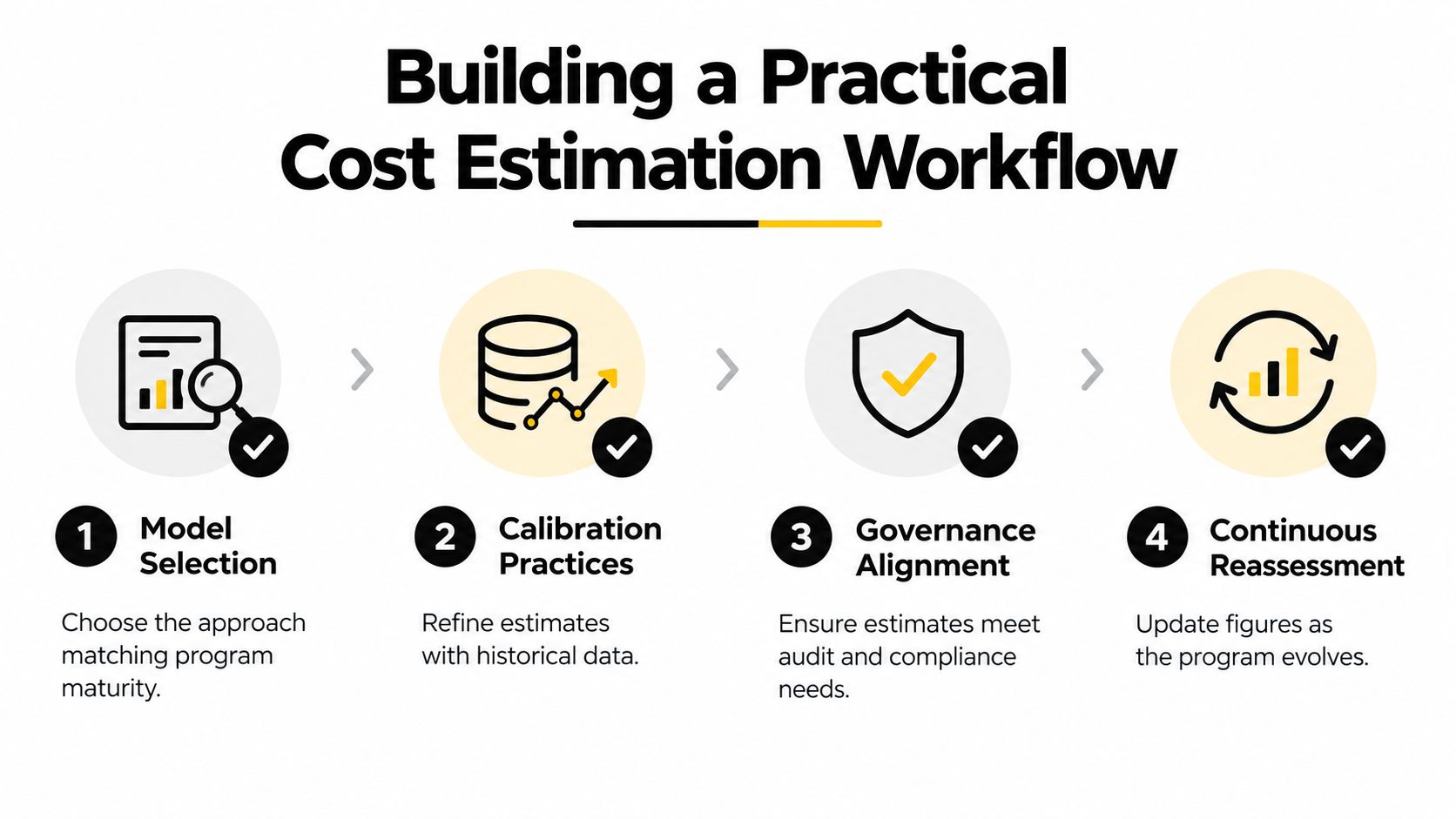
Building a Practical Cost Estimation Workflow
A repeatable workflow keeps cost modeling connected to delivery rather than leaving it as an annual planning exercise.
- Select the model: Match TCO, activity-based, parametric, analogy-based, or scenario analysis to the decision and the evidence available.
- Define the scope: Record workflows, users, integrations, autonomy, human review, controls, and operating ownership.
- Calibrate the inputs: Compare assumptions with completed work and separate genuine estimation error from approved scope change.
- Set decision gates: Specify what discovery, pilot, quality, governance, and adoption evidence is required before expansion.
- Reassess on triggers: Update the estimate when scope, staffing, architecture, usage, or control requirements materially change.
- Communicate uncertainty: Show ranges, assumptions, confidence, and the action attached to each scenario.
The final deliverable should serve three audiences at once. Executives need a decision and its consequences. Delivery teams need assumptions they can execute against. Governance and finance teams need traceability, ownership, and a record of revisions.
Cost estimation models become valuable when they help the organization make a better decision under uncertainty. They don't need to predict the future perfectly. They need to reveal what the program requires, what could change, and who must act when it does.
Head of Agents helps enterprises structure AI agent leadership decisions through readiness audits, build-versus-buy-versus-hire recommendations, verified leadership matching, and compensation and engagement scenarios. Visit Head of Agents to turn an uncertain agent budget into a documented ownership and delivery plan.