Fractional CTO Guide for AI-Agent Leadership
Learn what a fractional CTO does, when to hire one, how engagement models work, what they cost, and how to evaluate candidates for AI-agent leadership.
Written by HeadOfAgents
Your team has an AI-agent pilot that looks promising. Engineers are choosing models, product leaders are promising a launch, and someone has connected the agent to internal systems. But when you ask who can approve its actions, stop its deployment, or explain its failures to the board, the answers point to different people.
You don't necessarily need another engineer. You need an accountable technology leader, and a clear decision about whether that leadership should be fractional, permanent, or project-based.
Why Companies Hire a Fractional CTO
Consider a company preparing to move a customer-support agent beyond internal testing. The engineering lead owns implementation, the product manager owns the customer experience, and security reviews access requests. Nobody owns the trade-off between broader permissions, commercial value, and operational risk.
Hiring a fractional CTO can close that gap, but only if the executive receives authority to resolve it. Adding an experienced person to meetings won't fix a structure in which every consequential decision still lands on the founder's desk.
The discussion should bring business and engineering leaders around the same operating decisions.

Hire for a leadership gap
The strongest reason to hire isn't that a permanent executive feels expensive. It's that the company faces consequential technical decisions without enough senior leadership to make them coherently.
Define the gap in practical terms:
- Business priority: Which commercial objective requires a technology decision?
- Missing judgment: What can't the current leadership team confidently resolve?
- Expected outcome: What must change before the engagement ends?
- Executive sponsorship: Who will support decisions when stakeholders disagree?
The model belongs to a broader shift toward contract and part-time executive leadership. A fractional-work market report estimated approximately 120,000 fractional professionals globally in 2024, compared with 60,000 in 2022. Treat that estimate as directional, not a definitive census, because the category combines different forms of executive work.
My recommendation is narrower than the market trend: hire a fractional CTO for a defined leadership problem, not as a discounted substitute for an undefined executive role. Establish the expected decisions, operating responsibilities, and exit conditions before discussing candidates.
What a Fractional CTO Actually Does
A fractional CTO is a technology executive working part time or within a defined engagement. The useful distinction isn't employment status. It's whether the person has responsibility for technical direction and the authority to act within an agreed scope.
Think of a building architect retained for selected stages of construction. The architect doesn't need to perform every task, but consequential design choices still require judgment and clear sign-off. Likewise, a fractional CTO shouldn't need to review every change to remain accountable for architecture and engineering standards.
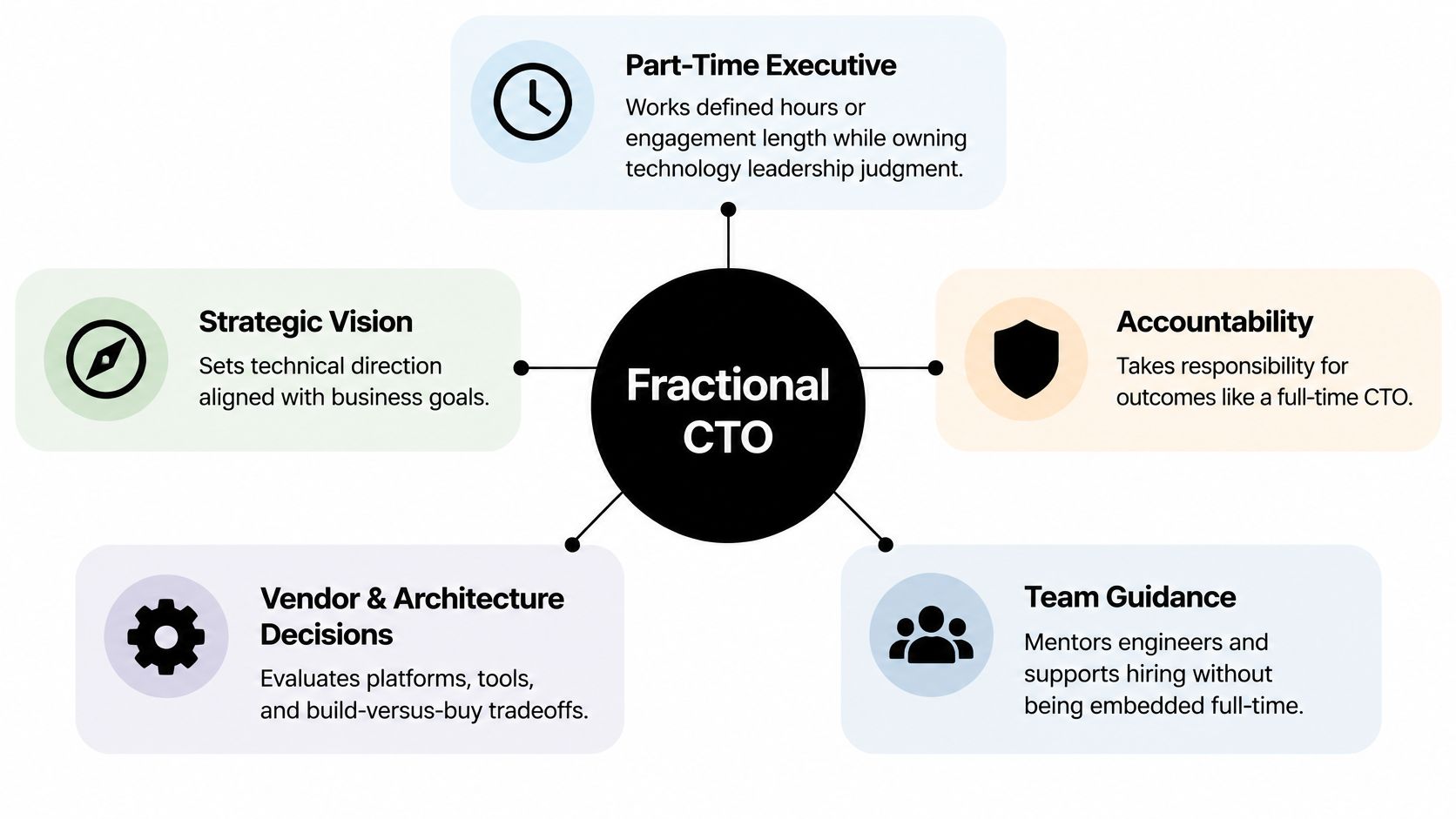
The responsibility map separates executive work from additional delivery capacity.
Direction is different from participation
Strategic leadership means choosing technical priorities that support the business. Technical stewardship means evaluating architecture, dependencies, and operational exposure. Organizational work includes clarifying reporting relationships, improving hiring decisions, and coaching existing leaders.
Hands-on work can belong in the engagement, but define it explicitly. Reviewing a critical integration is different from becoming the team's default implementer. If the executive spends the engagement clearing development tickets, you're buying delivery capacity under an executive title.
The same discipline applies to specialist support. In a healthcare setting, a resource such as devPulse's consulting for regulated healthcare tech can be considered for a bounded specialist assignment. The internal executive sponsor must still decide who accepts recommendations and owns implementation.
Practical rule: An adviser recommends a decision. An accountable executive has a defined role in making it, implementing it, and explaining the result.
Make availability operational
Specify scheduled leadership participation, response expectations, urgent escalation coverage, and delegated authority during absences. Don't imply continuous coverage through an agreement that only funds scheduled advice.
A fractional CTO also isn't automatically an interim placeholder or a consultant with a different title. The arrangement can be a continuing part-time executive role, a transition assignment, or focused leadership during a transformation. Judge the contract by its operating responsibilities.
Use this video as an additional discussion aid when aligning stakeholders on the role.
When a Fractional CTO Is the Right Hire
A temporary decision problem and a permanent leadership requirement need different hiring decisions. Start with that distinction rather than company size or budget alone.
A young company choosing architecture and vendors may need senior judgment before it needs a permanent executive team. An established business modernizing a platform may need focused transformation leadership while its existing managers run delivery. A company facing an executive absence may need continuity until a successor arrives.
For an AI-agent program, the fit depends on whether someone inside the business can execute and sustain the decisions made by the fractional leader.
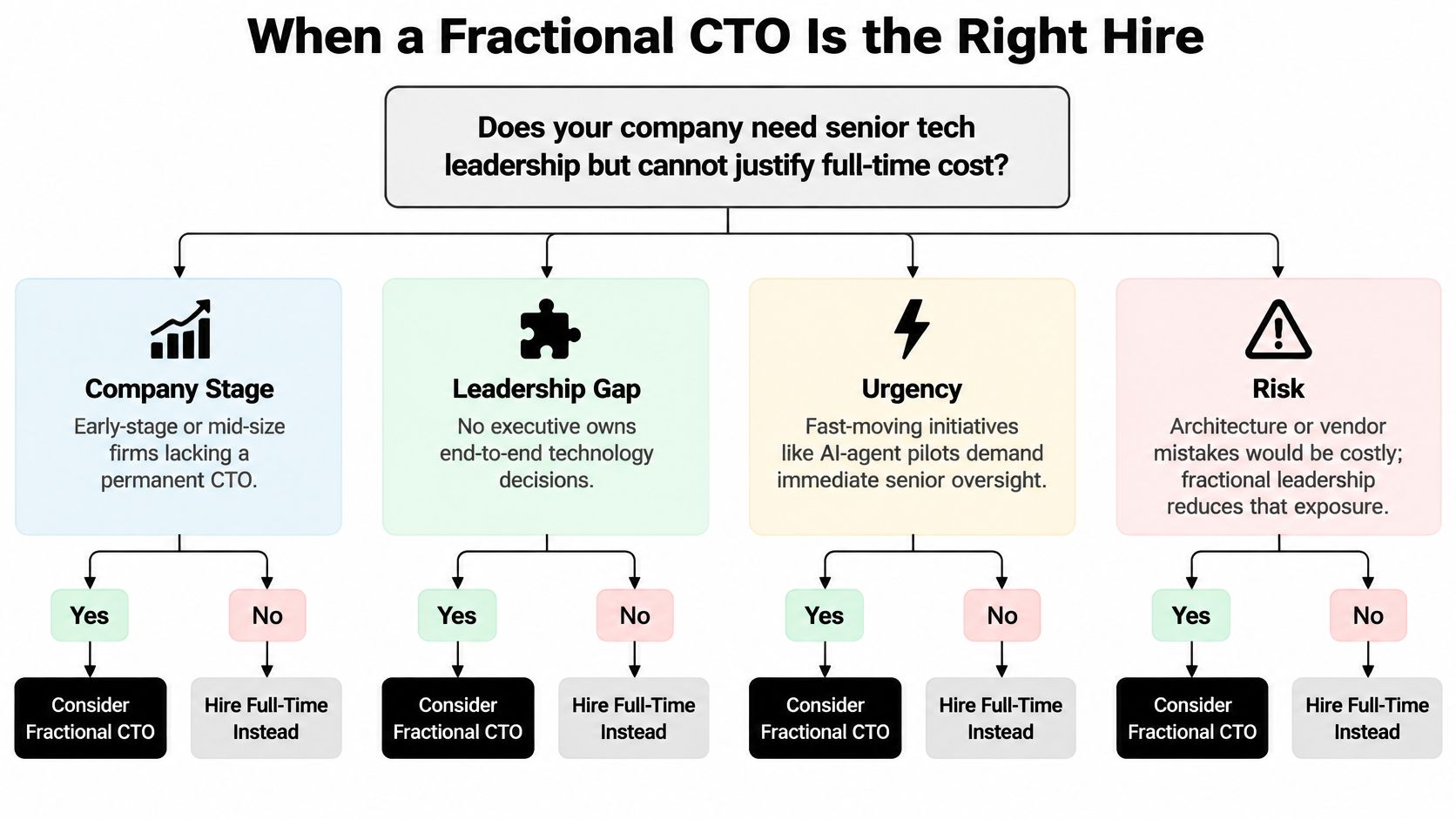
Diagnose the constraint
Use these signals to distinguish a useful engagement from an attractive but inadequate hire:
- A bounded milestone favors fractional leadership. Examples include acquisition diligence, fundraising preparation, platform selection, or establishing an agent operating model.
- A capable delivery team strengthens the fit. The executive can guide decisions without becoming responsible for every implementation task.
- Urgency requires coverage, not just experience. If decisions arise continuously, limited availability may be the wrong operating model.
- Risk demands explicit backing. A fractional leader can't enforce release conditions if business sponsors routinely override them.
For agent initiatives, an AI readiness assessment can help separate leadership gaps from missing data access, weak evaluation practices, or insufficient implementation capacity. Don't recruit an executive to solve a problem that requires a delivery team.
Know when to choose permanent leadership
Hire a full-time CTO when the company needs sustained, organization-wide technology ownership, continuous people leadership, and an executive whose responsibilities won't meaningfully narrow after the immediate initiative.
Pause the search if nobody can define the outcome or sponsor the role. A senior title won't resolve disagreement about the business objective.
Choose fractional leadership when the need is substantial but bounded. Choose permanent leadership when the responsibility is continuous.
An engineering leader may be enough when technical strategy is settled and the gap is day-to-day delivery management. Don't add a C-suite layer because execution needs attention.
Responsibilities and Deliverables That Create Accountability
Write the engagement as an operating contract, not a list of topics the CTO will discuss. Every responsibility should identify a decision owner, a tangible work product, an acceptance condition, and an escalation path.
Give the executive access to relevant systems, financial assumptions, engineering leaders, and business sponsors. Accountability without access, funded capacity, or decision rights is an empty promise.
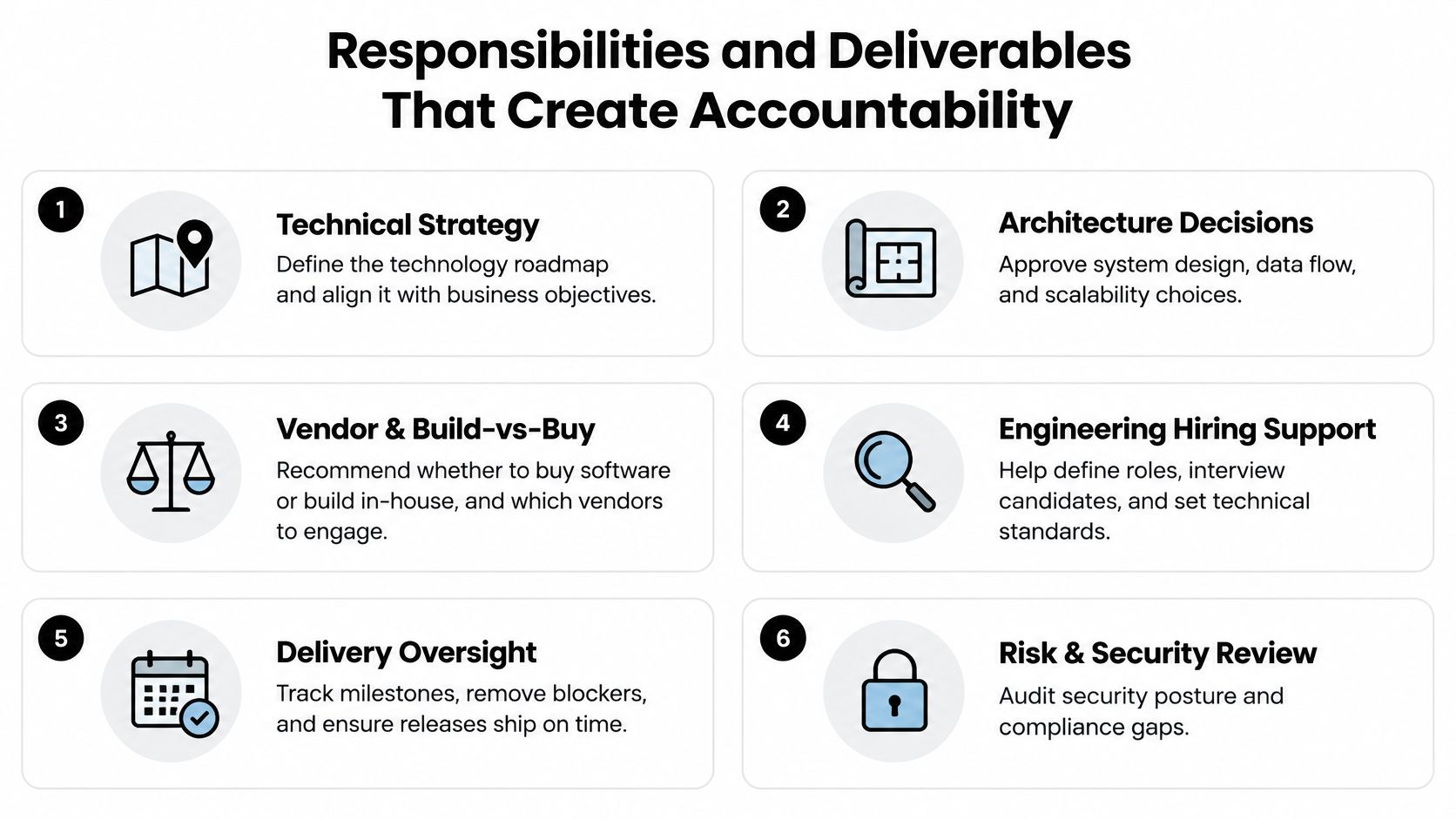
The core responsibilities should translate into inspectable outputs.
Require operating evidence
Ask for a technical roadmap linked to business priorities, an architecture decision log, documented build-versus-buy recommendations, and a hiring plan that distinguishes missing skills from missing capacity. Delivery oversight should expose blocked decisions and dependencies, not merely summarize ticket status.
Maintain a technical-debt register containing severity, age, affected services, unsupported dependencies, incident links, and remediation effort. Prioritize work that blocks revenue-critical changes or creates material reliability and security exposure.
The scale of the concern is visible in STX Next's survey of 500 CTOs, summarized by CTO Coach, in which 91% identified technical debt as their biggest challenge. The vendor-run survey is directional; the engagement should measure your own change lead time, escaped defects, and incident frequency rather than assume the survey describes your company.
Assign agent ownership across the lifecycle
The NIST AI Risk Management Framework organizes AI risk work around governing, mapping, measuring, and managing, with empowered and responsible individuals. Translate that principle into a responsibility matrix covering:
- Design and access: Agent boundaries, data and model selection, tool permissions, and approval thresholds.
- Release readiness: Evaluation ownership, acceptable error conditions, security review, and documented exceptions.
- Production operations: Monitoring, human escalation, audit logs, rollback, and incident response.
- Ongoing stewardship: Vendor risk, post-incident review, model changes, and retirement.
The fractional CTO may coordinate these responsibilities without personally performing each task. Legal, security, product, and engineering leaders retain their assigned decisions.
Establish a staged baseline
I recommend a 30-, 60-, and 90-day governance baseline, with timing adjusted to the program's risk. Begin with ownership, inventory, and risk tiers; move to evaluation gates and telemetry; then require evidence before expanding production use.
Track task success, factuality errors, unauthorized tool calls, escalation rates, latency, cost per successful task, and rollback time where relevant. Set thresholds from the use case and consequences of failure, not generic benchmarks.
End each executive operating review with decisions required, accepted risks, named owners, and unresolved exceptions. A dashboard without a decision process isn't governance.
How Fractional CTOs Differ From Other Leadership Options
Choose the model by the work you need someone to own. A title doesn't establish executive authority, and a project contract doesn't automatically create an internal leader.
The comparison below describes recommended contracting distinctions, not fixed rules. An interim executive can hold substantial authority; an interim consultant may only provide advice. Read the mandate rather than infer responsibility from the label.
Fractional CTO and alternative leadership models
| Model | Best for | Decision authority | Continuity | Main limitation | Transition signal |
|---|---|---|---|---|---|
| Fractional CTO | Defined-stage executive leadership | Delegated within an explicit mandate | Recurring but scheduled | Availability must match the workload | Decisions and people responsibilities exceed agreed coverage |
| Full-time CTO | Enduring technology and organizational ownership | Executive authority within company governance | Continuous leadership appointment | Commitment may precede a clearly defined need | Business scope changes enough to require a different mandate |
| Interim technical consultant | Bounded assessment or specialist recommendation | Advisory unless explicitly delegated | Assignment-based | Recommendations don't ensure adoption | Company needs ongoing decisions rather than an assessment |
| Consultancy | Implementation or transformation delivery | Project authority under contract | Team continuity for contracted work | Doesn't automatically become the internal business owner | Delivery ends and internal operations need ownership |
Match the model to the missing capability
If the company needs an independent architecture assessment, commission that assessment. Don't pay for recurring executive leadership when the deliverable is a recommendation your existing CTO can evaluate.
If the company has an approved roadmap but lacks implementation capacity, a consultancy may be the better choice. Name an internal sponsor who accepts deliverables, resolves scope questions, and takes responsibility after handover.
A fractional CTO is useful when those choices themselves require executive ownership. The person can coordinate internal teams and external specialists, provided the company delegates the necessary authority.
Treat people leadership separately
Don't leave performance management ambiguous. Coaching an engineering manager isn't the same as owning compensation, promotion, succession, or difficult employment decisions.
For a fractional arrangement, specify which people decisions remain with the permanent leadership team. For a full-time appointment, ensure the executive receives the organizational mandate implied by the role.
Contracting test: If the engagement ends tomorrow, who owns the next decision, the next incident, and the next performance conversation?
The strongest model is the one with a credible answer, not the one with the most impressive title. Moving between models should follow a change in responsibility, not disappointment that an advisory agreement failed to provide executive coverage.
Engagement Models and Cost Planning
A low retainer isn't proof of an economical engagement. If internal leaders must reconstruct decisions, duplicate oversight, or wait for unavailable expertise, include that burden in the comparison.
KPMG reported that 74% of leaders required cost reviews during project approval and 70% used real-time monitoring dashboards in its AI quarterly pulse survey. Apply that scrutiny to the leadership arrangement, not only to agent infrastructure spending.
Engagement-model planning worksheet
| Scenario | Scope and authority | Duration | Internal time and dependency | Risk and failure exposure | Conversion trigger |
|---|---|---|---|---|---|
| Fixed-scope diagnostic | Assess and recommend | Ends at accepted findings | Interviews and evidence collection | Important gaps remain unexamined | Findings require an accountable implementation owner |
| Advisory sprint | Support bounded decisions | Ends at decision acceptance | Sponsor makes final decisions | Advice isn't adopted | Repeated decisions need delegated authority |
| Recurring part-time leadership | Own agreed executive responsibilities | Reviewed against operating need | Internal managers execute | Coverage gaps or concentrated knowledge | Persistent workload exceeds availability |
| Milestone transformation | Lead an agreed change | Through acceptance and handover | Delivery team and business sponsor | Migration, integration, and adoption failures | Transformation becomes ongoing operations |
| Bridge appointment | Stabilize and prepare succession | Through successor handover | Search and knowledge-transfer effort | Delayed succession | Permanent mandate is ready to fill |
Calculate the full economic comparison
Use the same planning horizon for each scenario. Your worksheet should include executive fees or employment costs, internal management time, delivery dependencies, transition effort, and exposure to delay or failure.
Estimate launch delays from your own commercial assumptions. Estimate duplicated pilot spending from actual budgets. Treat security incidents and vendor lock-in as uncertain scenarios, not guaranteed savings attributed to the hire.
Use cost-estimation models to structure assumptions, then test what happens if scope expands, the engagement lasts longer, or an internal manager leaves. MR2 Solutions also provides a resource to compare fractional vs full-time CTOs; use it to frame questions, not replace your own cost analysis.
Price the accountability you require
Separate advisory-only pricing from responsibility for production outcomes. The latter needs adequate availability, decision access, escalation arrangements, and implementation support.
Define conversion conditions before signing: recurring decisions exceed coverage, permanent staff lack an available executive owner, or the program requires continuous cross-functional leadership. Compare the cost of converting with the cost of repeatedly extending a structure that no longer fits.
How to Source and Evaluate Candidates
Start with an engagement brief, not a search for impressive CTO résumés. State the business problem, decision authority, availability requirements, and evidence needed to demonstrate success.
Agent leadership requires evaluation beyond general AI familiarity. Deloitte research covering 3,235 leaders across 24 countries found that only 21% of organizations had mature agentic AI governance, while 74% expected at least moderate agent use by 2027. The latter is an expectation, not an achieved adoption outcome.
Use the candidate process to test operational judgment, not presentation quality.
Ask for evidence and verify it
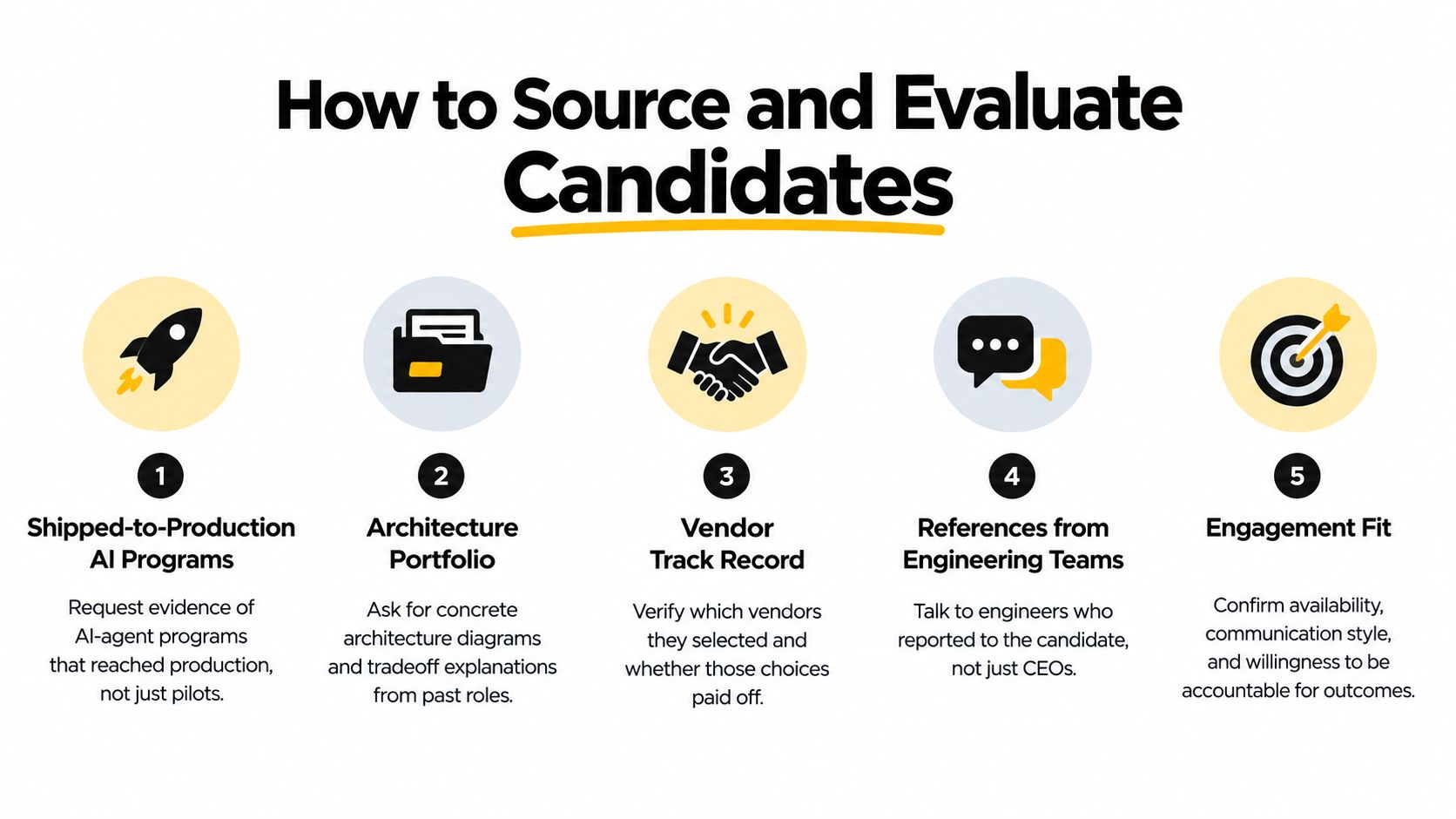
- Production experience: Request evidence of shipped agents, the candidate's personal decisions, and what happened after launch.
- Architecture judgment: Review sanitized diagrams and rejected alternatives, including vendor choices and exit considerations.
- Independent references: Speak with engineering colleagues and business sponsors. Separate their observations from self-reported results.
- Engagement fit: Confirm capacity, conflicts, communication expectations, and willingness to work within explicit decision rights.
Protect company identity during early screening when appropriate. Require disclosure of sourcing incentives, and exclude whoever oversees curation from eligibility for the shortlist.
Test a difficult decision
Give candidates a realistic case: an agent meets its task-completion target but occasionally attempts actions outside its permission boundary. Ask whether they would launch, restrict the workflow, change approvals, or stop deployment, and what evidence would change their decision.
Score business reasoning, governance judgment, delivery practicality, and clarity about uncertainty. Don't request unpaid production work or confidential material from previous employers.
An AI executive search process should distinguish executive ownership from staffing needs. If the assessment reveals an implementation gap instead, a route to hire developers from Brazil through HireDevelopers.com addresses a different requirement, not a replacement for leadership.
Convert the evaluation into a written mandate containing scope, acceptance criteria, sponsor responsibilities, review points, and handover obligations.
Make the Decision and Plan the Transition
Begin with the missing decision, not the preferred hiring model. Classify the requirement as advisory, transitional, or operational, then identify who must have authority to act.
Model the economic impact using your own assumptions. Agree on what evidence would justify extending the engagement, narrowing it, ending it, or converting the responsibility into a permanent appointment.
Questions the sponsor should answer
Before signing, record clear answers to these questions:
- Consequence: What happens if nobody owns this decision?
- Outcome: Which business or operating results must improve?
- Authority: What can the fractional CTO approve, reject, or escalate?
- Dependency: What would show that part-time coverage is no longer sufficient?
- Inheritance: What should a permanent successor receive?
Prepare the handover from the start
Require accessible records, not private knowledge held by the executive. A successor should inherit current architecture decisions, unresolved risks, ownership assignments, operating measures, and a candid account of what still isn't working.
Test whether the internal team can explain and run the agreed processes without the fractional leader directing every step. If it can't, distinguish incomplete knowledge transfer from a genuine need for ongoing executive leadership.
A fractional CTO works best as a deliberate, measurable bridge, not a way to avoid accountability. Choose the arrangement that matches the company's stage and risk, and change it when the evidence says the responsibility has changed. Success may mean a permanent hire, a narrower advisory relationship, or a completed engagement with no replacement needed.
Head of Agents offers agent-readiness audits, fractional leadership matching, and permanent placements for accountable AI-agent owners. Visit Head of Agents to assess the leadership gap, define the required mandate, and choose whether your next step should be fractional leadership, a permanent executive, or an implementation partner.