Fractional Head of AI: A Practical Guide for Leaders
Learn what a fractional head of AI does, when to hire one, what it costs in 2026, and how to evaluate, onboard, and measure ROI from part-time AI leadership.
Written by HeadOfAgents
The CTO approved three AI pilots last year. None reached production. Engineering is busy, product owns the roadmap, legal is asking who approved the model, and the board now wants a credible AI plan. That company doesn't need another polished strategy deck. It needs one accountable executive who can decide what stops, what ships, and what the organization must control before deployment.
That's the practical case for a fractional head of AI. The role sits between an advisor and a permanent chief AI officer, typically providing senior ownership on a part-time cadence rather than joining as a full-time executive. Industry descriptions place the commitment anywhere from roughly 8 to 32 hours per month, or approximately 2 to 5 days monthly, while other arrangements run from 2 days per month to 3 days per week. See the role definitions from Beyond Data's overview of fractional AI leadership and Iternal's explanation of the fractional chief AI officer role.
The key distinction is success measurement. A fractional leader should be judged by decision velocity, governance discipline, and shipped production use cases, not by the number of workshops held or documents delivered.
When a Part-Time AI Leader Makes Sense
The CTO in that scenario is facing a familiar pre-fractional moment. The company has enough technical talent to run experiments, but no one has the authority to sequence them across product, engineering, security, finance, and legal. Every team can explain why its pilot matters. Nobody owns the decision to kill two of them and concentrate resources on the one with a credible path to production.
A part-time AI leader can outperform both a full-time hire and a conventional consulting engagement when the bottleneck is executive coordination. The company may already have machine learning engineers, platform specialists, and product managers. What's missing is someone who can turn their work into an operating portfolio, set approval thresholds, challenge vendor claims, and report a coherent position to the board.
Four conditions point toward a fractional hire
- AI already sits on the product roadmap: The organization has real use cases, but delivery repeatedly stalls between prototype and production.
- Governance work is accumulating: Policies, vendor reviews, model evaluations, and risk decisions are being handled inconsistently by people whose primary jobs sit elsewhere.
- The executive team needs judgment before a permanent hire: The CEO or CTO wants an experienced operator to pressure-test priorities without committing immediately to a permanent C-suite search.
- The company has technical capacity: Engineers can build and deploy with the right direction. The missing capability is accountable prioritization, not basic implementation.
The model also works when the board wants an AI roadmap but the company isn't ready to create a permanent executive function. A fractional head of AI can establish decision rights, create the risk posture, and determine whether the eventual full-time role should be a Head of AI, chief AI officer, or a strong technical leader reporting to the CTO.
Operator's rule: If nobody can name the executive who has the authority to stop an AI project, the problem is leadership. If nobody can build or operate the system, the problem is engineering.
The model fails when leadership uses a fractional executive to disguise a talent shortage. A part-time strategist won't create missing data foundations, replace an absent engineering owner, or resolve a CEO who refuses to make trade-offs. Before signing, executives should ask a harder question: Do we need someone to make decisions, or do we need people to do the work?
What a Fractional Head of AI Does
A fractional head of AI is defined by cadence, decision rights, and operational deliverables. This is a part-time senior executive who owns AI strategy, governance, vendor selection, and roadmap execution, rather than providing detached recommendations. Beyond Data describes the role as an executive owner working part-time across these responsibilities.
Cadence determines impact
The leader may work 1 to 3 days per week, or use a smaller monthly retainer block, based on the company's active workstreams. Limited availability forces clear priorities. A fractional executive cannot attend every meeting, review every technical change, or manage each delivery issue personally.
Reserve their time for forums where decisions are made:
- Product and engineering roadmap reviews.
- Governance and risk reviews.
- Vendor and procurement decisions.
- Executive updates and board preparation.
- Escalations involving data access, security, compliance, or production readiness.
A leader who spends the engagement producing documents without entering these forums is functioning as an advisor, regardless of title. The arrangement should increase decision velocity and move viable use cases toward production, not generate a larger strategy deck.
Decision rights separate the role from consulting
The fractional head of AI should own the AI roadmap, use-case priorities, governance posture, and build-versus-buy recommendations. They may not control the full AI P&L or a permanent organization, but they need authority to approve, reject, defer, and escalate decisions.
That authority includes rejecting the CEO's preferred project when the evidence does not support it. If every executive request becomes a funded initiative, the role has failed.
Expected artifacts include:
- A prioritized use-case portfolio with named business owners.
- An AI policy and model-risk register.
- Vendor shortlists and evaluation criteria.
- Production-readiness gates.
- A written decision log.
- Board or executive reporting that connects activity to business outcomes.
Embedded execution is the defining test
The leader should review model evaluations, attend product planning, unblock data and platform teams, and require owners to define success before work begins. They do not need to write the model or configure the deployment. They must understand enough of the technical and commercial constraints to make consequential choices.
Use a direct test: Can this person reject a project on the company's behalf and explain the decision to the board? If the answer is no, hire an advisor for a defined deliverable instead. A 90-day engagement should make that answer visible through decisions made, work shipped, and risks stopped.
Fractional vs Full-Time Head of AI
The choice isn't primarily about title or prestige. It's about whether the company needs temporary executive support or a permanent operating function.
A full-time chief AI officer makes sense when AI spans multiple product lines, carries substantial regulatory exposure, requires a permanent organization, or has become a central part of the company's external commitments. The verified market material doesn't establish a universal revenue threshold, so executives should avoid using a fixed ARR number as a rule. Instead, assess whether AI now requires a permanent executive face, budget owner, and organizational mandate.
The fractional model fits when AI is strategically important but remains one of several major priorities. It also makes sense during a transition, while the board validates the operating model or the company searches for a permanent leader.
| Criterion | Fractional Head of AI | Full-Time CAIO |
|---|---|---|
| Company stage | AI is important, but the permanent organization is still forming | AI is a durable executive function |
| AI maturity | Several initiatives need sequencing and governance | Multiple production lines require continuous leadership |
| Budget | Supports senior ownership without a permanent executive commitment | Supports a permanent team, budget, and executive compensation |
| Ramp time | Fast access to judgment and operating discipline | Longer search and onboarding, deeper long-term integration |
| Scope | Roadmap, governance, vendor decisions, prioritization, and delivery oversight | Enterprise AI strategy, organization design, budget, talent, and sustained execution |
| Accountability | Contractual decision rights and named ownership within scope | Permanent authority on the org chart and executive team |
| Equity expectations | Usually limited or structured around the engagement | More likely to include long-term executive incentives |
| Typical failure mode | Scope drifts into meetings and strategy documents | Hire lacks the mandate, technical judgment, or organizational fit |
The trade-off executives underestimate
A full-time hire creates continuity, but continuity doesn't guarantee progress. If the company hasn't defined the decision rights, a permanent executive can inherit the same stalled portfolio and add another layer of management.
A fractional engagement creates speed and optionality, but the company must supply internal owners. Engineers, product leaders, security staff, and finance still need to act. The fractional leader coordinates and decides. They don't become a substitute for the operating team.
Decision test: Choose full-time when the company needs a permanent institution. Choose fractional when it needs an accountable operator to prove which institution should exist.
The wrong model is expensive in different ways. A failed permanent executive search can consume substantial cash, management attention, and runway. A drifting fractional engagement can produce a persuasive board narrative while leaving production unchanged. The slower decision is often cheaper than the wrong decision, provided the company defines a time-boxed test and measurable exit criteria.
Engagement Models and 2026 Compensation
The commercial structure should match the operating job. Use a monthly retainer when the leader must join recurring governance, product, and executive decisions. Use a project sprint for a bounded result, such as an evaluation framework, governance setup, or portfolio review. An equity-plus-cash arrangement can work for an early startup, provided the contract still names an accountable owner, decision rights, and production outcomes.
Market references for 2026 place fractional commitments at approximately 8 to 32 hours per month, 2 to 5 days monthly, or, for broader operating roles, 1 to 3 days per week. Those cadences sit between advisory access and full-time executive ownership. For a detailed breakdown of pricing structures and buyer questions, review this fractional head of AI cost guide.
| Engagement Model | Typical Cadence | 2026 Fee Range | Best Fit |
|---|---|---|---|
| Monthly retainer | Part-time recurring access | $8,000–$20,000/month | Ongoing roadmap, governance, vendor, and executive work |
| Project-based sprint | Defined days or milestones | $1,500–$3,000/day | Governance setup, model selection, portfolio triage, or an audit |
| Equity-plus-cash hybrid | Negotiated operating cadence | 0.1%–0.5% equity plus reduced cash | Early companies that need access but have limited cash |
| Interim executive bridge | Higher, operationally intensive cadence | $3,000–$6,000/day | Leadership gap, reset, acquisition integration, or permanent search |
These figures are starting points, not substitutes for scope. Seniority, authority, security requirements, and the number of teams involved should change the fee. A leader with authority to prioritize work and stop weak initiatives commands more than an adviser limited to workshops.
The fee is only one part of the cost. Security review, procurement, access approvals, legal contracting, and executive availability can delay the engagement before a decision is made. If the CEO cannot provide access, or every vendor discussion needs another internal committee, the company is paying for availability without gaining operating advantage.
Read the scope, not the label
A proposal covering a kickoff workshop, roadmap document, and final presentation is strategy consulting. It becomes fractional executive work only when the leader owns decisions, drives execution, and leaves behind production evidence.
Look for explicit contract language on:
- IP ownership: The company should own artifacts and work product created for its program.
- Kill clauses: Either side should be able to end the engagement when defined conditions are met or the fit is poor.
- Renewal mechanics: Renewal should depend on production outcomes, governance progress, or an agreed next phase.
- Decision authority: The contract should identify which decisions the leader can make and which require executive approval.
- Delivery evidence: The scope should name operational outputs, including shipped use cases, approved controls, or retired initiatives, rather than only meetings and documents.
A fair proposal states what the leader will stop doing, what the internal team must own, and how both parties will judge progress after the initial test. If the proposal avoids those questions, expect consultant theater instead of faster decisions and shipped production use cases.
Readiness Signals and When to Skip the Model
A fractional head of AI succeeds when the company has enough operating maturity to convert judgment into action. The role doesn't create readiness from nothing. It amplifies an existing product, engineering, and executive system.
Use each question as a diagnostic. Answer it in one sentence, without adding qualifications.
The readiness checklist
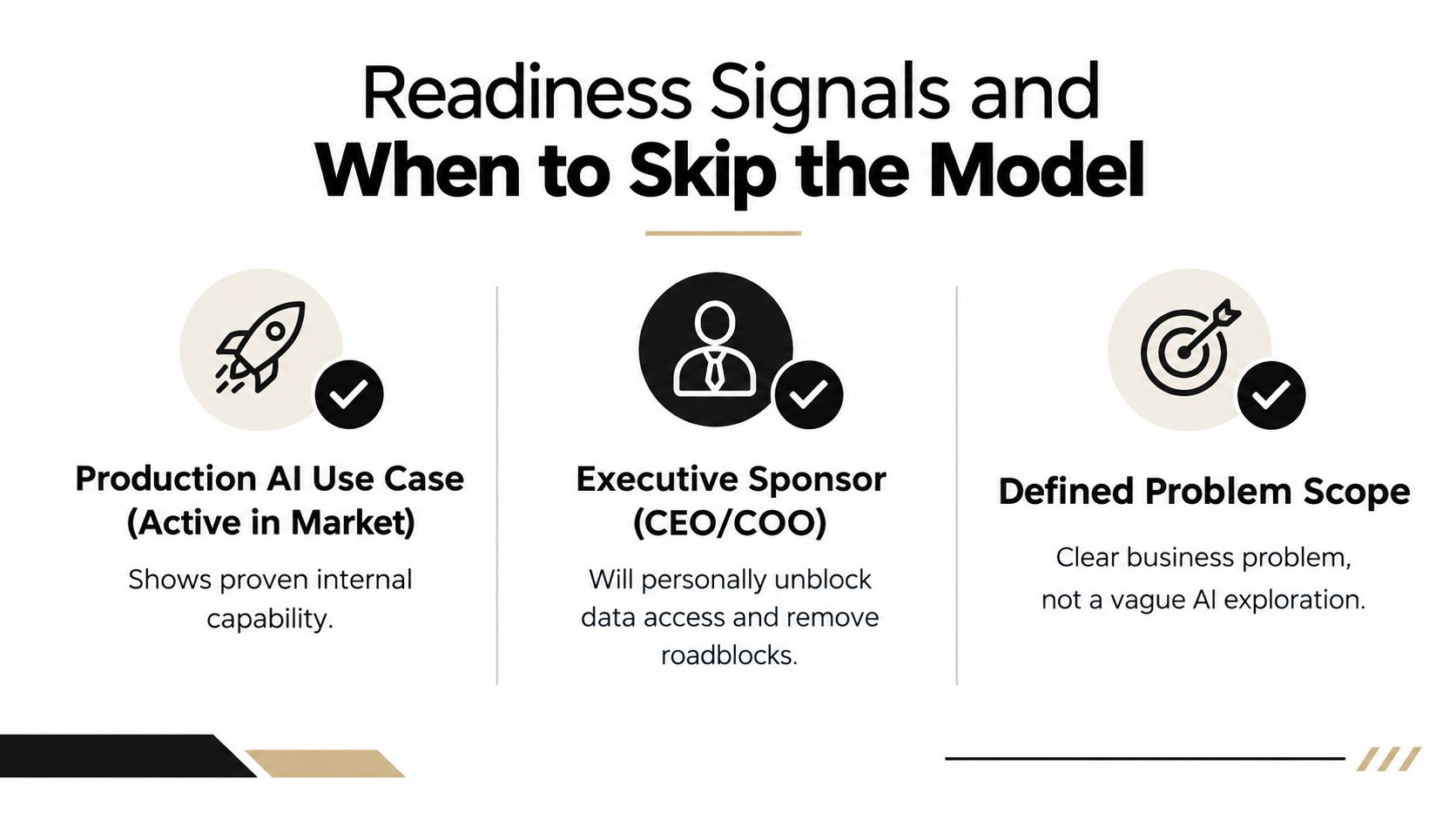
Is at least one AI use case already active in the market? A production use case demonstrates that the company can move beyond experimentation. It also gives the fractional leader a real operating problem to improve.
Will the CEO or COO personally unblock access? The executive sponsor needs authority over budget, data access, platform priorities, and cross-functional conflict. A sponsor who delegates every obstacle has hired a leader without influence.
Is the problem defined? “We need an AI strategy” is not a sufficient brief. “We need to reduce manual review in this workflow while preserving human approval” gives the leader a decision frame.
Does the company have an internal engineering owner? The fractional executive can sequence work and challenge implementation choices, but an internal technical owner must carry delivery after the meeting ends.
Does the board treat AI as an operating decision? If AI appears only in marketing language, the engagement will reward presentation quality rather than shipped outcomes.
Situations that require a different hire
Skip the model when the company expects one person to build data infrastructure from zero. Hire the engineers or platform specialists first, then bring in executive leadership when there is a portfolio worth governing.
Skip it when no internal team can own AI delivery. A fractional leader without a delivery counterpart will become a permanent escalation point for technical work the contract was never designed to perform.
Regulated organizations may also need dedicated compliance ownership. A fractional AI leader can coordinate model-risk decisions, but shouldn't be treated as a replacement for legal, compliance, or accountable risk functions.
Pre-product startups should be especially careful. The founder usually needs to own the AI thesis until the customer problem, product direction, and technical constraints are clear. An executive layer introduced too early can slow learning and obscure founder accountability.
Companies that want a structured diagnostic can use an AI readiness assessment, then decide whether the gap is leadership, engineering, governance, or product definition.
Evaluating and Onboarding a Fractional AI Leader
Treat the hire like an operating appointment, not a speaker booking. The candidate needs to demonstrate judgment inside constraints, not just fluency in AI terminology.
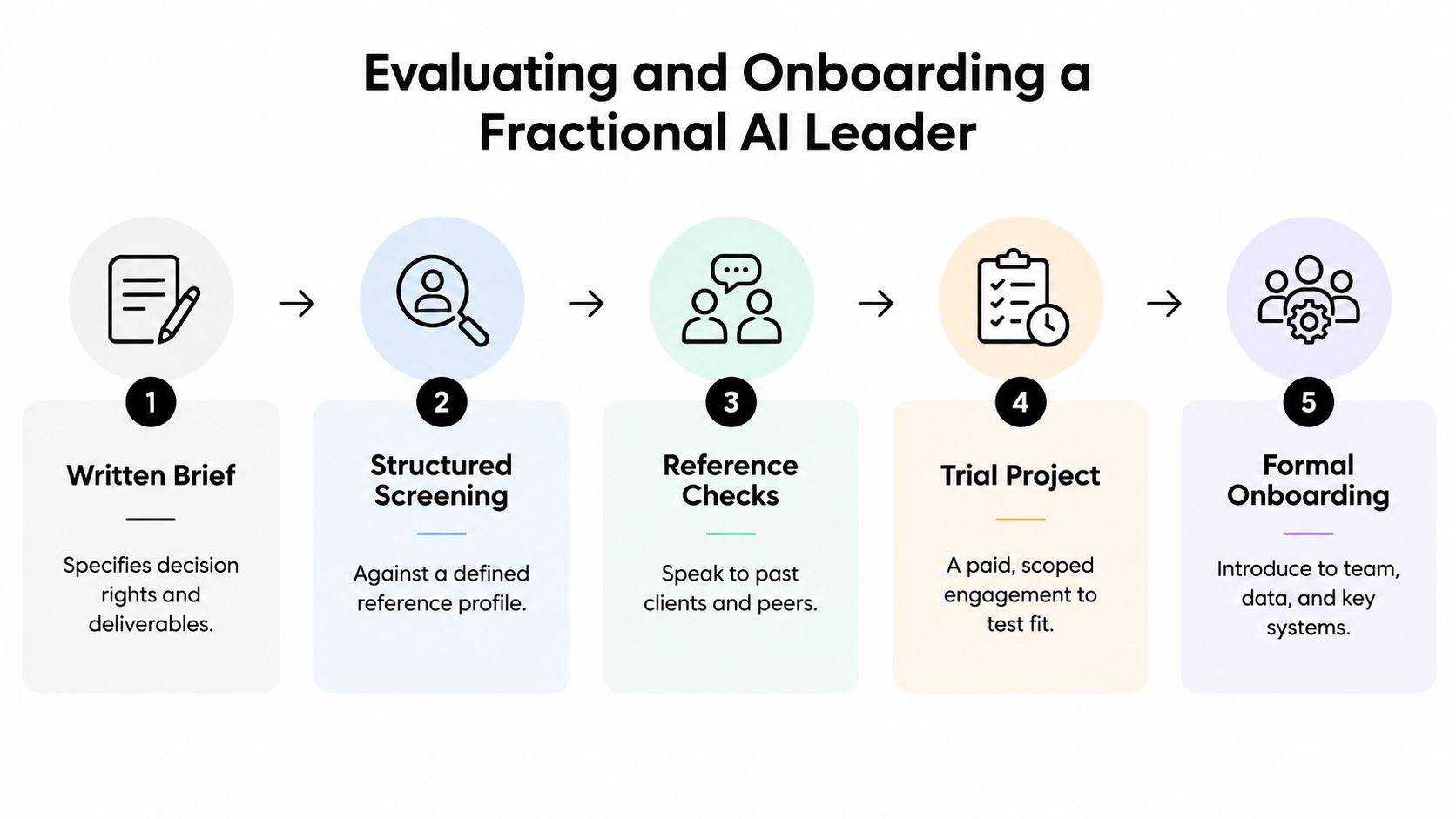
Start with a written brief
The brief should define the business context, current use cases, internal owners, executive sponsor, access requirements, decision rights, and first-phase deliverables. Include what the leader cannot approve. Ambiguity at this stage becomes conflict later.
A strong brief asks for outcomes such as:
- A prioritized portfolio with explicit stop, continue, and accelerate decisions.
- A governance baseline and risk register.
- A vendor evaluation process.
- A production path for selected use cases.
- A reporting format for executives and the board.
Screen for production judgment
Use a structured interview against a reference architecture of past deployments. Ask the candidate to explain the business problem, data constraints, evaluation method, production owner, failure mode, and decision that changed the outcome.
Don't be impressed by logos alone. Ask what they killed, what they underestimated, and which stakeholder resisted the decision. A candidate who describes only successful launches has probably never owned the uncomfortable part of the job.
Reference calls should probe for behavior:
- Did the leader make decisions or only facilitate them?
- Did they return with written follow-through?
- Did they escalate problems early?
- Did they improve delivery discipline?
- What happened when the original plan stopped making sense?
Use a paid trial audit
The 30-day paid trial audit is the most predictive step because it tests the candidate against the company's actual constraints. Give the person access to the current portfolio, relevant technical owners, existing governance documents, and the executive sponsor.
Require two tangible outputs:
- An AI portfolio prioritization memo with clear stop, continue, and accelerate decisions.
- One scoped prototype or production-directed deliverable that exposes the implementation path.
The trial should end early if the candidate cannot obtain necessary access, refuses to make trade-offs, produces generic recommendations, or fails to name internal owners. Don't extend the trial to avoid an uncomfortable decision.
Install the leader into the executive cadence
The first 90 days should place the fractional leader in existing product, engineering, risk, and executive meetings. The person should leave the onboarding period with named owners, a decision log, a prioritized roadmap, and a visible production path.
Use the final weeks to make a hard choice: continue at the agreed cadence, expand the mandate, convert to a permanent role, or close the engagement. A successful trial isn't a reason to remove the time box. It's evidence for making the next decision.
Watch the process in action:
Governance Setup and ROI Metrics That Matter
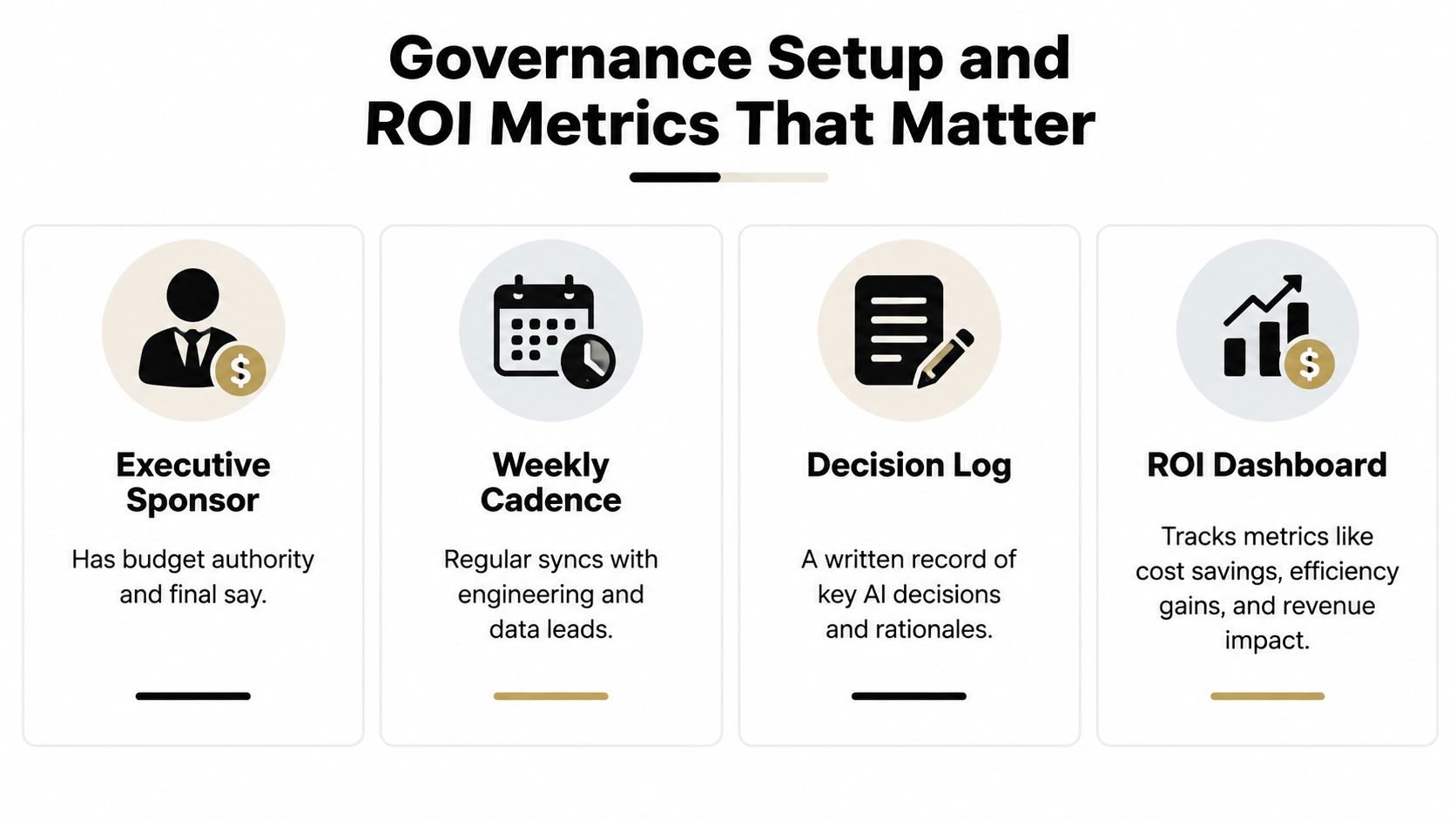
Governance should speed decisions and production work, not create a ceremonial approval layer. Give the fractional leader an executive sponsor with budget authority, a recurring working cadence with engineering and data leads, a written decision log, and a model-risk register that changes as work progresses.
The sponsor resolves cross-functional deadlocks. The weekly cadence turns priorities into assigned work. The decision log records why the company selected a model, rejected a use case, or accepted a specific risk. The risk register gives compliance and the board a current view of open issues, rather than a static policy document.
Measure production, not motion
The KPI set for fractional AI leadership should center on governance and production economics. The fractional chief AI officer playbook from Umbrex identifies experiment-to-production velocity, inference cost per user, compliance readiness, and model-risk policies as core ownership areas.
Use a quarterly scorecard with these measures:
- Shipped use cases: Count deployments that reached an agreed production state. Exclude prototypes and demos.
- Business attribution: Record the revenue, cost reduction, capacity release, or risk reduction tied to each deployment.
- Idea-to-deployment time: Track elapsed time from approved use case to production release.
- Post-deployment performance: Monitor quality drift, failure rates, human overrides, and escalation volume.
- Governance events: Record incidents prevented, unresolved exceptions, and completed policy controls.
For a closer examination of tracking these KPIs, review the guide to agent performance metrics.
Financial attribution requires discipline. If several teams benefit from the same evaluation framework or platform foundation, assign value to the deployed use case first, then record shared infrastructure as an enabling contribution. Do not credit the entire benefit to the fractional leader. Credit the team that shipped, and separate direct impact from program-level gains.
Detect consultant theater early
The engagement is drifting when slide output rises while shipped code stays flat. Warning signs also include meetings without a decision owner, pilots that remain “nearly ready,” and activity reports that never name the trade-off the work enabled.
A strategy document can inform execution. It does not prove return. The proof is a faster decision, a controlled deployment, a measurable economic result, or a risk the company can now identify and manage.
Scorecard standard: Every recurring executive update should answer three questions. What shipped, what changed financially or operationally, and what decision is blocked?
If current updates cannot answer those questions, reassess the leadership structure before extending the engagement. Head of Agents helps companies define AI leadership scope, assess readiness, and connect organizations with fractional or full-time leaders for agent programs. If pilots remain stalled between strategy and production, visit Head of Agents to evaluate the leadership gap and build a focused 90-day plan.