Head of AI Explained for Enterprise Agent Teams
What does a head of AI own in enterprise agent programs? Role, accountability, hiring, pay and readiness explained.
Written by HeadOfAgents
You already have the pattern in front of you. Pilots are moving, vendors are pitching, teams are building, and everyone assumes someone else is watching the finish line. Then the first real incident, budget question, or stalled rollout arrives, and the room discovers there's no named owner for the agent's behavior, no clear shutdown authority, and no one accountable for production value.
That gap is why the Head of AI matters. The role is not just about enthusiasm for automation or a talent for model talk, it's about owning the path from experimentation to governed execution, especially now that AI use is spreading fast across organizations and generative AI is moving into real business functions (Stanford AI Index 2025). The companies that feel stuck usually don't have a technology problem alone, they have an ownership problem.
Why Agent Programs Stall Without a Head of AI
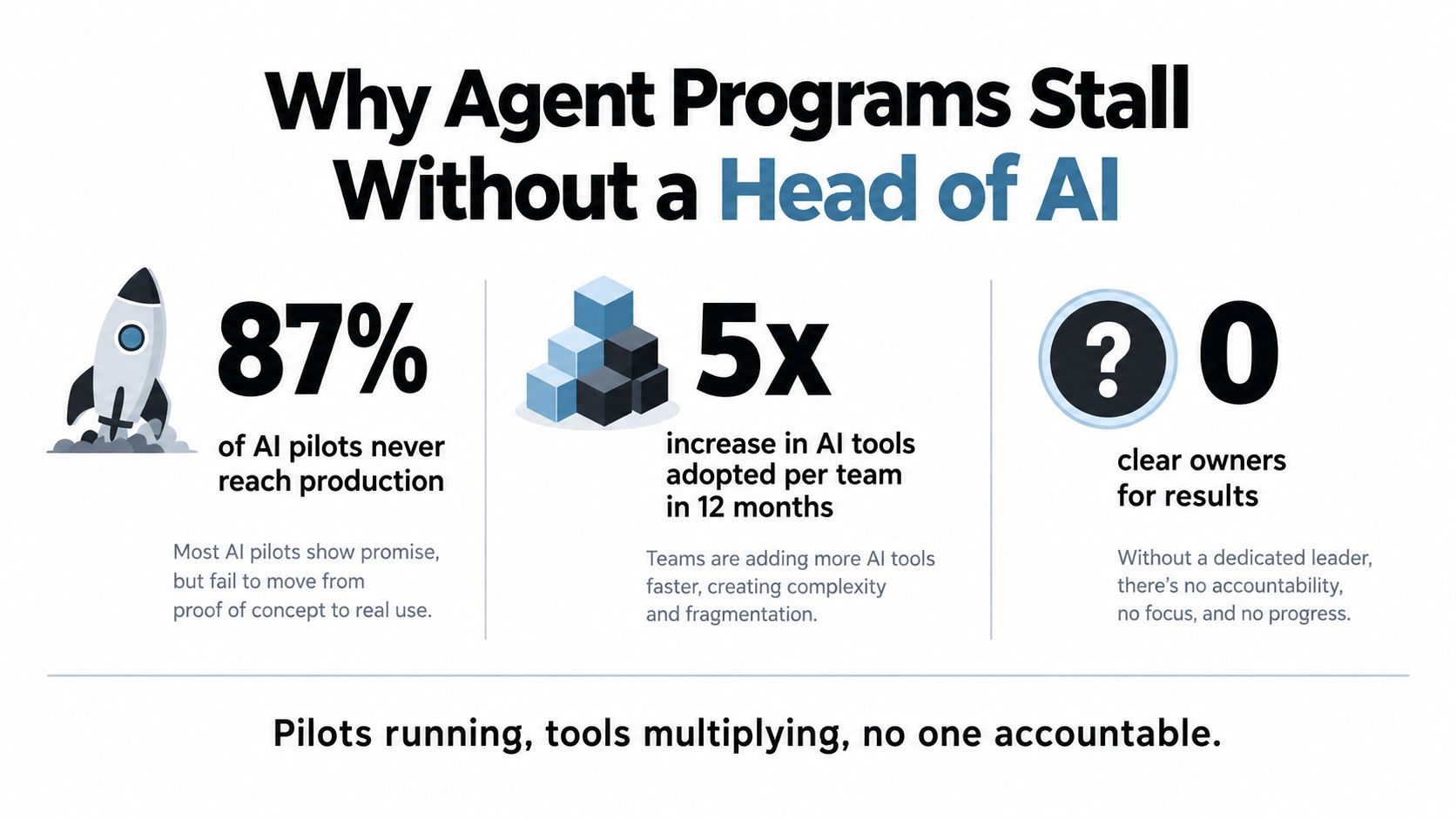
A pilot looks successful on paper. One team ships a useful workflow, another group wants the same capability, and soon three departments are testing overlapping agents, each with its own access rules, approval path, and informal owner. Then the hard question arrives, who can stop the agent if it starts making bad calls, and who proves the program is worth scaling?
That is where agent programs freeze. Leadership may still approve experiments, but no one is clearly responsible for deciding which use cases graduate, which vendors stay, which data stays out of reach, and what counts as acceptable risk. Some studies of enterprise AI deployments show that many projects never make it into production, which is a reminder that activity alone is not progress. The result is a program that looks busy in every steering meeting while the production numbers stay flat quarter after quarter.
Why ownership beats enthusiasm
Many enterprises assume AI progress will sort itself out once enough pilots exist. It will not. AI work crosses product, engineering, legal, security, compliance, operations, and HR, so the work fragments unless someone is explicitly assigned to hold the system together.
Practical rule: if no single leader can answer who owns outcomes, controls risk, and can halt deployment, the program is still in a pilot mindset.
A useful reference point is Projectify's take on agent protocols, which helps show why orchestration and decision rules matter once multiple agents start interacting. The broader lesson is simple. As systems become more autonomous, shared assumptions stop being enough, and named authority becomes the difference between coordinated execution and avoidable drift.
What the stall looks like in practice
The same pattern usually repeats. One group wants speed, another wants caution, and a third wants proof that the work is driving measurable results. Without a Head of AI, those tensions do not get resolved. They get absorbed into meetings, exceptions, and half-finished standards.
If your team cannot answer three questions clearly, it is not ready to scale:
- Who owns the agent's decisions? If that answer changes by department, the program is under-governed.
- Who can stop it? If shutdown authority is informal, incident response will be slow.
- Who proves value? If nobody tracks production ROI, the pilot can drift for months.
The point is not to create bureaucracy. It is to keep autonomy from becoming ambiguity.
What a Head of AI Actually Owns
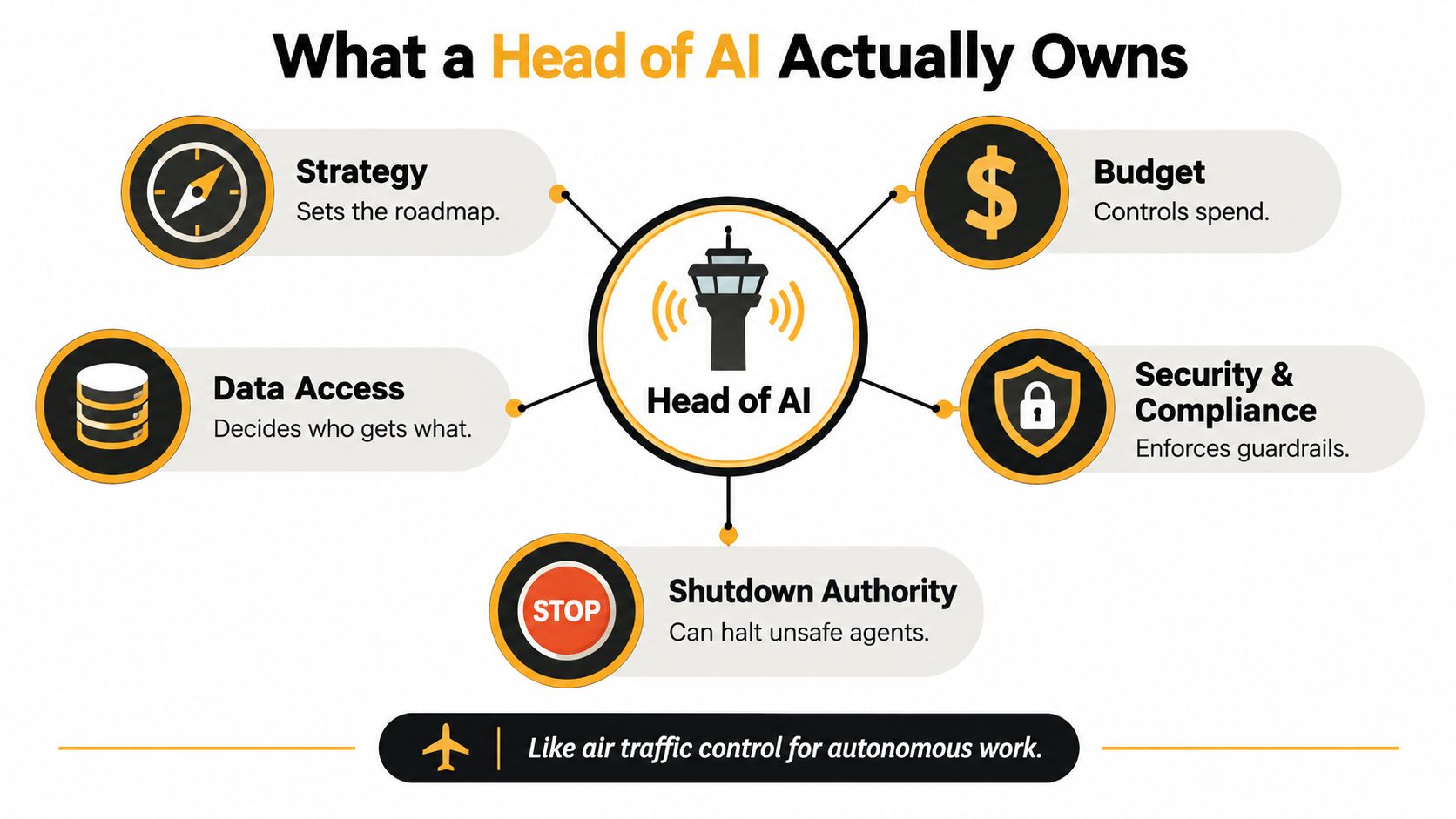
Think of the role like air traffic control for autonomous work. The Head of AI doesn't fly every plane, and shouldn't pretend to. The job is to manage the runway, the handoffs, the weather alerts, and the decision to ground a flight when conditions change. That's very different from being a sponsor, advisor, or technical cheerleader.
The center of gravity is operational ownership
A Head of AI owns the roadmap for where agents should go first, but also the controls that keep them from going where they shouldn't. That means budget decisions, data-access boundaries, review gates, and escalation paths that are written down before a crisis, not invented during one.
The title should be read as a decision-rights role, not a prestige label. If the person can't influence tooling choices, approve or block production rollout, or trigger a shutdown when monitoring flags a serious issue, then the role is decorative.
The role is broader than model expertise
The person doesn't need to be the best model builder in the company. They need to be able to translate business demand into safe deployment decisions, and that requires judgment across several domains at once. A strong Head of AI knows when the right answer is to build, when it's to buy, and when the right move is to pause until governance catches up.
For teams focused on customer-facing workflows, a customer support AI guide can be useful as a practical reminder that service automation only works when the workflow, safeguards, and escalation rules are all designed together. That same principle applies across the enterprise.
A simple ownership map
The Head of AI should be the named owner for:
- Strategy: deciding which use cases matter most and in what order.
- Budget: controlling spend and deciding what deserves continued funding.
- Data Access: setting who gets access to what, and why.
- Security and Compliance: making sure guardrails are enforced before deployment.
- Shutdown Authority: stopping unsafe agents immediately when needed.
A senior title without stop authority is coordination, not ownership.
If your company is shaping an agent program now, the internal reference point at this AI agent team overview helps clarify how the operating model around the role should be organized.
Head of AI Versus CAIO Versus Head of Agents
These titles get blurred together too often, and that creates hiring mistakes. A CAIO sits closer to enterprise-wide AI strategy and executive alignment, a Head of AI usually owns the operating model and production accountability, and a Head of Agents focuses more narrowly on agent deployment, controls, and measurable rollout.
| Dimension | Head of AI | CAIO | Head of Agents |
|---|---|---|---|
| Primary scope | Program ownership and operating model | Enterprise AI leadership | Agent deployment ownership |
| Decision rights | Production rollout, governance, shutdown paths | Cross-company AI direction | Agent-specific execution and controls |
| Typical focus | Safe scale and ROI | Strategy and executive alignment | Day-to-day agent delivery |
| Best fit | Companies moving from pilots to production | Larger firms needing a unified AI mandate | Teams centered on agent programs |
| Success signal | Durable production value with controlled risk | Coherent AI direction across functions | Reliable agent adoption and incident control |
How to choose the title
If the problem is broad AI fragmentation, a CAIO-style mandate can make sense. If the immediate issue is getting agent programs into production with real ownership, the Head of AI title is often the better fit. If the business is specifically organizing around agents as a product and operating layer, then Head of Agents is narrower and more exact.
The biggest mistake is letting one title do three jobs at once. That leads to fuzzy accountability, duplicated approvals, and a lot of executive optimism with no clean line of responsibility.
Don't hire for prestige, hire for decision rights
HR teams sometimes treat the title as a seniority signal, but the better question is what the person can decide on day one. A role without budget control or escalation authority can't manage real risk, and a role without production metrics can't prove value.
If the title sounds impressive but the authority is vague, the company is probably buying reassurance, not leadership.
That's why the name matters less than the operating boundaries underneath it.
Where the Role Sits and Who Decides What
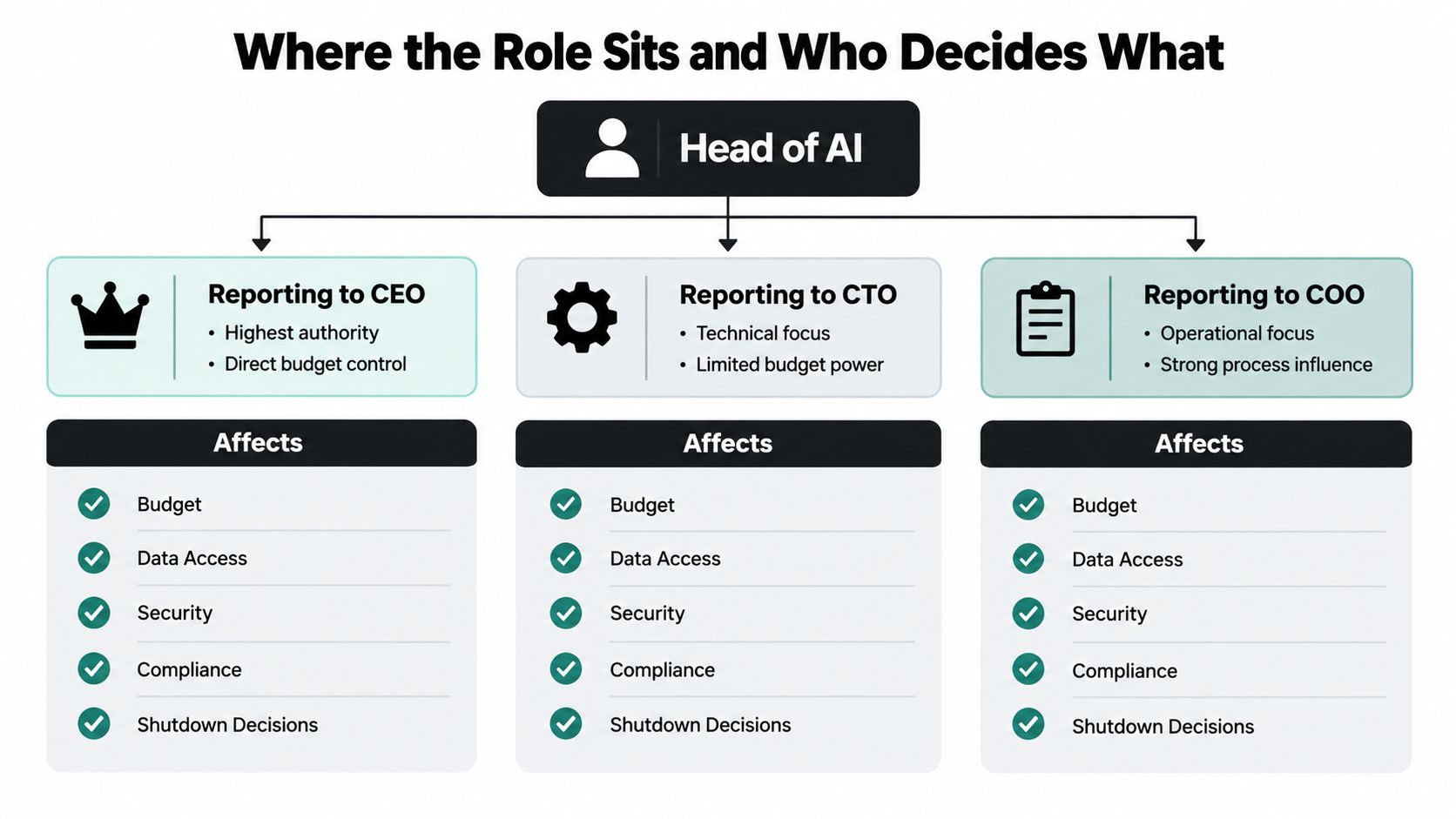
Org placement changes everything. A Head of AI reporting to the CEO usually has the clearest path to budget and escalation authority. Reporting to the CTO tends to create deeper technical alignment but can narrow influence over commercial priorities. Reporting to the COO often strengthens process discipline and operational follow-through, especially when the company treats agents as part of core execution.
Authority has to be explicit
A role title alone doesn't answer who can approve data access, who owns an incident, or who signs off on a vendor. Those questions need a written boundary. The best enterprise setups make that boundary visible across legal, security, compliance, product, and business-unit leaders so no one has to guess under pressure.
IBM's survey showed that even where enterprise AI had moved into a strategic phase, many organizations still needed accountable leadership to convert exploration into scaled deployment (IBM Global AI Adoption Index). That's the practical reason reporting structure matters, it determines whether accountability is real or just implied.
Use a RACI style boundary, not a handshake
The cleanest setup is to separate who recommends, who approves, who executes, and who can stop the system. Legal should not be the default operator of the AI program, security should not be the sole owner of use-case priorities, and business teams should not be able to launch agentic workflows without operational review.
A useful way to frame the boundary is:
- CEO layer: final escalation for strategic risk and enterprise-wide shutdowns.
- CTO layer: architecture, implementation standards, technical feasibility.
- COO layer: workflow design, operational monitoring, adoption discipline.
- Legal, compliance, security: review, constraints, audit trails, incident input.
The Head of AI sits at the intersection of these functions, but should not be reduced to a meeting coordinator.
Accountability must include the ugly scenarios
The difficult part is not launch approval, it's adverse outcome ownership. When an agent makes a bad decision, the enterprise needs to know who records the incident, who decides whether to suspend the system, and who handles remediation with the vendor if the failure came from outside the company.
The real test of authority is whether the leader can stop the system without asking permission from five separate teams.
That's why placement matters as much as competence.
Readiness Signals Before You Scale Agents
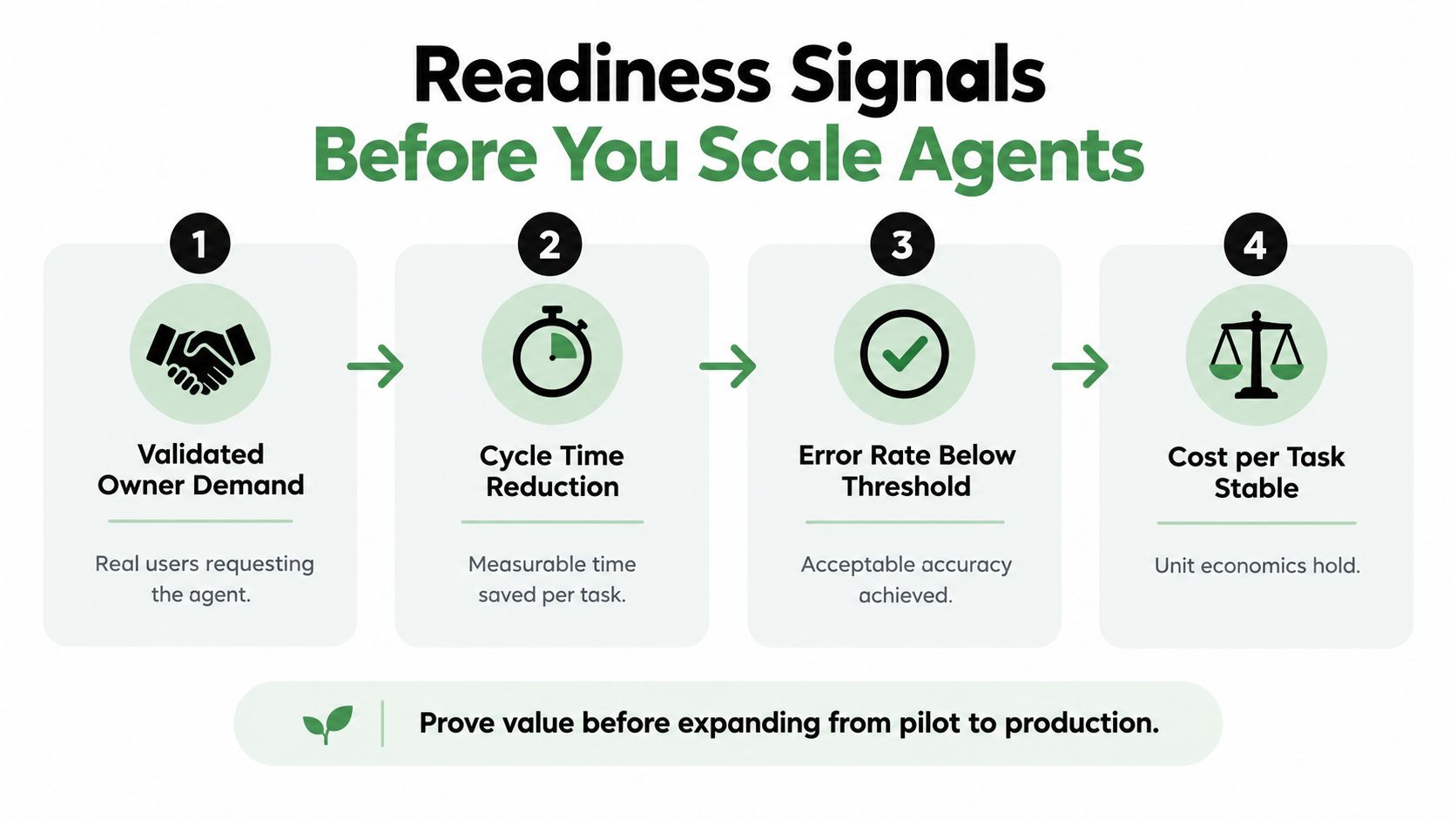
A pilot can look busy and still be unready for production. The Head of AI has to read the situation like a shop floor manager, not a demo host. Before scale, the program should show real demand, measurable time savings, and controls that can survive scrutiny. That matters because faster adoption can hide weak governance, especially when technical skills, workforce resistance, and system complexity are still common barriers in enterprise settings (Deloitte).
The four checks that matter
First, confirm validated owner demand. The request should come from people who feel the workflow pain, not from leadership wanting an AI headline.
Second, verify cycle time reduction. If the agent does not make the work faster or smoother in a way the business can see, production approval is hard to defend.
Third, check error rate below threshold. The goal is not perfection. The goal is that the remaining errors are known, monitored, and acceptable for the task.
Fourth, watch cost per task stable. If unit economics swing too much, scaling only creates a larger bill.
Don't confuse use with value
High usage can be misleading. A team may celebrate adoption before it has checked whether the agent is helping. The better standard is simple. Can the workflow be explained, monitored, and stopped, while operating cost stays predictable enough to justify wider use?
For teams building audit discipline around this stage, audit readiness guidance is a useful complement to the production gate, because the same controls that support an audit also shape scaling decisions.
Good rule: if a pilot cannot be explained to finance, security, and the business owner in the same meeting, it probably is not ready for production.
Production is a management decision, not a technical trophy
The Head of AI should ask for plain answers. Who wants it? What changed? What errors remain? What does it cost now? If those answers are unclear, the rollout stays small. That discipline avoids the common trap where teams mistake activity for maturity.
A structured readiness review can help connect adoption, controls, and rollout sequencing before you decide whether the next move is build, buy, or hire.
Hiring Checklist and Interview Assessments That Work
Hiring for this role goes wrong when companies screen for charisma instead of operating proof. You want someone who has shipped agentic or AI-driven work into production, dealt with governance friction, and made tradeoffs between speed and control. Resume inflation is common here, so the interview has to test judgment, not just vocabulary.
What to test before you make an offer
Ask for evidence of shipped work, not just strategy decks. Then probe how the candidate handled access controls, incident review, stakeholder disagreement, and rollout decisions when the team wanted to move faster than the guardrails allowed.
The candidate should also be able to explain build versus buy judgment in practical terms. If they can't describe why a team should own some capabilities internally and source others externally, they probably haven't run a real production program.
A useful interview exercise
Give them a short scenario. An internal team wants to deploy an agent into a customer workflow, legal is worried about escalation liability, and the business leader wants it live next month. Ask the candidate to outline the first week of decisions, who gets involved, what they'd block, and what evidence would let them green-light a limited rollout.
That test reveals whether they think like an operator or a slide-maker. It also shows whether they know how to lead across functions without turning every disagreement into a committee.
For broader assessment design, it can help to review AI proficiency evaluation guidance before you finalize your screening rubric, especially if HR needs a common yardstick across candidates with different backgrounds.
Red flags that should slow you down
- Vague ownership stories: if every project was “cross-functional” and nobody was accountable, ask deeper questions.
- No incident examples: strong leaders can describe what broke and what they changed.
- Tool-first thinking: if the candidate talks only about platforms and not controls, they may be too focused on novelty.
- No budget language: the role needs someone who can connect work to spend and value.
A strong candidate can talk about failures without sounding defensive, because they learned how to govern them.
For companies mapping leadership options, executive search guidance for AI roles can help you decide whether to hire full time, start fractional, or begin with an audit-first path.
Sample Job Spec and Your First 90 Days
A good job spec should say the mission plainly: own the company's AI agent roadmap, governance, and production value. It should also state the responsibilities without hiding the hard parts, including use-case prioritization, approval thresholds, vendor oversight, monitoring, incident response, and shutdown authority.
What belongs in the spec
The role needs a leader who can work across product, engineering, legal, security, compliance, and operations without losing the thread. It should ask for experience turning experiments into durable production systems, the ability to explain risk in business language, and enough credibility to push back when teams want to deploy too early.
The compensation section should be framed by scope and accountability, not by hype. If the role owns budget, production outcomes, and incident response, the package needs to reflect that level of responsibility.
The first 90 days should be sequenced
Start with the use-case map. Then identify governance gaps, ownership gaps, and any agent workflows already running without clear controls. From there, prioritize the highest-value production candidates, set the approval rules, and define the monitoring and shutdown process before expanding usage.
By the end of that window, the company should know three things clearly, which use cases deserve more investment, where the risk controls are still weak, and what the next quarter's rollout should look like. That makes the role measurable instead of symbolic.
The useful decision path is simple, if you lack ownership, run an audit. If you know the scope but need leadership, hire full time or fractional. If you're still proving value, keep the program small until the controls and ROI are visible.
Head of Agents helps companies do the work that sits behind this role, from readiness audits and vetted placements to practical guidance on who should own agent programs and how they should be evaluated. If you're deciding whether to hire, audit, or start with fractional leadership, visit Head of Agents and use that starting point to turn AI ownership into a real operating model.