Human in the Loop AI: A Practical Enterprise Guide
Learn what human in the loop AI really means, the patterns that work, and the tradeoffs around accuracy, cost, and governance for enterprise agent teams.
Written by HeadOfAgents
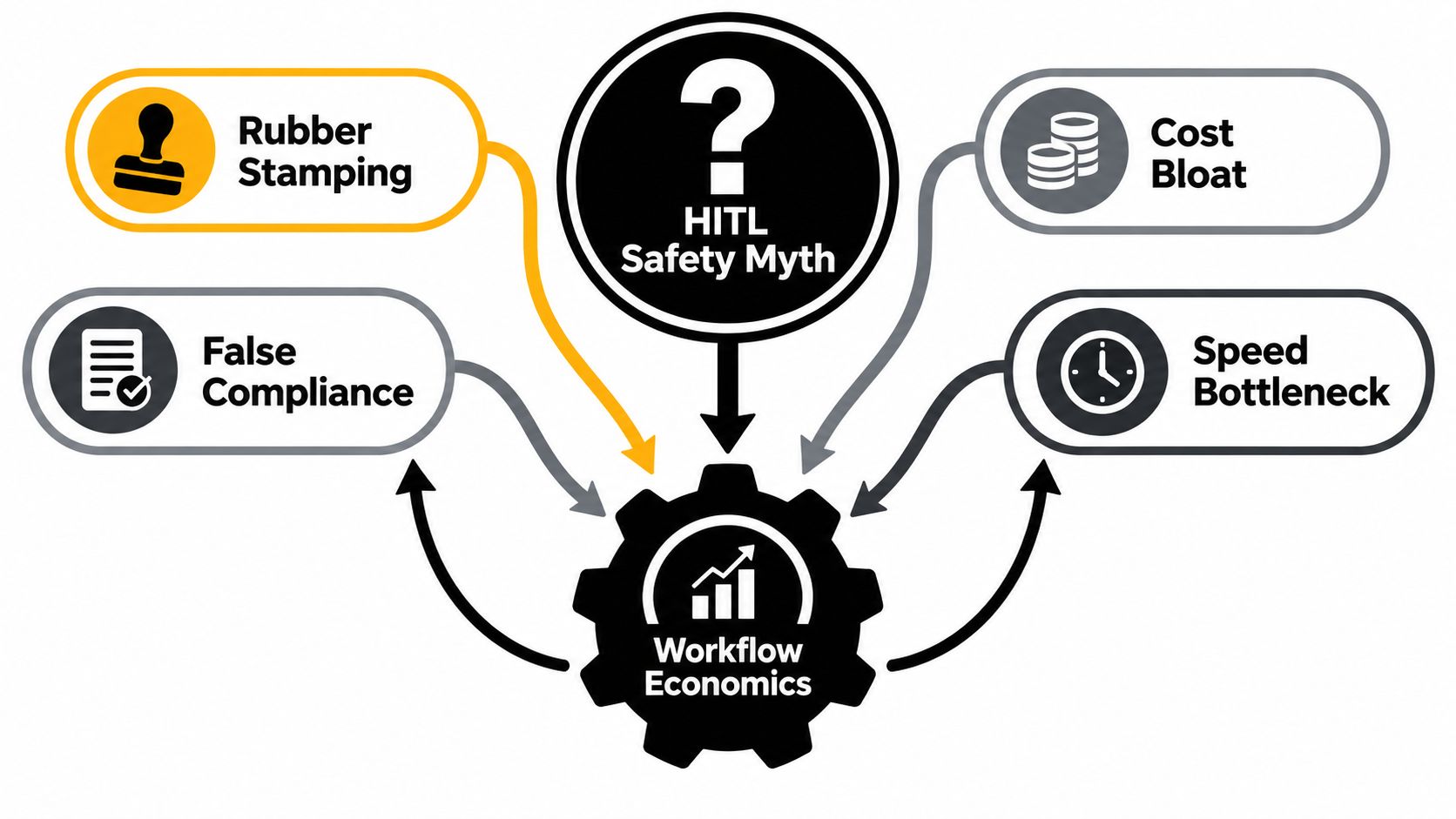
The popular advice is simple: put a human in the loop and the AI becomes safe. That advice is incomplete. A reviewer who approves every output without enough context, authority, time, or independence can turn oversight into a compliance performance, while adding queue pressure, latency, and cost.
Human in the loop AI works when it assigns human judgment to the decisions that genuinely need it. That means defining who intervenes, when they intervene, what evidence they receive, what happens when they disagree, and how the system learns from the decision. The safest agent programs aren't necessarily the ones with the most checkpoints. They're the ones that place checkpoints where human judgment changes the outcome.
Why Human in the Loop AI Is Not the Safety Net You Think It Is
HITL is often treated as a label that can be added to an architecture diagram. In production, it's a queue, a set of decision rights, a staffing model, and a record of what happened. If those pieces aren't designed together, the human becomes a rubber stamp rather than a control.
A reviewer can't challenge an output they don't understand, can't investigate a case they don't have time to inspect, and can't prevent an action if the system has already executed it. Approval fatigue makes this worse. When every case looks urgent, reviewers learn to process prompts quickly instead of exercising judgment. Vague escalation rules then push difficult decisions back onto individual intuition.
Practical rule: A human checkpoint is a control only when the human has context, authority, and enough time to use both.
Automation bias creates another failure path. Reviewers may trust a confident-looking answer, especially when the interface presents the AI recommendation before the underlying evidence. The workflow then measures agreement with the model instead of independent decision quality. That can make dashboards look healthy while errors pass through the very control intended to catch them.
A useful security architecture should therefore define more than model permissions. It should show how people authorize, interrupt, and review agent actions, as outlined in this agent security framework. The same principle applies to quality and compliance: supervision needs explicit mechanics.
The right design starts with three questions:
- Where does human judgment add signal? Route ambiguity, irreversible actions, and policy exceptions to qualified reviewers.
- Where does human review add delay without changing the result? Keep routine, reversible, high-confidence work automated or sampled.
- What evidence proves the control worked? Store the input, model output, reviewer reasoning, decision, and resulting action.
HITL isn't a safety badge. It's a deliberate operating choice that trades speed and cost for judgment and accountability. The rest of the system should be designed around that tradeoff.
What Human in the Loop AI Actually Means
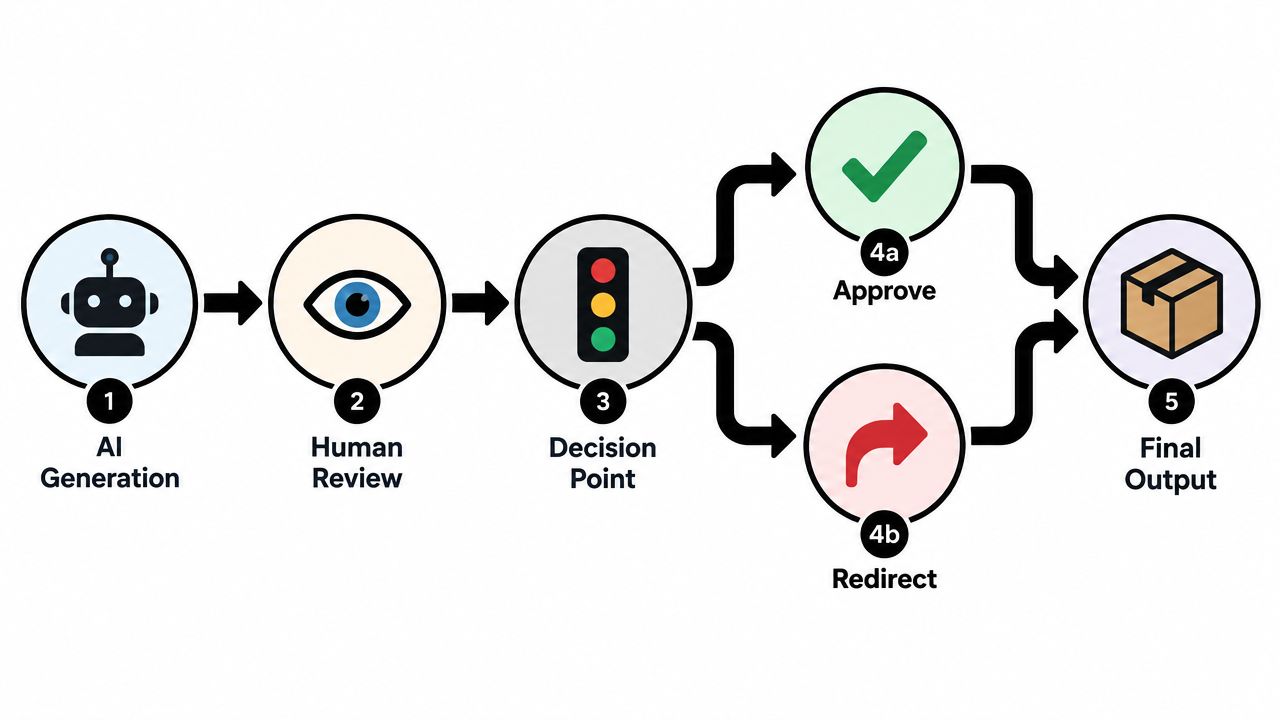
Think of an agent as an eager junior analyst. It can gather information, draft a recommendation, and prepare an action, but it doesn't automatically have the authority to send the message, change the record, or commit the company. A human can correct the draft, approve the action, redirect the investigation, or teach the agent how to handle a recurring exception.
The underlying logic resembles a feedback-control loop:
- Observe: The system receives a request, event, or data state.
- Predict: The agent interprets the situation and proposes a response.
- Act: It drafts, calls a tool, or prepares an external action.
- Inspect: A human reviews the result when policy or uncertainty requires it.
- Adjust: The human approves, edits, rejects, or supplies additional direction.
- Observe again: The system records the outcome and uses it to improve future decisions.
This feedback lineage is older than modern AI. A 2026 systematic review of human-in-the-loop systems traces human judgment in automated systems through foundational cybernetics work in the 1940s and 1950s, and identifies Amazon Mechanical Turk's launch in 2005 as a major step in bringing human intelligence tasks into mainstream digital workflows.
Four practical meanings of HITL
Review-and-correct means the AI produces a draft and a person edits it before release. This fits work where the output is reversible and human expertise can improve clarity or judgment.
Approval gates pause execution before an action with meaningful consequences. The human isn't proofreading a sentence. They're deciding whether the system may proceed.
Escalation paths send uncertain, unusual, or high-risk cases to a specialist. The agent keeps moving on ordinary work while a defined exception route handles the rest.
Active learning loops capture corrections as training or evaluation data. The reviewer isn't only fixing today's output. They're helping the system recognize similar cases tomorrow.
HITL differs from human-on-the-loop supervision, where the AI acts and a person monitors for exceptions. It also differs from human-out-of-the-loop automation, where the system operates without intervention. Mature programs use all three modes in one workflow, depending on reversibility, risk, and confidence.
Teams building these controls should also account for practical automation pitfalls, particularly unclear ownership and review processes that exist on paper but fail under load.
The Core Patterns for Humans Working With AI Agents
Most production systems combine several HITL patterns. The mistake is choosing one label for the entire workflow instead of assigning a control mode to each decision.
Review-and-correct
Use this for high-volume drafting where a person can improve the result quickly and the action remains reversible. A support agent might draft an answer, while a specialist handles unusual policy questions or emotionally sensitive cases.
The failure mode is editing without learning. If reviewers repeatedly fix the same omission but nobody captures the correction, the team pays for the same human effort indefinitely. Track correction categories, acceptance quality, and repeat-error frequency, not just the number of reviewed items.
Approval gates
Use a gate before irreversible or high-blast-radius actions, such as sending an external commitment, changing production data, or executing a financial instruction. The approval request should include the proposed action, relevant evidence, permissions, expected impact, and rollback path.
The main failure mode is approval theater. A button labeled “approve” doesn't create judgment. Measure meaningful rejection, modification, and intervention quality, while investigating a workflow where every request receives instant approval.
Escalation policies
Escalate when the model detects uncertainty, policy conflict, missing information, unusual scope, or a high-risk customer or transaction context. A threshold can be based on confidence, risk classification, action type, or a combination of signals.
Over-escalation creates queue collapse. Under-escalation produces silent guesses. Track precision of escalations, blocker recall, resolution time, and downstream incidents. HiL-Bench makes this problem explicit by testing whether agents know when to ask for help. It inserts human-validated blockers into software-engineering and text-to-SQL tasks and uses Ask-F1 to penalize both excessive questions and silent hallucination, with results showing a substantial gap between an agent's full-information performance and its judgment about when to ask (HiL-Bench evaluation).
Active learning loops
Route uncertain or novel examples to reviewers, then feed validated corrections into evaluation sets, prompts, policies, or retraining processes. The value comes from concentrating human effort on informative cases rather than annotating everything uniformly.
The risk is assuming reviewers are stable measurement devices. Research on collaborative human-in-the-loop decision settings models changing reviewer behavior and treats review as a stochastic control loop, not a static quality step (active learning framework). Monitor label consistency, reviewer disagreement, model drift, and the share of corrections that produce a measurable policy or model change.
| Pattern | Best Fit For | Primary Failure Mode | Key Success Metric |
|---|---|---|---|
| Review-and-correct | Reversible drafts and routine decisions | Repeated edits without system learning | Correction quality and repeat-error frequency |
| Approval gates | Irreversible or high-impact actions | Rubber-stamp approvals | Intervention quality |
| Escalation policies | Ambiguous or risky exceptions | Overloaded review queues | Escalation precision and blocker recall |
| Active learning loops | Novel and uncertain examples | Contaminated or inconsistent labels | Label quality and drift response |
Good context engineering for agents supports all four patterns by giving both the agent and the reviewer the information needed to make a bounded decision.
Tradeoffs Between Accuracy, Speed, Cost, and Governance
HITL does not improve every outcome at once. It shifts a deployment across four competing dimensions, so workflow design matters more than the label attached to it.
Review can improve accuracy when the reviewer has relevant expertise and access to information the model cannot reliably interpret. The gain shrinks when the reviewer only confirms a high-confidence output. Ask the commercial question directly: is a modest accuracy gain worth materially increasing handle time for this decision? The answer depends on the cost of the error, not on a general preference for human involvement.
Latency is structural. Each handoff adds routing, waiting, and decision time. A synchronous gate fits an access change or contractual action, but it can damage the customer experience when applied to a routine, reversible request. Use asynchronous review or sampling when the organization can contain errors without blocking the user.
Cost follows queue depth and specialist scarcity. Routing every item to a senior reviewer consumes capacity regardless of each case's business value. The SpendLens AI cost control framework provides useful context for separating model spend from the operational cost of human review, escalation, and exception handling.
Governance value exists only when the record demonstrates judgment. An informal acknowledgment does not show what the reviewer saw, why they decided, or whether they had authority. Store the decision context and preserve the link between the model's proposal, the human intervention, and the final action.
| Pattern | Accuracy Lift | Latency Added | Per-Decision Cost | Governance Value |
|---|---|---|---|---|
| Full synchronous approval | Often strongest where expertise matters | Highest | Highest | Strong if rationale is logged |
| Risk-based escalation | Targeted at uncertain or harmful cases | Variable | Targeted | Strong when thresholds are explicit |
| Review sampling | Detects drift and systemic errors | Low for most users | Controlled | Useful for monitoring, weaker for individual decisions |
| Human-on-the-loop monitoring | Limited direct correction before action | Low | Lower | Depends on intervention speed and audit quality |
| Autonomous execution | No review benefit | Lowest | Lowest | Weak unless other controls are tight |
Set two operating rules. Don't pursue HITL where the human is slower than the risk, especially when the action is reversible and the model is already reliable. Don't skip HITL where demonstrable human judgment is required, whether by policy, internal risk appetite, or the nature of the decision. Escalation thresholds, reviewer authority, and queue ownership determine whether oversight improves outcomes or adds delay.
Where Human in the Loop AI Works Best in the Enterprise
The strongest use cases have a clean boundary between routine work and consequential exceptions. They don't ask people to watch everything. They ask people to decide where automation should stop.
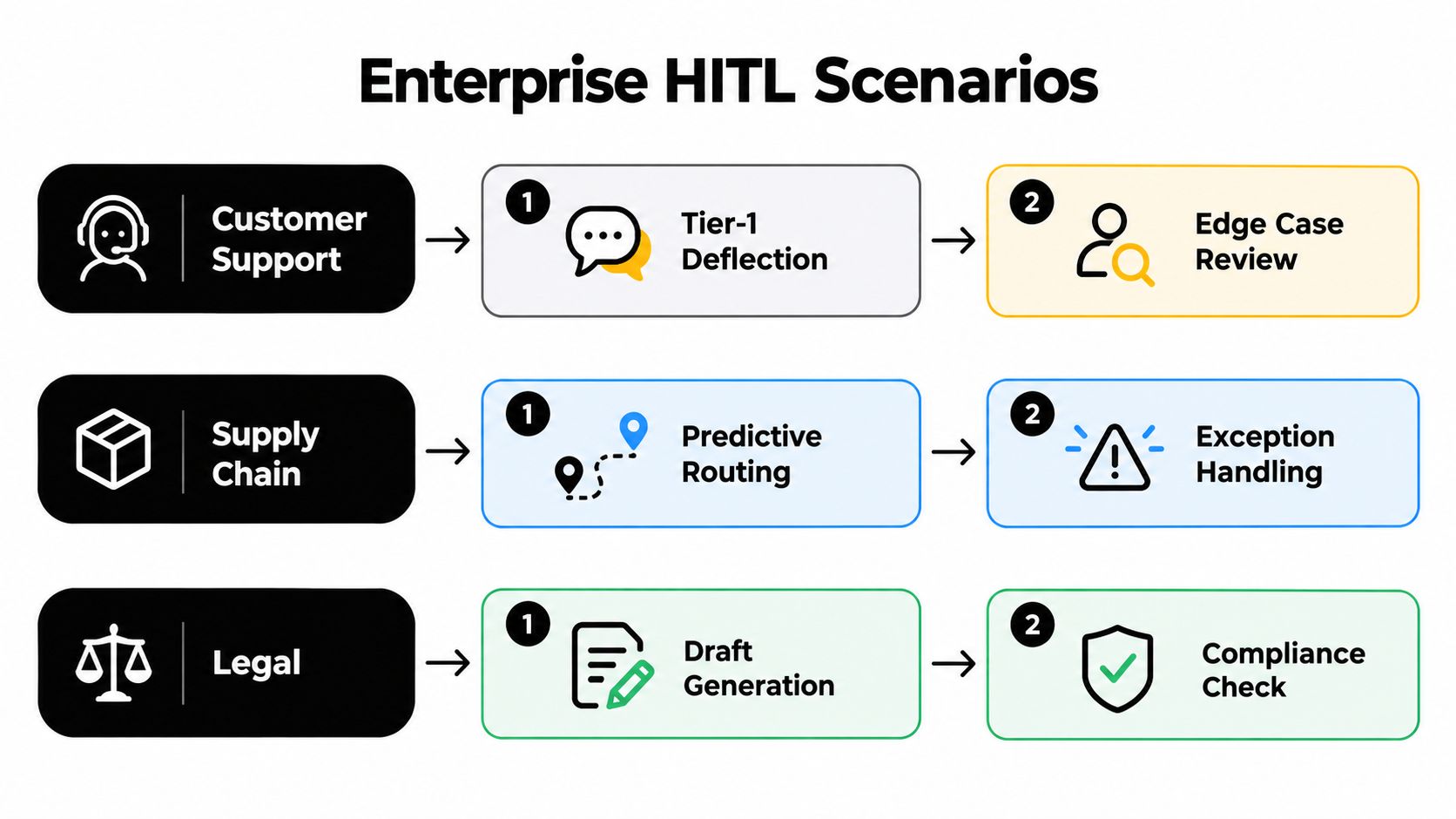
Customer support
A support agent can handle routine questions and draft responses for review. A human specialist should take over when the customer raises a sensitive complaint, requests an exception, or presents facts outside the policy context.
The human role is brand and relationship judgment, not merely factual correction. The failure mode is an answer that is technically plausible but tone-deaf, overconfident, or inconsistent with the customer's history. Measure unnecessary escalations, correction themes, repeat contacts, and customer-impact incidents. If reviewers change almost nothing on routine cases, narrow the queue rather than preserving universal approval.
Code agents
For code workflows, the key control is usually an approval gate around file writes, dependency changes, data migrations, and shell execution. The human is controlling blast radius and authorization, not manually rewriting every line.
A technically correct change can still be unsafe if it touches the wrong environment or lacks a rollback plan. Measure unauthorized-action attempts, rejected plans, rollback frequency, and time spent per approved change. Keep low-risk inspection and test generation automated when the action can't alter production state.
Compliance triage
An agent can classify incoming cases, extract relevant evidence, and route matters to the right adjudicator. The human decision creates the accountable record when the classification affects investigation, reporting, access, or customer treatment.
The failure mode is not only a wrong label. It's an untraceable judgment made without the evidence needed for later review. Measure routing accuracy, adjudication consistency, escalation completeness, and audit retrieval time. In this setting, HITL is part of the audit trail itself.
The pattern is wasted on low-stakes work where review doesn't change outcomes, and on creative drafts where a reviewer adds little beyond personal preference. If the human can't identify a meaningful intervention, remove the checkpoint or replace it with sampling.
A short visual example of these operating boundaries is available below.
Bias, Contamination, and the Hidden Failure Modes of Oversight
The most dangerous HITL mistake is showing the model's answer first and calling the resulting agreement ground truth. The suggestion anchors the reviewer, who may rationalize an error or overlook evidence that contradicts the recommendation.
A 2025 study involving 410 annotators and more than 7,000 annotations reported that displaying an LLM suggestion shifted label distributions, increased reviewer confidence, and inflated measured model performance when those labels were later used to evaluate the AI (study on annotation bias). The lesson is operational: sequencing changes the measurement.
Preserve independent judgment
Use a blind-first workflow for evaluation and high-value labeling. Let the reviewer make an initial decision from the source material, then reveal the model output for comparison and correction. Keep both decisions so analysts can distinguish independent agreement from model-influenced agreement.
Inject AI-free control samples into live review queues. If every item contains a recommendation, the team can't tell whether reviewers are detecting errors or following prompts. Rotate reviewers across case types, and limit throughput when speed targets begin to erode attention.
Separate disagreement from contamination
Human disagreement isn't automatically a defect. Reviewers may apply different interpretations, or the policy may be ambiguous. Track inter-reviewer agreement on selected samples, include golden tasks with known answers, and inspect disagreements before changing the model.
Reviewer fatigue creates a second hidden problem. People who supervise cases they rarely close themselves may lose practical skill and accept the system's framing too readily. Give reviewers feedback on outcomes, refresh policies, and preserve a route for challenging the workflow itself.
Good logging makes these failures visible. Guidance on oversight logging can help teams preserve the model output, human action, rationale, and audit context instead of storing only an approval event.
A HITL dashboard that reports agreement without measuring independence can flatter the model while weakening trust among the people closest to the work. Blind review, control samples, reviewer rotation, golden tasks, and throughput limits are design requirements, not optional refinements.
Why HITL Is Becoming an Operating Model, Not a Feature
A feature can pause an agent. An operating model decides who owns the pause, how quickly they respond, what evidence they need, and what the organization does with the result.
Enterprise adoption is moving in that direction. A 2025 Moody's survey found that 91% of respondents were aware of AI's role in risk and compliance, while 53% were actively using or trialing it, up from 30% in 2023, as reported in the published review of enterprise AI risk and compliance adoption. As AI moves into regulated workflows, oversight becomes a standing responsibility rather than an occasional engineering task.
Give oversight a real owner
Assign a review lead for each material workflow. That person owns policy interpretation, reviewer training, escalation capacity, and the quality of the decision record. Engineering owns system behavior and reliability, while risk or compliance owns control expectations. No single team should inherit all three responsibilities.
Define reviewer tenure and rotation. A permanent queue assignment encourages fatigue and narrow pattern matching. A structured rotation preserves domain contact and exposes more people to changing edge cases.
Measure judgment, not throughput
A review team's output isn't the number of tickets cleared. Useful measures include:
- Override quality: Whether an intervention prevented a harmful, invalid, or noncompliant action.
- Escalation precision: Whether routed cases required specialist judgment.
- Decision latency: How long risk-sensitive cases wait before resolution.
- Policy coverage: Whether material action types have explicit approval rules.
- Learning conversion: Whether recurring corrections change prompts, policies, tests, or models.
A governance framework for AI agents can help connect these measures to decision rights, access controls, and escalation ownership. The point isn't to create another document. It's to make the workflow enforceable.
Establish an operating cadence
Hold weekly reviews of label quality and high-severity overrides. Refresh escalation policies when products, regulations, or action scopes change. Bring agent engineering, operations, and risk teams into the same dashboard so they can see the same incidents and queue constraints.
The International AI Safety Report 2025 warns that human review or sign-off can become prohibitively costly even when it remains essential in high-risk settings. It also describes a broader organizational shift, with a 2026 industry report finding that nearly three-quarters of firms require humans in the loop for important decisions and 71% require AI risk management training. Those figures point to a staffing and training obligation, not a checkbox.
Implementing Human in the Loop AI and Knowing When Enough Is Enough
Start with the workflow, not the model. Map every decision the agent can make, the information it uses, the external action it can trigger, the person who owns that action, and whether the result can be reversed.
Build the control before scaling the traffic
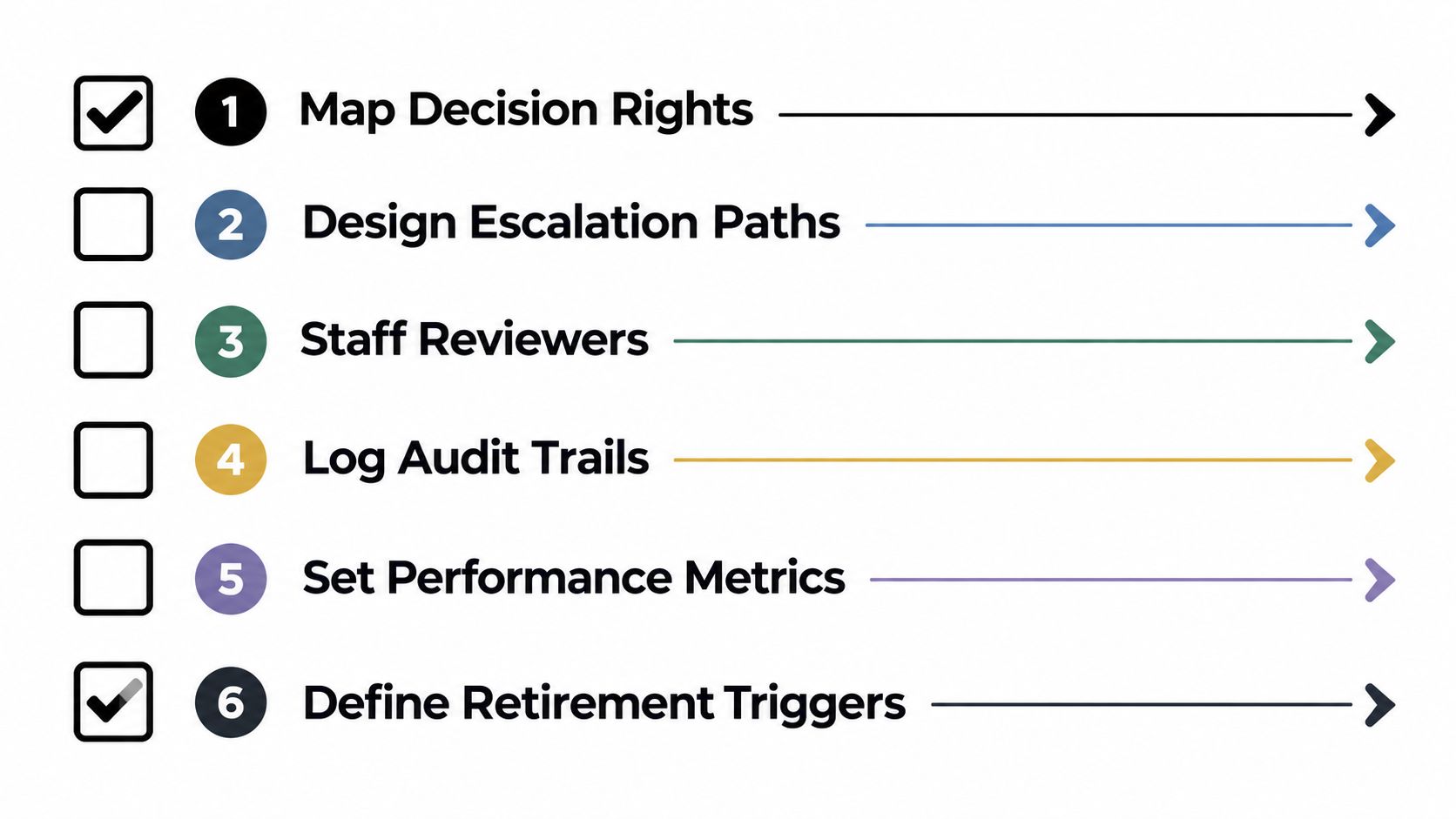
Use this implementation checklist:
- Map decision rights. Separate observation, recommendation, approval, execution, and rollback. Name the accountable human for each high-impact action.
- Design escalation paths. Define triggers for uncertainty, policy conflict, missing evidence, unusual scope, and customer or transaction risk. Specify the destination, response window, fallback, and fail-safe behavior.
- Staff reviewers. Estimate queue demand from expected exception volume and review time. Use trained specialists for decisions that require domain authority, and create backup coverage for absences and spikes.
- Log audit trails. Preserve the input, context, model output, reviewer identity, decision, rationale, edits, tool calls, and final outcome. A timestamp alone isn't an explanation.
- Set performance metrics. Track intervention quality, false escalations, missed escalations, latency, queue age, reviewer disagreement, drift, and downstream harm.
- Define retirement triggers. Decide what evidence allows a workflow to move from synchronous approval to escalation, sampling, or autonomous execution.
Retirement shouldn't mean “the model feels reliable.” Set promotion criteria before launch. Use sustained accuracy on representative evaluation data, a bounded override rate, stable drift indicators, clean golden-task performance, and an incident review process. If those conditions deteriorate, automatically return the workflow to a more supervised mode.
Operator FAQ
How should we size the review team? Start with the expected exception queue, average handling complexity, required response window, and specialist availability. Add a surge plan. A queue that works only on an average day isn't production-ready.
Which metrics matter most? Begin with missed-risk events, meaningful overrides, escalation precision, decision latency, queue age, and disagreement. Throughput is a capacity metric, not proof of quality.
How do we prevent queue collapse? Prioritize by risk, impose action-specific service levels, batch review where latency allows, and degrade safely when capacity is exhausted. The system should narrow autonomy or deny the action, not hide the backlog.
When does HITL stop paying for itself? Remove it when reviewers rarely change outcomes, the action is reversible, and sampling detects drift adequately. Keep it when the cost of an error is material, the action is irreversible, or the organization needs defensible human judgment in the record.
Who should own the program? Give one accountable leader authority across product, engineering, operations, and risk. A workflow without a clear owner will eventually become either over-supervised and expensive or under-supervised and risky.
Head of Agents helps enterprises assign accountable ownership for agent programs through readiness audits, leadership hiring, fractional matching, and implementation referrals. If your HITL design is stalled by unclear decision rights or missing operational leadership, visit Head of Agents to turn the control model into a staffed, measurable 90-day plan.