Implementation Plan of a Project: A Practical Guide
Learn how to build an implementation plan of a project with clear steps, a ready-to-use template, and a 90-day roadmap to keep your team on track.
Written by HeadOfAgents
Your team has a working AI agent prototype. Leadership has approved the rollout. Six weeks later, nothing is live, the integration owner is overloaded, the security review has no decision date, and nobody can explain who owns the next call.
That situation isn't unusual. The prototype proved that the agent can work. The implementation plan must prove that the organization can operate it safely, measure its value, and maintain it after launch. A strong implementation plan of a project turns approval into controlled execution, with explicit scope, named owners, decision gates, capacity assumptions, and a durable handoff.
What an Implementation Plan Really Does
An implementation plan is the operating document that explains how a project will move from intent to production. It translates goals into sequenced work, assigns responsibility to specific people, defines what “complete” means, and records the decisions that keep execution on course.
It isn't a strategy deck. A strategy deck describes the desired future. It isn't just a Gantt chart either. A schedule can show dates while hiding dependencies, unapproved requirements, missing skills, and unresolved risks. The implementation plan connects those details so stakeholders can see what must happen, who must act, and what evidence is required before the project advances.
For an AI agent rollout, the plan must go further than deployment milestones. It should define:
- Prompt and model versioning: Record which prompt, model configuration, and guardrails are approved for each release.
- Data access: Identify the systems, permissions, data owners, retention rules, and testing data required by the agent.
- Human review: Specify when a person must approve, override, or investigate an agent action.
- Monitoring: State which quality, safety, adoption, and operational signals the team will inspect after launch.
- Steady-state ownership: Name the team responsible for support, change requests, incident response, and benefits tracking.
Practical rule: If the plan ends at “production deployment,” it isn't complete. It stops before the organization starts operating the product.
The bridge between delivery and ownership
The most useful implementation plan produces three outcomes. First, it creates shared accountability, because every important workstream has a named owner rather than a department label. Second, it makes the timeline defensible, because dates are tied to dependencies and acceptance criteria instead of optimism. Third, it creates a formal transition from project mode to steady-state ownership.
That last outcome is routinely missed. A public implementation guide from the Food and Agriculture Organization treats long-run system maintenance as a core planning question. For AI agents, that means the plan should identify who owns prompt changes, model evaluation, connector failures, user feedback, escalation, and value measurement after go-live.
Write the handoff into the original plan. Don't leave it for a closing meeting when project resources are already disappearing.
Why Most Project Implementation Plans Slip
A rollout reaches its first pilot date, yet the integration owner has no confirmed access, reviewers have no scheduled capacity, and nobody can approve a scope tradeoff. The schedule looks active. The decisions required to execute it are still unresolved.
That pattern explains why implementation plans slip. Teams record features, dates, and status updates while leaving dependencies, authority, capacity, and post-launch ownership unclear. The plan becomes a delivery schedule instead of a transition document from project mode to steady-state operation.
The scale problem is documented in McKinsey research conducted with the University of Oxford. The published summary of that McKinsey and Oxford research reports that half of large IT projects, defined there as projects with initial price tags above $15 million, ran over budget. Average overruns reached 45% on cost and 7% on time, while those projects delivered 56% less value than predicted. Use explicit milestones, contingency buffers, and benefit tracking when the program has comparable scale or complexity.
A later McKinsey analysis reported that two out of three large programs regularly exceeded initial budgets, missed schedule estimates, and underdelivered on business objectives. It also reported that 25% to 40% of programs overshot budget or schedule by more than 50%, as summarized in this analysis of large technology program performance. These figures do not predict failure for every project. They show why a plan needs controls that expose unresolved decisions before they become schedule variance.
The failure patterns hiding in ordinary plans
| Failure Pattern | Typical Impact |
|---|---|
| Scope becomes a wish list | More work enters without extra capacity or an approved tradeoff |
| Milestones describe features | Teams report completion while business value remains unproven |
| Roles use job titles | Decisions wait because nobody knows who has authority |
| Capacity is assumed | Critical reviews, integrations, and testing become bottlenecks |
| Risk sits in a slide deck | Issues surface late, after mitigation options narrow |
| AI integration is underestimated | Data access, permissions, and system behavior delay the pilot |
| Human review is designed late | The agent cannot safely handle real exceptions |
PMI-cited implementation data summarized by Domont Consulting's operating-model framework puts roughly 14% of IT projects in the complete-failure category, with 43% going over budget and 49% experiencing scope changes during implementation. Treat those figures as a reason to inspect the plan before execution: unclear requirements, undefined reporting, and missing owners for migration or training are immediate warning signs.
AI agent rollouts add operating complexity. A prototype may use clean examples and limited permissions, while production requires authentication, logging, exception handling, data stewardship, user training, and a defined human takeover point. A plan that ignores those conditions will slip, then leave the operations team with an unsafe or unsupported system.
Treat slippage as evidence that the plan needs correction. Reconfirm the decision owner, dependency, capacity, or acceptance condition causing the delay. The objective is not to make the project team work harder. It is to hand over an operating system that the assigned owners can govern after launch.
Core Components of an Implementation Plan
Write the plan in the order decisions become necessary. Start with the outcome, then define the boundaries, the evidence required for progress, the people accountable for decisions, and the operating model that will remain after launch.
Scope and outcomes come first
Open with a short problem statement. Explain which business or operational problem the project addresses, who is affected, and what will change if the rollout succeeds. Then define in-scope and out-of-scope work in plain language.
For an AI support agent, in scope might include classifying incoming requests, retrieving approved internal guidance, drafting a response, and routing uncertain cases to a support specialist. Out of scope might include autonomous account changes, unrestricted access to internal systems, or handling regulated requests without review. The non-scope list is a control mechanism, not administrative decoration.
Define benefits in terms the business can inspect. Possible measures include resolution quality, escalation quality, response consistency, user adoption, operating effort, and safety exceptions. For agent-specific measurement design, use the agent performance metrics framework to connect operational signals with the outcomes recorded in the plan.
Milestones should be decision gates
A milestone matters when it creates a decision, not merely when someone finishes a feature. Useful gates include:
- Design review: The workflow, data boundaries, guardrails, and human-review rules are approved.
- Pilot cutover: The test environment, support process, evaluation set, and rollback procedure are ready.
- Go-live approval: Owners accept the evidence and authorize a controlled release.
- Handoff approval: Operations accepts dashboards, runbooks, training materials, access, and escalation paths.
Each gate needs a deliverable, an approver, a due date, and pass or fail acceptance criteria. “Agent tested” is weak. “The technical lead confirms the approved connectors work, the product owner accepts the evaluation results, and the operations lead approves the incident runbook” is enforceable.
Owners, dependencies, and capacity
Use named ownership. A useful responsibility model includes an executive sponsor, product owner, technical lead, data steward, prompt owner, security or risk reviewer, training lead, and operations owner. One person can hold more than one role in a small rollout, but the plan must make that explicit.
Build the timeline around dependencies. Data permissions may precede evaluation. Evaluation may precede user acceptance testing. Training may depend on a stable workflow. Production monitoring must exist before the agent is exposed to users.
Resource planning must show actual allocation, not just names. Include expected availability, decision latency, reviewer coverage, vendor dependencies, and backfill needs. Add a 15% to 20% capacity buffer for implementation work, as recommended in the project planning framework, and document what that buffer protects against. The buffer isn't permission to expand scope. It protects the approved scope from predictable disruption.
Risks, change, and benefits
Maintain a live risk and issue register. Every entry needs an owner, likelihood, impact, trigger, mitigation, response deadline, and current status. Review it in the operating cadence, not only before steering meetings.
Set a change-control rule before stakeholders request additions. A change should state its benefit, effort, dependency impact, risk, and required tradeoff. The sponsor or steering group then approves it, rejects it, or removes something else from scope.
Benefits tracking continues after deployment. Record the baseline, target direction, measurement owner, review frequency, and action if results fall short. The plan becomes valuable when it tells leaders not only whether delivery is on schedule, but whether the project is producing the reason it was funded.
Implementation Plan Template You Can Reuse
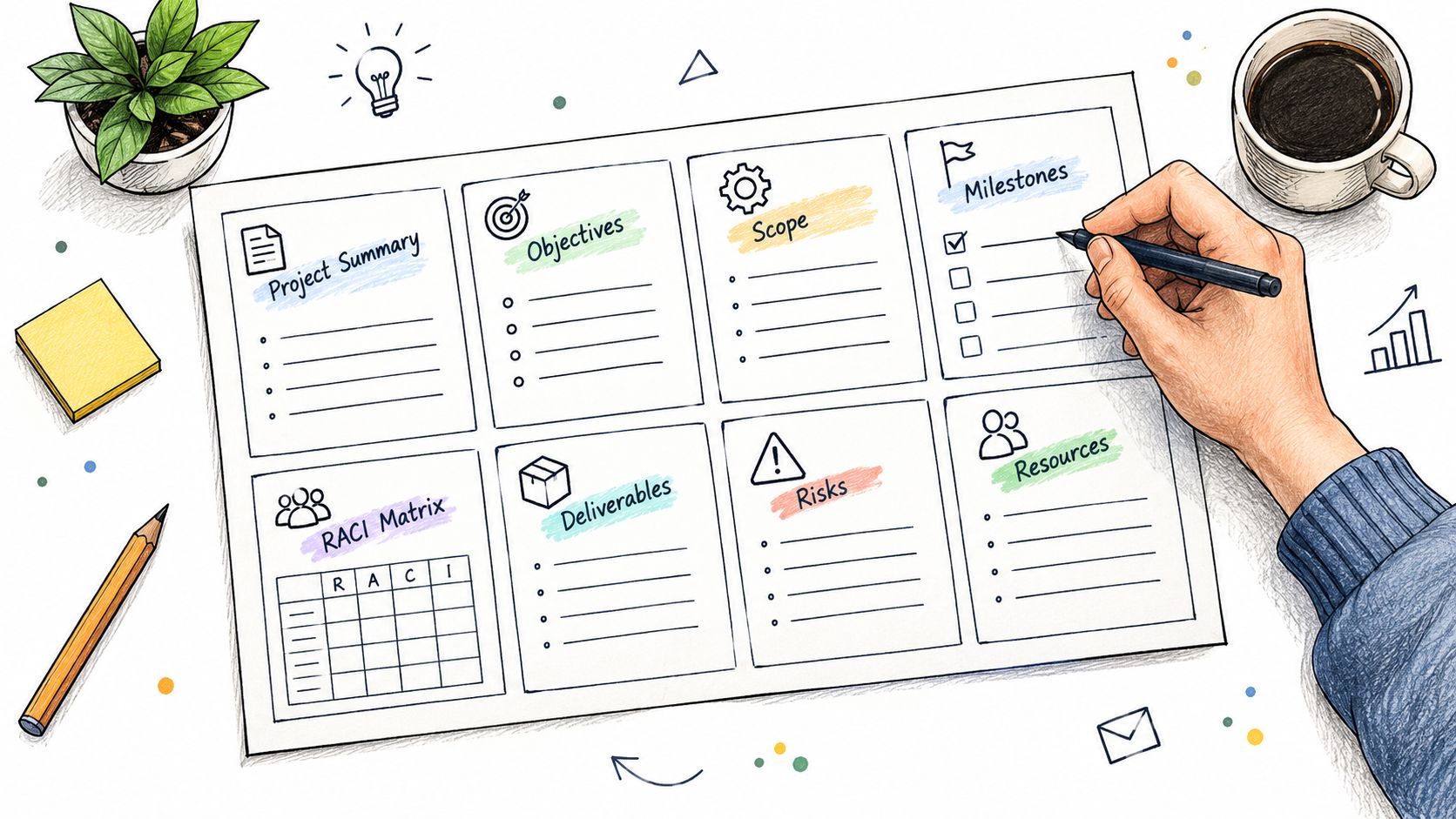
Use the following structure as a working document, not a form that gets completed once and forgotten. Keep one controlled version, record decisions beside the relevant milestone, and make every acceptance statement testable.
Project summary
State the problem, sponsor, product owner, delivery team, target users, and intended operational owner. Add the release boundary and the decision authority for scope, risk, and go-live.
Objectives and success metrics
Write one sentence describing the primary objective. Add three to five measurable KPIs that show whether the project is delivering useful, safe, and adoptable results. Assign one owner to each measure and specify how often it will be reviewed.
Scope and non-scope
List the workflows, users, systems, data sources, and actions included in the release. Follow that list with explicit exclusions. For an AI agent, include approved data access, guardrails, model or prompt version tracking, and the situations that require human review.
Milestones and timeline
Use decision gates rather than a long task inventory. For every gate, record the date, dependencies, deliverables, approver, and pass or fail criteria. Require a decision log at major gates and a change-request form whenever approved scope changes.
RACI role matrix
Map each workstream to a responsible person, accountable decision-maker, consulted specialists, and informed stakeholders. Include the operations owner before the pilot begins, not after production release.
Deliverables and acceptance criteria
Write acceptance as observable conditions. For example, “the approved support workflow is available in the test environment, access permissions are verified, escalation rules are documented, and the product owner signs the decision record.” Avoid “ready,” “complete,” or “validated” unless the plan defines what those words mean.
Risk register
Track technical, data, security, adoption, capacity, vendor, and operational risks. Add a trigger and response deadline so the register tells the team what to do, not just what to worry about.
Benefits and handoff tracking
Record the expected benefit, baseline, measurement method, owner, review cadence, and corrective action. The handoff checklist should confirm dashboards, runbooks, training, access, support coverage, escalation routes, version records, and rollback instructions.
Set a weekly delivery meeting for blockers and decisions, plus a monthly steering review for scope, risk, budget, and benefits. The cadence should continue through the early operating period, because go-live changes the nature of the work rather than ending it.
Micro-example for a support triage agent
| Plan Field | Example Entry |
|---|---|
| Scope | Classify internal support requests, retrieve approved guidance, draft responses, and route uncertain cases |
| Milestone | Pilot cutover after data access, guardrails, evaluation procedure, and reviewer training are approved |
| Acceptance | Product owner signs the scope, technical lead confirms connectors, and operations owner accepts the escalation runbook |
| Non-scope | Autonomous account changes and unrestricted access to internal records |
That level of detail gives the team something to inspect and approve. It also gives the operations owner a usable starting point instead of a vague promise that the project is “ready.”
90-Day Roadmap Example for an AI Agent Rollout
Consider an internal IT support agent. Its initial role is narrow: classify incoming tickets, retrieve approved guidance, draft responses, and route ambiguous cases to a human specialist. The rollout should prove the operating model as carefully as it proves the agent's technical behavior.
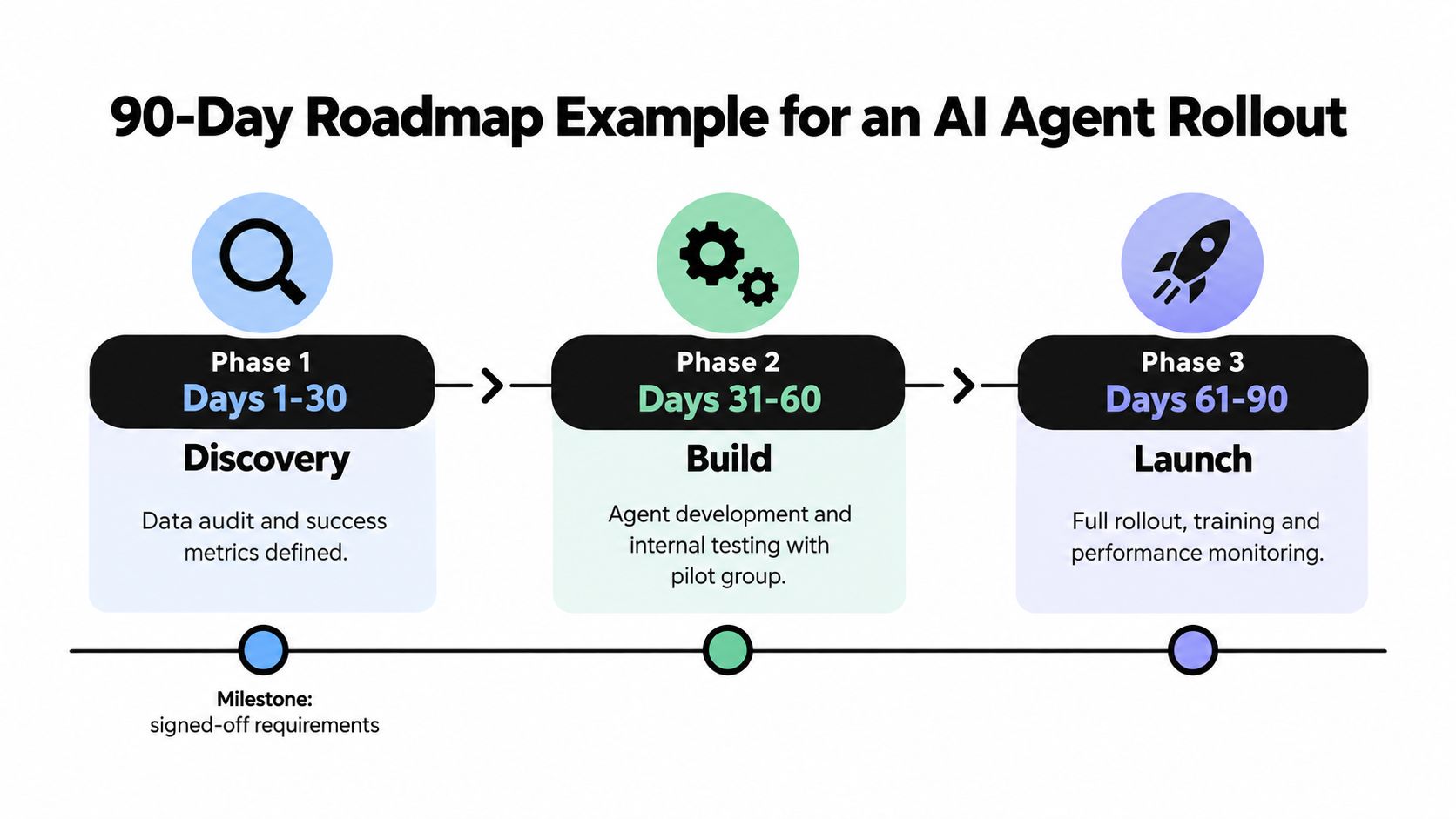
Days 1 to 30 focus on discovery
The product owner leads workflow interviews and signs the scope document. The data steward audits ticket history, knowledge sources, permissions, retention requirements, and known gaps. The technical lead maps integrations, while the risk reviewer approves the initial guardrail set.
The day-30 gate requires a signed scope, defined success measures, approved data boundaries, documented human-review rules, and an accepted guardrail set. If those artifacts aren't approved, the build phase shouldn't expand. Guardrails must precede training-data curation because the team needs to know which actions and outputs are acceptable before selecting and preparing examples.
Days 31 to 60 build the evidence
The technical lead owns the pilot build. The prompt owner records prompt versions and evaluation changes. The product owner organizes a sandbox evaluation against at least 200 historical tickets, and the operations owner defines the override process and reviews representative outputs.
Run a controlled shadow period before exposing users to the agent. The agent can generate classifications and drafts while human specialists continue making the production decision. A shadow run should last at least three weeks, giving the team enough operating time to identify recurring errors, integration failures, unclear escalation rules, and workload effects.
Decision gate: Don't approve launch because the agent performs well in a demonstration. Approve it when the team can explain failure handling, reviewer workload, rollback steps, and ownership.
Days 61 to 90 release gradually
Start production with 10% of traffic, subject to the approved release criteria. The operations owner leads weekly error review, the product owner monitors adoption and workflow outcomes, and the technical lead handles defects and connector changes. The risk reviewer confirms that incidents, overrides, and material behavior changes are recorded.
Use the AI agent team operating model to clarify how product, engineering, data, and operations responsibilities fit together. The exact roles can differ by organization, but the plan should never leave production ownership implied.
The day-90 transition requires a named operations owner, active dashboards, approved runbooks, trained reviewers, documented escalation, version records, a tested rollback path, and a benefits review schedule. Project mode ends only when operations can run the agent without depending on the original delivery team for routine decisions.
Risk, Capacity, and Post-Launch Ownership
The most common value leak after an AI rollout isn't always a flawed build. It is missing ownership and insufficient capacity to operate what was built.
Assign an operations lead before the pilot starts. Put the person's expected weekly hours, escalation coverage, review duties, and decision authority in the plan. For the first 90 days of production, specify who reviews quality, handles incidents, approves changes, and reports benefits. If nobody has time to do those jobs, the project isn't launch-ready.
A capacity-aware register scores more than abstract severity. It asks whether the team can respond quickly enough when the risk occurs. An apparently moderate connector failure can become serious if the only technical approver is unavailable and no rollback owner exists.
| Risk | Likelihood | Impact | Response Bandwidth | Mitigation and Owner |
|---|---|---|---|---|
| Prompt drift | Medium | High | Limited | Pin approved versions and assign the prompt owner to review changes |
| Silent model update | Medium | High | Limited | Record model versions, rerun evaluation, and require technical sign-off |
| Connector regression | Medium | High | Moderate | Test changes in a sandbox and keep a rollback runbook |
| Reviewer overload | Medium | High | Limited | Set review capacity, escalation rules, and an operations backup |
| Undetected quality decline | Medium | High | Moderate | Sample at least 50 conversations weekly and assign review findings to the product owner |
The governance design should cover decision rights, evidence, escalation, and release control. Use the AI agent governance framework to structure those controls, then adapt them to the risk profile of the workflow.
Before go-live, operations should have dashboards, runbooks, training, access, escalation contacts, version history, incident procedures, and a rollback path tested in practice. That checklist is what converts an implementation plan from a delivery document into a transition document.
Tips, Common Pitfalls, and Quick Answers
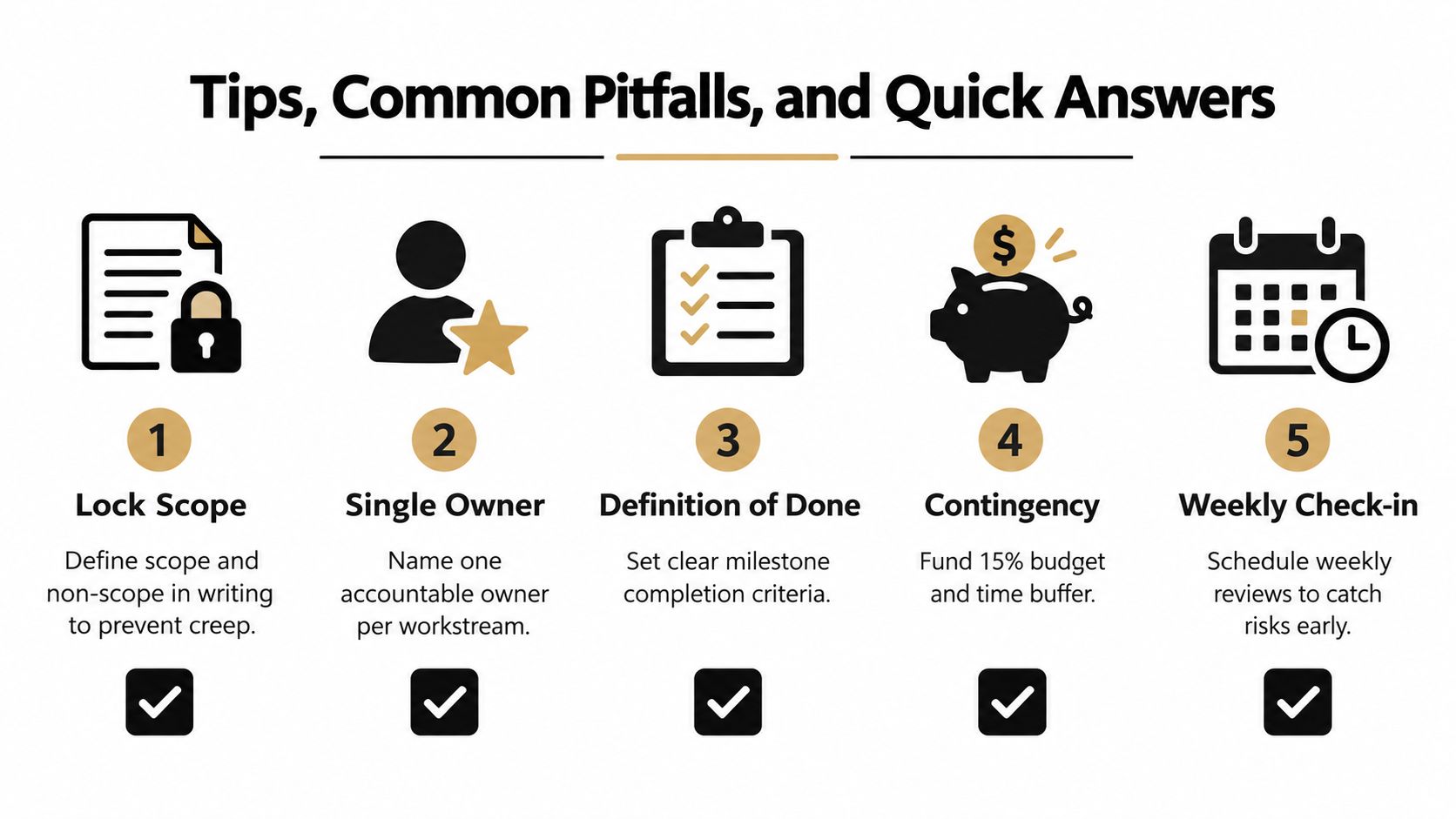
Five rules carry most of the execution value:
- Lock scope: Put in-scope and non-scope decisions in writing.
- Name one owner: Assign a single accountable person to every workstream.
- Define done: Make each milestone pass or fail against visible evidence.
- Fund contingency: Protect the approved plan with a 15% buffer for expected disruption.
- Review on schedule: Use weekly delivery reviews and 30/60/90 governance checkpoints.
Avoid ambiguous acceptance criteria, missing integration windows, skipped user acceptance testing, untracked model or prompt drift, and treating go-live as the finish line. Each one leaves the team unable to distinguish progress from evidence.
Quick answers
How long should drafting take? Long enough to resolve scope, ownership, dependencies, capacity, risks, and acceptance criteria before build work expands. A short project may need a compact document, but it still needs those decisions.
How does it differ from a project charter? A charter authorizes and frames the project. The implementation plan explains how the approved work will be executed, controlled, measured, and handed over.
What happens when requirements change? Record the request, estimate its impact, identify the tradeoff, and obtain the required approval. Don't absorb it.
Does a small project need one? Yes, if it has multiple owners, production risk, external dependencies, or ongoing operational responsibility. Scale the document down, but don't remove accountability or handoff criteria.
Head of Agents helps organizations identify accountable AI-agent leadership, assess readiness, structure governance gaps, and build a sequenced roadmap for production adoption. If your rollout has stalled or lacks a clear owner, visit Head of Agents to explore an audit, leadership match, or implementation referral aligned with your operating needs.