Make vs Buy Decision for AI Agents: A 2026 Guide
Make a sharper make vs buy decision for AI agents in 2026. Get a governance-weighted framework, decision matrix, and 90-day roadmap for enterprise leaders.
Written by HeadOfAgents
The popular advice is simple: buy what you can, build only what makes you special. For AI agents, that advice is incomplete. A purchased agent may reduce initial engineering work while increasing the amount of internal ownership required to control prompts, permissions, data, evaluations, incidents, and vendor changes.
The right make vs buy decision isn't a comparison between a license and a development budget. It's a decision about which parts of the operating model your company must own. The vendor may provide the model, interface, or workflow engine, but your team remains responsible for what the agent is allowed to do and what happens when it does the wrong thing.
Why Buying an AI Agent Often Raises the Stakes
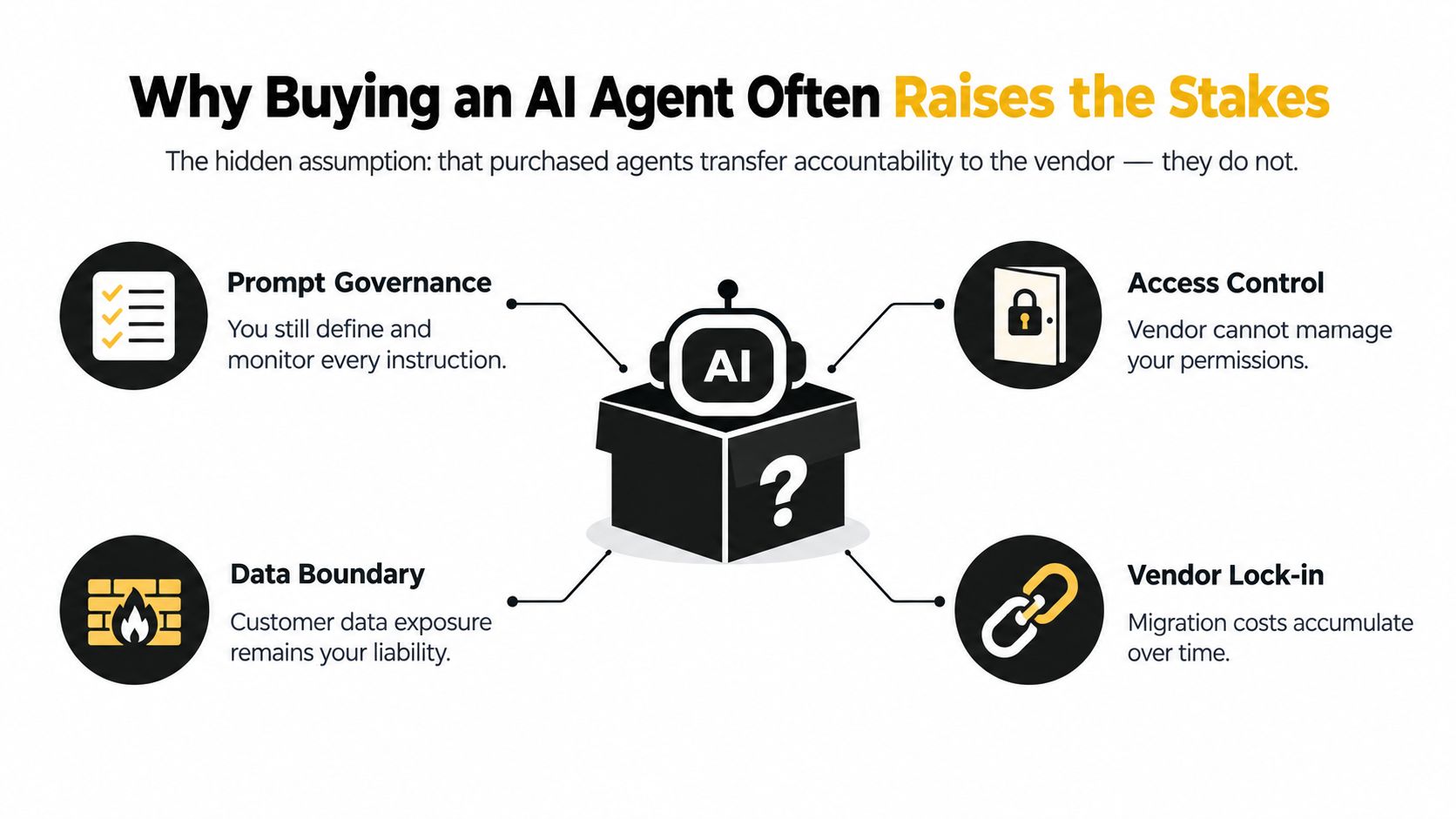
Buying an AI agent doesn't transfer accountability to the vendor. It transfers part of the implementation burden, while leaving your company with the production consequences. You still need to decide which data the agent can access, which tools it can call, when a human must approve an action, how its behavior is evaluated, and how the system is disabled or rolled back.
That burden grows when the agent moves from recommending an action to taking one. A vendor can provide contractual commitments, security documentation, and service support. It can't define your acceptable refund policy, determine which customer records are sensitive in your context, or explain to your board why an automated decision bypassed internal controls.
The three risks procurement misses
Vendor lock-in starts before the first renewal. It accumulates through embedded prompts, proprietary workflow definitions, decision histories, tool mappings, and employee training. If you can't export those assets in a usable form, replacing the vendor becomes an operational redesign rather than a straightforward migration.
Liability gaps appear when the agent acts without approval. Your contract may describe uptime and support response, but it may not resolve responsibility for an incorrect customer action, an exposed record, or a decision that conflicts with a regulated process. Procurement should treat agent behavior, audit access, incident cooperation, and model-change notification as core commercial terms.
Ownership inflation follows mission-critical adoption. The more consequential the agent becomes, the more your internal owner must negotiate service levels, review audit evidence, approve permission changes, monitor evaluation results, and coordinate remediation. Buying can therefore make the case for a named agent leader stronger, not weaker.
Practical rule: If nobody inside the company owns the agent's behavior, data boundary, and failure response, the company hasn't bought a solution. It has bought an unmanaged dependency.
The make vs buy decision should begin with one question: who owns the agent in production? Answer that before comparing vendors or estimating engineering hours. The rest of the analysis should assign ownership explicitly across the purchased foundation, internal integrations, prompts, tools, evaluations, security controls, and exit plan.
The Economic Logic Behind Make vs Buy
Transaction-cost economics provides the durable logic behind the make vs buy decision. A company should organize work internally when coordinating through a market costs more than managing the activity inside the firm. Those coordination costs include supplier discovery, negotiation, performance monitoring, and contract adaptation, as described in the transaction-cost economics reference on make-or-buy boundaries.
For AI agents, three variables make this logic practical.
Asset specificity asks how customized the investment is to your business. A generic retrieval workflow has low specificity. An agent connected to proprietary processes, internal approval logic, customer history, and specialized evaluation data has high specificity. When that investment is difficult to reuse elsewhere, switching suppliers becomes expensive and dependence increases.
Uncertainty covers both demand and behavior. You may not know how workloads will change, how often policies will shift, or how a model update will affect decisions. An agent with unpredictable workload, changing regulatory expectations, or a wide range of possible actions needs stronger internal control than a narrow assistant with stable inputs.
Transaction frequency asks how often the company must coordinate the activity. A rarely used specialist workflow may justify buying a focused capability. A heavily used agent creates repeated exposure to pricing, latency, access, quality, incident, and change-management decisions. Each interaction makes weak contracts and poor observability more costly.
| Variable | What it measures | AI agent signal | High score implies |
|---|---|---|---|
| Asset specificity | How tailored the investment is to one business or process | Proprietary data, unique workflows, specialized tools, custom evaluations | Internal ownership or a hybrid boundary |
| Uncertainty | How difficult demand and behavior are to predict | Volatile workload, changing policy, model variation, regulatory drift | Sensitivity analysis, stronger controls, and a reversible design |
| Transaction frequency | How often the company coordinates the activity | Repeated agent calls, frequent policy changes, ongoing vendor decisions | Greater value from internal capability and contract leverage |
A simple license comparison misses all three. It may show that a vendor subscription costs less than an initial build, while ignoring the cost of integrating proprietary data, reviewing decisions, adapting to model changes, or migrating later.
Research on component-level sourcing found asset specificity to be a statistically significant predictor of vertical integration in studies by Monteverde and Teece and by Masten, as summarized in the research on the economics of make-or-buy decisions. The lesson for an AI program is direct: don't let a low entry price disguise a highly specific dependency.
Use a quick self-test. If the agent relies on proprietary knowledge, faces uncertain behavior, or runs frequently enough that small failures repeat at scale, the case for build or hybrid ownership strengthens. A vendor pitch deck can't override those economics.
Build, Buy, or Hybrid at a Glance
The wrong question is, “Which option has the lowest license or build cost?” The better question is, “Who will own the agent's operating model?” Buying the underlying capability can reduce engineering effort while increasing the need for an internal owner of prompts, tools, permissions, data connections, evaluations, escalations, and release decisions.
For enterprise workflows, the strongest default is buy the foundation, then own the control plane. The supplier can operate the underlying capability, while your team retains authority over the parts that determine behavior, risk, and business fit.
| Dimension | Build | Buy | Hybrid | Why it matters |
|---|---|---|---|---|
| Reversibility | High when interfaces and data remain portable | Often limited by embedded workflows and proprietary exports | Moderate to high when internal control points stay portable | A fast launch becomes expensive when replacement requires a redesign |
| Governance control | Direct internal control | Shared control within supplier constraints | Internal control over the consequential layer | Agents need policy enforcement, auditability, and rollback |
| Customization depth | Deep and specific | Limited by configuration and the supplier roadmap | Deep where differentiation affects business value | Customization should follow business impact, not engineering preference |
| Exit cost | Engineering and maintenance burden | Migration, retraining, data conversion, and contract dependency | Replace the foundation while retaining internal assets | Exit planning reveals the real cost of dependence |
Build when the boundary is strategic
Build the agent architecture when the workflow differentiates the business, depends on proprietary knowledge, or carries consequences that require control beyond external configuration. Owning the architecture does not require recreating every underlying capability. It means controlling the components that determine how the system behaves in your environment.
That choice creates a lasting operating obligation. Your organization must fund reliability, security, evaluation, maintenance, and staffing after launch. Approve an internal build only when leadership is prepared to own those responsibilities, not just the initial project.
Buy when the capability is standardized
Buy a packaged capability when the use case is narrow, interfaces are stable, multiple suppliers can compete, and failure has a limited blast radius. A purchased foundation can shorten the path to routine automation and keep internal engineers focused on proprietary systems.
Treat the purchase as an operating-model decision, not a software transaction. Review data handling, export formats, logs, permission models, model-change controls, evaluation access, and termination support before declaring the choice low risk. A comparison of AI agent platforms can help structure that review, but the final boundary must reflect your controls and responsibilities.
Choose hybrid for consequential workflows
Hybrid is the practical choice when an agent affects customers, money, regulated data, or core operations. Buy infrastructure or a workflow foundation, then retain internal ownership of prompts, tool scopes, data transformations, policy checks, evaluation, and approval paths. Teams assessing implementation patterns can review building AI agents with AgentStack as one example of how an agent development layer can fit within a broader ownership model.
Score each option across reversibility, governance control, customization depth, and exit cost. Set a minimum threshold for each dimension. If an option falls below that threshold, make procurement conditional on controls such as export rights, a customer-controlled evaluation suite, or an internal approval layer.
The hybrid choice succeeds only when someone inside the company owns the boundary. Buying the agent does not transfer accountability for its decisions.
Cost Models That Account for Governance
A license fee is only the visible part of a purchased agent. A build estimate is only the visible part of an internal agent. Both numbers become misleading when they exclude the work required to operate a system that can access data, call tools, and make decisions.
The cost model should include five layers:
- Integration engineering: Connect enterprise data, identity systems, business rules, and operational tools.
- Evaluation and observability: Maintain test cases, trace agent decisions, measure failures, and detect behavioral changes.
- Human review: Staff approvals for high-risk actions and investigate exceptions that automation can't resolve.
- Incident response: Reserve capacity for containment, investigation, customer remediation, and policy updates.
- Expected loss: Estimate the financial and operational consequence of incorrect actions, not just the probability of an error.
| Cost component | Build | Buy | Hybrid |
|---|---|---|---|
| Core capability | Internal engineering and infrastructure | Subscription or usage fees | Purchased foundation plus internal control layer |
| Integration | Higher internal ownership | Often underestimated during implementation | Focused internal work around proprietary systems |
| Evaluation | Fully internal | Dependent on vendor access and tooling | Internal tests for the behavior your company controls |
| Monitoring | Designed and operated internally | May require extra access or paid features | Shared infrastructure with internal decision monitoring |
| Human approval | Designed around your risk policy | Configured within vendor limits | Internal approval for consequential actions |
| Incident response | Internal team and procedures | Vendor escalation plus internal remediation | Shared escalation with internal command authority |
| Exit cost | Rebuild or retirement effort | Data, workflow, and retraining migration | Replace the foundation while preserving internal assets |
Price the control, not just the component
A purchased agent may look inexpensive until the company adds audit logging, red-team testing, approval queues, rollback capability, and legal review. A custom system may look expensive until the company recognizes that it already has the domain expertise and needs a level of control the vendor cannot provide.
The same reasoning applies to contract terms. Ask for model-change notification, incident cooperation, audit access, data deletion, portability, escalation service levels, and clear treatment of liability. These aren't legal decorations. Each term protects a specific operating control.
A finance review should show which cost pays for which control. Monitoring pays for detection. Evaluation pays for release confidence. Human approval pays for risk containment. Portability work pays for reversibility. This makes the investment defensible to finance, security, compliance, and operations leaders.
For a more detailed way to structure the financial assumptions, use the cost estimation models for AI agent programs. Then score every candidate on expected value after governance costs, not on the license fee alone.
Mapping Use Cases to a Sourcing Decision
The same company can rationally buy one agent, build another, and use a hybrid model for a third. The correct answer depends on the dominant economic variable and the consequence of failure.
Case A, internal document questions
A high-volume internal document question-and-answer workflow usually favors buying a vertical capability when the data boundary is manageable and the agent only retrieves or summarizes information. The dominant variable is transaction frequency, but the blast radius remains limited if the agent doesn't change records, approve payments, or communicate externally.
The threshold flips toward hybrid ownership when the workflow requires proprietary classification, complex access rules, or a custom evaluation set that the vendor can't expose or support. Keep the data permissions and quality tests under internal control even when the retrieval foundation is purchased.
Case B, customer refund negotiation
A customer-facing refund negotiation agent calls for a hybrid model. License a narrow capability where it provides speed, but build the orchestration and approval layer around brand rules, refund limits, customer history, and escalation paths.
Here, uncertainty dominates. Customer conversations vary, policies change, and a wrong concession can create financial and reputational harm. The threshold for internal ownership is crossed when the agent can commit the company to an outcome without human approval.
Case C, regulated claims adjudication
Regulated claims adjudication should generally be built around a controlled internal decision process, with packaged evaluation and infrastructure components where useful. Auditability and consistent reasoning matter more than minimizing the unit price of each decision.
Asset specificity is high because the agent must reflect internal policy, evidence standards, exception handling, and regulatory expectations. If the vendor can't provide sufficient traceability, reproducible evaluations, or change control, buying the complete decision capability is the wrong boundary.
Case D, cross-system workflow orchestration
For orchestration across systems that change regularly, buy platform primitives and own the orchestration layer. The purchased foundation can handle common connectivity and execution patterns, while your team retains workflow definitions, permissions, approval gates, and regression tests.
The dominant variable is uncertainty. Quarterly process changes make vendor-only ownership risky because your business must respond faster than a generic roadmap may allow. Before selecting a foundation, review the pricing and latency comparison for AI agents as one input, then test those characteristics against your own workload and controls.
Use this reusable rubric:
- Score asset specificity, uncertainty, and transaction frequency.
- Score reversibility, governance control, customization depth, and exit cost.
- Weight the dimensions according to the consequence of failure.
- Route low-specificity, predictable work toward buy.
- Route proprietary or consequential work toward build or hybrid.
- Require a named owner and exit criteria before approval.
The rubric should constrain instinct, not disguise it. If executives can't agree on the scores, that disagreement is itself a signal that the use case needs clearer ownership and risk definition.
Why Buying Still Demands an Internal Owner
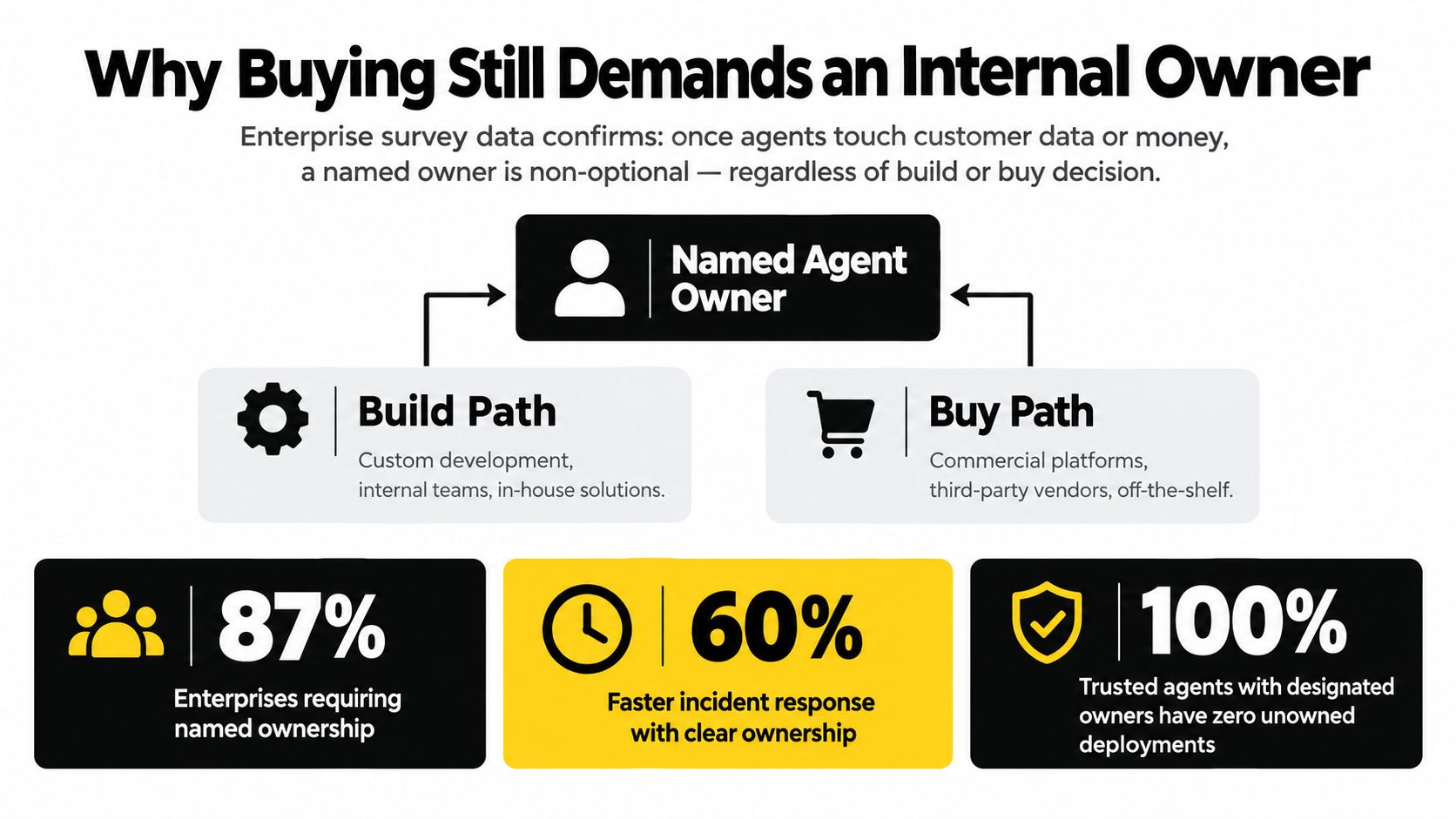
Enterprise adoption data shows why procurement can't be the end of the decision. Menlo Ventures reported that purchased AI use cases rose from 53% in 2024 to 76% in 2025 among 495 U.S. enterprise AI decision-makers, while the same research highlighted the growing need to explain and govern agent decisions in the enterprise AI adoption and governance analysis. Buying is growing, but buying doesn't eliminate the governance problem.
The scale gap is equally important. Capgemini found that only 14% of surveyed leaders had implemented AI agents at partial or full scale, while 23% were still piloting and 71% didn't fully trust autonomous agents for enterprise use, as reported in the enterprise generative AI adoption research. A vendor can make deployment easier without making the organization ready to supervise autonomous behavior.
Define the ownership stack
When an agent touches customer data, money, or regulated decisions, assign four roles:
- Product owner: Owns business outcomes, adoption, budget, and the decision to expand or stop the agent.
- Agent engineer: Owns evaluations, release controls, observability, tool behavior, and rollback.
- Risk partner: Reviews prompts, data access, tool scopes, human approvals, and incident procedures.
- Executive sponsor: Resolves cross-functional disputes and keeps the program aligned with enterprise risk appetite.
This is different from making the vendor responsible for support. The vendor operates its service. Your company owns the consequences of deploying that service into your process.
For a practical control structure, use the AI agent governance framework to document decision rights, escalation paths, and release requirements. The key question isn't whether a bought agent has a service-level agreement. It's who signs off when it produces an incorrect refund, exposes personal information, or violates an internal policy.
The operating model should be formal before the agent becomes mission-critical. Ownership ambiguity causes more organizational failure than a minor model-quality gap because nobody has authority to pause the system, change its scope, or fund remediation.
A 90-Day Roadmap and When to Bring in a Head of Agents
A make vs buy decision should produce an operating commitment, not a procurement preference. Use the first 90 days to create evidence, test the ownership boundary, and make the final sourcing call with a defined exit path.
| Phase | Weeks | Focus | Deliverables | Exit criteria |
|---|---|---|---|---|
| Diagnose | 1 to 4 | Inventory and score candidate use cases | Use-case map, economic scores, risk tiers, two shortlisted candidates | One build candidate and one buy candidate have named owners, clear failure boundaries, and comparable success measures |
| Test | 5 to 8 | Run parallel pilots under guardrails | Working pilots, evaluation suite, access model, approval flow, incident procedure, expected-loss ceiling | Leadership can compare quality, control effort, reversibility, and operational burden |
| Decide | 9 to 12 | Select the sourcing boundary and formalize ownership | Sourcing decision, contract requirements, control plan, portfolio roadmap | Executive sponsor approves the owner, budget, exit criteria, and next-stage deployment plan |
Weeks 1 to 4 establish the decision facts
Start with an inventory, not a vendor demo. List every proposed agent, the process it changes, the data it touches, the tools it can call, the people affected by its decisions, and the consequence of failure.
Score each use case for specificity, uncertainty, frequency, governance control, reversibility, and exit cost. Shortlist two candidates with comparable business value, one suitable for an internal build and one suitable for purchase. The phase is complete only when leadership can explain why each candidate belongs on its chosen path.
Do not advance a use case because a team is enthusiastic. Advance it when the company has defined the agent's authority, data boundary, evaluation method, and owner.
Weeks 5 to 8 test behavior and operating cost
Run the build and buy candidates in parallel where the comparison is meaningful. Give both paths the same business objective, representative inputs, approval rules, and failure categories. Measure more than task completion. Record review effort, exception handling, trace quality, integration friction, policy enforcement, and the time required to diagnose a bad result.
Set an expected-loss ceiling before testing begins. That ceiling should reflect what the business can tolerate during the pilot, not what the vendor says the system usually does. Include a stop condition for unsafe behavior, incomplete logs, unapproved data access, or a material increase in manual review.
The pilot should answer five questions:
- Can the agent perform the task?
- Can the company explain its decisions?
- Can a human interrupt or reverse it?
- Can the team replace the foundation without losing critical assets?
- Can the owner operate the system after the pilot team moves on?
If the answer to the last three questions is no, the pilot hasn't demonstrated production readiness.
Weeks 9 to 12 convert evidence into a portfolio decision
Make the sourcing call using the evidence from both pilots. A buy decision should specify which controls remain internal and which responsibilities the vendor accepts. A build decision should specify maintenance staffing, evaluation ownership, security review, and the point at which the company will reconsider buying. A hybrid decision should draw the boundary in architecture and contract language, not just in a presentation.
Publish a 12-month agent portfolio plan with priorities, owners, dependencies, control milestones, and retirement criteria. Include a replacement test for every purchased foundation. The test should cover data portability, workflow portability, evaluation portability, and the time required to operate with a substitute.
Bring in an operating leader at the right trigger
Engage a Head of Agents when more than three agents are in production, when product, engineering, security, and operations dispute ownership, or when a board-level governance review is scheduled. Those triggers indicate that the company no longer has isolated experiments. It has an agent portfolio requiring common standards and accountable prioritization.
The role isn't a vendor liaison. It is a buying-side operator who decides what the company should own, what it can safely purchase, how teams share controls, and when an agent should be paused or retired. That leader should have authority over the roadmap, evaluation standards, governance escalation, and the economics of make, buy, and hybrid decisions.
Head of Agents helps companies structure agent-readiness audits, build-versus-buy recommendations, 90-day roadmaps, and searches for accountable AI-agent leadership. If your pilots are multiplying or your sourcing decision keeps stalling on ownership, visit Head of Agents to turn the decision into an operating plan.