Persistent Memory for AI Agents
Design and operate persistent memory for AI agents with practical guidance on architecture, retrieval, governance, security, performance, and testing.
Written by HeadOfAgents
A procurement agent resumes a supplier negotiation after two quiet weeks. It remembers the discount agreed during the first conversation, applies that figure to a contract whose terms have since changed, and prepares a recommendation for approval. The model didn't fail because it lacked reasoning capacity. It failed because the system preserved a piece of state without proving that the state was still valid, authorized, or relevant.
That distinction defines persistent memory for AI agents. A larger context window can expose more history, but it can't decide which facts have expired, which instruction superseded another, who may access a memory, or whether a retrieved conclusion came from an authoritative source. Persistent memory must be designed as governed agent state, with deliberate rules for writing, retrieving, updating, discarding, and tracing information over time.
Why Persistent Agent Memory Changes the Product
The procurement scenario is easy to dismiss as a retrieval problem. It isn't. Even perfect retrieval would reproduce the wrong discount if the memory record carried no expiry, revision history, or requirement to validate the current contract. The agent needs a state-management system that distinguishes a historical event from a current commercial term.
That changes the product promise. A stateless assistant answers within a session. A durable agent resumes work across sessions, which means its stored commitments, preferences, permissions, and task history can influence future actions. The Memora benchmark for long-term agent memory treats this persistence as a distinct evaluation target over weeks to months of conversation, using tasks for remembering, reasoning, and recommending. It also introduces FAMA, a forgetting-aware metric that penalizes answers relying on obsolete or invalidated memory.
State has more dimensions than storage
A production memory record shouldn't be just text plus an embedding. It needs a contract that answers several operational questions:
- Write: Why does this information deserve durable storage rather than remaining in the session?
- Retrieve: What query, ranking logic, freshness rule, and authorization check make it eligible?
- Update: Which new event supersedes the old record, and can the system prove the relationship?
- Discard: When should the memory be deleted, archived, or marked invalid?
- Provenance: Which user, session, source system, and model produced or verified it?
- Access control: Which identity, tenant, role, and workflow may read or change it?
Teams that treat memory as configuration usually hide these decisions inside prompts or framework defaults. The resulting agent may appear coherent while repeating old assumptions. Teams that treat memory as governed state can make resumption trustworthy because the system knows not only what it remembers, but also why the memory exists and whether it remains usable.
Practical rule: A memory is production-ready only when the agent can explain its source, scope, freshness, and supersession status before using it to influence work.
The product consequence is substantial. Memory becomes part of the agent's behavior surface, not a background optimization. It shapes customer trust, auditability, model efficiency, and the safety of tool actions. The enterprise question is no longer “How much context can we fit?” It's “Which durable state may this agent use, under what conditions, and with what evidence?”
Choosing a Memory Architecture
Architecture selection starts with the workload, not the database. A short-lived assistant may only need episodic history, while a regulated workflow requires explicit state transitions and traceable recall. The important dimensions are durability, consistency, portability, latency, and operational complexity.
| Architecture | Durability | Consistency | Portability | Latency | Operational Complexity |
|---|---|---|---|---|---|
| Full-history replay | High while history is retained | Weak when old context conflicts with current facts | High | Degrades as prompts grow | Low initially, high at scale |
| External selective memory | High | Depends on write and update logic | Moderate to high | Usually selective and predictable | Moderate |
| Hybrid episodic and semantic memory | High | Requires synchronization and reconciliation | Moderate | Good when retrieval is well tuned | High |
| Specialized task and state manager | High | Strong for modeled workflow state | Lower | Predictable for known state queries | High |
Full history accepts prompt bloat
Replaying the entire conversation is straightforward and portable. It preserves raw evidence and avoids building a separate memory service, which makes it useful during prototyping or for assistants with narrow session horizons.
Its failure mode is structural. The prompt contains old and new claims side by side, and the model must infer which one wins. As history accumulates, the system also spends context and latency on information unrelated to the current task. A longer window can carry more records, but it doesn't provide a reliable supersession policy.
Teams often keep this design too long because it feels safe. Raw history seems more faithful than a curated memory, yet unfiltered history can reintroduce stale instructions and sensitive material that the current user shouldn't see.
External memory shifts the burden to retrieval
A key-value store works well for exact state, such as an order status or an approved workflow parameter. A vector index helps find semantically related memories when the user's wording differs from the stored wording. Hybrid retrieval combines those strengths, but it moves reliability risk into indexing, query formulation, ranking, freshness, and authorization filtering.
context engineering for agents becomes an architectural discipline rather than a prompt-writing exercise. The system must build a small, relevant context from governed records instead of asking the model to search an unstructured archive.
External memory is portable when records, metadata, embeddings, and lineage can be exported independently of the serving layer. It becomes difficult to operate when teams store only opaque summaries and can't reconstruct how those summaries were created.
Hybrid memory separates experience from meaning
A hybrid stack keeps episodic traces, such as tool calls and conversations, alongside semantic memories, such as stable preferences, validated business rules, and reusable conclusions. This division supports direct evidence retrieval while allowing the agent to operate on concise, generalized state.
The trade-off is synchronization. A new event may invalidate a semantic summary while the underlying episode remains accurate. Without version links and repair jobs, the two layers drift. Hybrid systems also need clear rules for whether the agent should cite the summary, inspect the original episode, or consult a system of record.
Specialized state improves traceability
A task graph, slot model, or workflow state manager represents known business processes explicitly. It can enforce required fields, transition rules, approvals, and ownership, which makes it appropriate for regulated or high-impact workflows.
The constraint is flexibility. A specialized schema won't capture every unexpected insight, and changing the workflow model requires engineering work. That limitation is often beneficial: the agent can't invent a new state transition when the system requires a documented one.
Use episodic-only history for short assistants, hybrid memory for product copilots, and specialized state for regulated workflows where every recall must be traceable. Most enterprise programs need more than one pattern, but they shouldn't hide critical workflow state inside a generic semantic store.
Building the Memory Operating Lifecycle
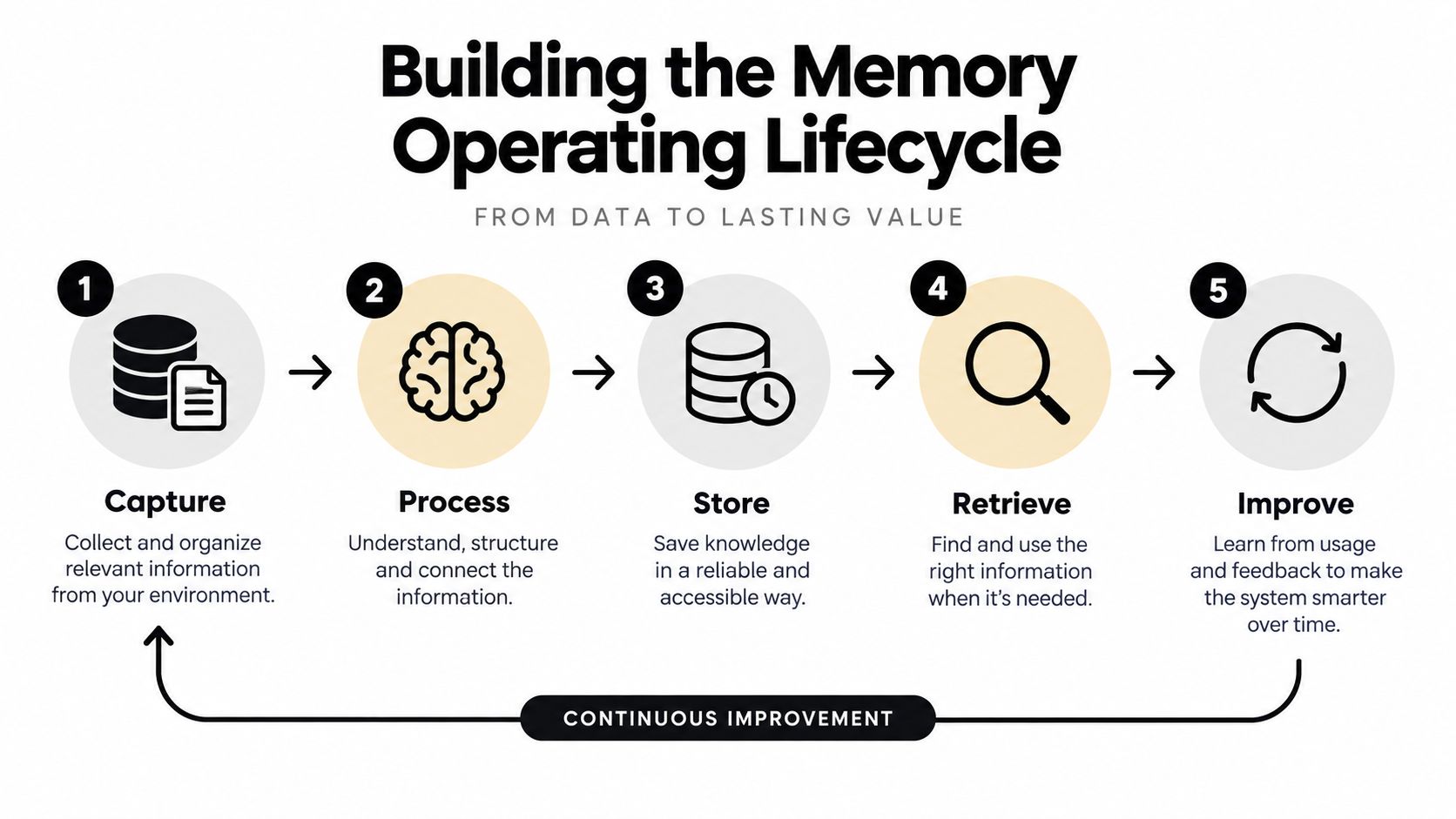
A vendor risk agent illustrates why memory needs a lifecycle. The agent may support an onboarding engagement across multiple sessions, collecting questionnaire answers, reviewing evidence, tracking open issues, and revising a risk conclusion as new documents arrive. Storing everything isn't the objective. The objective is to preserve useful state while making invalid state easy to detect and remove.
Classify before writing
Every candidate memory should receive a type before it reaches durable storage:
- Fact: A statement about the current world, such as an approved certification or documented control.
- Preference: A user or team choice, such as a preferred review format.
- Task state: An open request, pending evidence item, owner, or workflow transition.
- Derived conclusion: An interpretation produced from multiple facts, such as a provisional risk rating.
The type determines its treatment. A preference may remain useful until changed. A task state may expire when the workflow closes. A derived conclusion should retain the evidence that supports it and should be re-evaluated when those inputs change.
Attach confidence, source, creation time, effective time, expiry, sensitivity, and scope at classification. Confidence shouldn't substitute for verification, but it helps retrieval and review policies distinguish an authoritative record from an agent hypothesis.
Write through a controlled API
Don't give the model unrestricted access to a database or filesystem. Expose a memory API that validates schemas, normalizes entities, checks required metadata, and records provenance before accepting a write.
For the vendor risk workflow, a write might include the supplier identifier, control domain, evidence reference, reviewer identity, source timestamp, and permitted audience. The API should reject an entry that lacks a source or attempts to write a conclusion as if it were a fact.
Controlled writes also make idempotency possible. Replaying a session shouldn't create duplicate memories, and an agent retry shouldn't produce multiple versions of the same event.
Retrieve selectively and securely
Retrieval should combine exact filters with semantic similarity, then apply recency, validity, and authorization rules. Lexical matching helps with named controls and identifiers. Semantic search helps when the user's wording differs from the stored record. Neither method should bypass tenant boundaries or sensitivity labels.
The retrieval result should expose lineage, not just text. The model needs enough metadata to know whether it has found a current record, a superseded version, or a conclusion that requires confirmation.
Revise by versioning
Never overwrite a material memory without preserving its prior form. Create a new version, link it to the superseded record, and mark the old record as inactive for ordinary retrieval. This maintains an audit trail and lets investigators reconstruct what the agent knew at a particular point in the workflow.
A revised supplier discount, for example, should point to the earlier negotiation record and identify the event that changed the terms. The agent can then distinguish “the supplier once offered this discount” from “the current contract authorizes this discount.”
Repair when systems disagree
Repair is the lifecycle stage teams most often omit. A memory can be correctly extracted and still become wrong later. Reconciliation jobs should compare sensitive or high-impact records against authoritative systems, identify conflicts, quarantine questionable memories, and request human confirmation where automated resolution isn't safe.
This lifecycle prevents the opening scenario. The discount record would carry an expiry, a revision pointer, and a source reference. Before reusing it, the procurement agent would check the active contract rather than treating old memory as current truth.
The lifecycle works only when the platform records every transition. A memory that can be written but not revised or discarded isn't durable state. It's cached risk.
The operating flow should also be observable in the agent runtime. A short instructional overview can help teams connect collection, retrieval, and repair behavior to the broader execution loop:
Governing Retention Security and Compliance
Memory governance isn't a document attached after implementation. It's the contract enforced by every read, write, update, export, and delete path. Persistent memory can contain private preferences, commercial terms, operational history, and inferred conclusions, so the platform must govern the record as carefully as the source data.
Retention must follow memory class
A single retention policy creates unnecessary exposure and unnecessary cost. Define retention by purpose and sensitivity:
- Task records should remain available while the workflow is active, then move through closure and deletion rules.
- User preferences should persist only while the relationship and consent basis remain valid.
- Derived conclusions should expire or trigger revalidation when their supporting evidence changes.
- Audit records may require separate preservation rules, including legal holds that prevent ordinary deletion.
Automated purging should enforce tenant boundaries and record the deletion event. Legal hold must override routine expiration, while a deletion request should propagate through derived summaries, indexes, caches, and backups according to the organization's policy.
Provenance makes memory inspectable
A trustworthy record should link to the source session, user or service identity, source system, relevant model version, and verification status. Signed or tamper-evident provenance helps investigators determine whether a memory came from a user statement, a tool result, an imported document, or an agent inference.
Lineage also protects against unsafe abstraction. A generalized memory can accidentally reveal a sensitive business pattern even if it omits the original document. The system should carry sensitivity labels and access rules through distillation, not apply them only at ingestion.
For a broader control model, align memory decisions with an AI agent governance framework, then map each control to an executable policy in the platform. Governance becomes real when an unauthorized read fails, an expired record is excluded, and a deletion request produces evidence.
Security includes poisoning resistance
Persistent memory creates an attack surface because an attacker may try to place misleading content into a store that the agent will trust later. Recent work on long-term memory poisoning in LLM agents highlights why validation, provenance, and access control need to be treated as memory controls rather than optional security enhancements.
Defenses should operate at several points:
- Write-time validation: Require structured fields, source references, identity, and permitted memory classes.
- Anomaly detection: Flag unusual embedding patterns, sudden bursts of writes, contradictory claims, or changes outside normal workflow behavior.
- Retrieval sandboxing: Keep untrusted memories from directly authorizing high-impact actions without independent verification.
- Human confirmation: Require approval before a memory changes payment terms, access rights, legal posture, or another consequential state.
- Tenant isolation: Enforce identity-aware retrieval before ranking results, not after the model has seen them.
- Redaction on write: Remove secrets and unnecessary personal data before durable storage.
Security teams should test poisoning as a lifecycle failure. Ask whether a malicious user can write a false preference, whether another tenant can retrieve it, whether a summary preserves the attack, and whether operators can identify and purge every affected record.
Testing Reliability and Troubleshooting Failures
A memory system can pass a recall demo and still fail in production. Reliability appears when an agent writes state in one session, retrieves it later, revises it after a change, and continues correctly after an interruption. Test the full multi-session task sequence, not an isolated question. The evaluation should cover what the agent chose to write, which record it retrieved, whether it recognized obsolete state, and whether access controls held throughout the workflow.
The 2026 Mem2ActBench benchmark includes 400 memory-dependent tool-use tasks derived from 2,029 long-context dialogue sessions. Human verification found that 91.3% could not be solved without long-term memory, as reported in the Mem2ActBench paper on persistent memory for agent behavior. The practical lesson is to measure whether memory enables the correct action, rather than whether the agent can repeat a stored sentence.
Build a replayable regression suite
Create paused and resumed workflows that exercise delayed retrieval, knowledge updates, temporal dependencies, conflicting instructions, and deliberate discard or supersession. Include restarts, index rebuilds, schema migrations, and model upgrades. The methodology in persistent memory evaluation research uses repeated sessions and separate evaluation modes to examine improvement, retention, forgetting, generalization, and conflict resolution over time.
Score these dimensions independently:
- Recall quality: Did the system retrieve the right memory while excluding irrelevant or superseded records?
- State correctness: Did the agent preserve the workflow after interruption or restart?
- Freshness: Did it recognize when a stored fact required revalidation?
- Operational behavior: Did it choose the correct tool action without duplication or unauthorized access?
- Provenance: Can the system show which source, version, and write event support the retrieved state?
A single score hides important failures. The system may store records reliably but retrieve the wrong one, or retrieve quickly while acting on stale state. Track these signals alongside agent performance metrics, including latency, tool errors, and action outcomes.
Diagnose symptoms by layer
| Symptom | Likely Cause | First Diagnostic Step |
|---|---|---|
| Duplicated actions after resume | Missing idempotency or unclear task state | Trace the write and tool-action identifiers |
| Missing context | Failed extraction, indexing, or query formulation | Compare source session records with indexed memories |
| Stale facts | Missing expiry, supersession, or repair logic | Inspect the version chain and freshness decision |
| Slow responses | Excessive candidates, synchronous indexing, or slow synthesis | Break down retrieval and generation latency |
| Cross-tenant information | Authorization applied too late or incorrect scope metadata | Audit pre-retrieval identity filters |
| Contradictory recommendations | Unresolved versions or weak source ranking | Inspect lineage, authority, and conflict status |
Attach a trace ID to every memory operation. Record memory IDs considered and retrieved, ranking signals, authorization decisions, freshness checks, model version, write or discard decision, and final tool action. A lineage log should answer the production question that matters: which state influenced this decision?
During an incident, freeze high-impact writes for the affected scope, preserve relevant traces, compare the active record with the source system, and locate the failing layer, classification, storage, indexing, retrieval, or execution. Repair both the data and the control. Then replay the original workflow against the corrected state before restoring writes.
Tuning Quality Latency and Cost
Memory optimization should follow the dependency chain. Improve correctness first, then reduce retrieval work, then tune infrastructure. Compressing prompts before fixing stale or poorly ranked records only makes wrong context cheaper to deliver.
A selective memory system can materially reduce prompt load. The 2026 Memori system reported 81.95% accuracy on LoCoMo while using 1,294 tokens per query, described as roughly 5% of full context, according to its reported benchmark results. The useful lesson isn't a universal target. It's that teams should measure accuracy, token consumption, and latency together.
Tune the retrieval path
Use structured filters for tenant, entity, memory class, validity, and authorization before semantic ranking. Combine lexical and semantic retrieval when exact identifiers and conceptual similarity both matter. Refresh embeddings when the representation model or memory schema changes, but don't re-embed indiscriminately without measuring whether retrieval improves.
Index sizing and sharding should reflect access patterns. Keep frequently used, current state on fast storage, and move cold episodic history to cheaper durable storage while preserving lineage and retrieval-on-demand behavior. Deduplication prevents repeated events from competing with stronger records.
Summarization helps only when the system preserves source links, temporal qualifiers, and uncertainty. A compact summary that removes “formerly,” “pending,” or “only for this tenant” may reduce tokens while increasing risk.
| Lever | Quality Impact | Latency Impact | Cost Impact |
|---|---|---|---|
| Hybrid lexical and semantic retrieval | Improves coverage across exact and conceptual queries | Adds retrieval work, usually manageable with parallel execution | Increases index and query resources |
| Candidate filtering before ranking | Reduces irrelevant context | Lowers ranking and synthesis time | Reduces model input consumption |
| Deduplication and version pruning | Improves signal and conflict handling | Shortens search paths | Lowers storage and processing demand |
| Asynchronous indexing | Preserves write responsiveness | Moves indexing off the critical path | Requires queue and retry capacity |
| Tiered storage | Preserves access to cold history | Makes cold recalls slower | Controls durable storage cost |
| Quotas and cache policies | Prevents noisy tenants from dominating | Can improve predictability | Keeps usage within budget |
Set budgets around cost per active memory, retrieval latency, token consumption, and failed retrievals, then alert on changes rather than relying on a single monthly total. Cache stable authorization and entity metadata where policy permits, batch low-risk writes, and enforce per-tenant quotas before traffic spikes expose a shared bottleneck.
A good operating model is staged: validate memory quality on representative workflows, cap retrieval context, move noncritical work asynchronously, and only then scale indexes and shards. Affordability comes from disciplined selectivity, not from accepting lower reliability.
Launching a Durable Memory Program
Many leaders assume the first decision is which memory technology to buy. The first decision should be who owns memory correctness. Without an accountable steward, teams optimize retrieval demos while nobody approves retention rules, investigates stale records, or validates deletion.
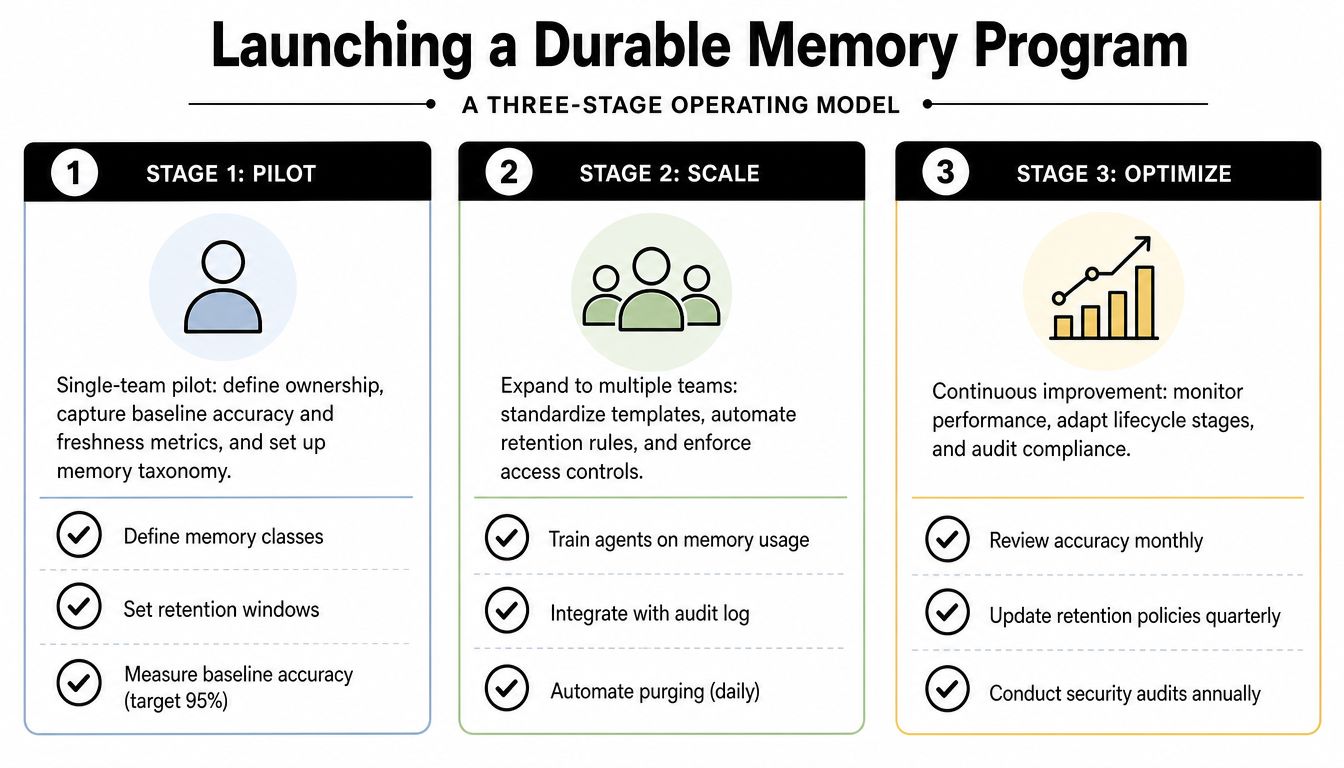
A durable program can expand through three gates:
- Pilot: One team defines memory classes, ownership, access rules, freshness measures, and deletion tests. The team must show that the agent can resume representative workflows without relying on unverified historical state.
- Shared infrastructure: A central catalog enforces schemas, audited reads and writes, tenant capacity, provenance, and retention policies. Each business unit receives clear operational boundaries rather than sharing an ungoverned store.
- Standardized operation: Product teams use certified memory contracts, regression suites, incident runbooks, and recurring reviews of access logs, retention behavior, and cost.
At each gate, require documented sign-off for recall quality, freshness, safe deletion, authorization, and compliance evidence. Don't open production access because a pilot produced convincing conversations. Open it when the team can prove that the agent remembers the right state, forgets the wrong state, and explains why a memory influenced an action.
Before expanding deployment, ask:
- Ownership: Is a named memory steward responsible for policy and incidents?
- Contract: Does every agent declare what it stores, retrieves, updates, and deletes?
- Evidence: Can operators trace each consequential answer to authorized, current records?
- Repair: Can the platform quarantine and correct conflicting memories?
- Exit: Can the organization export or delete memory without losing audit evidence?
Head of Agents helps enterprise teams assign accountable leadership for agent programs through readiness audits, leadership placement, fractional matches, and implementation referrals. If persistent memory is becoming a platform capability rather than a feature experiment, visit Head of Agents to assess ownership, governance gaps, and the operating roadmap before expanding deployment.