8 Web Site Scraper Tools for Smarter Data Collection
Compare 8 web site scraper tools and approaches by use case, scale, cost, implementation effort, and compliance considerations.
Written by HeadOfAgents
The most powerful web site scraper isn't automatically the best one. A browser that can render JavaScript may still be the wrong choice for a small static extract, while a lightweight parser can become a liability when a team needs recurring collection, monitoring, validation, and clear ownership. The useful decision starts with data complexity, JavaScript requirements, scale, engineering effort, recurring cost, source restrictions, and compliance evidence.
This list organizes eight resources by operating model, from code libraries and browser automation to no-code platforms, hosted actors, proxy infrastructure, and API abstractions. That distinction matters because buying infrastructure doesn't remove the cost of maintaining selectors, classifying failures, validating records, or checking whether a source permits the intended use.
For a practical way to see how crawlers interpret pages, use the Sight AI crawler simulator. The same collection principles apply to market-data workflows such as HeadOfAgents' hiring indexes, salary analysis, and agent-readiness decisions, where collected signals need to be structured, dated, and defensible rather than merely gathered.
1. Scrapy
Scrapy is the strongest fit when a team wants to own a repeatable crawling pipeline. The open-source Python framework handles request scheduling, link following, extraction, and item processing, so developers can build a system around a defined data model instead of a collection of ad hoc scripts. It's more than an HTML parser, but it still leaves infrastructure, deployment, monitoring, and source-specific maintenance with the team.
That control suits a market-data workflow. A HeadOfAgents pipeline could collect AI-agent job postings from LinkedIn, AngelList, and specialist technology boards, normalize role titles, and preserve source URLs and collection dates. Another crawler could monitor compensation references for CAIO or Head of Agents roles across public salary pages and surveys. A third could track mentions of frameworks such as LangChain or AutoGPT in job descriptions.
Where Scrapy earns its complexity
Scrapy becomes more valuable as the number of sources, fields, and recurring transformations grows. Its Item Pipeline can normalize titles, locations, compensation formats, and employer names before records reach storage. That separation makes validation easier than embedding every transformation inside a single extraction function.
Teams can also distribute crawling through Scrapy Cloud, but managed execution doesn't eliminate the need to understand the pipeline. Developers still need to test selectors, detect template changes, record failed requests, and distinguish an empty result from a genuinely empty page. For JavaScript-heavy pages, Scrapy may need a browser-rendering companion such as Splash or Playwright.
Practical rule: Treat every scraper as a maintained data product. Store the raw response or an auditable representation alongside the normalized record whenever the use case justifies it.
Use request delays, review robots.txt and terms of service, and avoid treating rotating proxies or user-agent changes as permission to ignore source restrictions. Scrapy's main limitation is ownership. It offers deep control and can support large workflows, but your team pays in engineering time whenever a target changes its markup, introduces a new interaction, or returns inconsistent data.

2. BeautifulSoup and Requests
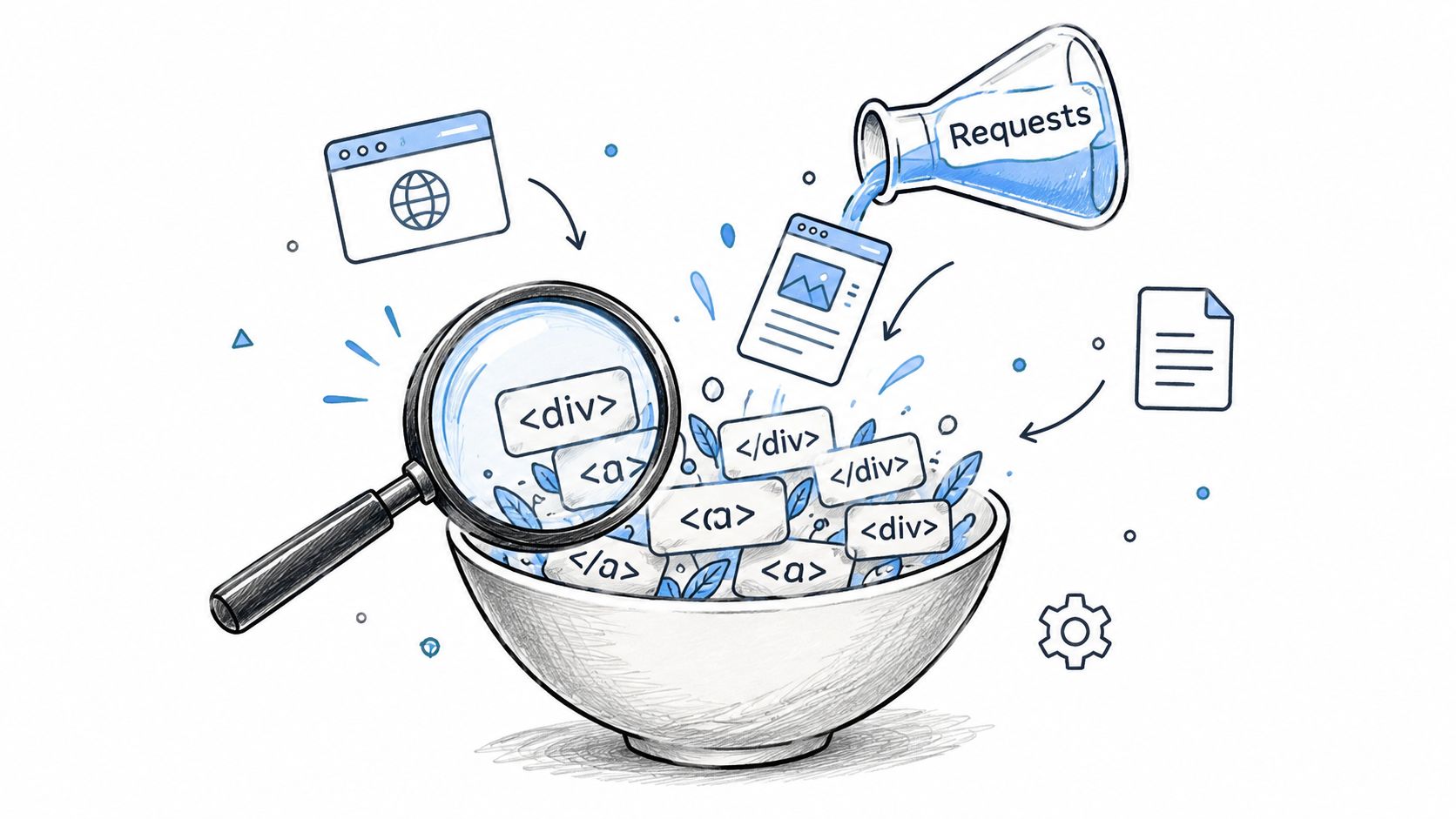
BeautifulSoup paired with Requests is the sensible starting point for small, static, and well-understood extracts. Requests fetches the HTML, while BeautifulSoup parses it and exposes tag searches and CSS selectors. The combination is easy to inspect, inexpensive to run, and fast to prototype when the information appears in the initial server response.
A recruiter or analyst could use it to collect job listings from a small set of company career pages, monitor a particular job-board category, or assemble publicly listed salary references for AI leadership roles. The code can remain short because the workflow has few moving parts. That simplicity is an advantage during discovery, when the team is still deciding whether a dataset deserves a production pipeline.
The boundary between simple and fragile
The key limitation is rendering. If a page loads listings after JavaScript runs, Requests may receive an HTML shell without the records visible in a browser. BeautifulSoup can parse what it receives, but it can't execute the scripts that populate the page. That creates a dangerous failure mode, because a script may complete successfully while returning an incomplete dataset.
Use CSS selectors through .select() rather than relying on long chains of positional tags. Save downloaded HTML during development so you can test parsing without repeatedly contacting the source. Add sensible delays, retry handling, and an appropriate user-agent, but don't confuse those technical settings with authorization to collect restricted data.
For teams working on structured lead or market datasets, HeadOfAgents data extraction and enrichment provides a relevant use-case context. The important design question is what happens after extraction. A raw job title isn't yet a hiring signal, and a salary string isn't yet a comparable compensation record. Normalization, provenance, deduplication, and review rules determine whether the output can support a decision.
BeautifulSoup and Requests are therefore excellent for a controlled experiment or a narrow recurring task. They become a poor fit when the source requires interaction, the schema changes often, or no one has time to inspect silent failures.
3. Selenium
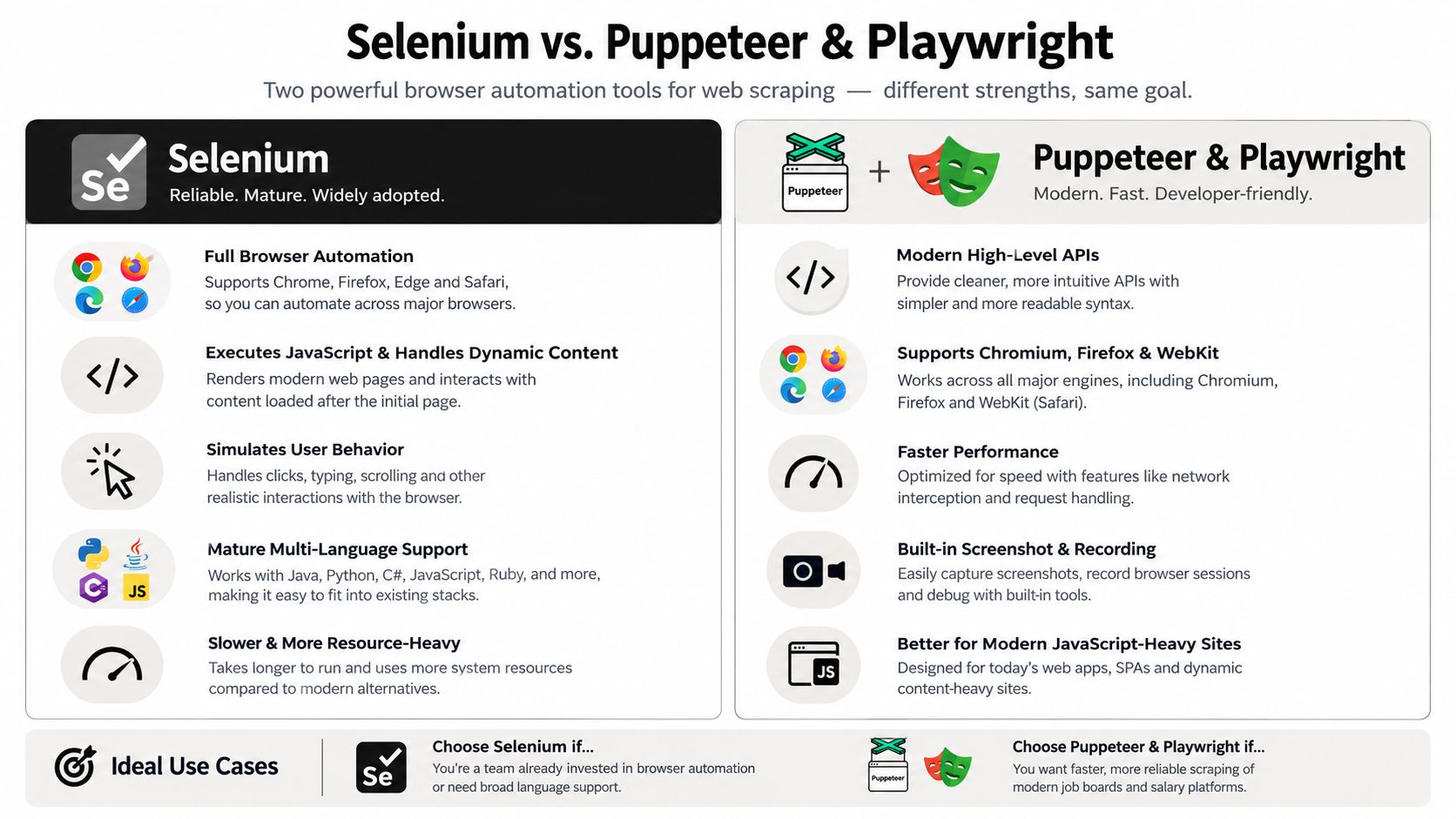
Selenium controls a real browser programmatically, which makes it useful when the target behaves like an application rather than a document. It can execute JavaScript, interact with forms, wait for dynamic elements, and work across Chrome, Firefox, Safari, and Edge. Those capabilities make it relevant to job boards, interactive salary platforms, and interfaces where the desired records appear only after a search or filter action.
A market analyst might use Selenium to run a role search, paginate through results, and capture the visible fields for CAIO or Head of Agents positions. A compensation workflow could automate an authorized session on a platform and extract information available to that account. A monitoring process could revisit a career page, apply a stored filter, and compare the resulting roles with the previous run.
Control comes with browser overhead
Selenium gives developers detailed control, but every browser session consumes operational attention. Headless execution can reduce unnecessary visual overhead, while explicit waits such as WebDriverWait are generally more reliable than arbitrary sleeps. Containers can isolate browser dependencies and make scheduled execution easier to reproduce.
The framework doesn't solve selector brittleness or source permission. A page redesign can break element locators, a changed login flow can stop a job, and an anti-bot response can look like a normal page unless the pipeline checks content quality. Randomized delays or user-agent rotation may affect request behavior, but they don't grant permission to bypass access controls.
Browser automation should be selected because the workflow needs browser behavior, not because a browser looks more sophisticated than an HTTP client.
Selenium remains a practical choice for teams that already operate browser tests or need broad browser compatibility. It's less attractive when the task is a simple fetch, when startup and session management dominate the work, or when the team wants a managed service rather than another runtime to operate.

4. Puppeteer and Playwright
Puppeteer and Playwright represent a more modern browser-automation model. Puppeteer is closely associated with Node.js and Chromium, while Playwright supports Python, JavaScript, Java, and.NET and can control Chromium, Firefox, and WebKit. Both provide high-level methods for navigation, waiting, browser contexts, and network events.
They're particularly useful when a market-data collector needs to handle client-side rendering, interactive filters, pagination, or authenticated workflows that the source owner has authorized. A company-career monitor could observe newly loaded roles without relying only on the initial HTML. A salary workflow could capture structured responses from a page interaction rather than parse every visual element.
Network data can be better than rendered markup
One of the most useful techniques is network interception. If a page requests structured data from an endpoint after a search, capturing that response may be faster and less brittle than parsing the rendered interface. That approach still requires authorization and source-specific review, especially if the endpoint is undocumented or access-controlled.
Browser pooling can reduce repeated startup work, while disabling unnecessary images or styles can lower resource consumption. page.goto() settings and explicit readiness checks help prevent extraction before the target content has loaded. These optimizations improve engineering efficiency, but they don't guarantee successful collection across domains.
A benchmark cited by AIMultiple tested 12,500 requests across more than 3,000 real-world URLs, while another benchmark across 100 e-commerce domains recorded content-verified success rates from 59.4% to 76.0% across concurrency tiers. The lesson is not that one browser library wins universally. It's that teams should test the actual domains and concurrency pattern they care about, then measure verified content rather than HTTP status alone. AIMultiple's web scraping API benchmark supports that domain-specific approach.
A technical team should choose this model when it needs browser behavior but wants a cleaner automation API and stronger control over modern rendering. It should not choose it merely to avoid designing a monitoring and validation layer.
5. Octoparse
Octoparse is a visual no-code and low-code platform for teams that need recurring collection without making every analyst a software engineer. Users configure extraction flows through a graphical interface, then use desktop or cloud execution, scheduling, and export options. Its operating model shifts the trade-off away from developer control and toward faster business-led setup.
That makes it suitable for an HR or research team monitoring job postings across career pages and job boards. A team could schedule collection of AI-agent leadership roles, export the results to Google Sheets, and refresh a compensation benchmark without asking engineering to maintain a custom crawler for every small change. Templates for familiar site patterns can shorten the first implementation.
Faster setup, less transparent control
The visual workflow is valuable when the extraction logic is understandable and the business owner can test it. Start with a small sample, inspect the returned records, and confirm that pagination, missing fields, duplicates, and location filters behave as intended before scheduling repeated runs. Off-hours scheduling and deliberate request pacing can reduce unnecessary load on source systems.
No-code doesn't mean no maintenance. A changed button, renamed field, modal, or consent prompt can alter the flow. Business users need an owner for failure alerts, schema review, and data-quality checks. They also need to understand where proxy rotation or IP management is available and where the source's restrictions still apply.
Octoparse is a buy decision for teams that value deployment speed and can accept a visual abstraction. It's less suitable when the dataset requires complex joins, custom validation, version-controlled code review, or tightly controlled handling of personal data. For a recurring market-data workflow, export convenience is useful, but it should sit behind a documented schema and retention policy rather than become the data model by accident.
6. Apify
Apify uses a hosted actor model. Teams can start with prebuilt scrapers from the Apify Store or develop custom actors, then run them on managed infrastructure with scheduling, datasets, transformations, and integrations. This sits between writing a crawler from scratch and buying a narrow API. The team gets a reusable execution unit, while still retaining more customization than a fixed endpoint usually provides.
For HeadOfAgents-style research, a prebuilt job scraper could collect postings for AI-agent leadership roles across selected locations. A custom actor could combine multiple job-board formats, standardize employer and role fields, and send cleaned output to a database. Scheduled actors could support recurring signals such as startup hiring activity or changing demand for agent leadership.
Hosted actors make scaling a product choice
Apify is attractive when the workload is varied. A team can test a marketplace actor for a common source, then build an internal actor when the data requirements become specialized. Webhooks can push completed datasets into a spreadsheet, collaboration tool, or database, while transformations can move cleaning closer to collection.
The trade-off is platform and usage management. Teams need to monitor compute consumption, proxy use, run frequency, concurrency, failed items, and output quality. A completed actor run isn't proof that the records are correct. A source can return a consent page, login wall, empty result, or changed template while the job itself remains technically successful.
Use HeadOfAgents' AI agent platform comparison as the kind of downstream context that makes collected market data useful. The scraper should preserve source identity and collection time so analysts can distinguish a change in the market from a change in the collection process.
Apify fits a build-versus-buy decision where the team wants managed execution but expects custom source logic. It's a stronger choice than a local script when scheduling and operational repeatability matter, but it still requires someone to own actor health, legal review, and data validation.
7. Bright Data
Bright Data operates as enterprise collection infrastructure, combining proxy products, web scraping APIs, and dataset services. Its operating model is designed for organizations that need managed access layers across multiple sources and geographies rather than a single local scraper. That can reduce the amount of proxy and browser infrastructure a team builds itself, but it doesn't remove the need for source-by-source permission and governance.
A labor-market data program might use managed collection to gather job-posting pages, company information, and compensation references from multiple sources. The operational benefit is centralization. Instead of each internal team selecting and configuring its own proxy behavior, a data function can apply shared monitoring, routing, and usage controls.
Infrastructure doesn't equal compliance
The supplied capability list includes residential and data-center proxies, geo-targeting, prebuilt scraper APIs, batch processing, and monitoring of bandwidth and failure rates. Those features address operational questions such as location, throughput, and failure handling. They don't decide whether a particular page may be collected, whether personal data should be retained, or whether a source's terms restrict automated access.
The legal analysis is more nuanced than a public-versus-private rule. Recent analysis describes different exposure depending on jurisdiction, data type, intent, technical access controls, personal data, cease-and-desist behavior, AI-training questions, and database rights. This analysis of web scraping legal risk is useful because it frames compliance as a fact pattern rather than a single yes-or-no test.
A managed proxy is an operational control. It isn't a legal opinion.
Bright Data makes sense when a team needs enterprise infrastructure and can support procurement, monitoring, data governance, and legal review. It's less appropriate for a small static extract where a local parser would be clearer and easier to audit.
8. SerpAPI and Similar API Abstractions
API abstractions replace scraper construction with structured requests. SerpAPI and similar services can return search or job-related results through an API, while other specialized providers focus on a particular data category. The appeal is speed. A product team can validate a market-data idea without first building browser sessions, URL queues, retry logic, and source-specific parsers.
A HeadOfAgents workflow could query for CAIO or Head of Agents roles by company and location, store returned records, and trigger an internal alert when a target pattern appears. A scheduled process could compare new results with previous records. Specialized salary APIs may also help when their coverage, licensing, fields, and permitted use match the intended analysis.
Evaluate the abstraction, not only the endpoint
The central risk is hidden dependence. The API may change fields, coverage, query interpretation, freshness, or usage limits. Teams should test representative queries, compare returned records with what users can see, and define how missing or ambiguous values enter the dataset. Caching responses can reduce duplicate calls, while batch requests may suit historical analysis better than one live query per record.
The best comparison is not only “which API is cheapest.” It includes coverage, verified accuracy, source restrictions, latency, data freshness, schema stability, retention terms, and migration effort. A narrow API can be excellent for a known workflow but unusable when the research question changes.
For competitive market monitoring, HeadOfAgents' competitive intelligence use case illustrates the downstream need for organized signals rather than isolated search results. The API should feed a process that records provenance, deduplicates postings, normalizes role names, and flags uncertain matches for review.
API abstractions suit teams that value time-to-data and have a predictable query pattern. They're less suitable when the source mix is highly specialized, when the team needs full extraction control, or when an API's permitted use doesn't align with the intended dataset.
Top 8 Web Scraping Tools, Quick Comparison
| Tool | Core capabilities | Best for (HeadOfAgents use) | Key benefits / unique selling points | Pricing & scale |
|---|---|---|---|---|
| Scrapy | Async distributed crawling, item pipelines, selectors, middleware | Enterprise teams building production market-intel pipelines | High-throughput scraping, built-in politeness/compliance, mature ecosystem for long-term indexing | Open-source; infra, proxies, and engineering costs apply; scales well |
| BeautifulSoup + Requests | Lightweight HTML parsing + HTTP fetching | Individual researchers, small teams, rapid prototyping of job/salary pages | Very low barrier to entry, fast iteration, minimal setup for static pages | Free; not cost-effective for large-scale or JS-heavy sites |
| Selenium | Full-browser automation, JS execution, user interaction simulation | Teams needing to scrape JS-heavy sites, handle logins and dynamic flows | Access to dynamic content, simulates real users, good for protected job boards | Open-source; high resource & maintenance costs; scales poorly without infra |
| Puppeteer & Playwright | Modern browser automation, multi-engine support, network interception | Teams building reliable scrapers for modern JS job boards and APIs | Faster/more reliable than Selenium; capture API calls directly; cross-browser | Open-source; better performance but requires browser resources and orchestration |
| Octoparse | No-code visual builder, cloud execution, proxy management, scheduling | Non-technical HR/business teams for recurring job/comp data pulls | Zero-code, managed infra, templates and scheduling for repeat jobs | Freemium; monthly plans (~$99–$999+); can be costly at scale; less flexible |
| Apify | Cloud actors, marketplace of pre-built scrapers, serverless scaling, webhooks | Teams wanting quick deployment with custom actor options and integrations | Managed cloud, pre-built templates, API-first workflows, auto-scaling | Pay-as-you-go compute units; free tier for testing; costs grow with usage |
| Bright Data | Enterprise proxy networks, scraper APIs, dataset services, compliance controls | Large enterprises needing high-reliability, compliant data collection at scale | Massive residential IP pool, compliance-first, dedicated support, pre-built APIs | Premium enterprise pricing (commonly $500–$5,000+/mo); costly for small teams |
| SerpAPI & similar API abstractions | REST APIs returning structured job/search data; proxy & anti-bot handled | Fast integrations for non-technical teams and PoCs, real-time monitoring | Instant time-to-insight, no infra, validated JSON output, vendor-managed compliance | Per-call pricing; very fast ROI but per-call costs can add up at high volume |
Match the Scraper to the Risk and Workload
The right web site scraper depends on where the work sits between static extraction, interactive browsing, recurring operations, and managed data delivery. BeautifulSoup and Requests are appropriate for a small static dataset with a known page structure. They keep the implementation transparent and make debugging straightforward. Move to Selenium, Puppeteer, or Playwright when the page requires JavaScript, filters, scrolling, or other browser actions, and choose the library that matches your team's language, browser compatibility, and operational experience.
Scrapy is the natural fit for an owned production pipeline. It gives engineering control over queues, item processing, storage, retries, and custom validation, but the team must own maintenance. Octoparse suits business-led recurring work where visual configuration and exports matter more than code-level control. Apify is a useful middle path when teams want hosted execution with reusable actors and room for custom logic. Bright Data addresses infrastructure-heavy collection across multiple sources, while API abstractions are compelling when speed and a stable query model matter more than direct control.
The market context supports treating this as a strategic engineering decision. One independent report estimates that the web scraping market could grow from USD 1.34 billion in 2025 to USD 3.49 billion by 2031, implying a 17.39% CAGR over 2026 to 2031. Another projects growth from USD 0.99 billion in 2025 to USD 2.28 billion by 2030 at an 18.2% CAGR. These are publisher forecasts, not guarantees, but their similar direction indicates sustained commercial demand for structured web data. Mordor Intelligence's web scraping market report provides the referenced forecasts.
Apply a compliance gate before recurring collection
Before scheduling a job, document the source, intended purpose, access method, fields, retention period, and responsible owner. Then check:
- Authorization: Confirm that the team has permission for the account, page, endpoint, or dataset it plans to access.
- Terms and robots rules: Review the source's terms of service and
robots.txt, and record the decision rather than relying on memory. - Technical barriers: Don't bypass access controls, CAPTCHAs, login restrictions, or other safeguards without a clear, authorized basis.
- Personal data: Minimize collection, avoid unnecessary identifiers, define retention, and restrict access to the resulting dataset.
- Rate limits: Use conservative pacing, retries, and concurrency controls that reduce avoidable load.
- Source restrictions: Check geographic, licensing, redistribution, AI-training, database-right, and contractual limits for each source.
- Monitoring: Track domain-level success, failure classifications, empty-result rates, schema changes, and validation exceptions.
Indicative tool pricing isn't total cost of ownership. Add engineering maintenance, proxy or compute consumption, monitoring, data validation, storage, incident handling, and legal review. A cheap request can become an expensive dataset if the team has to repair silent omissions or rebuild a pipeline after a source changes.
For organizations evaluating broader agent-data operations, HeadOfAgents offers stated directories, market datasets, a cost estimator, and an Agent Readiness Audit. Its published focus is AI-agent leadership, including hiring and readiness decisions that benefit from dated, sourced market signals rather than unverified scrape output.
Head of Agents provides specialized directories, hiring indexes, salary and adoption datasets, a cost estimator, and an Agent Readiness Audit for teams making AI-agent ownership decisions. Visit Head of Agents to connect your data-collection workflow with clearer role definitions, market evidence, and build-versus-buy-versus-hire planning.