What Is Audit Readiness for AI Agents
Learn what is audit readiness for AI agent programs, why perceived and operational readiness diverge, and how an audit diagnoses gaps.
Written by HeadOfAgents
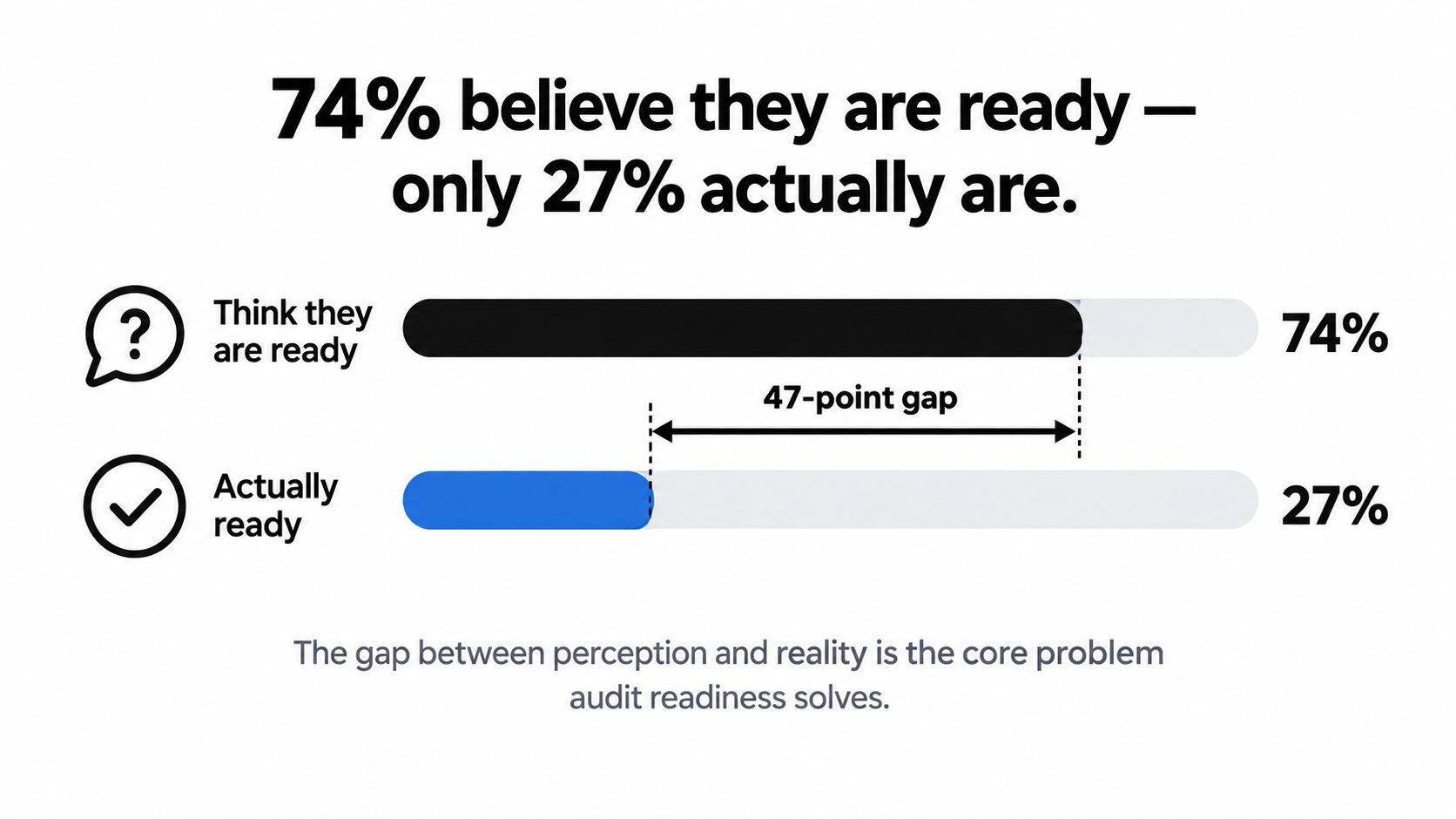
74% of organizations believe they could pass an AI compliance audit immediately, but only 27% say their governance programs are fully mature, according to Schellman's 2026 enterprise research. That gap isn't a paperwork problem. It's the difference between having policies on file and being able to prove, quickly and precisely, that an AI agent operated within those policies.
For AI-agent programs, audit readiness means maintaining a defensible chain from requirement to control, from control to action, and from action to evidence. Model versions change. Prompts are edited. Retrieval sources expand. Tool permissions shift. Human approval thresholds get revised. A static governance binder can't keep pace with those changes.
The practical answer is to treat readiness as continuous evidence engineering. A one-week diagnostic can expose where proof breaks, assign the gaps to accountable owners, and turn a vague confidence statement into a sequenced 90-day remediation plan.
The 74% Problem and Why It Matters
The central audit-readiness problem is the gap between what leadership believes and what the organization can demonstrate. Schellman's research found that 74% of organizations believed they were ready for an AI compliance audit, while only 27% said their governance programs were fully mature. The same source reports that 90% had allocated funding for AI governance, which shows that investment alone doesn't establish operational readiness. Schellman's research also identifies a second warning sign, confidence can coexist with incomplete controls and weak evidence.
Why confidence gets ahead of proof
Executives often anchor their assessment to visible artifacts. There's an AI policy, a risk register, a review committee, and perhaps a training module. Those materials create a credible governance narrative, but an auditor tests whether the operating environment matches the narrative.
Decentralized agent deployments widen the gap. Product teams may launch assistants outside the central inventory, engineering teams may change prompts without a formal review record, and security teams may own access controls without knowing which agents invoke which systems. Meanwhile, audit scopes often begin with legacy inventories that don't reflect how quickly agent programs evolve.
When fieldwork begins, the failures are concrete:
- Walkthroughs stall because nobody can reconstruct a decision from input to tool call to human review.
- Control statements conflict with practice because the documented owner, approval route, or testing frequency no longer matches the deployed system.
- AI-specific evidence is missing because model lineage, retrieval sources, prompt changes, and human-in-the-loop approvals weren't captured when they occurred.
A recent compliance survey found that 91% of organizations must resubmit evidence during audit cycles, while 53% struggle to collect evidence across multiple tools and nearly 35% say submitted evidence isn't auditor-ready. Those figures appear in Schellman's research release, and they describe the operational liability behind the readiness gap.
The diagnostic question is simple: can your team answer an auditor's request with a complete, dated, owner-linked artifact, or will it reconstruct the answer from messages, screenshots, and memory?
What Is Audit Readiness, Really
Audit readiness is the continuous ability to produce reliable evidence that defined controls operate as designed within a defined scope. Every important artifact should connect to a control objective, a named owner, a verifiable time window, and a review status. If the organization can't establish those connections, it has documentation, not readiness.
The concept has a formal standards history. ISO audit-guideline work began with ISO 10011-1 in 1990, moved into ISO 19011 in 2002, was updated in 2011, and was revised again in 2018. The ISO 19011 history matters because it shows that audit management developed into a repeatable discipline for planning, conducting, and improving management-system audits, rather than a one-off checklist.
Documentation is only one layer
A policy says what should happen. Evidence shows what did happen. An auditor may ask for the approval behind a model change, the access review covering a tool-connected agent, or the record showing that an exception received authorized treatment. A policy binder can't answer those questions by itself.
For an AI agent, the evidence chain may include:
- Model lineage, including the deployed version and approved changes.
- Prompt and configuration history, including who reviewed edits.
- Data provenance, including sources, access rules, and retention treatment.
- Tool-call records, including actions taken against external systems.
- Human decisions, including overrides, approvals, and escalations.
- Monitoring and incident records, including how the team handled anomalous behavior.
This is why readiness is a state, not a project milestone. The moment an agent changes without corresponding evidence, the readiness claim becomes stale.
Practical rule: If an artifact can't show what changed, who authorized it, and when the control operated, treat it as incomplete evidence.
Teams starting from uncertainty can run an AI readiness check to establish the current inventory, ownership picture, and highest-risk evidence gaps before committing to remediation work.
The Building Blocks an Auditor Actually Inspects
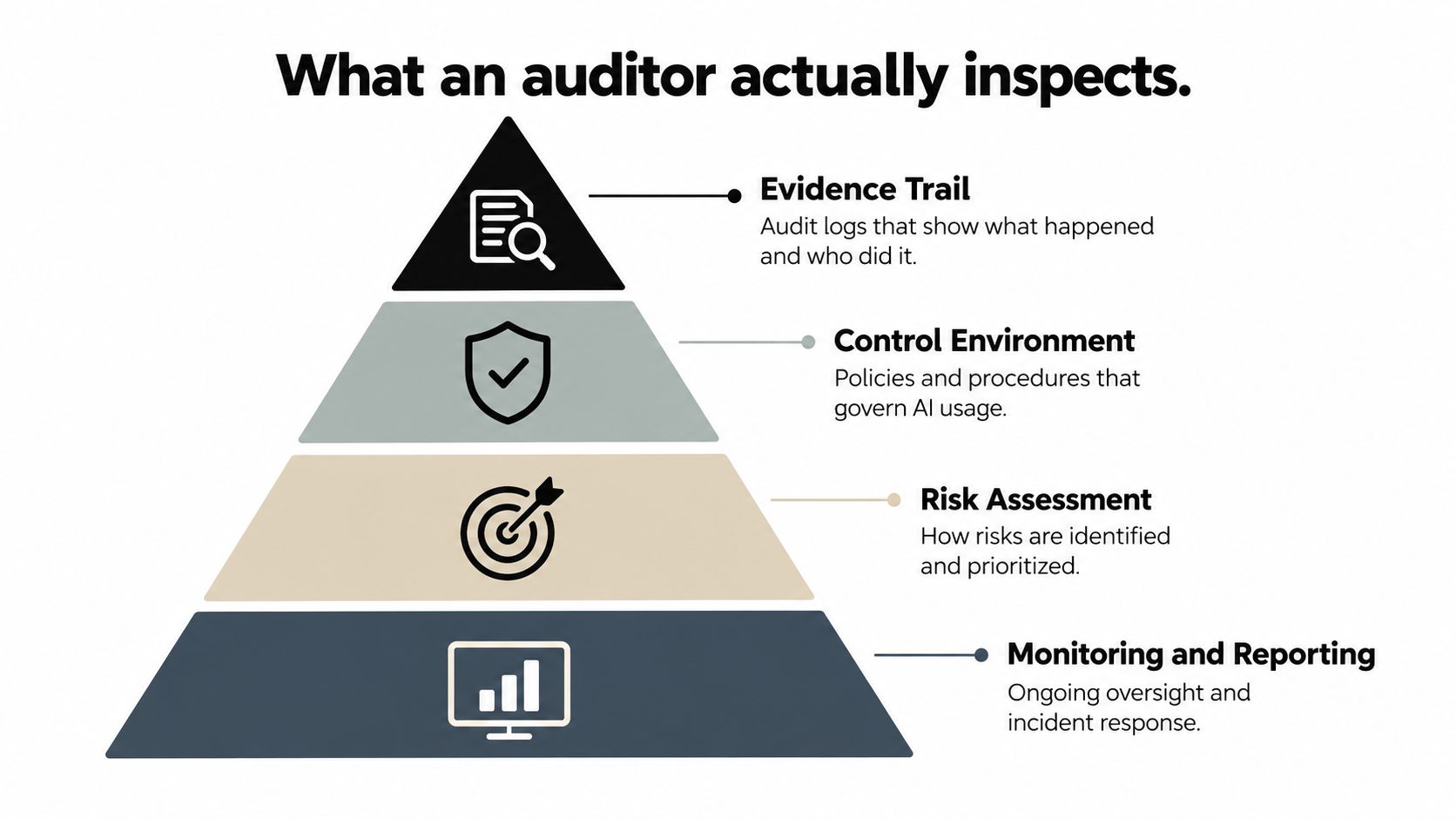
Auditors don't inspect confidence. They inspect whether the program can support its claims. For an AI-agent environment, four connected building blocks determine whether fieldwork produces a credible result.
The evidence trail
The evidence trail is the record of control operation. It should preserve timestamps, relevant system context, approvals, and the relationship between the artifact and the requirement it supports. Useful evidence can include system logs, configuration records, signed approvals, review notes, training records, and incident history.
A mature trail also preserves the agent's lifecycle. Neutral compliance guidance describes evidence spanning intake, design, data governance, development, validation, deployment approval, monitoring, change management, and incidents in this audit-preparedness evidence framework. Capturing proof when the control operates is more defensible than recreating it after an auditor asks.
The control library
The control library maps requirements to operational controls. It should identify the applicable framework, control objective, procedure, evidence source, owner, testing method, and testing frequency.
Don't write one broad control such as “AI systems are governed.” Break it into testable statements. For example, an agent's production deployment requires an approved change record, the model version is recorded, tool permissions are reviewed, and monitoring is enabled before release.
A practical governance design can be organized through an AI agent governance framework that connects each agent to its purpose, owner, model, tools, data sources, external systems, and failure behavior.
Ownership
Ownership can't stop at “engineering,” “legal,” or “the AI committee.” The auditor needs a person who can explain the control, provide the evidence, authorize remediation, and confirm whether an exception remains acceptable.
Ownership records must also survive organizational change. When a manager leaves, a team is reorganized, or responsibility moves between product and security, the control library and approval chain need updating. A stale owner is an evidence defect because no accountable person can validate the artifact.
Governance cadence
Governance is the operating rhythm around the controls. It covers control-health reviews, exception handling, risk acceptance, change approvals, incident escalation, and management reporting.
The decisive test sounds like this: “Show me the approval for the model change deployed on the requested date.” A ready program can locate the change record, identify the approver, show the relevant model and configuration state, and connect the approval to deployment. Partial coverage fails because one missing layer breaks the chain.
What Readiness Looks Like Inside an AI Agent Program
Consider a financial operations team using a deployed assistant for transaction inquiries, reconciliation summaries, and exception routing. The assistant doesn't merely generate text. It retrieves operational data, drafts a recommendation, and sends selected cases to a human reviewer.
A credible audit trail follows the assistant through each layer. The model record identifies the deployed version and links every material change to an approved ticket. The data record maps retrieval sources to access controls and retention rules. Prompt and tool configuration changes carry review history. When the assistant routes an exception, the approval trail identifies the reviewer, the decision, and the accountable owner responsible for the control.
Reconstructability is the standard
The auditor should be able to select a decision and work backward:
- Identify the agent state at the time of the decision.
- Trace the model, prompt, and retrieval sources used for the response.
- Review the tool calls and permissions available to the agent.
- Confirm the human review and any override or escalation.
- Match the event to the control and its named owner.
That sequence is what turns an agent from a black box into an auditable operational system. The agent security framework provides a useful reference for thinking about boundaries, access, actions, and evidence in this environment.
A parallel pilot may have a substantial governance binder, approved policies, and meeting minutes. If it can't tie a specific agent decision to a reviewer, a model state, and an authorized action, it isn't ready. The binder establishes intent. The artifacts establish operation.
Three signals separate a credible program from a checkbox exercise:
- Decisions are reconstructable from the available records.
- Every artifact has a named owner, not just a department.
- Changes pass through a logged approval gate before deployment.
If any one of those signals is absent, leadership should describe the program as partially prepared, not audit-ready.
The Gaps That Show Up in Almost Every First Audit
First audits expose the distance between a designed control and the way teams work. AI agents make that distance more visible because their behavior depends on changing models, prompts, data, tools, and permissions.
| Readiness Gap | Auditor Finding |
|---|---|
| Stale screenshots with no version metadata | Evidence doesn't demonstrate current operating effectiveness |
| Ownership assigned to a committee or department | No accountable person can authorize or explain the control |
| Direct production changes without append-only records | Change management can't be independently verified |
| Undocumented prompt edits | Agent behavior can change without review or approval |
| Untracked training or retrieval-data sources | Data provenance, access, and retention claims can't be substantiated |
Stale evidence
A screenshot collected months ago may show that a review happened once. It doesn't prove that the same control operated during the audit period. Evidence needs enough context to establish the system state, the action taken, the person responsible, and the relevant date.
Ownership drift
Committees can make decisions, but they shouldn't replace control ownership. A RACI document that lists a function without an accountable individual leaves the auditor with no person who can confirm whether the control still works or accept responsibility for correction.
Missing append-only records
If a production agent can be reconfigured directly, the program needs a tamper-evident or otherwise protected record of the change. Governance guidance emphasizes audit trails and structured control evidence, including configuration records, approval history, system logs, training records, and review notes.
The recurring pattern is straightforward. Each finding may look like a documentation defect, but the underlying failure is operational: the program didn't capture proof when the control operated.
An audit finding often starts where an operational event has no durable record.
Build, Buy, or Hire Your Way to Readiness
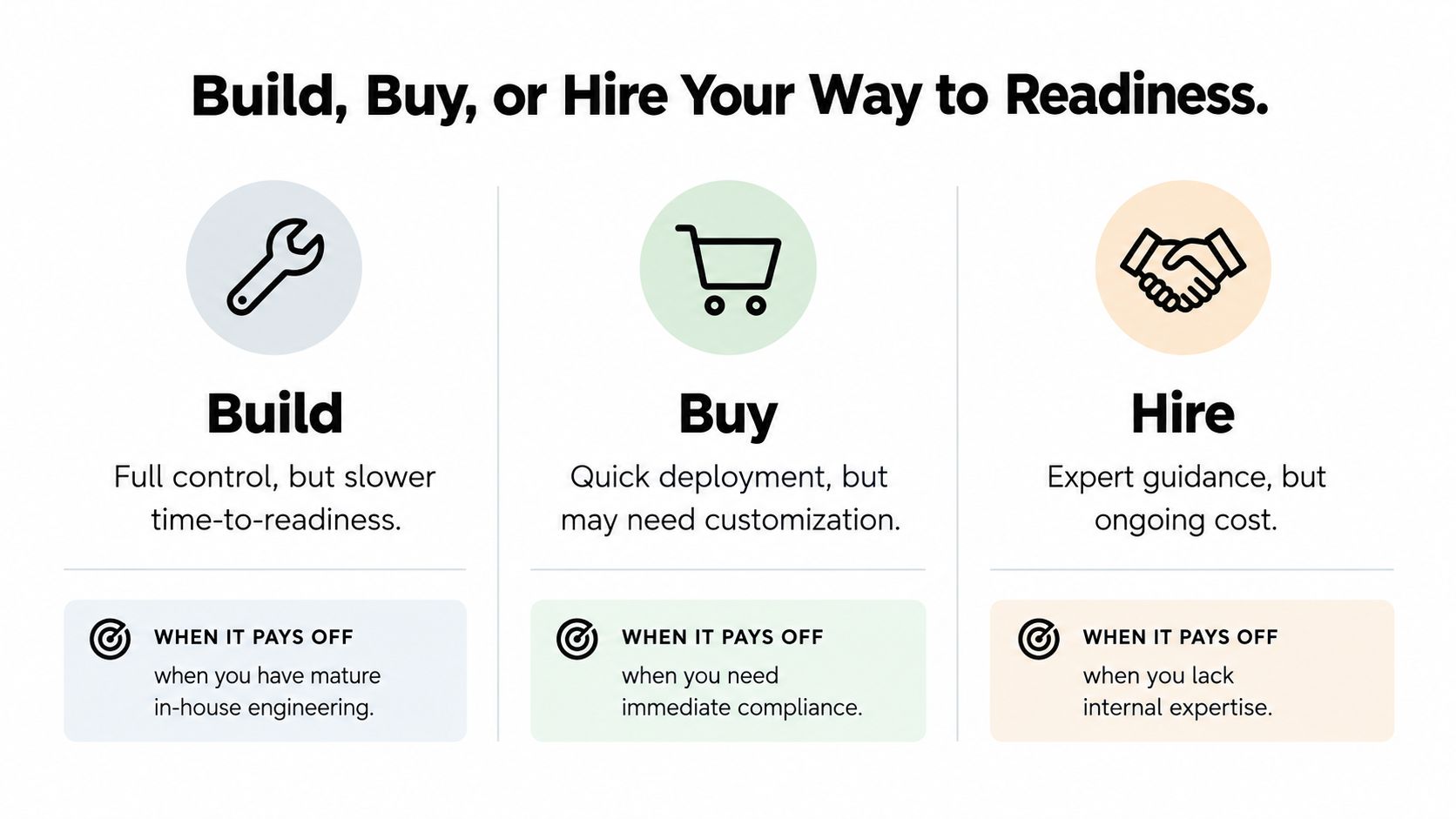
Organizations usually close readiness gaps through three capabilities: internal construction, packaged support, or accountable expertise. The right choice depends on agent volume, sensitivity, audit frequency, and the distance between current practice and the next audit requirement.
Build
Build an internal evidence pipeline when the organization has strong engineering capacity and needs control over how data moves through governance systems. This approach suits programs with many agents, sensitive data, complex internal systems, and recurring audits.
The internal team can extend existing governance, risk, and compliance workflows with agent-specific records for model lineage, prompts, tool permissions, data provenance, approvals, monitoring, and incidents. The tradeoff is speed. Building a durable system requires product ownership, integration work, policy decisions, and ongoing maintenance.
Buy
A packaged readiness or evidence-collection platform makes sense when speed matters and the risk profile is moderate. It can centralize requests, map evidence to controls, track owners, and preserve review history without requiring the organization to build every workflow.
Customization remains the key question. A generic compliance workflow may handle policies and access reviews but fail to capture agent-specific events such as prompt revisions, tool calls, retrieval-source changes, or human overrides. Buy only when the system can support the evidence your auditor will request.
Hire
Hire a fractional AI governance leader or external readiness advisor when the first audit is approaching, internal ownership is unclear, or the program has a small production footprint. This path provides judgment, sequencing, control interpretation, and accountability while the organization decides which capabilities should become permanent.
Head of Agents offers an Agent Readiness Audit that produces a use-case map, governance and readiness gap analysis, build-versus-buy-versus-hire recommendations, and a 90-day roadmap. It can be one input into the decision, not a substitute for assigning an internal owner.
Most organizations combine the three paths. Build the evidence integrations that create strategic differentiation, buy commodity workflow capabilities where they fit, and hire expertise to resolve ambiguity and establish the operating model. Start with the gaps that could block the next audit, not with the option that appears cheapest on paper.
Inside the Agent Readiness Audit and a 90-Day Plan
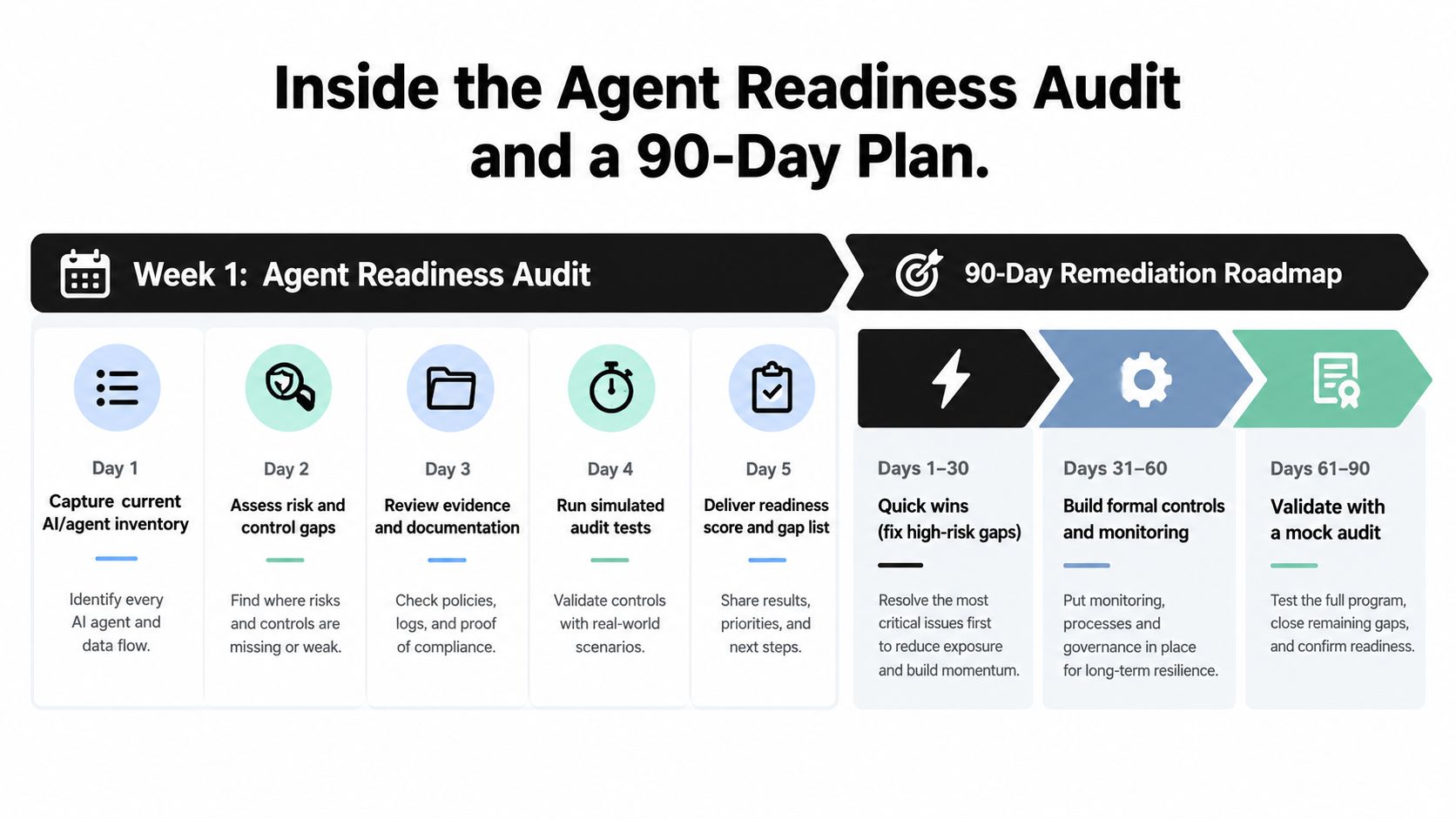
A useful diagnostic has a fixed scope, a short timeline, and deliverables that translate directly into remediation. The one-week Agent Readiness Audit should not produce a generic maturity label. It should show which evidence exists, where the chain breaks, who owns the fix, and what an auditor will request next.
The five-day diagnostic
Day 1 establishes scope. Capture the agent inventory, business purpose, data flows, external systems, owners, deployment status, and applicable audit boundaries. An unowned or undiscovered agent is an immediate scope risk.
Day 2 follows one representative agent end to end. Pull the actual artifacts behind its controls, including model records, prompt history, data-source records, access reviews, deployment approvals, monitoring events, and human decisions. Don't accept a policy description as a substitute for operating evidence.
Day 3 tests the trail under pressure. Ask whether the team can prove provenance, approvals, override rights, model changes, data changes, and incident handling. Screenshots and manually reconstructed records usually fail.
Day 4 maps the findings. Benchmark the program against applicable requirements from SOC 2, ISO 42001, and the EU AI Act. The mapping should identify overlapping controls and obligations that require additional evidence.
Day 5 produces the decision package. Deliver the gap report, readiness assessment, ownership map, build-versus-buy-versus-hire recommendation, and sequenced remediation plan. Teams can use an Averta observability guide for additional context on connecting operational visibility with audit evidence.
Turning findings into ninety days of action
The roadmap should group remediation under model risk, security, legal, and product. Every item needs an accountable owner, a target date within the 90-day window, a risk rationale, and the artifact an auditor will later request.
Use a practical delivery structure:
- First phase: Close high-risk evidence breaks, assign owners, and stop uncontrolled production changes.
- Second phase: Formalize controls, approval gates, monitoring, retention, and exception workflows.
- Third phase: Run a mock audit, test retrieval of evidence, and correct remaining ownership or traceability failures.
A roadmap without artifact-level acceptance criteria is only a task list. A strong AI implementation plan states what must exist, who must produce it, and how the team will verify that it supports the relevant control.
Readiness Is an Operating Model, Not a Project
Audit readiness lasts only while someone operates it. Assign one accountable leader, usually a head of AI governance, AI risk lead, or equivalent executive, to maintain the evidence engine between formal assessments. That owner should have authority across product, engineering, security, legal, and operations, because agent controls cross all of those boundaries.
The cadence needs to match the rate of change:
- Monthly evidence refreshes should follow agent releases and material configuration changes.
- Quarterly control attestations should confirm that owners, procedures, evidence sources, and exceptions remain current.
- Standing pre-audit drills should test whether teams can answer realistic evidence requests without reconstruction.
These activities aren't administrative decoration. They detect ownership drift, undocumented changes, missing logs, and controls that operate differently from their written descriptions. They also turn audit preparation into a normal operating responsibility instead of an emergency project.
The opening gap between perceived readiness and mature governance persists when leaders measure policy coverage instead of proof quality. A program can have funding, committees, and approved documents while still failing to demonstrate how an agent made a decision or who authorized a change.
The decision to make now: name the owner, define the agent scope, and schedule the diagnostic.
AI-agent programs will keep changing. Models, prompts, data sources, tools, and approval rules won't remain fixed for the convenience of an audit calendar. Your readiness engine must evolve with those changes, or the next audit will measure the gap between your policy and your production system.
Head of Agents helps organizations assess AI-agent use cases, identify governance and evidence gaps, recommend a build, buy, or hire path, and create an accountable 90-day remediation roadmap. Visit Head of Agents to structure your readiness diagnostic and connect the work to the leader responsible for keeping it current.