Dify
Visual orchestration for AI workflows. Supports RAG, agents, and model management.
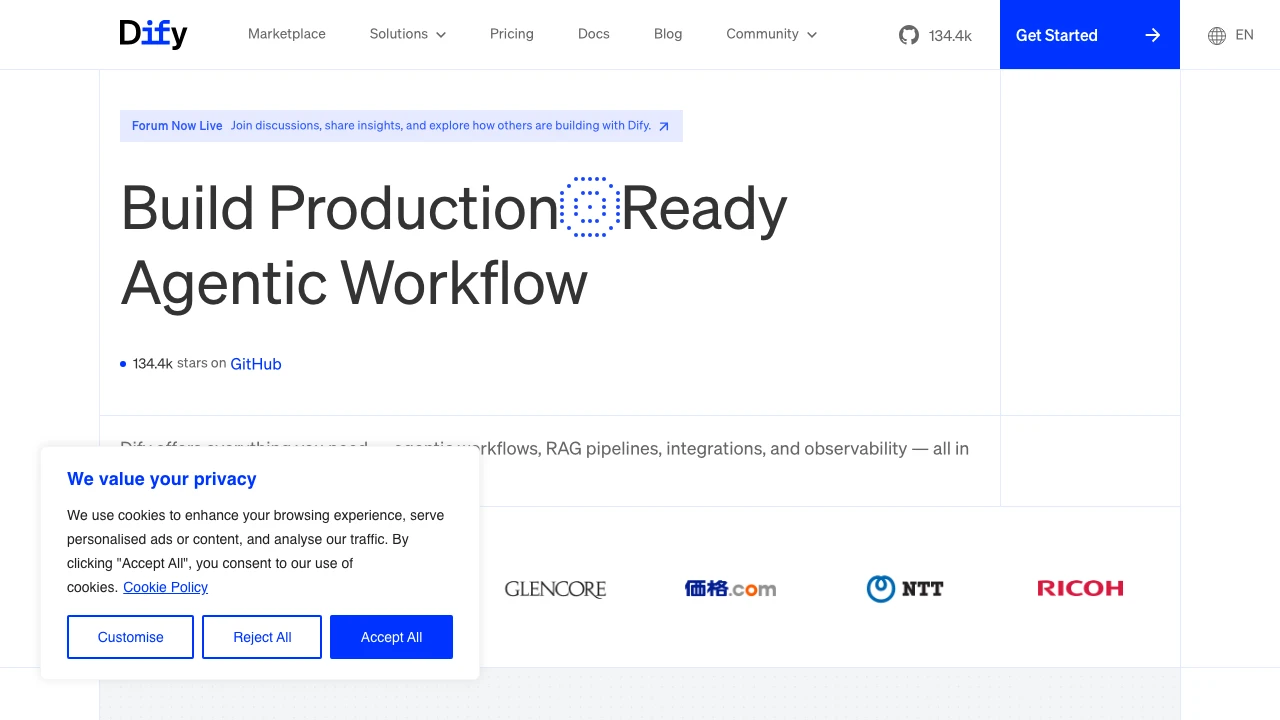
Dify is an open-source LLM application development platform built by LangGenius that provides a unified environment for building, deploying, and managing AI agents and workflows. It sits at the intersection of visual no-code tooling and developer-grade infrastructure, making it accessible to both technical and non-technical teams.
At its core, Dify offers a visual workflow builder for constructing agentic pipelines — chains of LLM calls, tool invocations, conditionals, and data retrieval steps — without requiring users to write orchestration code from scratch. This positions it as a direct alternative to frameworks like LangChain or LlamaIndex, but with a GUI-first approach rather than a code-first one. Unlike purely code-based frameworks, Dify lets teams prototype and iterate on complex multi-step AI workflows through a drag-and-drop interface while still exposing APIs for programmatic integration.
RAG (Retrieval-Augmented Generation) pipelines are a first-class feature. Users can connect document stores, configure chunking strategies, and wire retrieval steps into workflows without managing embedding infrastructure manually. This makes Dify practical for building internal knowledge bases, document Q&A systems, and customer-facing chatbots grounded in proprietary data.
Dify supports multiple LLM providers — including OpenAI, Anthropic, Mistral, and open-source models — through a centralized model management interface. Teams can switch or compare models across workflows without reconfiguring each integration individually.
The platform includes observability tooling: trace logs, token usage tracking, and prompt versioning help teams monitor production deployments and debug regressions. This is an area where many open-source alternatives fall short, often requiring third-party tools like LangSmith or Helicone to achieve comparable visibility.
Dify can be self-hosted via Docker Compose or Kubernetes, which is a significant advantage for organizations with data residency requirements or those operating in air-gapped environments. The cloud-hosted version at cloud.dify.ai provides a managed alternative with a free tier.
Compared to alternatives like Flowise (also open-source and visual) or n8n with AI nodes, Dify is more opinionated toward LLM-native use cases and offers deeper model management and RAG support out of the box. Against commercial platforms like Vertex AI Agent Builder or Amazon Bedrock, Dify trades off managed infrastructure for flexibility and cost control.
The Dify Marketplace provides pre-built workflow templates and integrations, reducing time-to-value for common use cases. An active open-source community on GitHub with a large contributor base indicates the project is well-maintained and evolving rapidly.
Key Features
- Visual agentic workflow builder with drag-and-drop node orchestration for LLM chains, tool calls, and conditionals
- Built-in RAG pipeline support with configurable document ingestion, chunking, and retrieval steps
- Centralized model management supporting multiple LLM providers including OpenAI, Anthropic, and open-source models
- Observability tooling including trace logs, token usage tracking, and prompt versioning
- Self-hosting support via Docker Compose or Kubernetes for on-premises or private cloud deployments
- Dify Marketplace with pre-built workflow templates and third-party integrations
- Cloud-hosted managed version with a free tier at cloud.dify.ai
- API access for programmatic integration of deployed workflows into external applications
Pros & Cons
Pros
- Open-source codebase with an active community and transparent development roadmap
- Combines visual workflow building with production-grade RAG and agent capabilities in one platform
- Self-hosting option gives organizations full data control and avoids vendor lock-in
- Multi-model support lets teams experiment with and switch LLM providers without rearchitecting workflows
- Built-in observability reduces dependence on external monitoring tools
Cons
- Visual interfaces can become unwieldy for very complex workflows compared to code-first frameworks
- Self-hosting requires infrastructure expertise; not suitable for teams without DevOps capacity
- Feature velocity of open-source releases may lag behind the cloud-managed version
- Less suited for teams that prefer full programmatic control and code-native orchestration
Pricing
Dify offers a free tier via its cloud-hosted platform at cloud.dify.ai. Paid plans are available for teams requiring higher usage limits or additional features. Visit the official website for current pricing details.
Who Is This For?
Dify is best suited for development teams and organizations that want to build production-ready AI agents and RAG-powered applications without starting from a blank code framework. It is particularly well-matched for teams with data privacy requirements who need a self-hostable platform, and for product teams who want to iterate quickly on LLM workflows through a visual interface while retaining the option to integrate results programmatically.
Common Use Cases for Dify
View allSimilar to Dify