Flowise
Drag-and-drop UI for building customized LLM flows. Self-hostable, open source.
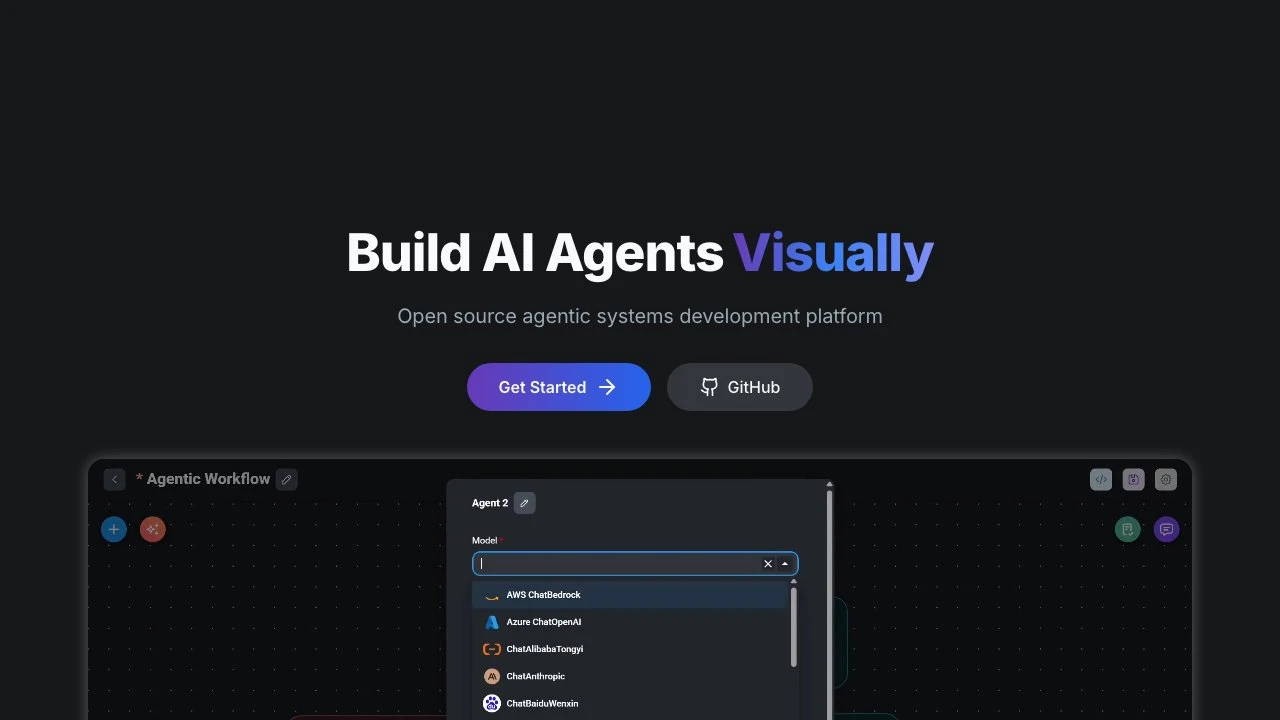
Flowise is an open-source, visual development platform for building LLM-powered applications and agentic systems. Originally launched as a drag-and-drop tool for composing LLM flows, it has grown into a full-featured platform for building everything from simple chatbots to complex multi-agent orchestration systems. Flowise has since joined Workday, signaling enterprise-level backing and adoption.
At its core, Flowise provides two primary building modes: Chatflow for single-agent systems and chatbots with RAG (retrieval-augmented generation) and tool calling support, and Agentflow for multi-agent systems with workflow orchestration distributed across coordinated agents. This dual-mode approach makes it flexible enough to handle a wide range of use cases without forcing developers into a one-size-fits-all paradigm.
Flowise positions itself as developer-friendly despite its no-code visual interface. Flows can be exposed via REST API, embedded as chat widgets, or accessed through TypeScript and Python SDKs, making it straightforward to integrate into existing applications. It supports 100+ LLMs, embedding models, and vector databases, covering virtually every major provider in the current ecosystem.
For teams that need oversight of autonomous agents, Flowise includes a Human in the Loop (HITL) feature, allowing humans to review and approve agent actions within the feedback loop. This addresses one of the most common concerns with production agentic deployments. The platform also ships with built-in observability: full execution traces, Prometheus support, and OpenTelemetry compatibility for teams already invested in monitoring infrastructure.
Compared to alternatives like LangChain (code-first) or n8n (general automation), Flowise is specifically optimized for LLM and agent workflows with a lower barrier to entry. It occupies similar territory to Langflow, another open-source visual LLM builder, though Flowise's enterprise trajectory via Workday distinguishes it for larger organizations. For teams that want the flexibility of self-hosting with an optional cloud offering, Flowise fits well — it can run locally with a single npx flowise start command or scale horizontally using a message queue and worker architecture for production deployments.
The platform is trusted by organizations including AWS, Accenture, Deloitte, Priceline, and Publicis, suggesting it has proven itself beyond hobbyist or prototype use cases. Its open-source foundation means teams can inspect, modify, and extend the codebase, a meaningful advantage for enterprises with strict compliance or data-residency requirements.
Key Features
- Visual drag-and-drop builder for composing LLM flows, chatbots, and multi-agent systems without writing boilerplate code
- Agentflow mode for orchestrating multi-agent systems with distributed workflow coordination
- Chatflow mode for single-agent chatbots with tool calling and RAG from multiple data sources
- Human in the Loop (HITL) support for human review and approval within agent feedback loops
- Full execution traces with Prometheus, OpenTelemetry, and other observability integrations
- REST API, embeddable chat widget, and TypeScript/Python SDKs for integrating flows into external applications
- Support for 100+ LLMs, embedding models, and vector databases
- Self-hostable on-premises or deployable to cloud with horizontal scaling via message queue and workers
Pros & Cons
Pros
- Truly open-source and self-hostable, giving teams full control over data and infrastructure
- Low barrier to entry — runs locally with a single npm command, accessible to non-engineers
- Broad ecosystem support with 100+ LLMs, embeddings, and vector databases out of the box
- Enterprise-grade observability and horizontal scaling capabilities for production workloads
- Developer escape hatches (API, SDK, embed) prevent lock-in to the visual interface
Cons
- Visual low-code tools can become difficult to maintain as flow complexity grows
- Joining Workday may shift product priorities toward enterprise features over open-source community needs
- Teams with sophisticated engineering workflows may find the visual interface slower than code-first alternatives like LangChain
- Self-hosting requires infrastructure management overhead that smaller teams may not want
Pricing
Visit the official website for current pricing details.
Who Is This For?
Flowise is best suited for developers and technical teams who want to build and deploy LLM-powered applications quickly without writing extensive integration code. It is particularly strong for organizations that require self-hosted or on-premises deployments due to data privacy or compliance requirements. Teams building RAG pipelines, multi-agent workflows, or internal AI assistants that need to integrate into existing products via API will find it a practical fit.

Similar to Flowise