Neon
Serverless Postgres with branching. Great for agent application databases with pgvector support.
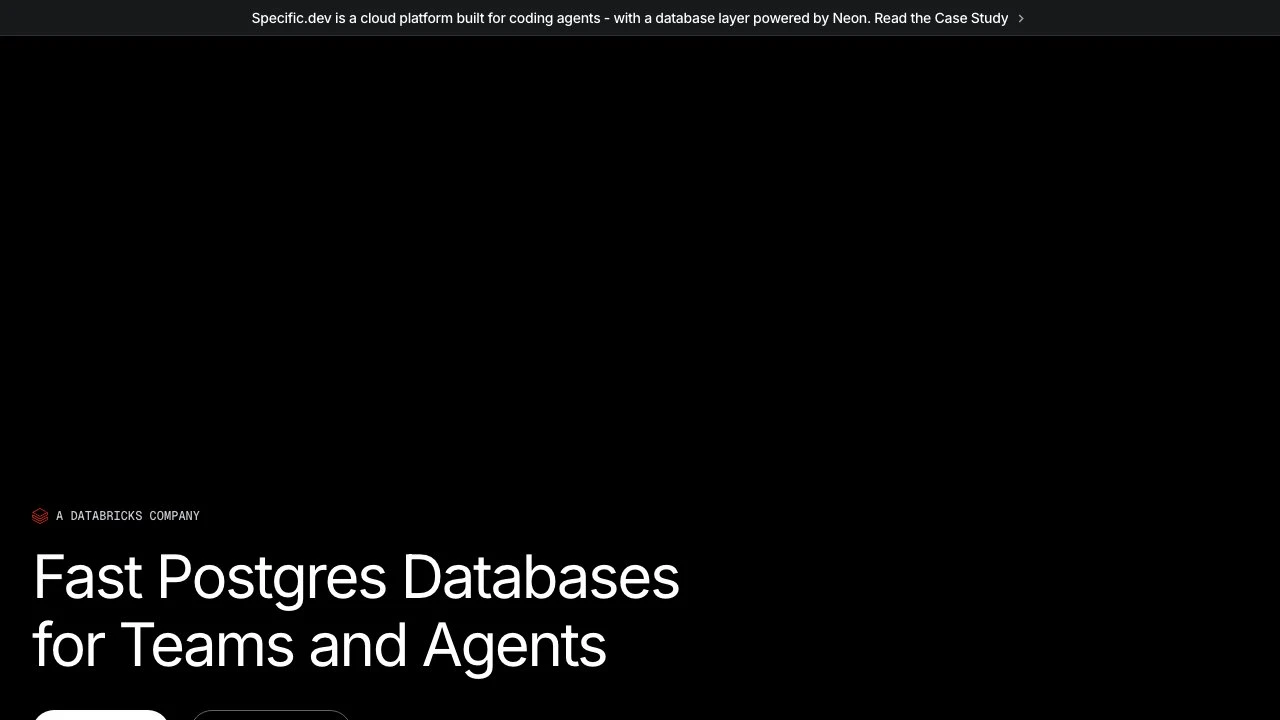
Neon is a serverless Postgres database platform built for modern application development and AI agent workloads. Now a Databricks company, Neon separates storage from compute, enabling databases to scale automatically based on actual workload demand rather than fixed instance sizes.
At its core, Neon is fully Postgres-compatible — no proprietary query language or ORM required. Developers connect with standard Postgres drivers and tools. What differentiates Neon from traditional managed Postgres offerings like AWS RDS or Google Cloud SQL is the architectural split between compute and storage, which enables three capabilities that are difficult or impossible on conventional databases: instant database branching, true autoscaling down to zero, and sub-second cold starts.
Database Branching is Neon's most distinctive feature. Using copy-on-write technology, developers can create isolated copies of any database instantly — including production — without duplicating the underlying data. These branches are used for testing migrations, previewing features in CI/CD pipelines, or giving each developer their own environment. Branches can be configured to self-delete after work completes, keeping environments tidy without manual cleanup.
Autoscaling addresses a real operational problem: most databases are over-provisioned to handle peak load, wasting money during off-peak hours. Neon scales CPU and memory up and down automatically, including scaling to zero when idle. This is particularly valuable for applications with variable or unpredictable traffic patterns, and for AI agents that may spin up database sessions intermittently.
AI Agent Support is a first-class use case. Neon includes pgvector support for embedding storage, making it suitable as the persistent layer for RAG pipelines and agent memory. The platform's API-first design allows agents and orchestration systems to provision databases programmatically — Specific.dev, for instance, uses Neon to provision thousands of databases for coding agents. An MCP (Model Context Protocol) server is available, enabling LLM-connected tools to interact with Neon databases directly from an IDE.
Built-in Authentication is available at no additional charge, letting developers handle user management directly within the database layer rather than standing up a separate auth service.
Neon also exposes a REST HTTP Data API, enabling direct database queries over HTTP without a persistent connection — useful for serverless functions and edge environments where connection pooling is constrained.
Compared to PlanetScale (MySQL-based, now sunset for free tier), Supabase (which also offers Postgres with auth and storage), and Turso (SQLite-based edge databases), Neon occupies a distinct position: pure Postgres semantics, deep branching workflows, and strong agent/AI tooling. Supabase is the closest competitor in terms of features, but Neon's compute-storage separation gives it an architectural edge for workloads that need aggressive autoscaling and ephemeral environments at scale.
Neon is production-ready with SOC2 and HIPAA compliance, 99.95% uptime SLAs, private networking via PrivateLink, and observability integrations with Datadog and OpenTelemetry-compatible services — all available without platform fees or spend minimums.
Key Features
- Copy-on-write database branching for instant, space-efficient environment copies
- Automatic compute scaling including scale-to-zero when idle
- pgvector support for AI embedding storage and vector similarity search
- Built-in user authentication included at no additional cost
- REST HTTP Data API for connectionless database access from serverless and edge environments
- MCP server integration for LLM tools and AI agents to interact with databases directly
- Connection pooling built in to handle serverless connection patterns
- SOC2 and HIPAA compliance with private networking via PrivateLink
Pros & Cons
Pros
- Instant database branching makes CI/CD and per-developer environments practical at scale
- True autoscaling, including scale-to-zero, reduces costs for variable or low-traffic workloads
- Fully Postgres-compatible — no migration of queries or tooling required
- Strong fit for AI agent architectures with pgvector, API access, and programmatic database provisioning
- Enterprise compliance features (SOC2, HIPAA, SLAs) available without minimum spend
Cons
- Scale-to-zero introduces cold start latency, which may be unsuitable for latency-sensitive production workloads
- Serverless architecture may behave differently from self-hosted Postgres in edge cases around connection handling
- Branching and ephemerality features add workflow complexity that teams must learn and manage
- As a relatively young platform (acquired by Databricks), long-term pricing and feature roadmap carry some uncertainty
Pricing
Neon offers a free tier to get started. Paid plans eliminate platform fees and monthly minimums — enterprise features including HIPAA compliance, private networking, and uptime SLAs are available without fixed spend commitments. Visit the official website for current pricing details.
Who Is This For?
Neon is best suited for development teams building serverless applications, multi-tenant SaaS products, or AI agent systems that require isolated, ephemeral database environments at scale. It is particularly well-matched for teams that want production-like Postgres branches in CI/CD pipelines without managing separate infrastructure, and for AI engineers who need a database that can be provisioned programmatically and supports vector search via pgvector.

Similar to Neon