Supabase
Postgres database with vector support (pgvector). Auth, storage, and realtime for agent backends.
Supabase is an open source backend platform built on top of PostgreSQL, positioning itself as an alternative to Firebase and other backend-as-a-service solutions. Where Firebase uses a proprietary NoSQL document store, Supabase gives developers a full relational Postgres database with all the surrounding infrastructure they need to ship production applications quickly.
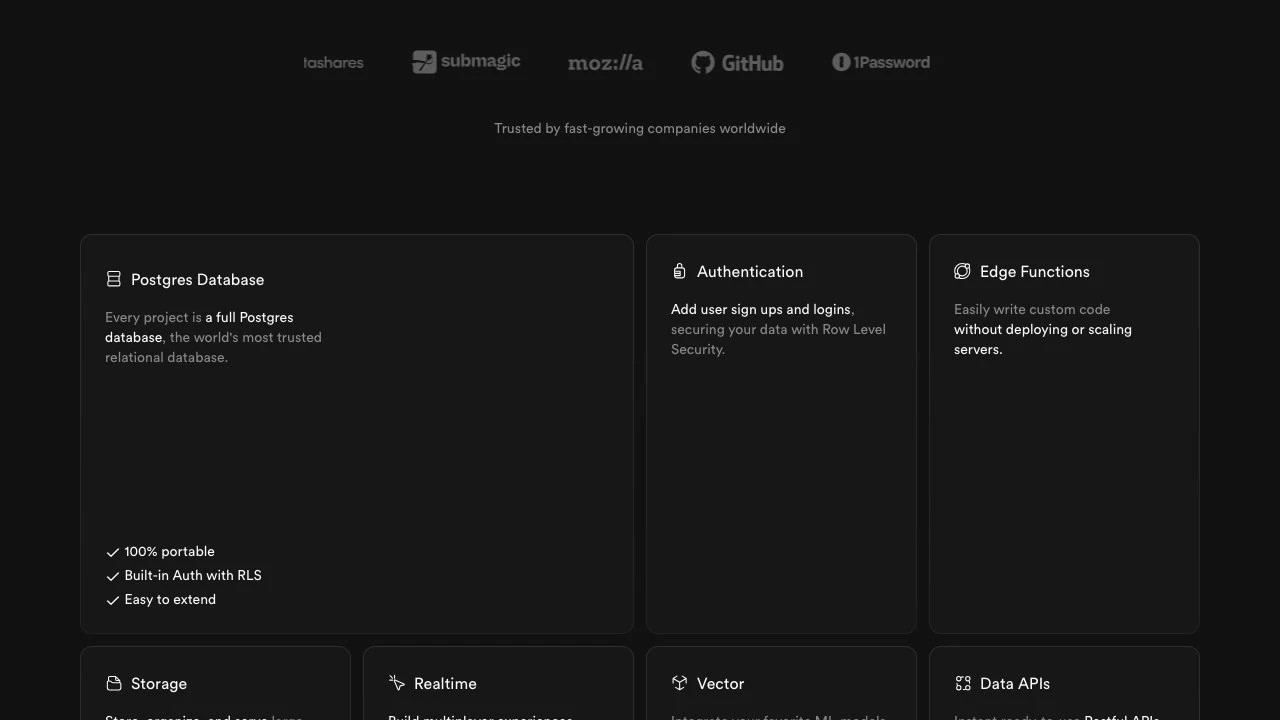
At its core, Supabase provides a managed Postgres instance per project, but the platform extends well beyond raw database access. It bundles authentication, file storage, realtime subscriptions, edge functions, auto-generated REST and GraphQL APIs, and native vector embedding support — all accessible through a single dashboard or via client SDKs.
The vector support (via pgvector) is particularly relevant for AI and agent-based applications. Developers can store and query high-dimensional embeddings directly in Postgres alongside relational data, enabling semantic search, retrieval-augmented generation (RAG), and memory layers for LLM applications without spinning up a dedicated vector database like Pinecone or Weaviate. Integrations with OpenAI and Hugging Face make it straightforward to embed and index content at scale.
Authentication in Supabase is handled through a built-in system with support for email/password, magic links, OAuth providers, and one-time passwords. Row Level Security (RLS) policies are enforced at the database level, meaning access control is defined close to the data rather than scattered across application logic.
Realtime functionality allows applications to subscribe to database changes and broadcast events across connected clients, making it suitable for collaborative tools, live dashboards, and multiplayer experiences. Storage handles large files — images, videos, documents — with support for access policies consistent with the rest of the platform.
Edge Functions let developers run server-side logic without managing infrastructure. They run on Deno and can be deployed globally without configuration.
Compared to Firebase, Supabase offers the full power of SQL — joins, transactions, complex queries — rather than a document model. Compared to running a raw Postgres instance on a cloud provider, Supabase adds the auth, storage, and API layers that would otherwise require substantial custom engineering. Compared to dedicated vector databases, Supabase's pgvector integration is less specialized but has the advantage of keeping vector data co-located with relational data.
Supabase is open source and can be self-hosted, which matters for teams with compliance requirements or cost constraints at scale. The managed cloud offering handles infrastructure, backups, and scaling automatically.
The platform is trusted by companies including Mozilla, GitHub, 1Password, LangChain, and Resend, reflecting its adoption across both traditional web applications and AI-native products.
Key Features
- Full PostgreSQL database per project with support for extensions, functions, and RLS policies
- Built-in authentication with email, magic links, OAuth, and OTP support secured by Row Level Security
- Native vector embedding support via pgvector for semantic search and RAG pipelines
- Realtime subscriptions for live data synchronization across connected clients
- File storage for large assets (images, video, documents) with integrated access control
- Auto-generated REST and GraphQL APIs from your database schema
- Edge Functions for custom server-side logic without managing servers
- Open source codebase with self-hosting option available
Pros & Cons
Pros
- Full Postgres access gives developers the complete power of SQL, including joins, transactions, and complex queries
- Combines database, auth, storage, realtime, and vector search in a single platform, reducing the number of third-party services needed
- Open source and self-hostable, providing flexibility for compliance or cost-sensitive deployments
- pgvector integration makes it a practical choice for AI applications without requiring a separate vector database
- Generous free tier lowers the barrier for prototyping and small projects
Cons
- Less mature than Firebase for mobile-first use cases and offline-first sync patterns
- Self-hosting adds operational overhead compared to using the managed cloud offering
- pgvector performance may lag behind dedicated vector databases at very large scale or with high query throughput requirements
- Edge Functions run on Deno, which may require adjustments for teams with Node.js-heavy workflows
Pricing
Supabase offers a free tier for getting started with no credit card required. Paid plans are available for production projects and larger teams. Visit the official website for current pricing details.
Who Is This For?
Supabase is best suited for developers and teams building web or AI applications who want a complete backend without managing separate services for auth, storage, and databases. It is particularly well-matched for AI agent and LLM application builders who need vector search co-located with relational data, and for teams that want the flexibility of open source software with the option to self-host.

Similar to Supabase