OpenAI Agents SDK
OpenAI's framework for building multi-agent workflows with handoffs, guardrails, and tracing.
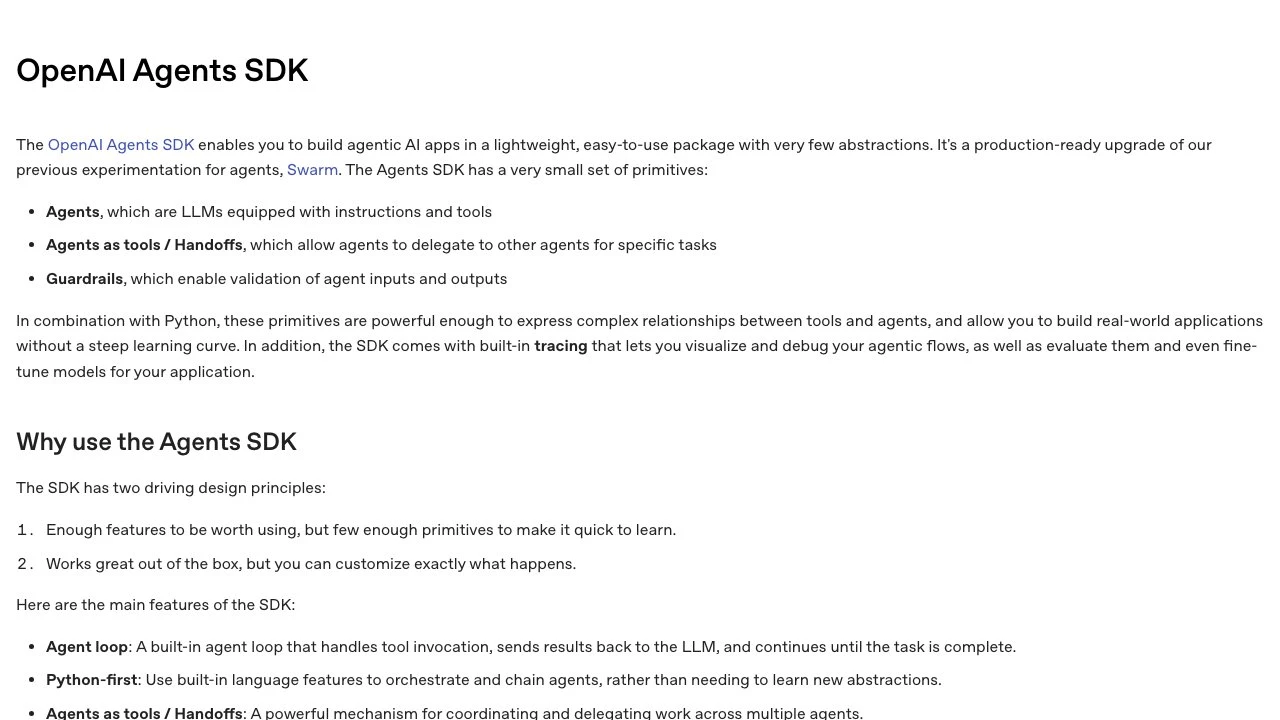
OpenAI Agents SDK is an open-source Python framework for building multi-agent AI applications. Released by OpenAI, it provides the primitives and orchestration logic needed to compose individual AI agents into workflows that can hand off tasks, enforce guardrails, and trace execution—all within a single coherent library.
At its core, the SDK models agents as configurable units that combine a model, a set of tools, and instructions. Agents can be run individually or wired together so that one agent delegates to another via handoffs—a first-class concept in the framework that handles context passing and control flow between agents automatically. This makes it practical to build specialized agent networks where, for example, a triage agent routes requests to a research agent or a code-writing agent, without manually managing message state.
The SDK includes built-in support for guardrails, which let developers define input and output validation rules that run alongside the agent's execution. Guardrails can abort or modify agent behavior before responses are returned, making it easier to enforce safety policies or domain constraints in production systems.
Tracing is another first-class feature. Every agent run produces structured trace data covering spans, tool calls, handoffs, and model responses. Traces can be sent to external processors, making it straightforward to integrate with observability platforms or OpenAI's own dashboard.
Beyond the core loop, the SDK covers sessions (including SQLAlchemy-backed and encrypted variants), human-in-the-loop interruption points, context management, streaming, voice and realtime agent pipelines, and Model Context Protocol (MCP) server integration. Agent behavior can be visualized, and a REPL utility is included for interactive development.
Compared to alternatives like LangChain or LlamaIndex, the OpenAI Agents SDK is narrower in scope but more opinionated. It does not attempt to abstract over dozens of model providers or retrieval backends. Instead, it is tightly integrated with OpenAI's model APIs (Chat Completions and Responses), though a multi-provider interface exists for using third-party models. Developers already invested in the OpenAI ecosystem will find the integration frictionless; those needing model-agnostic flexibility may find other frameworks a better fit.
Relative to CrewAI or AutoGen, the SDK sits closer to the infrastructure layer. It gives developers control over agent definitions and orchestration logic without prescribing role-based team metaphors. This makes it more composable but requires more explicit design work for complex workflows.
The library is installable via pip, actively maintained on GitHub, and documented with guides, API references, and runnable examples. It supports Python and is designed to scale from simple single-agent scripts to production multi-agent systems.
Key Features
- Multi-agent orchestration with native handoff support for routing tasks between specialized agents
- Built-in guardrails for input and output validation that run alongside agent execution
- Structured tracing with spans and processor interfaces for observability and debugging
- Session management with SQLAlchemy, SQLite, and encrypted session backends
- Human-in-the-loop support for pausing and resuming agent runs at defined checkpoints
- Realtime and voice agent pipelines with dedicated transport and workflow primitives
- Model Context Protocol (MCP) server integration for tool extensibility
- Streaming support with granular event types for building responsive applications
Pros & Cons
Pros
- First-class handoffs and agent orchestration make multi-agent workflows explicit and manageable
- Guardrails and tracing are built in, not bolted on—reducing the need for third-party tooling
- Tight OpenAI integration means less glue code for teams already using GPT models
- Covers a wide surface area: sessions, voice, realtime, MCP, streaming, and visualization in one library
- Open source with active maintenance and comprehensive documentation
Cons
- Primarily designed for OpenAI models; multi-provider support exists but is secondary
- Python-only—no official support for JavaScript, TypeScript, or other runtimes
- Opinionated structure may require adaptation for teams with existing agent architectures
- Less suited for retrieval-augmented generation (RAG) or data pipeline use cases compared to LlamaIndex or LangChain
Pricing
The OpenAI Agents SDK is open source and free to use. Model usage costs depend on the OpenAI API pricing for whichever models are used in the application. Visit the official website for current pricing details.
Who Is This For?
OpenAI Agents SDK is best suited for Python developers and AI engineers building production-grade multi-agent applications on top of OpenAI's model APIs. It fits teams that need structured orchestration, tracing, and guardrails without assembling these capabilities from separate libraries. It is particularly well-matched to use cases involving task delegation across specialized agents, voice or realtime interaction, and applications that require session persistence or human-in-the-loop review steps.
Tags:

Similar to OpenAI Agents SDK