Perplexity API
Search-augmented LLM API. Get grounded, cited answers for research and knowledge agent use cases.
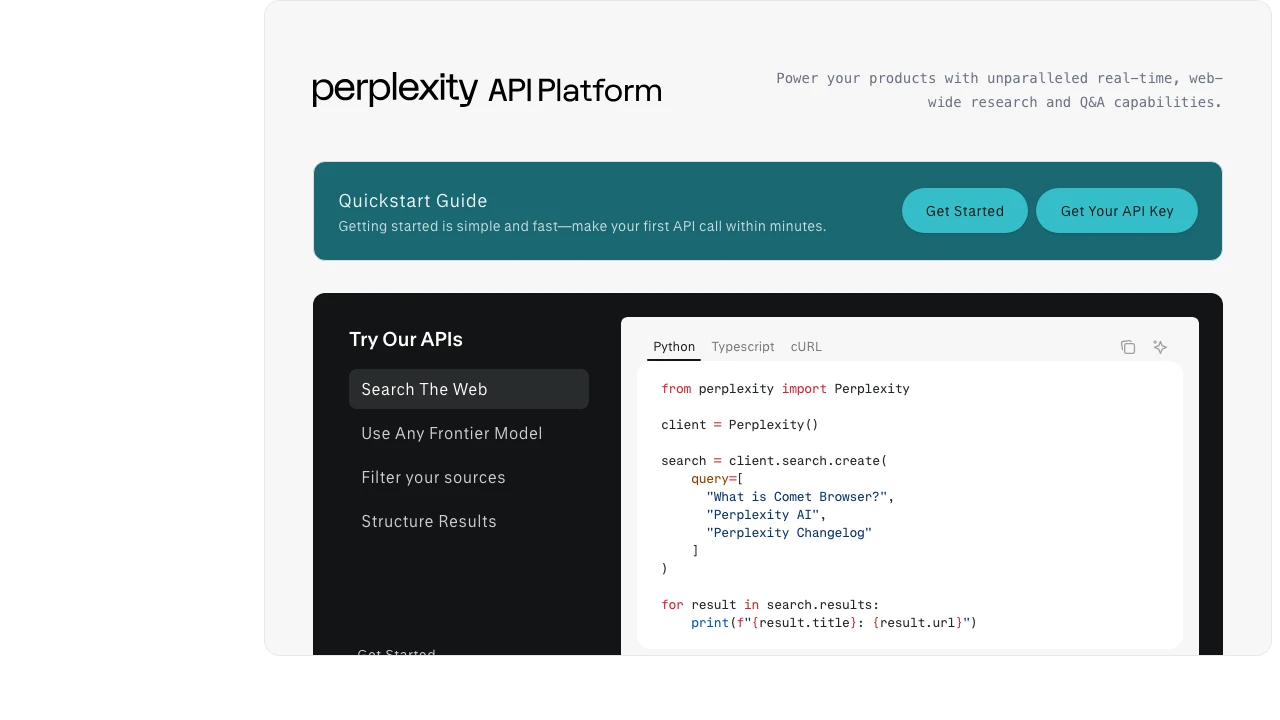
Perplexity API is a suite of developer APIs that brings real-time, web-grounded intelligence to applications. Built on top of Perplexity's search infrastructure, it gives developers programmatic access to the same capabilities that power the Perplexity consumer product — live web search, cited answers, semantic embeddings, and agentic reasoning — without having to build or maintain any crawling infrastructure themselves.
The platform is organized into four distinct APIs, each targeting a different part of the AI application stack. The Agent API lets developers call third-party models (including models from other providers) augmented with web search tools and presets, making it straightforward to build research agents that stay current with the web. The Search API provides raw, ranked web search results with advanced filtering and real-time data — useful when you want the retrieval layer without the synthesis step. The Sonar API is Perplexity's own family of search-augmented language models, offering grounded, cited completions that are well-suited to Q&A and knowledge retrieval tasks. The Embeddings API generates high-quality vector representations, including contextualized embeddings, which can power semantic search and retrieval-augmented generation (RAG) pipelines.
The API is OpenAI-compatible at the interface level, which means teams already using the OpenAI SDK can switch with minimal code changes. This lowers adoption friction considerably compared to APIs that require proprietary client libraries.
In the broader ecosystem, Perplexity API sits between a pure LLM API (like OpenAI or Anthropic) and a dedicated web search API (like Bing Search or SerpAPI). The key differentiator is that it combines retrieval and generation in a single call — responses come back with inline citations, grounded in live web content, rather than requiring a separate orchestration layer. For teams building knowledge agents, research assistants, or fact-checking tools, this reduces both latency and architectural complexity compared to a roll-your-own RAG stack.
The platform includes API key management, rate limit tiers, and billing grouped by API group — useful for teams that need to track costs across multiple products or sub-teams. A developer community, changelog, and system status page are available for ongoing support and transparency.
Perplexity API is best compared to Bing Grounding (Microsoft) and Google Search API when the goal is web-augmented generation, or to standard LLM APIs when the goal is general text generation. Its advantage is the tight integration of search and synthesis; its trade-off is that it is less suitable for pure offline reasoning tasks where web access is unnecessary or undesirable.
Key Features
- Agent API: Access third-party LLMs augmented with web search tools and configurable presets for agentic workflows
- Search API: Retrieve raw, ranked web search results with advanced domain, recency, and content-type filters
- Sonar Models: Perplexity's own search-augmented LLMs that return cited, grounded answers in a single API call
- Embeddings API: Generate standard and contextualized vector embeddings for semantic search and RAG pipelines
- OpenAI compatibility: Drop-in compatible with the OpenAI API interface, minimizing migration effort
- Real-time web access: All search and agent endpoints retrieve live web data at inference time, not a static training snapshot
- API Groups & Billing: Organize API keys and usage by team or product with grouped billing controls
- Rate limit tiers: Tiered usage plans with documented limits to support scaling from prototype to production
Pros & Cons
Pros
- Combines web retrieval and LLM synthesis in a single API call, reducing the need for separate orchestration layers
- OpenAI-compatible interface lowers switching costs for teams already using OpenAI SDKs
- Citations included in responses, which is valuable for research, fact-checking, and trust-sensitive applications
- Multiple APIs (Agent, Search, Sonar, Embeddings) cover a broad range of use cases from raw retrieval to full agentic pipelines
- Real-time web access keeps responses current without relying on stale training data
Cons
- Less suitable for tasks that require purely offline reasoning or sensitive data that should not touch the web
- Dependency on Perplexity's infrastructure means availability is tied to their system status
- Grounded, cited output may introduce latency compared to a direct LLM call without search
- Pricing details require visiting the official site — less transparent upfront than some competitors
Pricing
Visit the official website for current pricing details.
Who Is This For?
Perplexity API is best suited for developers building research assistants, knowledge agents, or Q&A products that need answers grounded in live web data with citations. It is particularly well-matched to teams who want to avoid building their own retrieval pipeline and prefer a single API that handles both search and synthesis. Organizations already using OpenAI-compatible tooling will find the migration path especially low-friction.
Tags:

Similar to Perplexity API