PydanticAI
Type-safe AI agent framework built on Pydantic. Strong validation and structured outputs.
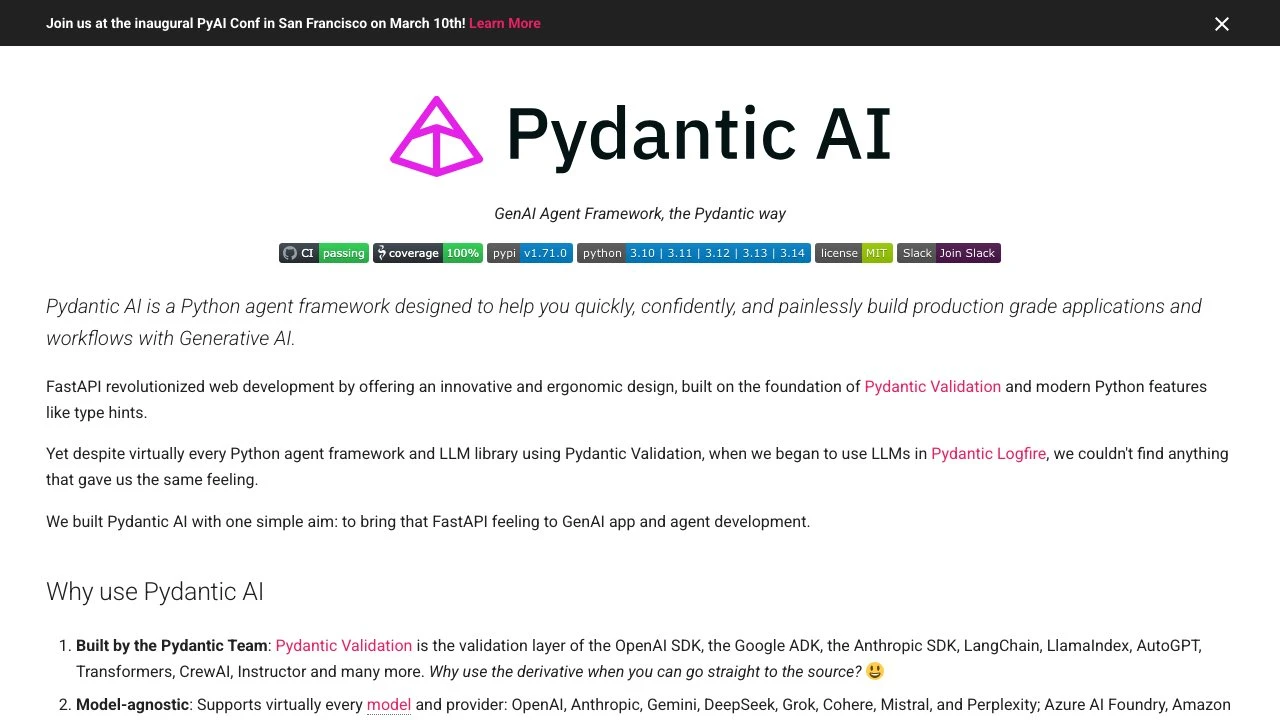
PydanticAI is an open-source Python agent framework developed by the team behind the widely-used Pydantic data validation library. It brings Pydantic's signature approach — strict type safety and structured validation — directly into the AI agent development workflow, making it a natural fit for Python developers who already rely on Pydantic in their applications.
At its core, PydanticAI provides a clean abstraction for building AI agents with strongly typed inputs, outputs, and dependencies. Agents are defined using Python classes and decorators, and all data flowing through them is validated against Pydantic models. This means agents produce predictable, structured outputs rather than raw text, which is essential for production systems where downstream code needs to parse and act on LLM responses.
The framework supports a wide range of model providers out of the box: OpenAI, Anthropic, Google, xAI, AWS Bedrock, Groq, Mistral, Cohere, Cerebras, Hugging Face, and OpenRouter. This breadth makes it straightforward to swap providers without rewriting agent logic.
PydanticAI includes a dependency injection system that allows agents to declare and receive runtime dependencies — database connections, HTTP clients, configuration — in a testable, type-safe way. This patterns makes agents significantly easier to unit test compared to frameworks that rely on global state or implicit context.
Function tools are first-class citizens: Python functions can be registered as tools that agents call during execution, with full type inference for arguments and return values. The framework also ships with built-in tools and supports third-party toolsets, as well as MCP (Model Context Protocol) client and server integration for interoperability with the broader MCP ecosystem.
For multi-agent workflows, PydanticAI supports agent composition patterns and includes Pydantic Graph — a beta module for defining stateful, branching agent pipelines with parallel execution support. Pydantic Evals, also included, provides a structured evaluation framework with built-in evaluators, LLM-as-judge support, and Logfire integration for tracing.
Observability is handled through Pydantic Logfire, which provides structured logging and tracing out of the box. This integration is tighter than what most competing frameworks offer.
Compared to alternatives like LangChain or LlamaIndex, PydanticAI is more opinionated about type safety and validation, which trades some flexibility for reliability. Compared to lower-level SDKs like the Anthropic or OpenAI Python clients, it adds significant scaffolding for agents, tools, and structured outputs without requiring boilerplate. Compared to CrewAI or AutoGen, it is more Python-idiomatic and leans heavily on the Pydantic ecosystem rather than introducing its own abstractions for things validation handles well already.
Key Features
- Type-safe agent framework with Pydantic model validation for all inputs and outputs
- Multi-provider support: OpenAI, Anthropic, Google, Groq, Mistral, Bedrock, Cohere, Cerebras, Hugging Face, OpenRouter, and more
- Dependency injection system for testable, runtime-configurable agents
- Function tools with full type inference, plus built-in and third-party toolset support
- MCP (Model Context Protocol) client and server integration
- Pydantic Graph for stateful multi-agent pipelines with parallel execution (beta)
- Pydantic Evals for structured agent evaluation with LLM-as-judge and custom evaluators
- Native Pydantic Logfire integration for observability and tracing
Pros & Cons
Pros
- Deep type safety and structured output validation inherited from Pydantic makes production deployments more reliable
- Broad model provider support with a consistent API across providers
- Dependency injection makes agents genuinely testable without mocking LLM calls
- Strong ecosystem coherence — Logfire, Evals, and Graph are purpose-built to work together
- Python-idiomatic design that fits naturally into existing Pydantic-based codebases
Cons
- Python-only; not an option for TypeScript or other language stacks
- Pydantic Graph (multi-agent pipelines) is still in beta and may have API changes
- Heavier Pydantic dependency may feel excessive for simple, single-turn LLM use cases
- Smaller community and fewer third-party integrations compared to LangChain
- Observability story is tightly coupled to Pydantic Logfire, which may conflict with existing monitoring setups
Pricing
PydanticAI is open source and free to use under its open-source license. Visit the official website for details on any paid offerings such as Pydantic Logfire, which is a separate hosted product.
Who Is This For?
PydanticAI is best suited for Python developers building production AI agents who prioritize type safety, structured outputs, and testability over rapid prototyping flexibility. It is particularly well-matched to teams already using Pydantic in their stack — such as those building FastAPI services — where a consistent validation model across the entire application is valuable. It also fits teams that need to evaluate agents systematically and want observability baked in from the start.
Tags:

Similar to PydanticAI