Mem0
Add persistent memory to AI agents. User, session, and organizational memory for personalized experiences.
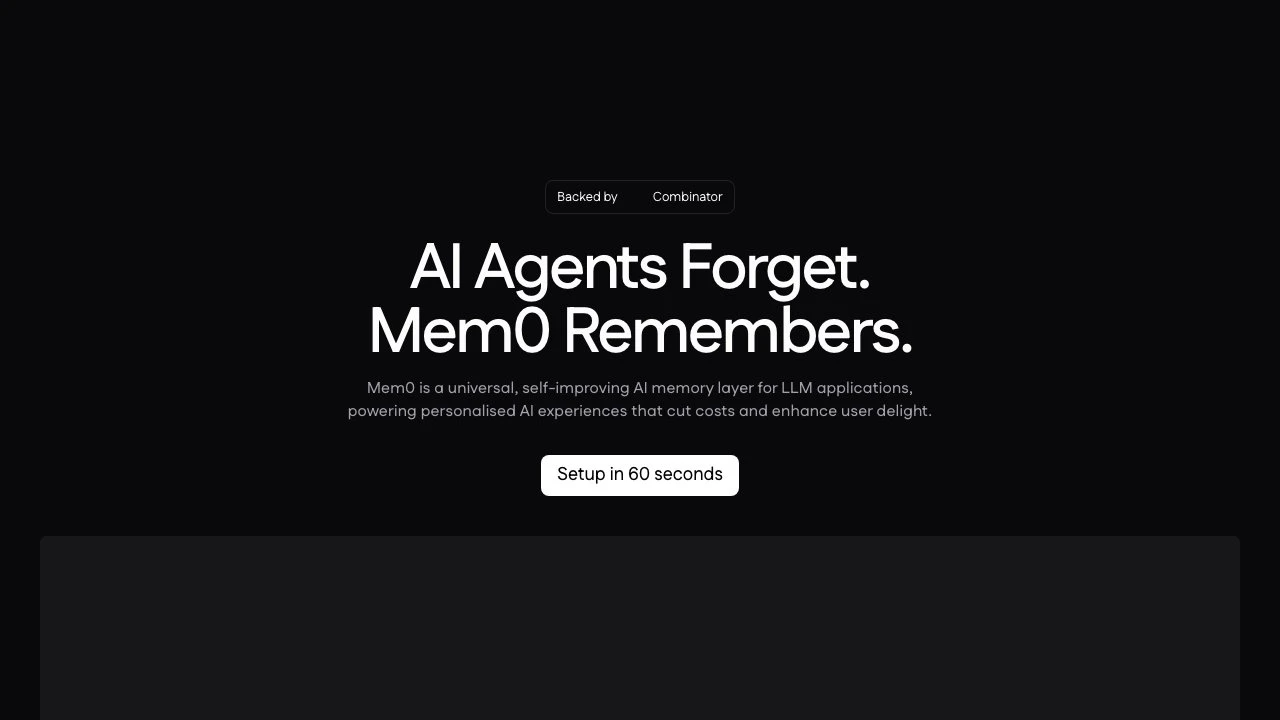
Mem0 is a persistent memory layer designed for LLM applications and AI agents. It addresses one of the core limitations of stateless language models — the inability to retain information across sessions — by providing a structured system for storing, retrieving, and updating memories at three distinct levels: user, session, and organizational.
At its core, Mem0 acts as an intelligent memory store that sits between an AI agent and its underlying model. When a user interacts with an agent, relevant facts are extracted and stored. On subsequent interactions, those memories are retrieved and injected into context, giving the agent continuity without requiring the entire conversation history to be replayed. This selective retrieval reduces token usage significantly — one documented case study shows a 40% reduction in token costs.
Mem0 is available both as an open-source Python library and as a managed platform (mem0.dev). The open-source version gives developers full control over storage backends and embedding models, while the hosted platform handles infrastructure, scaling, and memory management automatically. The API-first design means it integrates with any LLM stack — whether that's OpenAI, Anthropic, or an open model running locally.
The library is used by over 100,000 developers and has adoption from organizations including Microsoft, NVIDIA, AWS, PwC, CrewAI, and Mastra. This breadth of enterprise use suggests it handles production workloads at scale rather than being a prototype-only tool.
In the broader ecosystem, Mem0 fills a specific gap that general-purpose vector databases like Pinecone or Weaviate do not address out of the box: the semantic, self-improving memory layer tailored for conversational AI. While you could build similar functionality manually with a vector store and a retrieval pipeline, Mem0 handles the extraction, deduplication, and update logic that makes memory actually useful in practice. It is more opinionated and purpose-built than raw vector search, and more flexible than memory systems locked into a single agent framework like LangChain's memory modules.
Common use cases include customer support agents that remember past interactions, coding assistants that track user preferences and project context, health and wellness apps that personalize advice over time, and education platforms that adapt to individual learning styles. The Sunflower Sober case study — scaling personalized recovery support to 80,000+ users — illustrates that Mem0 can handle high-volume, emotionally sensitive contexts where personalization directly affects outcomes.
For teams building multi-agent systems, Mem0 also supports organizational memory, meaning shared context across agents and users within a workspace rather than only per-user state. This makes it useful in enterprise deployments where multiple agents need a shared understanding of company-specific context.
Mem0 is backed by Y Combinator and Basis Set Ventures, which signals a product with a growth trajectory and ongoing development investment.
Key Features
- Persistent memory across user sessions, with user-level, session-level, and organizational memory scopes
- Self-improving memory that extracts and updates relevant facts from conversations automatically
- Open-source Python SDK with full control over storage backends and embedding models
- Managed cloud platform (mem0.dev) for teams that want infrastructure handled
- API-first design compatible with any LLM provider or agent framework
- Token cost reduction through selective memory retrieval instead of full context replay
- Organizational memory for sharing context across multiple agents and users
- Integrations with popular agent frameworks including CrewAI and Mastra
Pros & Cons
Pros
- Reduces token costs materially by retrieving only relevant memories rather than replaying full histories
- Works with any LLM stack — not locked into a single provider or framework
- Open-source option gives full data control and self-hosting flexibility
- Purpose-built for conversational AI memory, handling extraction and deduplication logic that would otherwise need custom implementation
- Strong enterprise adoption (Microsoft, NVIDIA, AWS) suggests production-grade reliability
Cons
- Adds an external dependency and network hop to every agent interaction on the managed platform
- Memory extraction quality depends on the underlying model and prompt design — garbage in, garbage out
- Self-hosted setup requires managing a vector store and embedding model in addition to the library
- No built-in memory privacy or access controls described publicly — enterprise compliance requirements may need custom handling
Pricing
Mem0 offers a free tier to get started via the managed platform. Visit the official website for current pricing details on paid plans.
Who Is This For?
Mem0 is best suited for developers and engineering teams building AI agents or assistants that require continuity across sessions — such as customer support bots, personal coaching apps, coding assistants, and health or wellness platforms. It is particularly valuable in high-volume production environments where reducing token costs matters and where user personalization is a core product requirement rather than a nice-to-have.
Tags:

Similar to Mem0