BabyAGI
Lightweight autonomous agent that creates, prioritizes, and executes tasks using LLMs.
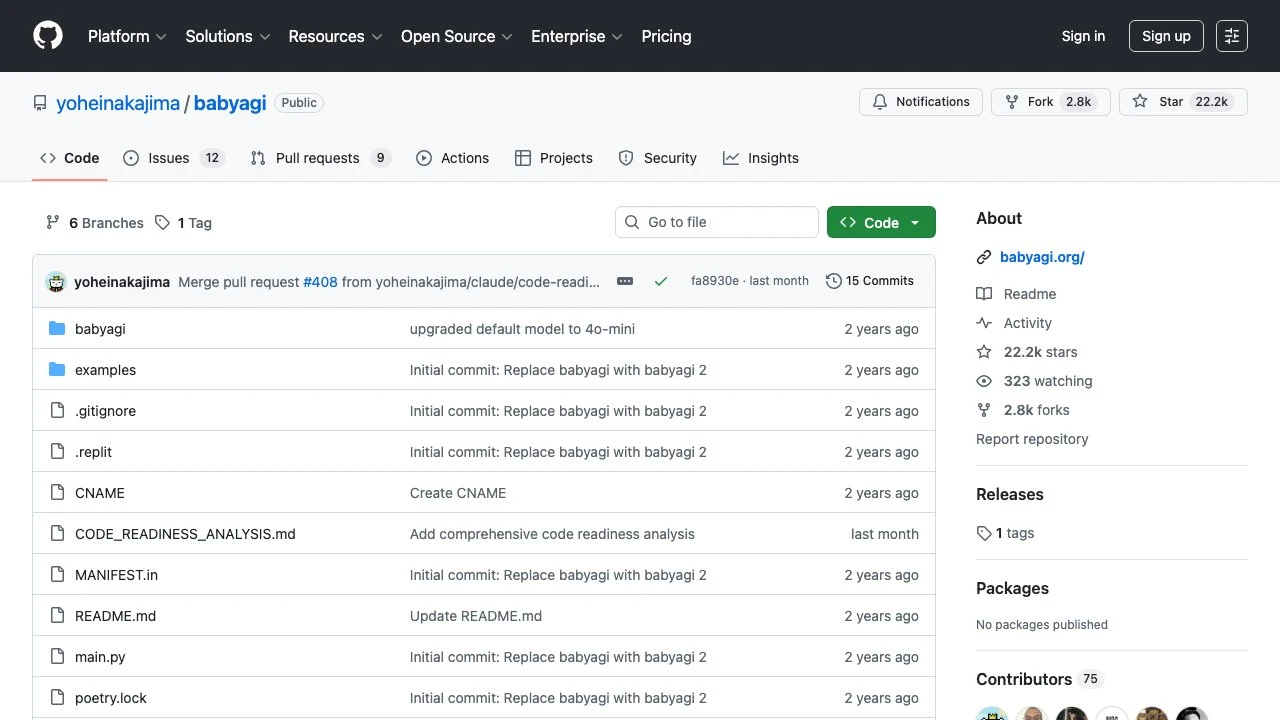
BabyAGI is a lightweight, open-source autonomous agent framework built in Python that demonstrates how large language models can be used to generate, prioritize, and execute tasks in a continuous loop. Created by Yohei Nakajima and released on GitHub, it became one of the earliest and most influential examples of task-driven autonomous AI agents, accumulating over 22,000 GitHub stars.
At its core, BabyAGI operates through a simple but powerful loop: given an objective, the system uses an LLM to generate a list of tasks, executes the first task, evaluates the result, and then re-prioritizes the task list before repeating. This cycle continues until the objective is met or the agent is stopped. The framework was designed intentionally as a minimal reference implementation — the codebase is compact enough to read and understand in a single sitting, making it an effective educational tool for developers exploring agentic AI patterns.
BabyAGI is best understood as a conceptual framework and starting point rather than a production-ready platform. It popularized the idea of task-driven autonomous agents and directly influenced more feature-complete successors like AutoGPT, AgentGPT, and LangChain's agent primitives. Where AutoGPT and similar tools added browser access, file system interaction, and plugin ecosystems, BabyAGI stays deliberately minimal — its value is in the clarity of its architecture, not breadth of features.
The system integrates with OpenAI's API for task generation and execution, and originally used Pinecone as a vector store to persist task results and provide memory across iterations. This memory layer allowed the agent to use prior results when generating and evaluating subsequent tasks, creating a feedback loop that mimics goal-directed reasoning.
For developers, BabyAGI serves as a readable blueprint for understanding how autonomous agents work: how objectives decompose into tasks, how LLMs can be prompted to act as executors and planners simultaneously, and how memory can be wired in to maintain context across iterations. It is frequently cited in academic and practitioner writing on AI agents as a foundational reference.
BabyAGI fits into a broader ecosystem of agentic frameworks. Compared to LangChain or LlamaIndex, it offers far less infrastructure but far more conceptual clarity. Compared to CrewAI or AutoGen, it lacks multi-agent coordination but requires no framework-specific abstractions to understand. For teams building production agentic systems, BabyAGI is more useful as a teaching tool than a deployment target — but its influence on the field is substantial and the codebase remains a worthwhile read for anyone building on top of LLMs.
Key Features
- Autonomous task loop: generates, prioritizes, and executes tasks toward a defined objective without manual intervention
- LLM-powered task creation: uses language models to break down objectives into concrete, actionable subtasks
- Dynamic task reprioritization: re-ranks the task queue after each execution step based on new results and remaining goals
- Vector memory integration: stores task results in a vector database (originally Pinecone) to inform future task generation with prior context
- Minimal Python codebase: designed to be read and understood quickly, making it a clear reference implementation for agentic patterns
- OpenAI API integration: uses GPT models for both task planning and execution steps
- Open-source and forkable: MIT-licensed and publicly available on GitHub, with an active community of forks and adaptations
Pros & Cons
Pros
- Extremely readable codebase — the architecture is easy to audit, fork, and learn from
- Historically significant: one of the first public demonstrations of task-driven autonomous agents, directly influencing the modern agentic AI ecosystem
- Low setup overhead — minimal dependencies make it straightforward to run locally
- Strong community: over 22,000 GitHub stars and a wide base of forks and derivatives
- Good pedagogical starting point for developers learning how autonomous agents are structured
Cons
- Not production-ready — lacks error handling, reliability features, and safety guardrails needed for real deployments
- Limited built-in capabilities — no native browser, file system, or API tool integrations out of the box
- Development appears mostly stable/archived — not actively developed with new features
- Single-agent architecture — no built-in support for multi-agent coordination or role-based agent teams
- Dependent on external services (OpenAI API, Pinecone) which introduce cost and latency
Pricing
BabyAGI is fully open-source and free to use under the MIT license. Running it requires API access to OpenAI and optionally a Pinecone account, both of which have their own pricing structures separate from BabyAGI itself.
Who Is This For?
BabyAGI is best suited for developers, researchers, and students who want to understand the foundational mechanics of autonomous AI agents by studying a minimal, readable implementation. It is particularly well-suited for those building their own agentic systems who want a clear conceptual reference rather than a batteries-included framework. Teams evaluating agentic architectures will find it useful as a learning artifact, though production use cases are better served by more mature frameworks built on similar principles.
Tags:

Similar to BabyAGI