AutoGen
Framework for building LLM applications via multi-agent conversation. Supports diverse conversation patterns.
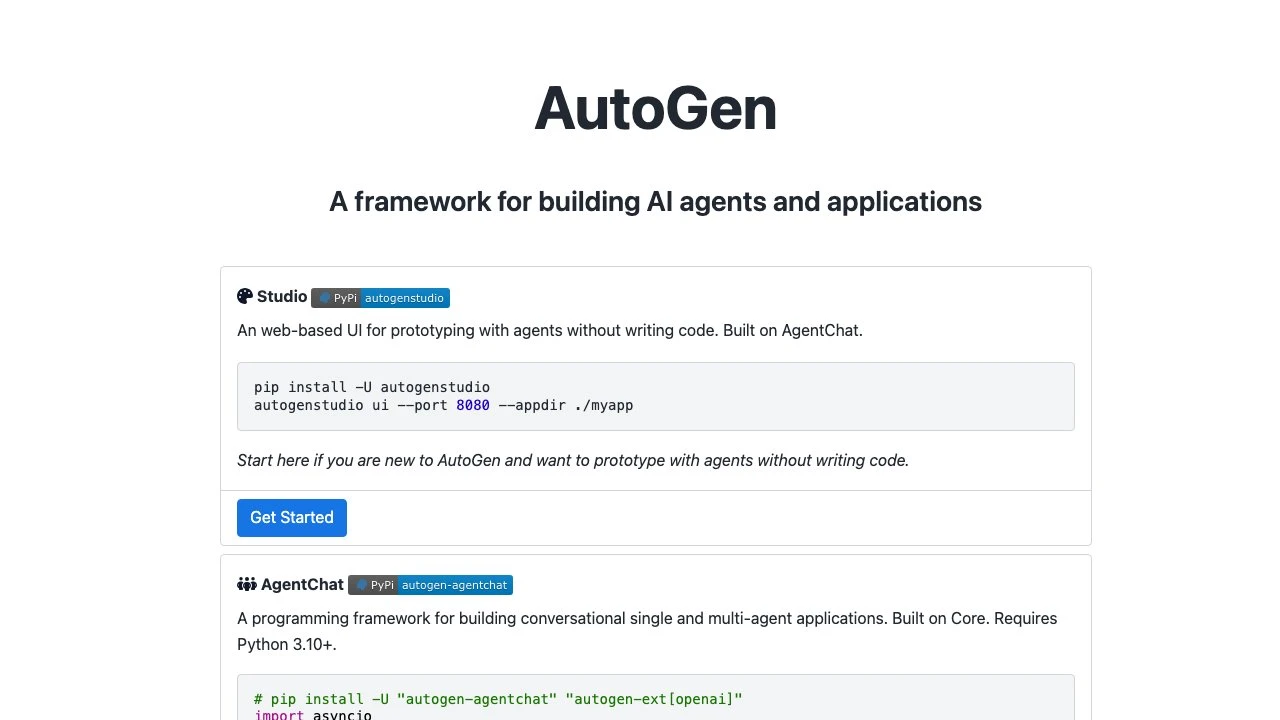
AutoGen is an open-source framework from Microsoft for building AI agent systems and multi-agent applications. It provides a layered architecture that scales from quick prototyping to production-grade distributed systems, making it one of the most comprehensive agent frameworks available today.
At its core, AutoGen is structured into four distinct layers. Core is the foundational event-driven runtime for building scalable, distributed multi-agent systems. It handles agent lifecycle, message passing, and supports both deterministic workflows and dynamic agentic behavior. AgentChat sits on top of Core and provides a higher-level, conversation-oriented API for building single and multi-agent applications in Python — the entry point most developers will start with. Extensions (autogen-ext) provides ready-made integrations with external services including MCP (Model Context Protocol) servers, OpenAI's Assistant API, Docker-based code execution, and gRPC runtimes for distributed deployments. Finally, AutoGen Studio offers a no-code web UI for prototyping agent workflows without writing any Python.
The framework's multi-agent conversation model is its defining characteristic. Rather than a single LLM doing all the work, AutoGen allows multiple agents — each with different roles, tools, and models — to collaborate through structured message passing. This makes it well-suited for tasks that benefit from specialization: one agent might write code, another reviews it, a third executes it in a sandbox, and a fourth synthesizes the results.
Compared to alternatives like LangChain and CrewAI, AutoGen takes a more programmatic and lower-level approach. LangChain offers a broader ecosystem of integrations but can feel abstract; CrewAI focuses on role-based crews with a higher-level DSL. AutoGen sits closer to the metal — the Core layer gives developers direct control over agent runtimes, message routing, and execution topology. For teams that need fine-grained control over multi-agent coordination or are building distributed systems, this is a significant advantage. The addition of AutoGen Studio closes the gap for non-developers and rapid prototyping.
The framework supports Python 3.10+ for the AgentChat and Core packages, and also provides a .NET implementation for teams outside the Python ecosystem. Community extensions are discoverable and the framework is designed to be extensible — developers can publish and consume third-party agent components.
AutoGen is actively maintained by Microsoft Research and has a substantial open-source community with official Discord and GitHub presence. Version 0.4 (the current stable) introduced significant architectural changes from the earlier 0.2 line, and a migration guide is provided for existing users. For teams already using Azure OpenAI or other Microsoft services, AutoGen integrates naturally into that stack.
Key Features
- AgentChat API: High-level Python framework for building conversational single and multi-agent applications, requiring Python 3.10+
- Core event-driven runtime: Low-level framework for scalable, distributed multi-agent systems with support for deterministic and dynamic workflows
- AutoGen Studio: Web-based no-code UI for prototyping agent workflows without writing code, installable via pip
- Extensions ecosystem: Pre-built integrations including MCP server support, OpenAI Assistant API, Docker code execution, and gRPC distributed runtimes
- Multi-language support: Python packages plus a separate .NET implementation for cross-language agent applications
- Docker sandboxed code execution: Agents can generate and run code safely inside Docker containers via
DockerCommandLineCodeExecutor - Community extension system: Developers can discover, use, and publish third-party AutoGen components
- Model-Context Protocol (MCP) support: Native
McpWorkbenchintegration for connecting agents to MCP servers
Pros & Cons
Pros
- Layered architecture lets teams start with Studio or AgentChat and graduate to Core as complexity grows
- Strong Microsoft backing with active research and community support
- Native MCP support and Docker sandboxing reflect practical production concerns
- .NET support broadens the framework beyond Python-only teams
- AutoGen Studio lowers the barrier for non-developers to prototype agent workflows
Cons
- Version 0.4 introduced breaking changes from 0.2, requiring migration effort for existing users
- The layered architecture adds conceptual overhead — understanding Core, AgentChat, and Extensions takes time
- Python 3.10+ requirement excludes older environments
- Lower-level control compared to higher-level frameworks like CrewAI means more boilerplate for simple use cases
- Community extensions quality varies; the ecosystem is less mature than LangChain's
Pricing
AutoGen is fully open-source and free to use under Microsoft's open-source license. All packages are available via PyPI at no cost. Visit the official website for any enterprise or hosted service pricing details.
Who Is This For?
AutoGen is best suited for software engineers and AI researchers who need fine-grained control over multi-agent system design, particularly those building production systems where agents must collaborate, execute code, or operate in distributed environments. It is an especially strong fit for teams working within the Microsoft and Azure ecosystem, or those building complex workflows where multiple specialized agents need to coordinate across well-defined roles.

Similar to AutoGen