Relevance AI
No-code platform for building AI agent workforces. Sales, support, and operations agents.
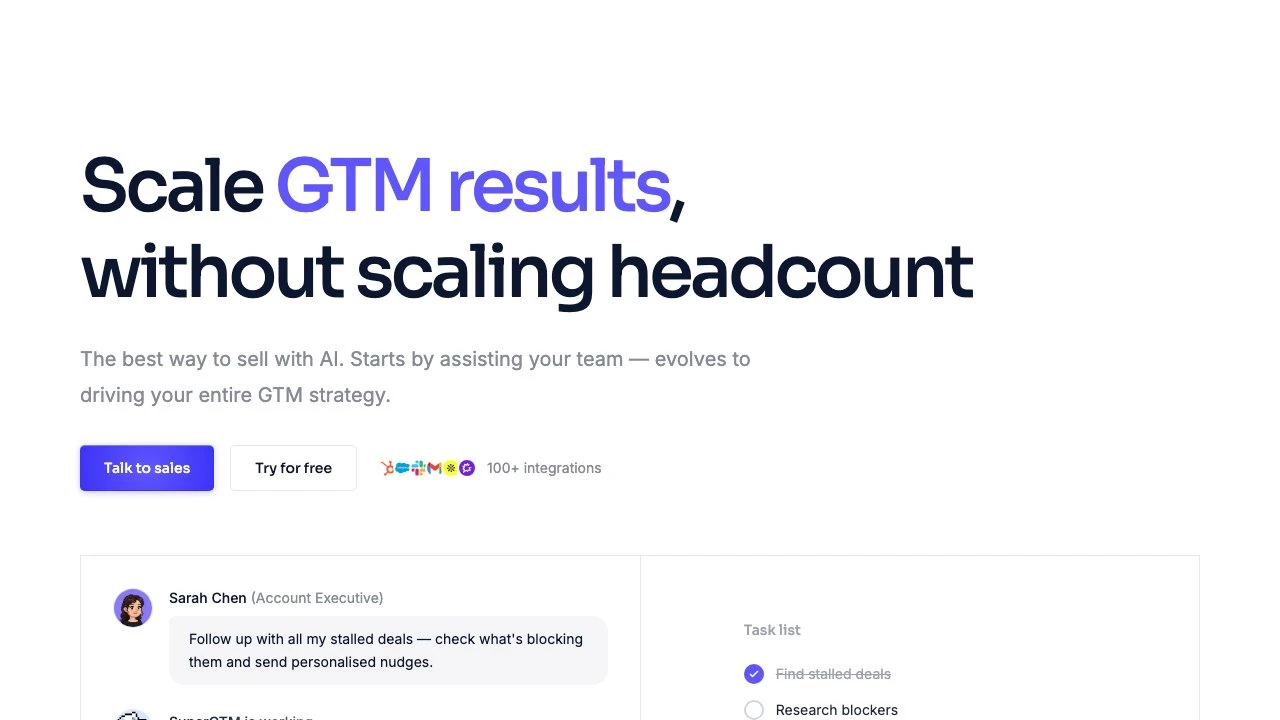
Relevance AI is a no-code platform for building and deploying AI agent workforces, with a strong focus on go-to-market (GTM) functions including sales, marketing, and customer success. The platform is designed to help revenue teams scale output without proportionally scaling headcount, positioning itself as infrastructure for AI-driven sales development, inbound routing, lead enrichment, and customer onboarding.
At its core, Relevance AI offers two modes of operation. The first is SuperGTM, a conversational AI teammate that integrates directly into a team's existing tools — calendar, email, CRM — allowing individual reps to delegate tasks like research, CRM updates, and email drafting without changing their workflows. The second is AI Workforces, where teams build coordinated groups of specialized agents (e.g., Lead Router, Enrichment Agent, Outbound SDR) that run autonomously, triggered by events or pipeline signals.
The platform describes a four-stage adoption roadmap: Assisted (delegating busywork), Copilot (owning end-to-end workflows), Autopilot (autonomous agent workforces), and Self-Driving (agents that optimize themselves and spawn new agents). This framing allows organizations to start with low-risk automation and incrementally increase autonomy as confidence builds.
Relevance AI integrates with over 100 tools including HubSpot, Salesforce, Slack, Gmail, Apollo, Gong, and LinkedIn. This breadth makes it practical for GTM teams that already operate across multiple platforms. Notable customers include Canva, Autodesk, KPMG, Databricks, and Confluent — suggesting the platform is production-ready at enterprise scale.
Compared to alternatives like Zapier (which focuses on workflow automation between apps), Make (Integromat), or newer agent platforms like Crew AI or LangGraph, Relevance AI is more opinionated about the GTM use case. It trades raw flexibility for pre-built agent templates and a GTM-specific mental model. Teams looking for general-purpose automation or developer-first agent frameworks may find it more constrained, but GTM teams benefit from faster time-to-value.
The platform also recently introduced Programmatic GTM, a capability that integrates with tools like Claude Code and Codex, targeting technically capable GTM teams that want to automate at a code level — bridging the gap between no-code agent building and developer-grade automation.
Enterprise security is a clear priority: Relevance AI holds SOC 2 Type II certification, supports GDPR compliance, offers SSO and role-based access control, multi-region data residency, version control on agents, and pre-built trust center documentation. This positions it well for procurement processes at larger organizations.
Key Features
- Build AI agent workforces without writing code, using a visual interface to design multi-agent pipelines
- SuperGTM assistant integrates into email, calendar, and CRM to handle rep-level delegation from day one
- 100+ pre-built integrations including HubSpot, Salesforce, Slack, Gmail, Apollo, Gong, and LinkedIn
- Four-level autonomy roadmap (Assisted → Copilot → Autopilot → Self-Driving) for incremental AI adoption
- Programmatic GTM capability for code-level automation using Claude Code and Codex
- Enterprise-grade security: SOC 2 Type II, GDPR, SSO, RBAC, and multi-region data residency
- Version control and rollback on all agents, plus monitoring dashboards and regression evals
- Pre-built agent templates for outbound SDR, lead routing, enrichment, onboarding, and expansion workflows
Pros & Cons
Pros
- Strong GTM focus means sales and revenue teams get purpose-built workflows rather than generic automation
- No-code interface lowers the barrier for non-technical users to build and deploy agents
- Enterprise security posture (SOC 2 Type II, GDPR, SSO, data residency) makes procurement straightforward
- Incremental autonomy model lets teams start with low-risk assistance and scale up gradually
- Broad integration library covers the tools most revenue teams already use
Cons
- GTM-specific positioning makes it less suitable for teams with automation needs outside sales, marketing, or support
- Pricing is not publicly listed, requiring a sales conversation before evaluating cost
- Teams seeking developer-first or fully custom agent architectures may find the opinionated structure limiting
- Heavy reliance on external integrations means performance can depend on third-party API reliability
Pricing
Relevance AI offers a free trial via their app. Detailed pricing is not publicly listed on the website — enterprise and team plans require contacting sales. Visit the official website for current pricing details.
Who Is This For?
Relevance AI is best suited for B2B revenue teams — sales, marketing, and customer success — at mid-market and enterprise companies that want to automate GTM workflows without building custom agent infrastructure. It is particularly strong for organizations running high-volume outbound, inbound lead routing, or account expansion plays, where deploying coordinated teams of AI agents can replace or augment SDR and ops headcount.
Tags:

Similar to Relevance AI
