Temporal
Durable execution platform. Ideal for long-running, stateful AI agent workflows.
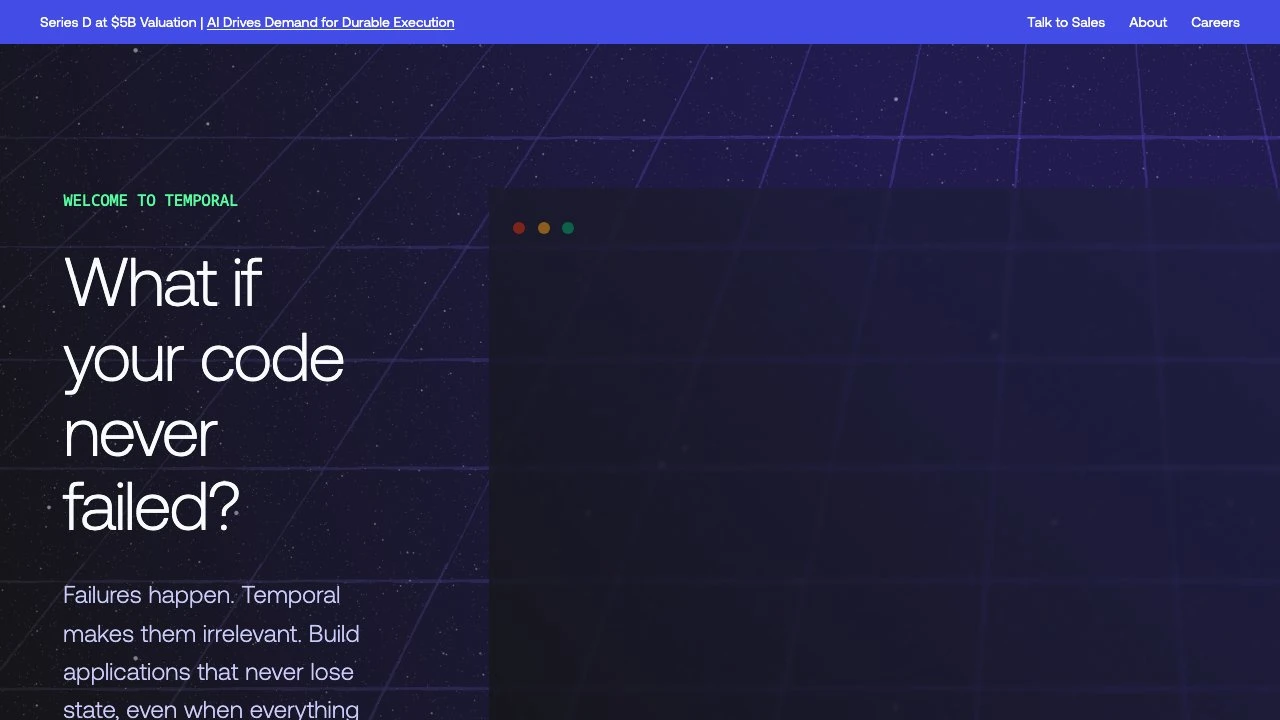
Temporal is a durable execution platform designed to make distributed systems resilient to failures. At its core, Temporal solves one of the hardest problems in distributed computing: ensuring that long-running, stateful workflows complete reliably even when individual components crash, networks partition, or services restart unexpectedly.
The platform works by persisting workflow state automatically. When a failure occurs mid-execution, Temporal replays the workflow from where it left off rather than starting over or losing progress. This means developers can write code that appears to run continuously for days, weeks, or even months — including sleeping for 30 days between steps — without managing state machines, checkpointing logic, or retry infrastructure manually.
Temporal supports multiple languages including Python, Go, TypeScript, Ruby, C#, Java, and PHP, making it accessible across a wide range of engineering teams. The programming model is intentionally familiar: developers write ordinary functions and classes decorated with workflow annotations, while Temporal handles the durability layer underneath.
For AI and agent workloads specifically, Temporal addresses a critical gap. LLM-powered agents often need to coordinate multiple tool calls, wait for human approvals, poll external APIs, or run for extended periods — all scenarios where a simple HTTP request/response model breaks down. Temporal provides the infrastructure to run these workflows reliably without custom state management.
The platform comes in two deployment options: a self-hosted open source version (Apache 2.0 licensed) and Temporal Cloud, a fully managed service. The open source project has significant adoption across enterprises including OpenAI, Snap, Cloudflare, GitLab, DoorDash, Deloitte, and Vodafone, indicating mature production use at scale.
Compared to alternatives like Apache Airflow or Prefect, Temporal focuses on general-purpose durable execution rather than data pipeline orchestration specifically. Unlike AWS Step Functions, Temporal is cloud-agnostic and language-native. Against tools like Inngest or Trigger.dev, Temporal is the more established and battle-tested option, though with a steeper learning curve and more infrastructure overhead for self-hosted deployments.
Temporal fits naturally in the AI orchestration ecosystem alongside frameworks like LangGraph or CrewAI — those tools manage agent reasoning and tool routing, while Temporal handles the execution durability layer that ensures those agents complete their work even across failures, long waits, and distributed service boundaries.
Key Features
- Automatic state persistence and workflow replay after failures, eliminating manual checkpointing
- Support for workflows that sleep or wait for days, weeks, or months without holding server resources
- Built-in activity retry logic with configurable timeouts and backoff policies
- Multi-language SDKs covering Python, Go, TypeScript, Ruby, C#, Java, and PHP
- Temporal Cloud managed service option alongside self-hosted open source deployment
- Workflow versioning to safely update long-running workflows without breaking in-flight executions
- Visibility and observability tooling to query, inspect, and debug workflow execution history
- Signal and query APIs for external systems to interact with running workflows
Pros & Cons
Pros
- Eliminates entire categories of distributed systems bugs around partial failures and lost state
- Widely adopted in production by large enterprises, indicating stability and maturity
- Language-native SDKs mean workflows are written in regular code, not YAML or DSL config
- Open source core with Apache 2.0 license provides flexibility for self-hosted deployments
- Particularly well-suited to the long-running, asynchronous nature of AI agent workflows
Cons
- Steeper learning curve compared to simpler job queue or pipeline tools
- Self-hosted deployment requires operating a stateful service cluster (Temporal server + database)
- Workflow code must follow determinism constraints, which require developers to learn new patterns
- Can be over-engineering for simple, short-lived background jobs that don't require durability
Pricing
Temporal offers a free tier through Temporal Cloud to get started. Paid cloud plans are available with pricing based on usage. Visit the official website for current pricing details.
Who Is This For?
Temporal is best suited for backend engineers and platform teams building distributed systems that require reliability guarantees on complex, long-running processes — payment flows, onboarding pipelines, data processing jobs, and AI agent workflows. It is particularly valuable for teams running LLM-powered agents that need to coordinate multi-step tool calls, handle human-in-the-loop approval steps, or recover gracefully from third-party API failures without losing progress.
Similar to Temporal