Weaviate
Open-source vector database with built-in ML models for vectorization.
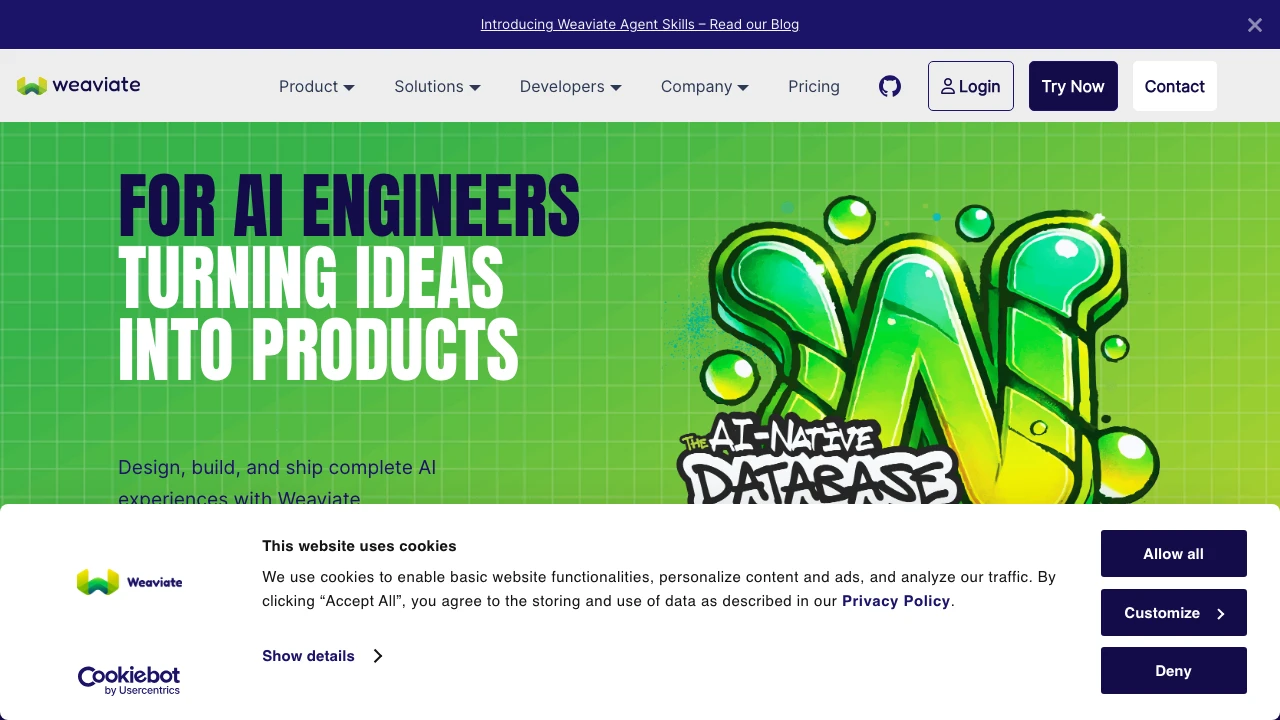
Weaviate is an open-source vector database designed to store, index, and query high-dimensional vector embeddings alongside structured metadata. It is built to support AI-native applications that rely on semantic search, retrieval-augmented generation (RAG), and similarity-based lookups at scale.
At its core, Weaviate stores objects as combinations of vector representations and traditional scalar properties. This hybrid approach allows developers to perform vector similarity searches while simultaneously filtering on structured fields — a common requirement in production AI pipelines. Vectors can be generated externally and imported directly, or Weaviate can handle vectorization internally using its built-in ML model integrations, which connect to providers such as OpenAI, Cohere, Hugging Face, and others through a modular plugin system.
Weaviate is designed with production deployments in mind. It supports horizontal scaling through distributed architecture, making it suitable for datasets that exceed what a single node can handle. Data persistence, replication, and multi-tenancy are supported features, giving engineering teams the infrastructure controls expected in enterprise environments.
For teams building RAG systems, Weaviate fits naturally as the retrieval layer. It can serve as the long-term memory store for an AI assistant, the semantic search backend for a document retrieval system, or the foundation for recommendation engines that need to find similar items across large catalogs. Its GraphQL and REST APIs make it accessible from any language, and an official Python client library (weaviate-client) is the most common integration path.
Compared to alternatives like Pinecone, Qdrant, and Chroma, Weaviate occupies a middle ground. Pinecone is fully managed and requires no infrastructure work but offers less flexibility and comes with higher cost at scale. Chroma is lightweight and easy to run locally, making it popular for prototyping, but it lacks the production-grade features Weaviate provides. Qdrant is similarly open-source and performant, with strong filtering capabilities — the two are often compared directly. Weaviate differentiates itself through its native module system for vectorization, its GraphQL query interface, and a longer track record in production enterprise deployments.
Self-hosting is a first-class option: Weaviate can be run locally via Docker, deployed to Kubernetes using official Helm charts, or hosted on Weaviate Cloud Services (WCS) for a managed experience. This flexibility makes it appealing to organizations with strict data residency requirements as well as teams that prefer not to manage infrastructure.
The project is actively maintained with a large open-source community, extensive documentation, and integrations with major AI frameworks including LangChain and LlamaIndex, making it straightforward to incorporate into existing AI application stacks.
Key Features
- Hybrid search combining vector similarity and structured metadata filtering in a single query
- Built-in vectorization modules supporting OpenAI, Cohere, Hugging Face, and other providers without external preprocessing
- Horizontal scaling and distributed architecture for handling large-scale datasets
- Multi-tenancy support for isolating data across customers or use cases within a single cluster
- GraphQL and REST APIs with official Python, JavaScript, Go, and Java client libraries
- Native integrations with LangChain, LlamaIndex, and other AI application frameworks
- Self-hosted deployment via Docker or Kubernetes, plus managed cloud option through Weaviate Cloud Services
- Persistent storage with replication support for production reliability
Pros & Cons
Pros
- Open-source with an active community and strong documentation, reducing vendor lock-in
- Built-in vectorization modules simplify the pipeline by eliminating a separate embedding step
- Flexible deployment options — local, self-hosted, or fully managed — suit a wide range of organizational needs
- Hybrid search capabilities handle real-world queries that require both semantic and structured filtering
- Well-established integrations with LangChain and LlamaIndex make it easy to adopt in existing AI stacks
Cons
- GraphQL query interface has a steeper learning curve compared to simpler SQL-like alternatives
- Self-hosting requires meaningful infrastructure knowledge for production-grade deployments
- Module system adds complexity when configuring multiple vectorizer integrations
- Managed cloud option (WCS) can become expensive at high data volumes compared to self-hosting
Pricing
Visit the official website for current pricing details.
Who Is This For?
Weaviate is best suited for engineering teams building production AI applications that require semantic search, RAG pipelines, or similarity-based recommendations at scale. It is particularly well-matched for organizations that need data residency control or want to avoid vendor lock-in, since the open-source self-hosted path is a first-class deployment option. Teams already using LangChain or LlamaIndex will find the integration straightforward.
Similar to Weaviate