AssemblyAI
Speech-to-text and audio intelligence APIs. Transcription, summarization, and sentiment analysis for voice agents.
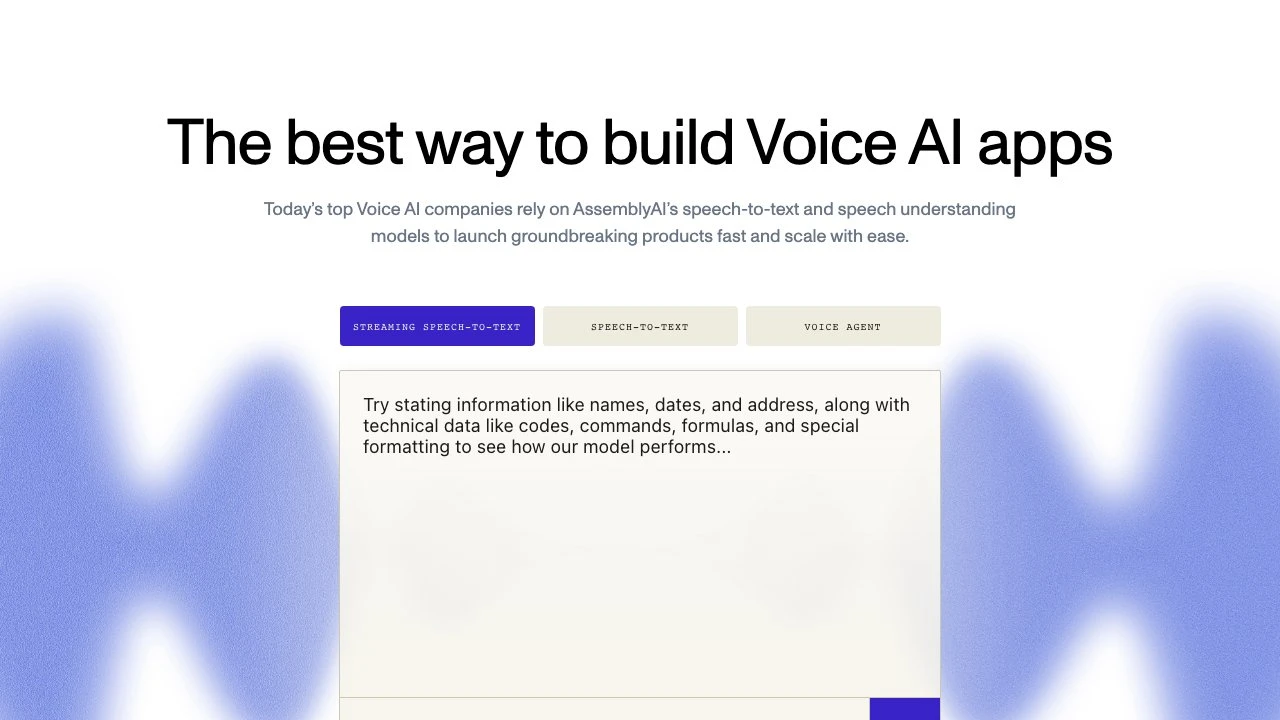
AssemblyAI is a speech AI platform that provides developers and enterprises with APIs for transcribing, analyzing, and understanding audio and voice data. Founded to serve the growing demand for voice-enabled applications, it has become a core infrastructure layer for companies building conversation intelligence tools, AI notetakers, contact center analytics, voice agents, and medical transcription software.
At its core, AssemblyAI offers two transcription modes: batch (asynchronous file transcription) and real-time streaming. The streaming product is powered by Universal-3 Pro Streaming, which the company positions as the most accurate real-time transcription model available for voice agent use cases. The batch transcription pipeline supports a wide range of audio intelligence features on top of raw transcription — including summarization, sentiment analysis, speaker diarization, chapter detection, and PII redaction.
What separates AssemblyAI from general-purpose transcription APIs like Google Speech-to-Text or AWS Transcribe is its focus on audio understanding, not just speech-to-text conversion. Its Speech Understanding product layer enables downstream analysis of transcripts without requiring developers to stitch together multiple services. This makes it particularly useful for product teams that want to extract structured insights from audio at scale without building custom NLP pipelines.
The recently introduced Universal-3 Pro model is context-aware and promptable — developers can pass a text prompt to influence how the model transcribes, capturing disfluencies, formatting conventions, domain-specific terminology, and speaker roles. This is a meaningful differentiator for regulated industries like healthcare, where capturing exact speech patterns matters.
AssemblyAI also introduced an LLM Gateway and Guardrails product, signaling a move toward being a broader voice AI infrastructure provider rather than a point solution for transcription. The Speech-to-Speech API rounds out a full-stack offering for voice agent developers.
Deployment options include AssemblyAI's managed cloud and a self-hosted option for organizations with data residency or compliance requirements. The platform integrates with common voice agent frameworks and SDKs, and notable customers include Zoom, which uses AssemblyAI to advance its AI research and development.
Compared to alternatives like Deepgram, Rev AI, or OpenAI Whisper, AssemblyAI offers a stronger feature set around audio intelligence and a more developer-friendly API with extensive documentation, cookbooks, and an active Discord community. Deepgram competes closely on streaming latency, while OpenAI Whisper is primarily a transcription-only model without built-in audio analytics. For teams that need both high-accuracy transcription and rich downstream audio understanding in a single API, AssemblyAI occupies a distinct position in the market.
Key Features
- Real-time streaming transcription via Universal-3 Pro Streaming, optimized for low-latency voice agent applications
- Context-aware, promptable transcription model that adapts output format to domain-specific instructions
- Batch Speech-to-Text with audio intelligence features: summarization, sentiment analysis, speaker diarization, PII redaction, and topic detection
- Speech Understanding layer for extracting structured insights from transcribed audio without additional NLP tooling
- LLM Gateway and Guardrails products for voice agent safety and routing
- Speech-to-Speech API for end-to-end voice application development
- Self-hosted deployment option for data residency and compliance-sensitive workloads
- Supports multiple use-case verticals including medical transcription, contact centers, conversation intelligence, and AI notetakers
Pros & Cons
Pros
- Combines high-accuracy transcription with built-in audio intelligence features, reducing the need for external NLP services
- Promptable Universal-3 Pro model allows domain-specific customization without fine-tuning
- Offers both managed cloud and self-hosted deployment, supporting compliance-sensitive industries
- Strong developer experience with comprehensive documentation, API reference, cookbooks, and Discord support
- Proven at scale with enterprise customers like Zoom
Cons
- Pricing for high-volume or enterprise usage is not transparently listed and requires direct contact
- Newer products like LLM Gateway and Guardrails are less mature and less documented than the core transcription APIs
- Self-hosted deployment adds operational complexity for smaller teams
- Streaming and batch features are not always at feature parity, requiring careful evaluation for specific use cases
Pricing
AssemblyAI offers a free tier for developers getting started. Paid plans are usage-based, priced per minute of audio transcribed, with rates varying by model and feature set. Visit the official website for current pricing details.
Who Is This For?
AssemblyAI is best suited for developers and engineering teams building voice-enabled products that require both accurate transcription and downstream audio analysis — such as AI notetakers, conversation intelligence platforms, contact center analytics tools, and voice agents. It is particularly well-matched for companies in regulated industries like healthcare where domain-specific transcription accuracy and data privacy controls are critical requirements.

Similar to AssemblyAI