Synthflow
Build and deploy AI voice agents without code. Real-time voice conversations for support and sales.
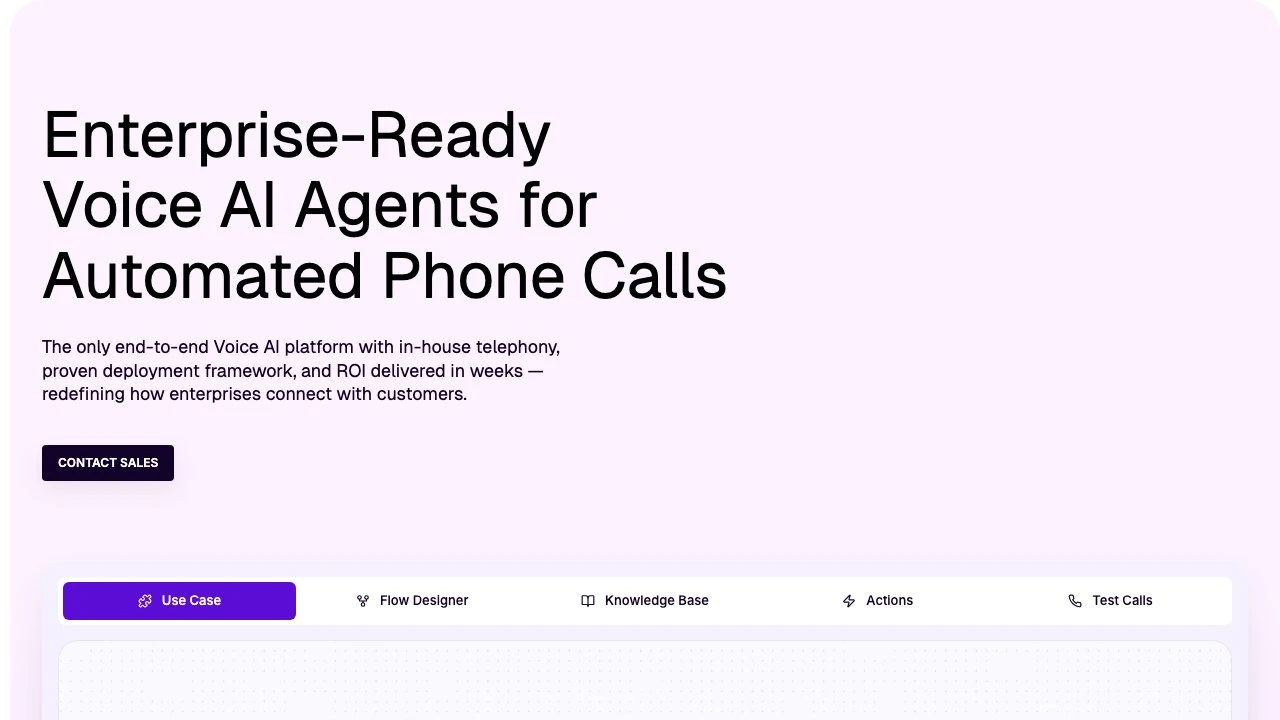
Synthflow is an enterprise-grade Voice AI platform that enables businesses to build, deploy, and manage AI-powered voice agents for automated phone calls — without writing code. The platform positions itself as an end-to-end solution with in-house telephony infrastructure, meaning businesses do not need to wire together separate voice providers, STT/TTS services, and call routing systems as they would with alternatives like Bland AI, Retell AI, or Vapi.
At its core, Synthflow provides a visual Flow Designer that lets users map out conversation logic — qualification branches, objection handling, booking flows — and a Prompt View for teams that prefer natural language instructions over node-based editors. Agents are backed by a Knowledge Base, can trigger external Actions (integrations, calendar bookings), and can be tested directly inside the platform before going live.
The platform targets sales and support automation across industries including healthcare, real estate, financial services, retail, and BPO/call centers. Typical deployments include inbound customer service agents, AI receptionists, appointment setters, lead qualification bots, and IVR replacements. Use cases shown on the site demonstrate agents handling real-time appointment booking, lead qualification with conditional routing, and multi-step conversational flows that adapt to caller responses.
Synthflow differentiates itself from developer-first alternatives like Vapi or Retell by emphasizing a no-code builder and a structured deployment framework aimed at reducing time-to-ROI. Where Vapi is primarily an API product requiring engineering resources, Synthflow targets business users and operations teams who want to deploy agents without deep technical involvement. That said, Synthflow also exposes API access for teams that need programmatic control or custom integrations.
The platform includes a Marketplace for pre-built agent templates, an Academy for onboarding and training, and a Partner program — signals that the company is building around an ecosystem rather than just a point product. Integration support is highlighted as a core capability, allowing agents to connect with CRMs, calendars, and other business systems.
For enterprises evaluating AI voice automation, Synthflow fits the profile of a platform that bundles telephony, conversation design, and deployment tooling in one place, trading some flexibility for faster setup and lower technical overhead. Teams with specific infrastructure requirements or heavily custom use cases may still gravitate toward API-first alternatives, but for organizations prioritizing speed of deployment and non-technical operator ownership, Synthflow presents a coherent and well-documented option.
Key Features
- Visual Flow Designer for building branching conversation logic without code
- Prompt View for defining agent behavior in natural language
- In-house telephony infrastructure — no third-party voice provider required
- Knowledge Base support so agents can draw on company-specific information
- Actions and integrations layer for calendar booking, CRM updates, and external APIs
- Pre-built templates via Marketplace covering common use cases (receptionist, lead qualification, appointment setting)
- WhatsApp Business integration in addition to standard phone calls
- Test Calls feature for validating agent behavior before live deployment
Pros & Cons
Pros
- No-code builder makes voice agent deployment accessible to non-technical teams
- In-house telephony removes the need to integrate a separate call infrastructure provider
- Broad industry coverage with templates and documented use cases across healthcare, real estate, BPO, and more
- End-to-end platform reduces the number of vendors required to run a production voice AI system
- Structured deployment framework with Academy, documentation, and Help Center lowers onboarding friction
Cons
- Primarily aimed at enterprise customers — pricing and onboarding process may not suit small teams or solo builders
- Less flexibility for developers who want low-level API control compared to alternatives like Vapi or Retell
- Sales-led motion ("Contact Sales" as the primary CTA) means self-serve evaluation may be limited
- Platform lock-in risk given bundled telephony — migrating away later would require replacing multiple components
Pricing
Synthflow lists a pricing page on its website, but specific plan details and costs are not surfaced in the available content. Visit the official website for current pricing details.
Who Is This For?
Synthflow is best suited for mid-market and enterprise teams in industries like healthcare, real estate, financial services, and BPO that need to deploy AI voice agents for inbound or outbound calling without dedicated engineering resources. It excels at use cases involving high call volume automation — appointment setting, lead qualification, customer support, and receptionist replacement — where a structured, no-code deployment process and built-in telephony reduce time to production.
Similar to Synthflow