Chroma
Simple, developer-friendly embedding database. Great for prototyping RAG agents.
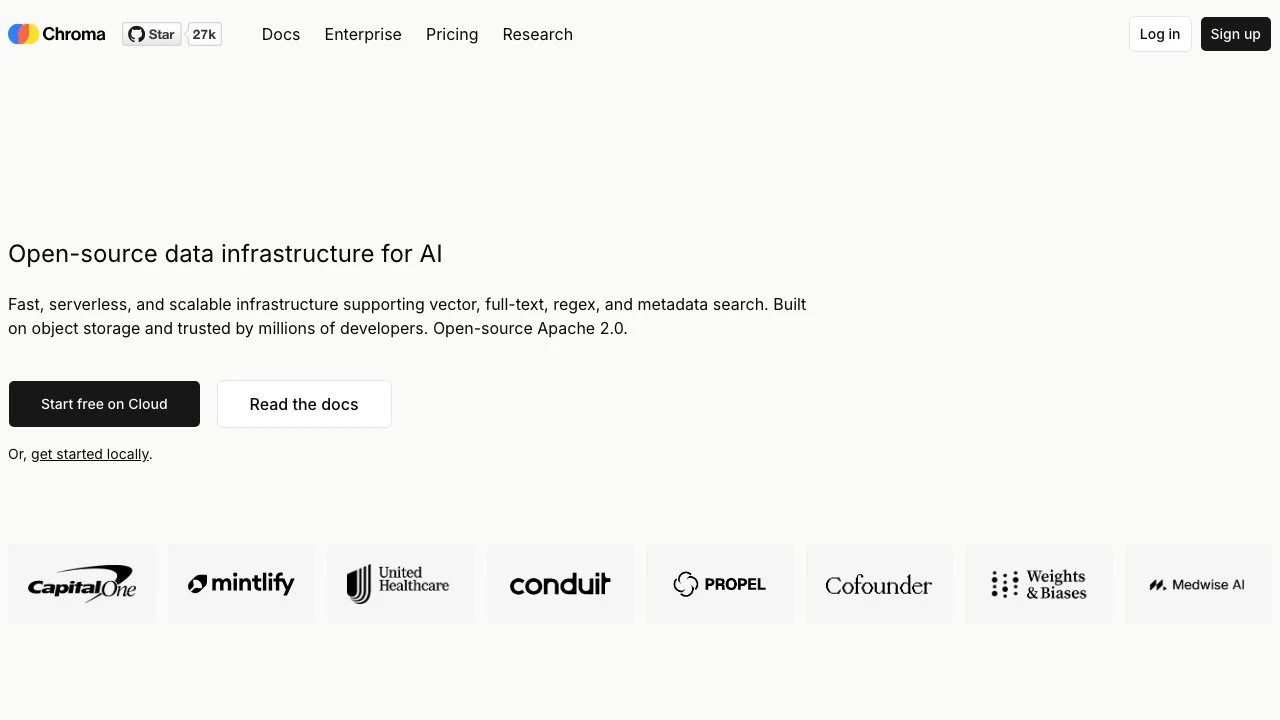
Chroma is an open-source embedding database designed specifically for AI applications. Built on object storage and licensed under Apache 2.0, it provides fast, serverless, and scalable infrastructure for storing and querying vector embeddings alongside full-text, sparse vector, regex, and metadata search capabilities.
At its core, Chroma allows developers to store documents with their associated embeddings and query them by semantic similarity. The architecture uses intelligent data tiering — hot data lives in memory cache, warm data on SSD, and cold data in object storage (S3/GCS) — which makes it significantly cheaper than in-memory-only alternatives. According to the company, this approach can be up to 10x cheaper than legacy systems.
Chroma supports TypeScript, Python, and Rust clients, making it accessible across the most common AI development stacks. The Python SDK in particular makes it a natural fit for the data science and LLM ecosystem, where it integrates easily with frameworks like LangChain and LlamaIndex for building RAG (Retrieval-Augmented Generation) pipelines.
For developers getting started, Chroma can run locally in a single process — making it one of the easiest vector databases to prototype with. When ready for production, the managed cloud offering provides the same API with serverless scaling, SOC 2 Type II compliance, and no infrastructure management overhead. Enterprise customers get additional options: BYOC (Bring Your Own Cloud) deployment in their own VPC, multi-region replication, and point-in-time recovery.
Performance benchmarks published on the site show p50 query latency of 20ms (warm) and 650ms (cold) at 100k vectors with 384 dimensions. The system supports up to 1 million collections per database and 5 million records per collection, with write throughput of 30 MB/s and 90-100% recall.
Compared to alternatives like Pinecone, Weaviate, or Qdrant, Chroma differentiates itself on simplicity and cost. Pinecone is fully managed but proprietary and more expensive at scale. Weaviate and Qdrant are also open-source but carry more operational complexity. Chroma's object-storage-first architecture gives it a cost advantage for large-scale deployments, while its developer-focused API keeps the getting-started experience minimal. The tradeoff is that cold-start latency (650ms p50) is higher than purely memory-backed systems — a consideration for latency-sensitive production workloads.
With 24k GitHub stars and 5 million monthly downloads, Chroma has established itself as one of the most widely adopted vector databases in the open-source AI tooling space. Customers include Capital One, UnitedHealthcare, Weights & Biases, and Mintlify.
Key Features
- Vector similarity search with configurable embedding dimensions and distance metrics
- Sparse vector search using BM25 and SPLADE for lexical/keyword retrieval
- Full-text search with trigram and regex matching
- Metadata filtering and faceted search for hybrid query patterns
- Dataset forking for versioning, A/B testing, and staged rollouts
- Automatic query-aware data tiering across memory, SSD, and object storage
- Multi-tenant support with up to 1M collections per database
- TypeScript, Python, and Rust client SDKs
Pros & Cons
Pros
- Extremely simple local setup — ideal for rapid prototyping and development
- Open-source (Apache 2.0) with no vendor lock-in
- Object-storage-first architecture makes large-scale deployments significantly cheaper than memory-backed alternatives
- Supports hybrid search (vector + full-text + metadata) in a single system
- Managed cloud offering requires no infrastructure operations
Cons
- Cold-start query latency (650ms p50) is high compared to fully in-memory systems
- Maximum 5M records per collection limits very large single-collection use cases
- Serverless pricing model may become expensive at very high query volumes compared to self-hosted
- Enterprise features (BYOC, multi-region) require contacting sales — no self-serve path
Pricing
Chroma offers a free tier on its managed cloud platform. Paid plans are available with serverless pricing that scales with usage. Enterprise pricing for BYOC deployment, multi-region replication, and dedicated clusters requires contacting the sales team directly.
Who Is This For?
Chroma is best suited for developers building RAG pipelines, semantic search features, or AI agents who need a vector database that works locally in minutes and scales to production without infrastructure overhead. It is particularly well-suited for teams that want open-source flexibility with the option to graduate to a managed service, and for cost-conscious deployments where storing large embedding datasets in object storage is preferable to expensive in-memory alternatives.
Tags:
Similar to Chroma