LangChain
The most popular framework for building LLM-powered applications with chains, agents, and retrieval.
LangChain is an open-source framework designed for building applications powered by large language models (LLMs). Originally launched as a Python library, it has expanded to include TypeScript support and has grown into one of the most widely adopted frameworks in the AI development ecosystem, used by companies ranging from startups to enterprises like LinkedIn, Cloudflare, Klarna, and Lyft.
At its core, LangChain provides abstractions for chaining together LLM calls, connecting models to external data sources, and building agents capable of reasoning and taking actions. The framework handles the plumbing that would otherwise need to be built from scratch: prompt management, memory, retrieval-augmented generation (RAG), tool calling, and multi-step reasoning pipelines.
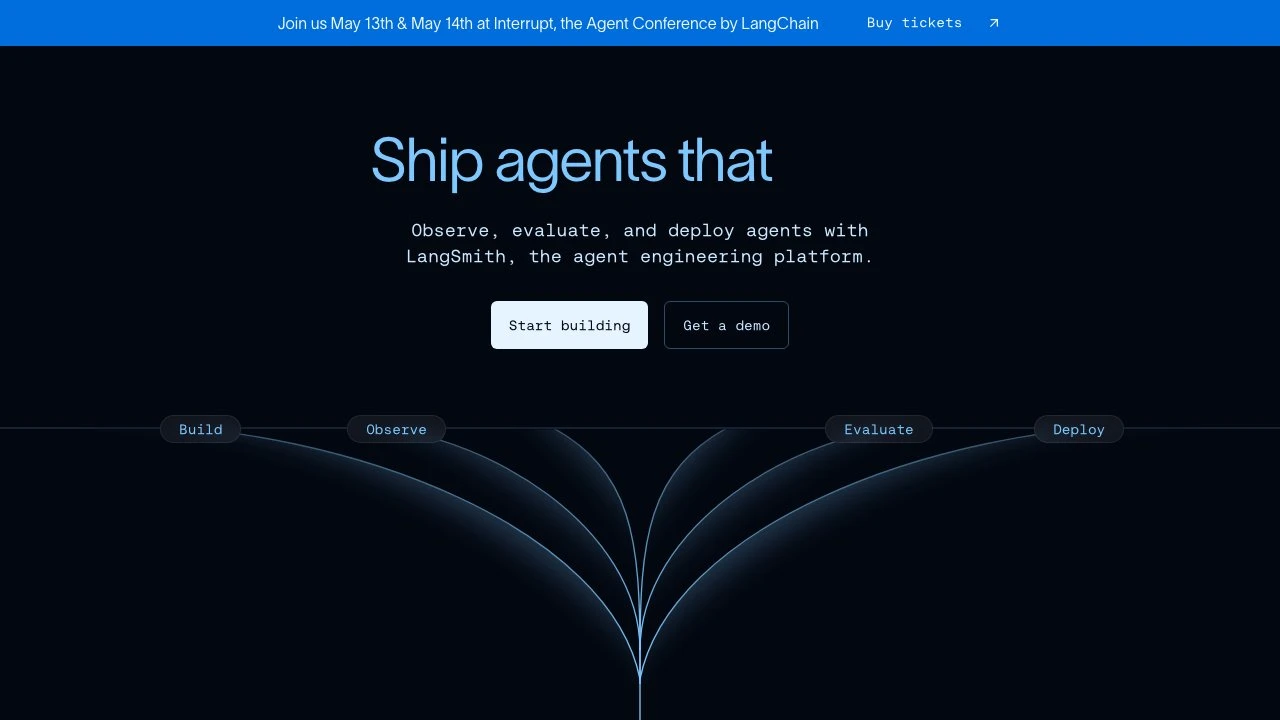
LangChain's ecosystem has expanded beyond the base framework into a broader platform. LangSmith is the production-grade observability and evaluation layer, giving teams visibility into what agents are doing, how they're performing, and where they fail. LangGraph, a newer addition, is designed for building stateful, graph-based agent workflows with fine-grained control over execution flow — particularly suited for complex, long-running agents. LangSmith also includes a deployment layer for shipping agents to production and a Fleet feature for managing agents across an organization.
Compared to alternatives like LlamaIndex, LangChain is more general-purpose and agent-focused, while LlamaIndex specializes more narrowly in retrieval and indexing pipelines. Frameworks like CrewAI or AutoGen focus on multi-agent orchestration but lack the breadth of integrations and tooling that LangChain's ecosystem provides. For developers who want low-level control without abstractions, building directly on provider SDKs (OpenAI, Anthropic) is always an option, but LangChain reduces the boilerplate significantly.
LangChain's primary strength is its integration coverage: it supports virtually every major LLM provider, vector store, document loader, and tool out of the box. This makes it a practical choice for teams that need to prototype quickly and then scale to production without switching frameworks.
The framework has faced criticism for abstraction complexity — early versions were often difficult to debug and the chains could obscure what was actually happening. The introduction of LangGraph and LangSmith addresses this directly, giving developers lower-level graph primitives and full tracing capabilities respectively.
For teams building RAG systems, conversational agents, document processing pipelines, or multi-step reasoning workflows, LangChain provides a mature foundation with extensive community resources, documentation, and examples.
Key Features
- Open-source Python and TypeScript frameworks (LangChain, LangGraph) for building LLM-powered applications
- LangGraph for building reliable, stateful agents with graph-based control flow and support for long-running tasks
- LangSmith observability platform for tracing, debugging, and understanding agent behavior in detail
- Evaluation tooling to score and systematically improve agent performance over time
- Production deployment infrastructure for shipping and scaling agents
- Fleet management for deploying agents across entire organizations
- Broad integrations with LLM providers, vector databases, document loaders, and external tools
- Active open-source community with extensive documentation, tutorials, and LangChain Academy courses
Pros & Cons
Pros
- Largest ecosystem of integrations — supports virtually all major LLM providers and data sources out of the box
- Full-stack platform covering development, observability, evaluation, and deployment under one roof
- LangGraph provides fine-grained control for complex, stateful agent workflows
- Strong community, documentation, and learning resources including LangChain Academy
- Both Python and TypeScript support makes it accessible to a wide range of developers
Cons
- Abstraction layers can obscure what's happening under the hood, making debugging harder without LangSmith
- The ecosystem has grown quickly, leading to some inconsistency between older and newer APIs
- Can be overkill for simple LLM use cases where a direct provider SDK would suffice
- LangSmith's production features are a paid product, adding cost for teams that need full observability
Pricing
Visit the official website for current pricing details.
Who Is This For?
LangChain is best suited for software engineers and AI teams building production-grade LLM applications — particularly those involving retrieval-augmented generation, multi-step agents, or complex reasoning pipelines. It is especially well-matched for teams that need to move from prototype to production without switching tools, and for organizations that want a unified platform for development, observability, and deployment.
Common Use Cases for LangChain
View allSimilar to LangChain