Milvus
Scalable open-source vector database. Handles billions of vectors for enterprise RAG.
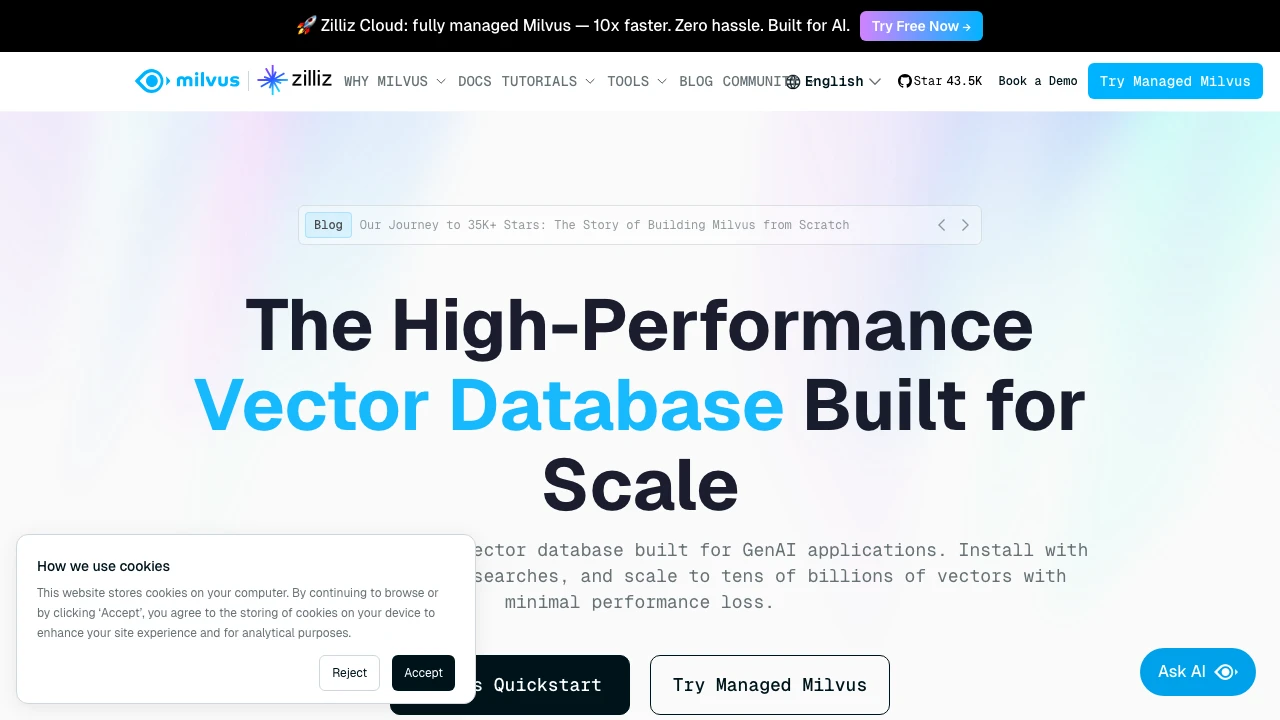
Milvus is an open-source vector database purpose-built for AI and machine learning applications at scale. Originally developed to solve the challenge of similarity search across massive high-dimensional datasets, it has grown into one of the most widely adopted vector databases in the GenAI ecosystem, with over 43,500 GitHub stars.
At its core, Milvus stores, indexes, and retrieves vector embeddings — the numerical representations that modern AI models produce from text, images, audio, and other data types. This makes it a foundational component in Retrieval-Augmented Generation (RAG) pipelines, recommendation systems, image search, multimodal search, and semantic similarity applications.
What distinguishes Milvus from alternatives like Chroma, Pinecone, and Weaviate is its explicit design for scale. While Chroma is optimized for local development and Pinecone is a fully managed proprietary service, Milvus offers a spectrum of deployment modes that span from a lightweight pip-installable library to a horizontally scalable distributed cluster capable of handling tens of billions of vectors. This flexibility means teams can prototype on a laptop and graduate to enterprise infrastructure without switching tools.
Milvus offers four deployment configurations. Milvus Lite installs via pip and runs in notebooks or laptops — ideal for learning and quick prototyping. Milvus Standalone is a single-machine deployment suited for production workloads up to millions of vectors. Milvus Distributed is the full enterprise-grade configuration that scales horizontally across nodes for billion-scale datasets. Finally, Zilliz Cloud is a fully managed hosted version built on Milvus, offered as both SaaS and BYOC (Bring Your Own Cloud), described as delivering 10x faster performance than self-hosted Milvus.
The database integrates natively with the major AI development frameworks: LangChain, LlamaIndex, OpenAI, Hugging Face, DSPy, Haystack, Ragas, and MemGPT. This broad ecosystem compatibility means Milvus fits into most existing AI development stacks without requiring significant rework.
Milvus supports a range of AI use cases out of the box, with community-built notebooks for RAG pipelines, image similarity search, multimodal search, hybrid search (combining dense and sparse vectors), and Graph RAG. The Python SDK (pymilvus) provides a straightforward API for collection management, data insertion, and vector search.
For teams evaluating vector databases, Milvus is particularly compelling when the anticipated data volume is large, when self-hosting is preferred for cost or compliance reasons, or when flexibility across deployment environments is a priority. Its open-source nature means no vendor lock-in, and the Zilliz Cloud managed option provides an escape hatch for teams that eventually want to offload infrastructure concerns.
Key Features
- Four deployment modes: Milvus Lite (pip install), Standalone (single machine), Distributed (cluster), and Zilliz Cloud (fully managed)
- Scales to tens of billions of vectors with minimal performance degradation in distributed mode
- Native integrations with LangChain, LlamaIndex, OpenAI, Hugging Face, DSPy, Haystack, Ragas, and MemGPT
- Supports RAG, image search, multimodal search, hybrid search (dense + sparse), and Graph RAG use cases
- Python SDK (
pymilvus) for collection creation, data insertion, similarity search, and deletion - Open-source under an OSS license with 43,500+ GitHub stars and an active community on Slack, Discord, and GitHub Discussions
- Companion tooling including Attu (GUI), Milvus CLI, Milvus Backup, and a hardware sizing tool
- Zilliz Cloud managed option available as SaaS or BYOC for security and compliance requirements
Pros & Cons
Pros
- Flexible deployment spectrum from local prototype to billion-scale distributed cluster without switching databases
- Genuinely open-source with a large, active community and strong ecosystem integrations
- No vendor lock-in — self-host or migrate to managed Zilliz Cloud as needs evolve
- Broad framework compatibility covers most AI development stacks
- Extensive documentation, tutorials, demos, and community notebooks for common AI use cases
Cons
- Self-hosted distributed deployment introduces significant infrastructure complexity compared to fully managed alternatives like Pinecone
- Milvus Lite and Standalone have scale ceilings; teams needing billions of vectors must manage distributed infrastructure or pay for Zilliz Cloud
- Operational burden (monitoring, upgrades, backups) falls on the team unless using the managed cloud option
- Steeper learning curve than simpler in-process databases like Chroma for users who just need local prototyping
Pricing
Milvus itself is open-source and free to self-host across all deployment modes (Lite, Standalone, Distributed). Zilliz Cloud, the fully managed hosted version, is available with a free trial; paid tiers are offered as serverless and dedicated cluster options, with both SaaS and BYOC configurations. Visit the official website for current Zilliz Cloud pricing details.
Who Is This For?
Milvus is best suited for engineering teams building production AI applications — particularly RAG pipelines, semantic search, recommendation engines, and multimodal search — that need to scale beyond millions of vectors without being locked into a proprietary service. It is especially well-matched for organizations with compliance or data residency requirements that prefer self-hosted infrastructure, as well as teams that want a single database that works from local development all the way to enterprise-scale deployment.
Similar to Milvus