Phoenix by Arize
Open-source tool for LLM tracing, evaluation, and experimentation. Works with any LLM framework.
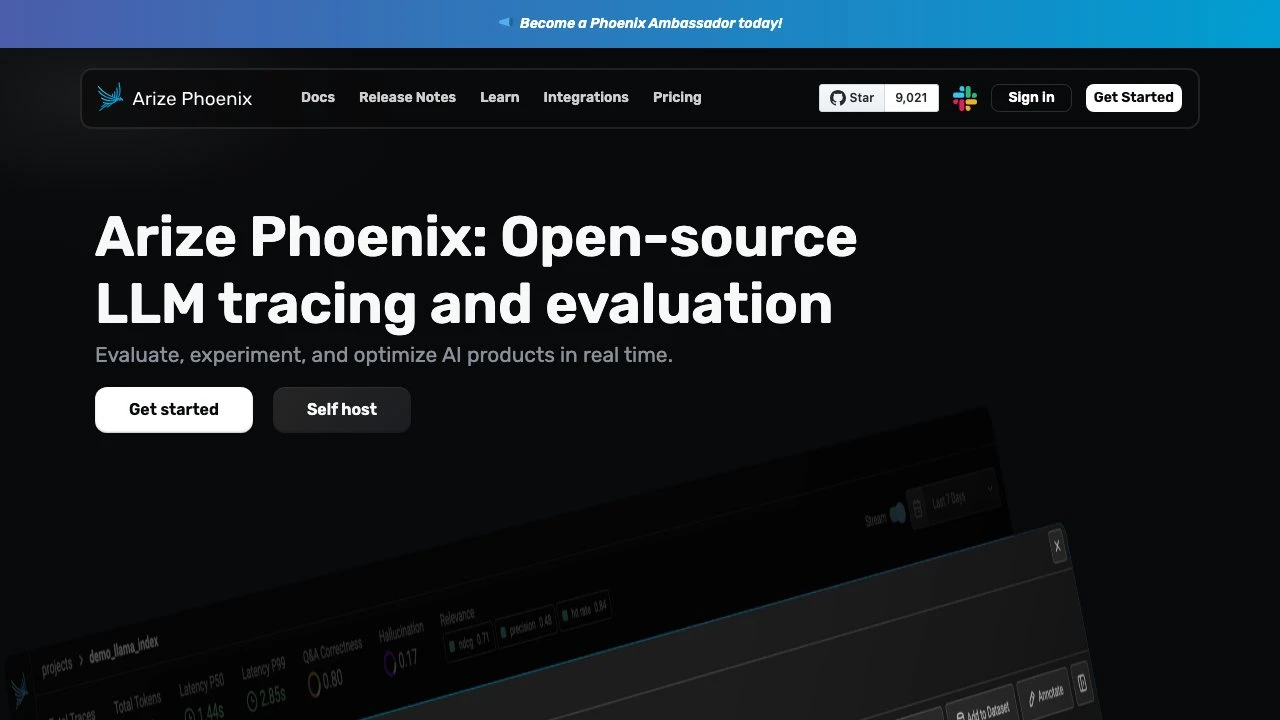
Phoenix by Arize is an open-source observability platform built specifically for LLM applications. It provides developers and AI teams with the tooling needed to trace, evaluate, and experiment with AI pipelines — from prototype through production. With over 9,000 GitHub stars and 2.5 million monthly downloads, it has established itself as a widely adopted solution in the AI observability space.
At its core, Phoenix is built on OpenTelemetry (OTEL), the industry-standard observability protocol. This architectural choice means teams avoid vendor lock-in: instrumentation written for Phoenix is portable, and the tool integrates with existing observability stacks without custom adapters. Automatic instrumentation covers most major LLM frameworks out of the box, while manual instrumentation is available for teams that need precise control over what gets traced.
The platform covers four primary workflows. Tracing captures the full execution graph of LLM applications — spans, latencies, token counts, inputs, and outputs — giving teams visibility into exactly what happens inside complex agentic pipelines or RAG systems. Evaluation provides a library of pre-built eval templates (relevance, toxicity, hallucination, etc.) that can be customized to any task, with support for human annotation alongside LLM-as-judge approaches. Experimentation is facilitated through an interactive prompt playground where teams can compare prompts side-by-side, iterate on model parameters, and debug failures without context-switching to external tools. Dataset analysis leverages embedding-based clustering to surface semantically similar queries, document chunks, and responses, helping teams identify where performance degrades.
Phoenix integrates with most of the major LLM ecosystem: OpenAI, LlamaIndex, LangChain, AWS Bedrock, Vertex AI, Weaviate, Pinecone, Vercel AI SDK, and GuardrailsAI, among others. This breadth makes it practical for teams using heterogeneous toolchains.
Compared to alternatives like LangSmith (LangChain's hosted observability product) or Weights & Biases, Phoenix's primary differentiator is its open-source, self-hostable nature with no feature gates. LangSmith is tightly coupled to the LangChain ecosystem and operates as a hosted service; Phoenix is framework-agnostic and can run entirely on-premises. Helicone and Langfuse are closer comparisons in the open-source space, but Phoenix's OTEL-native approach and built-in eval library give it an edge for teams that want evaluation and tracing in a single tool.
Phoenix is available as both a managed cloud product (via app.phoenix.arize.com) and as a self-hosted deployment, giving teams flexibility based on their data residency and compliance requirements.
Key Features
- LLM Application Tracing: Automatic and manual instrumentation via OpenTelemetry to capture spans, latencies, token usage, inputs, and outputs across complex pipelines
- Evaluation Library: Pre-built eval templates for relevance, toxicity, hallucination, and more — customizable to any task with LLM-as-judge or human annotation
- Interactive Prompt Playground: Side-by-side prompt and model comparison with output visualization and failure debugging
- Dataset Clustering & Visualization: Embedding-based clustering to identify semantically similar queries and document chunks, isolating performance degradation
- Human Annotation Support: Incorporate human feedback directly into the evaluation workflow alongside automated evals
- Framework-Agnostic Integrations: Works with OpenAI, LangChain, LlamaIndex, AWS Bedrock, Vertex AI, Weaviate, Pinecone, Vercel AI SDK, and more
- Self-Hostable with No Feature Gates: Full functionality available on-premises; no restrictions or paywalled features in the open-source version
- OpenTelemetry-Native: Built on OTEL for portability, transparency, and compatibility with existing observability infrastructure
Pros & Cons
Pros
- Fully open-source and self-hostable with no feature restrictions, unlike many hosted competitors
- OpenTelemetry-native design prevents vendor lock-in and integrates with existing observability stacks
- Broad framework and provider support covers most common LLM toolchains
- Combines tracing, evaluation, and experimentation in a single platform, reducing the need for multiple tools
- Active community (7,000+ members) and strong adoption signal from high-profile teams
Cons
- Self-hosting requires infrastructure setup and maintenance overhead compared to fully managed alternatives
- Evaluation templates, while customizable, may require additional work to adapt to highly domain-specific tasks
- As an open-source tool, enterprise support and SLAs depend on the managed cloud offering rather than the self-hosted version
- Teams without existing OTEL familiarity may face a learning curve during initial setup
Pricing
Phoenix offers a free cloud tier accessible via app.phoenix.arize.com, with self-hosting available at no cost for the open-source version. Paid plans with additional features are listed on the official pricing page. Visit the official website for current pricing details.
Who Is This For?
Phoenix is best suited for AI engineers and data science teams building and iterating on LLM-powered applications — particularly those working with RAG pipelines, multi-step agents, or complex prompt chains where visibility into execution is critical. It is especially well-matched for teams with data residency requirements or a preference for open-source tooling, given its self-hosting capability and no-feature-gate policy. Organizations already using OpenTelemetry for broader observability will find Phoenix integrates naturally into their existing infrastructure.
Tags:

Similar to Phoenix by Arize