Rasa
Production-grade framework for building text and voice assistants. On-premise deployment for data privacy.
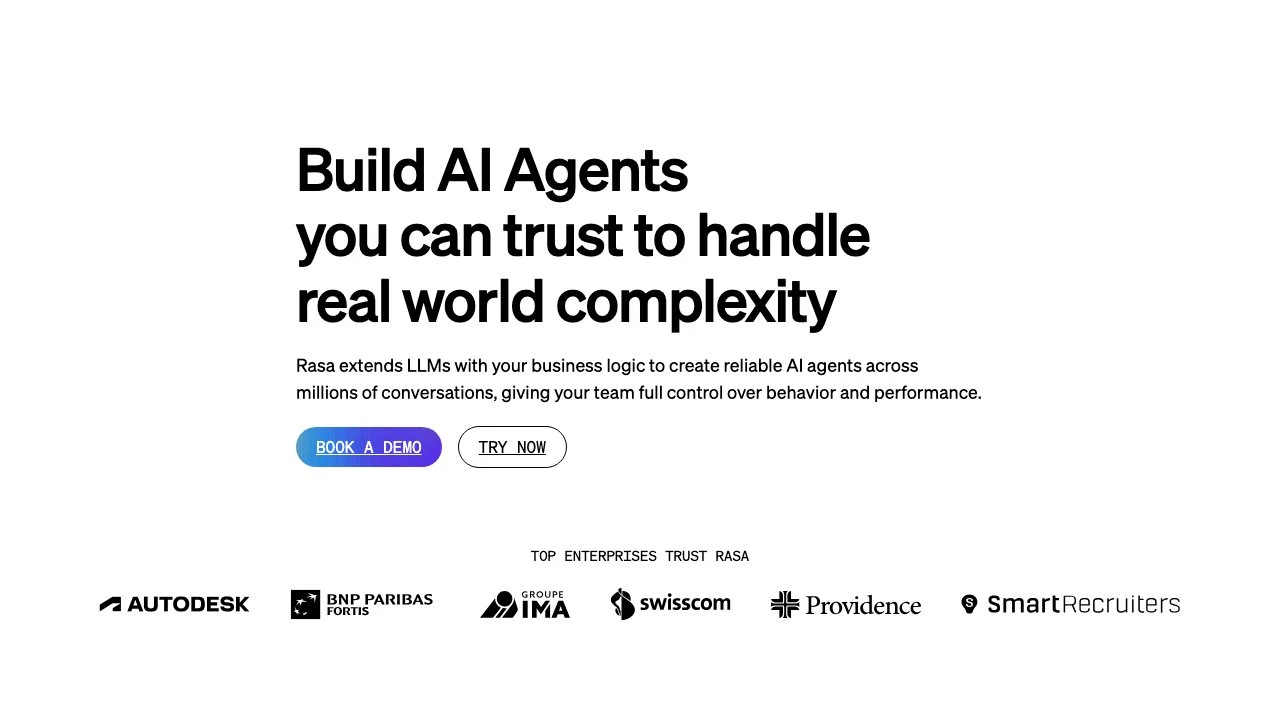
Rasa is an enterprise-grade conversational AI platform for building, deploying, and managing AI agents across text and voice channels. Originally established as an open-source NLU framework, Rasa has evolved into a full platform that combines the flexibility of large language models with deterministic business logic — a hybrid architecture the company calls CALM (Conversational AI with Language Models).
At its core, Rasa lets engineering teams define structured conversation flows, embed business rules, and wire up backend systems, while still leveraging LLMs for natural language understanding and generative responses. This makes it well-suited for regulated industries where conversation behavior must be auditable and predictable — finance, healthcare, insurance, and government are all explicitly targeted verticals.
The platform runs on your own infrastructure, which distinguishes it sharply from cloud-native SaaS alternatives like Dialogflow (Google) or Amazon Lex. Teams that cannot route customer data through third-party cloud services — due to compliance requirements, data residency rules, or internal security policy — tend to find this a decisive advantage. Rasa also supports any LLM backend, so organizations are not locked into a single model provider.
The architecture is modular. NLU handles intent classification and entity extraction for teams that want to start with structured rules. Enterprise RAG layers in real-time retrieval so agents can answer questions from internal knowledge bases without hallucinating. The voice module adds real-time speech infrastructure with low-latency characteristics suited to call center environments. An orchestration layer coordinates multiple agents and tools across a single conversation.
Rasa also supports the Model Context Protocol (MCP), giving agents a standardized interface for connecting to external APIs and tools — aligning with the broader ecosystem direction around interoperable agentic systems.
Compared to Botpress or Microsoft Bot Framework, Rasa offers more fine-grained control over conversation logic and a stronger story around on-premise deployment. Compared to low-code platforms like Voiceflow, Rasa requires more engineering investment but provides correspondingly more flexibility. It sits closer to the developer end of the build-vs-configure spectrum.
Rasa offers a Developer Edition at no cost, making it accessible for prototyping and evaluation before committing to an enterprise contract. The open-source roots mean a substantial community and ecosystem of tutorials, integrations, and third-party resources exist alongside the commercial platform.
Enterprises like Autodesk, BNP Paribas, and Swisscom are listed as customers, suggesting the platform handles production workloads at meaningful scale. Professional services are available for teams that need deployment support or accelerated implementation.
Key Features
- CALM architecture: Combines LLM flexibility with deterministic flow control and built-in error recovery patterns
- On-premise deployment: Runs entirely on your own infrastructure, supporting strict data privacy and compliance requirements
- LLM-agnostic: Compatible with any LLM provider, avoiding vendor lock-in
- Enterprise RAG: Real-time information retrieval from internal knowledge bases for fresh, verifiable answers
- Voice support: Real-time voice infrastructure with enterprise-grade latency for phone and voice channel deployments
- MCP integration: Standard protocol for connecting agents to external APIs and tools
- Multilingual AI: Built-in support for multi-language deployments with tone and context adaptation
- Agent orchestration: Coordinates multiple specialized agents and tools within a single conversation flow
Pros & Cons
Pros
- Full infrastructure ownership — no customer data leaves your environment
- Hybrid LLM + deterministic logic reduces hallucination risk in regulated use cases
- LLM-agnostic design prevents lock-in to any single model provider
- Free Developer Edition lowers the barrier to evaluation and prototyping
- Large open-source community and extensive documentation from years of ecosystem development
Cons
- Steeper engineering investment compared to low-code or no-code chatbot platforms
- Enterprise pricing is not publicly listed, requiring direct sales engagement for production use
- Self-hosted deployment adds infrastructure management overhead versus fully managed SaaS alternatives
- The shift from open-source Rasa to the commercial CALM platform means some older community resources may not apply to current versions
Pricing
Rasa offers a free Developer Edition that provides access to the platform including CALM capabilities. Enterprise pricing is not publicly listed — interested teams must book a demo or contact sales for production licensing details.
Who Is This For?
Rasa is best suited for enterprise engineering teams in regulated industries — finance, healthcare, insurance, and government — that need production-grade conversational AI with full control over infrastructure and data. It excels at high-volume customer support automation, voice agent deployments, and any use case where conversation behavior must be auditable, recoverable, and tightly integrated with existing backend systems.
Similar to Rasa