Semantic Kernel
Lightweight SDK from Microsoft for integrating LLMs into C#, Python, and Java applications.
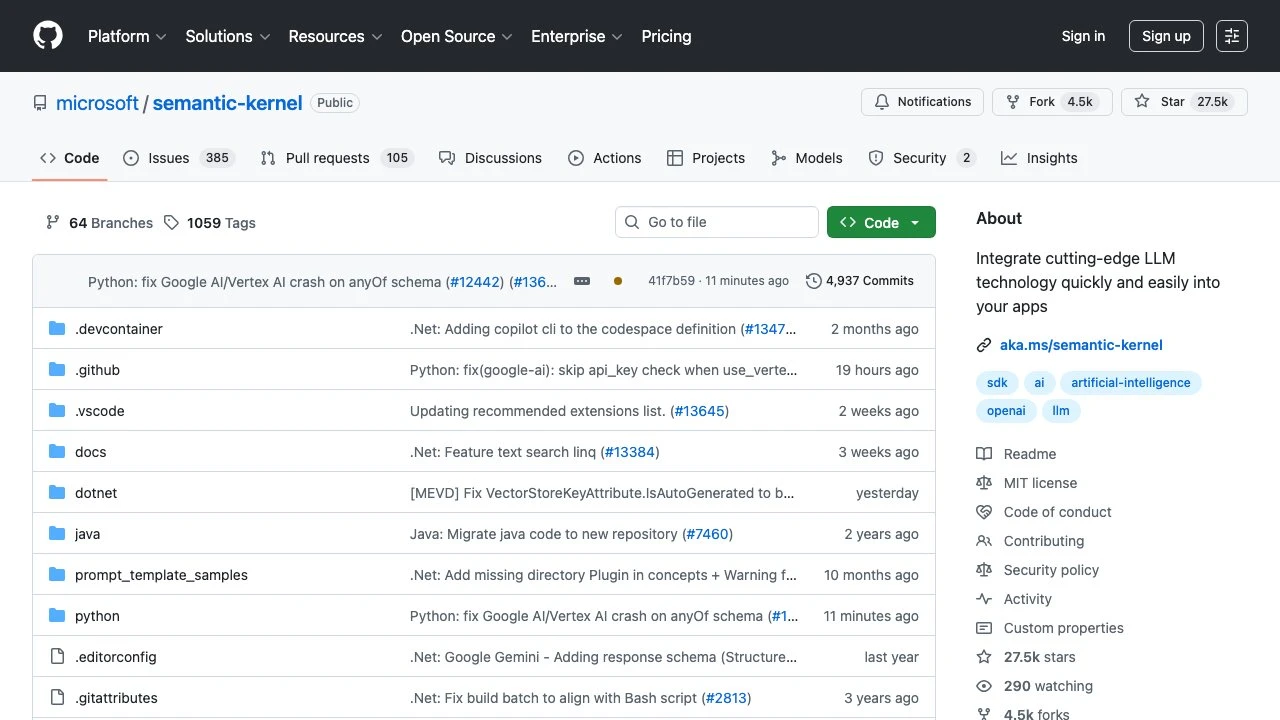
Semantic Kernel is an open-source SDK developed by Microsoft that enables developers to integrate large language models (LLMs) into enterprise applications. It supports C#, Python, and Java, making it one of the few AI frameworks with first-class support across multiple mainstream enterprise languages.
At its core, Semantic Kernel acts as an orchestration layer between application code and AI models. Developers define "plugins" — collections of functions that the AI can invoke — and the SDK handles the coordination between model reasoning and function execution. This plugin architecture is central to how Semantic Kernel builds agentic workflows: the AI can plan a sequence of steps, call native code or external APIs, and return structured results back to the application.
The framework supports a range of AI providers including Azure OpenAI, OpenAI, Hugging Face, and others, giving teams flexibility in model selection without rewriting application logic. Memory and vector store integrations allow developers to build retrieval-augmented generation (RAG) pipelines, connecting AI responses to proprietary data sources like databases, documents, and internal knowledge bases.
Semantic Kernel's agent framework allows developers to build multi-agent systems where multiple AI agents collaborate on tasks. This is particularly relevant for enterprise scenarios where complex workflows need to be broken into specialized roles — a research agent, a summarization agent, a data retrieval agent — coordinated by an orchestrator.
Compared to alternatives like LangChain (Python-first) or LlamaIndex (RAG-focused), Semantic Kernel's distinguishing characteristic is its deep integration with the Microsoft ecosystem. Teams already using Azure, .NET, or Office 365 will find native connectors and familiar patterns. However, Python developers who are not in the Microsoft ecosystem may find LangChain or CrewAI offer a broader community and more extensive third-party integrations.
The SDK follows enterprise software conventions: strong typing, dependency injection patterns, and testable abstractions. This makes it more approachable for software engineers with traditional backend backgrounds compared to notebook-centric frameworks that originated in the data science community.
With 27.5k GitHub stars and active development from Microsoft, Semantic Kernel is a mature choice for teams building production AI applications rather than prototypes. The project has an active discussion forum and frequent pull request activity, indicating ongoing community investment.
Key Features
- Plugin system for wrapping native functions, APIs, and prompts that AI agents can discover and invoke
- Multi-language support across C#, Python, and Java with consistent abstractions
- Built-in agent framework for creating and orchestrating single and multi-agent workflows
- Vector store and memory integrations for building RAG pipelines against proprietary data
- Support for multiple LLM providers including Azure OpenAI, OpenAI, and Hugging Face
- Process framework for designing structured, stateful AI workflows
- Native integration with the Microsoft Azure ecosystem and enterprise tooling
- Open-source codebase with active Microsoft maintenance and community contributions
Pros & Cons
Pros
- Multi-language support (C#, Python, Java) is rare among AI frameworks and critical for enterprise polyglot environments
- Deep Azure and Microsoft ecosystem integration reduces setup friction for organizations already on that stack
- Strong enterprise software conventions (typing, DI, testability) make it accessible to backend engineers
- Active Microsoft maintenance provides long-term support confidence for production deployments
- Plugin and agent abstractions are well-suited to complex, multi-step enterprise workflows
Cons
- Python community and third-party integrations are less extensive than LangChain's ecosystem
- Microsoft ecosystem orientation may feel heavy for teams outside the Azure/Office stack
- Multi-language parity can lag — features sometimes arrive in C# before Python or Java
- Steeper conceptual learning curve compared to simpler prompt-chaining libraries for straightforward use cases
Pricing
Semantic Kernel is open-source and free to use under the MIT license. Costs are determined by the underlying AI model providers and infrastructure (such as Azure OpenAI or OpenAI API usage) that developers connect to the SDK.
Who Is This For?
Semantic Kernel is best suited for enterprise development teams building production-grade AI applications on .NET, Python, or Java, particularly those already invested in the Microsoft Azure ecosystem. It excels at complex agentic workflows, multi-agent orchestration, and RAG pipelines that need to integrate with existing enterprise systems and data sources.

Similar to Semantic Kernel